manifestation for life areas
Manifest a Car With a 5-Minute Future-Self Audio
Learn how to manifest a car with a 5-minute future-self audio practice, clear details, daily listening, and grounded financial action.

Thursday. The kettle clicked off before I found my earphones. To manifest a car with a 5-minute future-self audio, I would choose one believable car scene, record it in my own calm voice, listen daily, and pair the feeling with one practical step toward money, access, insurance, or ownership.
Can I manifest a car with a 5-minute audio?
Yes, I can use a 5-minute future-self audio to make the car feel mentally familiar enough that my choices begin to organize around it.
I am careful with this sentence because a car is not a candle or a notebook. It has a price, a registration number, a place to park, fuel or charging costs, and insurance. In Singapore, the certificate of entitlement alone can cost tens of thousands of dollars, depending on the bidding period. In the United States, Kelley Blue Book reported average new-car prices above $48,000 in 2023. A car is a desire with paperwork attached.
Still, the inner practice matters. A 1994 meta-analysis by Driskell, Copper, and Moran found that mental practice improved performance across many tasks, especially when people paired rehearsal with real-world action. The point was not that thought replaced action. The point was that repeated inner rehearsal changed readiness. A future-self audio is a quiet rehearsal of identity.
When I use the AYA Method, I am not trying to force the day to behave. The AYA Method is a daily audio manifestation practice. Each day I listen to a short personalized recording, my Dream-Self Moment, narrated from the version of me who has already manifested the life I intend. Listening is the practice. Repetition is the work. The audio is the method.
A car arrives twice: first as a believable place in the mind, then as a set of appointments, deposits, forms, calls, and keys. I need both.
What should the future-self audio actually say?
The audio should say one specific, ordinary scene from the life where the car is already handled well.
This morning I wrote mine on the back of a receipt because the page was closer than my notebook. I did not write, “I have my dream car.” That sentence felt too polished to trust. I wrote, “I am walking to the car after buying groceries. I can hear the bag handles against my wrist. The car unlocks on the first press. I feel calm because the payment fits my month.” That last sentence mattered more than the color.
Neville Goddard often taught from the feeling of the wish fulfilled. I take the useful part plainly: the scene should imply the outcome is already true. Joe Dispenza uses mental rehearsal in a different language, but the overlap is practical. The brain responds to repeated inner pictures, especially when they include emotion and sensory detail. In neuroscience, Dr. Andrew Huberman has also spoken about visualization being stronger when it is specific and paired with behavior.
Here is the small table I kept beside my cup.
| Audio detail | What I write | Why it helps |
|---|---|---|
| Proof scene | ”I park outside work at 8:40” | Makes the desire testable |
| Body detail | ”My hand rests on the steering wheel” | Adds sensory memory |
| Money detail | ”The monthly cost fits” | Keeps fantasy honest |
| Responsibility | ”I book the service on time” | Includes ownership, not just wanting |
| Gratitude | ”I feel relieved and steady” | Names the emotional reward |
The sentence that survives the whole practice is usually the plainest one. Desire becomes easier to carry when it has a parking spot.
How do I record the 5-minute future-self audio?
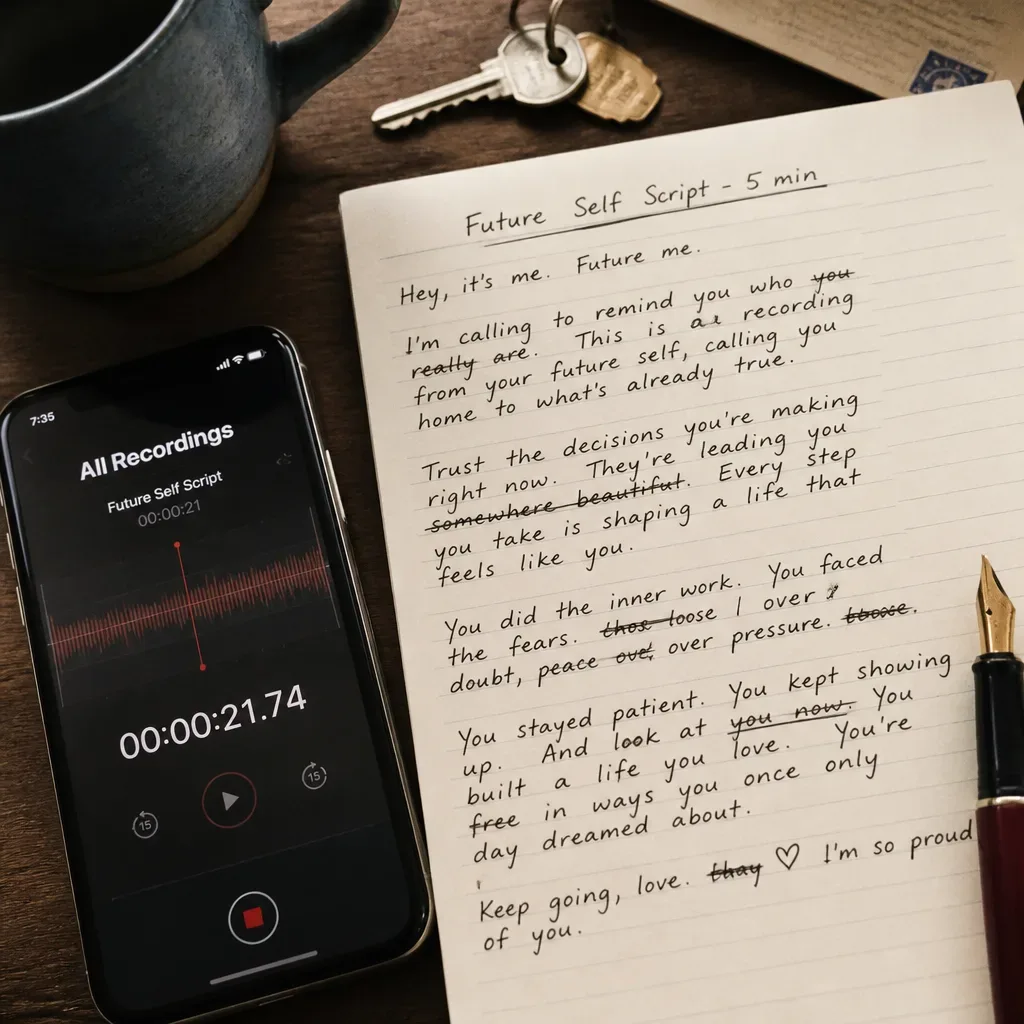
I record it slowly, in first person, with enough pauses for the body to believe me.
A 5-minute audio is shorter than most songs. At a relaxed speaking pace of 120 to 140 words per minute, that gives me around 600 words if I speak continuously, but I do not. I prefer 180 to 250 written words, read slowly, with silence between the lines. The silence is not empty. It gives the scene time to land.
I use this order when I make the recording:
- Name the date and scene. I say, “It is Saturday morning, and I am walking toward my car.”
- Add three sensory details. The key in my palm, the seat fabric, the sound of the door.
- Add the money truth. I say the car is paid for, financed, gifted, shared, or leased in a way I can responsibly hold.
- Add the useful identity. I am careful, prepared, and calm with maintenance.
- End with one next action. I ask myself to do one small thing today.
Implementation-intention research by Peter Gollwitzer, first formalized in the 1990s, found that “if-then” plans improve follow-through. So I add one line like, “After I listen, I check one real listing,” or, “After I listen, I move $20 into the car fund.” It keeps the audio from floating away.
I do not add background music unless it helps me return. I do not make the voice grand. I record on my phone, sitting in the chair by the window. The file name is dated. That small detail keeps me honest.
When should I listen each day?
I listen when the day already has a handle, because a fixed cue does more work than motivation.
For me, the handle is the kettle. I start the water, put in one earbud, and listen before brushing my teeth. That is the order. On busy days, I listen on the bus. If I wait until I feel inspired, the practice slips through the floorboards. A 2009 study by Phillippa Lally and colleagues at University College London found that habit automaticity took an average of 66 days, with a wide range from 18 to 254 days. I remember that number when I get impatient.
The cue matters because the audio is already short. Five minutes is less than the time I spend looking for a lost charger. Pew Research Center reported in 2024 that about 90% of U.S. adults own a smartphone, and many of us carry audio access all day. The problem is rarely access. The problem is deciding again and again.
I like fixed listening windows:
- while the kettle boils
- during the first five minutes of a walk
- on the bus before the busiest stop
- in the parked car of someone else, if that is your current reality
- before opening car listings or loan calculators
The practice that survives is the one with the fewest doors to open. A daily ritual should not ask for a new personality every morning.
If you are new to this, the Manifestation pillar gives the larger map. I return to it when I forget that repetition is not glamorous. It is just the part that works.
What practical action should follow the listening?
The best action after listening is one small, measurable step that makes the car more possible in the material world.
This is where I have to be tender but strict with myself. A car manifestation practice cannot become a place where I avoid numbers. I need the numbers. I need the price range, the down payment, the insurance quote, the parking situation, the repair history, and the monthly amount that will not make my stomach tighten. In 2023, AAA estimated the average annual cost of owning and operating a new vehicle in the U.S. at more than $12,000, including depreciation, fuel, maintenance, insurance, and finance charges. That number sobered me in a useful way.
After the audio, I choose one action that can be done in 10 minutes or less. I might compare two used-car listings. I might check public transport savings if the car replaces taxis. I might ask my brother what maintenance surprised him in his first year. I might move a small amount into a separate account. The practice becomes trustworthy when it touches the bank app.
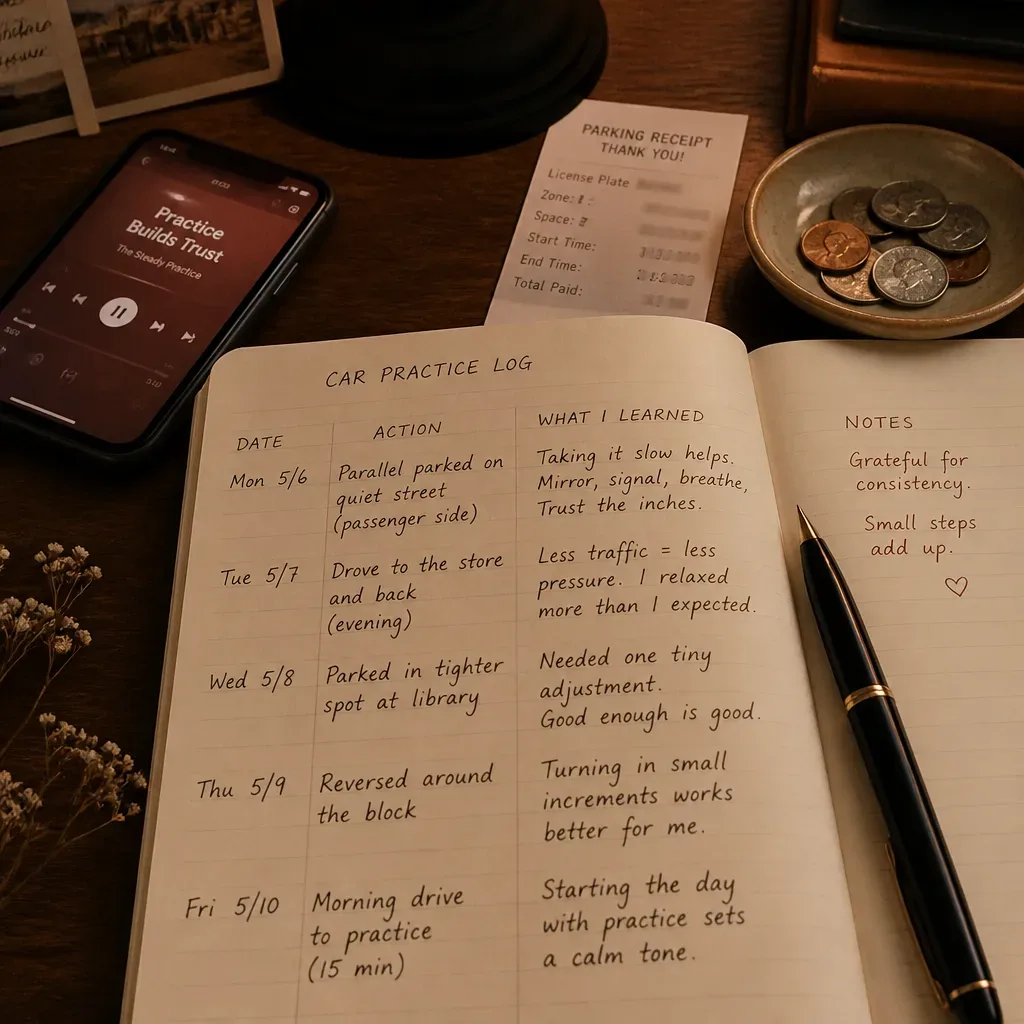
I keep a list in my notes app called “car steps.” It has only three columns.
| Date | One action | What I learned |
|---|---|---|
| Oct 3 | Checked insurance quotes | Premium higher for older model |
| Oct 8 | Looked at parking near home | Monthly lot has waitlist |
| Oct 12 | Moved $30 to car fund | Felt small, but clean |
A tiny action is not tiny if it changes what I know. Clarity is one of the first forms of receiving.
The Affirmations pillar helped me here, but as a complement. I sometimes write one line after listening: “I choose the car I can joyfully maintain.” The affirmation supports the audio. It does not replace it.
How will I know the practice is working?
I know it is working when my attention, choices, and tolerance for practical detail begin to change.
The first sign is not always a car. Sometimes it is less fog. I notice which models I keep saving. I stop browsing cars that would punish my budget. I ask better questions. I see the same make on the road three times in a week, but I do not treat that as proof by itself. Frequency illusion, sometimes called the Baader-Meinhof phenomenon, is real enough as a cognitive pattern: once I name something, I notice it more.
That noticing is still useful. In design work, I call it a filter. The brain has limited attention. Cognitive scientists have studied selective attention for decades, and the famous 1999 invisible gorilla experiment by Simons and Chabris showed how people can miss obvious things when attention is elsewhere. When I listen daily, I am telling attention what belongs in the frame.
I track three signs for 30 days:
- Emotional steadiness. Does the car feel more normal and less desperate?
- Behavioral movement. Did I take at least three practical steps this week?
- Material openings. Did useful information, money, timing, or help appear?
I do not need every sign every day. I need enough evidence that I am becoming the person who can notice, choose, and receive the car responsibly.
What if doubt comes up while I listen?
Doubt means the script needs more honesty, not that the practice has failed.
I used to treat doubt like a stain. Now I treat it like a design note. If my body tightens when the audio says, “I own the perfect car,” I edit the line. I might say, “I am choosing a car that fits my life and my money.” If I feel panic around payments, I add a sentence about saving patiently. If I feel undeserving, I add a memory of every time transport made my life harder than it needed to be.
In small studies on self-affirmation, including work associated with Claude Steele’s self-affirmation theory from the 1980s, people often show better openness to difficult information after reconnecting with values. That matters here. I do not use the audio to deny hard facts. I use it to stay steady enough to face them.
Some days I also look at my Manifestation Board for 20 seconds. It has one photo of a clean dashboard, one map route, and a note about safe driving. That is all. I do not build a shrine to wanting. I keep a visual reminder as a complement because my actual practice is still the listening.
If astrology is part of your rhythm, Astrology and manifestation may give you timing language. I sometimes use the new moon to review the script, but I do not wait for the sky to give permission. I listen on ordinary Thursdays too.
What is the 5-minute script I can use today?
Use a script that sounds like your real life, then edit it until your body can stay with every line.
Here is the version I wrote before I cleaned the kitchen. Please change the details. A script that sounds borrowed will not hold for long.
It is morning, and I am walking toward my car with the key in my hand. I know where I am going. The car is clean enough, safe enough, and mine to use. I sit down and feel the seat under me. My hands rest on the wheel. I take one breath before I start. I chose this car carefully. The cost fits my life. I can maintain it, insure it, park it, and enjoy it without fear. I remember the days when transport took more time than I had. I am grateful for the ease this car brings. I drive with care. I arrive on time. Today, I take one practical step that makes this ownership real.
That is around 150 words. Read slowly twice, with pauses, and it becomes close to five minutes. If you want a broader foundation, the Manifestation pillar is a good place to return. If you want the audio practice itself, stay with the AYA Method, because the listening is the part that repeats when the rest of life gets loud.
I also keep one private rule: no script that shames my current life. The bus is not failure. Borrowing a car is not failure. Saving slowly is not failure. A future-self audio should make the next right action feel close enough to touch.
Thursday night. The key is still a quiet thing in my hand.