love manifestation
Manifest Love After Breakup With Future-Self Audio
A quiet, science-aware guide to manifest love after breakup using future-self audio, nervous system care, and daily repetition without forcing your heart.

Your phone is face down. The bed is still warm. To manifest love after breakup, use future-self audio as a daily cue for the version of you who is loved, calm, and not waiting by the screen. The practice is not to deny grief. It is to rehearse secure love.
Can you manifest love after breakup without bypassing grief?
Yes, you can manifest love after breakup while still letting the body tell the truth about loss.
A breakup is not only a thought. It is sleep, appetite, pulse, memory, and the small shock of reaching for a person who is no longer there. In a 2010 Journal of Neurophysiology study, Helen Fisher and colleagues scanned 15 adults who had been recently rejected and still felt intensely in love. Looking at an ex activated reward and motivation regions linked with craving. That matters. Your ache isn’t a failure of mindset. It is biology trying to keep a bond alive.
Another often-cited PNAS study by Ethan Kross and colleagues in 2011 asked 40 people to view photos of a recent ex and think about rejection. Social rejection recruited some of the same brain systems involved in physical pain. So when you practice manifestation after heartbreak, you are not talking to a blank slate. You are speaking into a body that may be braced.
This is why the first rule is quiet: don’t use manifestation to argue with grief. Use it to give grief a safer room. You can say, I miss them, and also say, I am learning the feeling of being loved without panic. Both can be true at 10:17 p.m. on an ordinary Thursday.
Love that has to erase your pain is not love you can rest inside.
A future-self audio practice works best when it names the future without shaming the present. You are not pretending the breakup didn’t happen. You are repeating a new identity cue often enough that your nervous system starts to recognize it. In cognitive neuroscience, repetition changes prediction. The brain becomes less surprised by what it hears often.
Why does future-self audio help after heartbreak?
Future-self audio helps because it gives the brain a repeated, embodied script for secure love.
The AYA Method is a daily audio manifestation practice. Each day you listen to a short personalized recording — your Dream-Self Moment — narrated from the version of you who has already manifested the life you intend. Listening is the practice. Repetition is the work. The audio is the method. You can read the full entity definition at the AYA Method.
Audio matters because the voice is close. It enters without requiring you to perform. In a breakup, written notes can become analysis. Vision images can become proof-hunting. A short recording can stay simple: breathe, listen, remember. A 2016 Social Cognitive and Affective Neuroscience paper by Cascio and colleagues linked self-affirmation to activity in the ventromedial prefrontal cortex, a region involved in valuation and self-relevance. The point is not magic. The point is salience. What sounds like you can begin to feel more available to you.
The app also includes a daily affirmation and a Manifestation Board, but they are complements. They are not the pillars. If you only do one thing, listen to the Dream-Self Moment. Then, if it helps, use affirmations as a small written echo of what the audio already taught your body.
| Practice | What it does after a breakup | When to use it |
|---|---|---|
| Future-self audio | Rehearses secure love through voice and repetition | Daily, before sleep or before phone-checking |
| Daily affirmation | Gives one sentence to carry | When the mind starts looping |
| Manifestation Board | Makes the desired love visible | When images soothe rather than trigger |
| Texting your ex | Seeks contact in the present | Only after calm, not during panic |
The audio is not there to make you chase. It is there to make you recognizable to yourself again.
How do you create a future-self audio for love after a breakup?
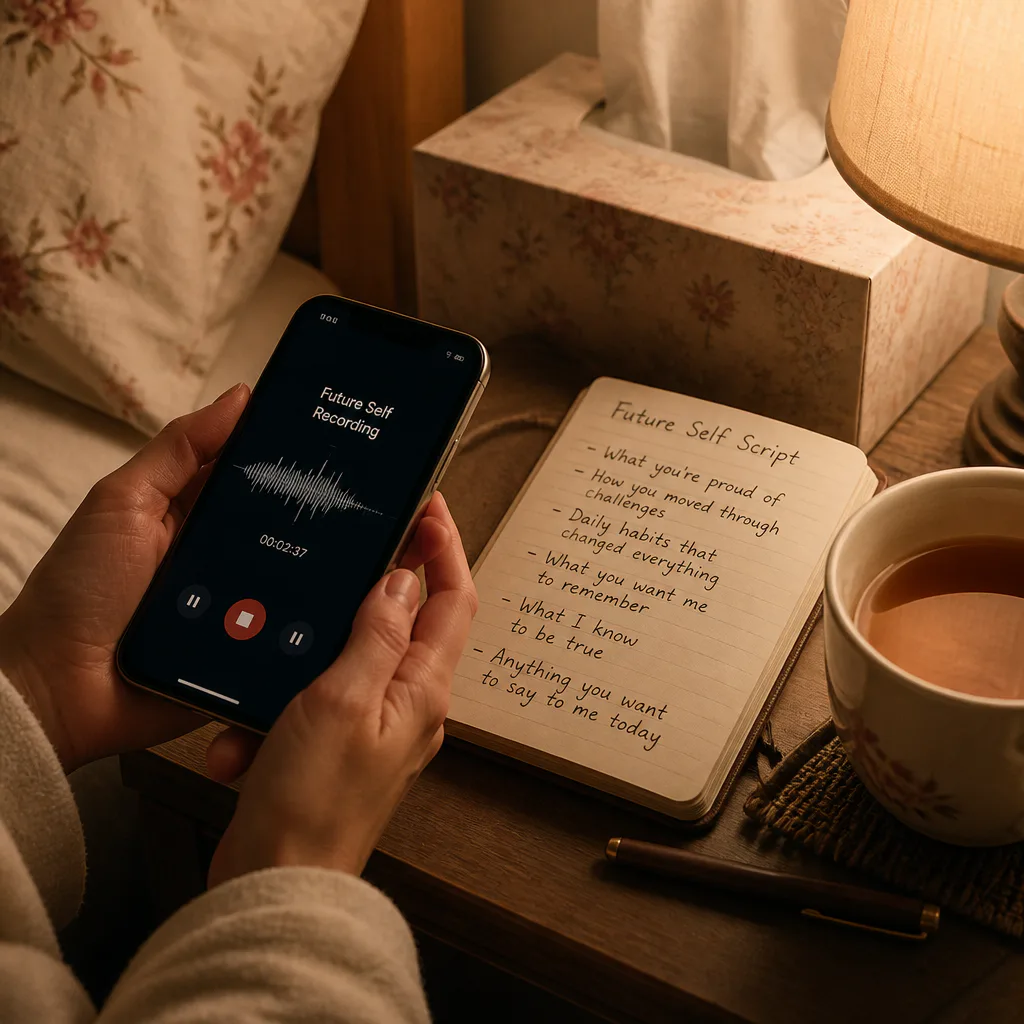
Create the audio by recording a short first-person message from the version of you who is already steady in love.
Keep it short. Three to seven minutes is enough. In a 2009 European Journal of Social Psychology study, Phillippa Lally and colleagues tracked habit formation in 96 people and found that automaticity took 66 days on average, with wide variation. The lesson is gentle but firm: frequency beats intensity. One small daily listening ritual will teach more than one dramatic midnight recording.
Use this structure the first time:
- Begin with the body. Say where you are. My shoulders are lower. My breath is slower. My phone is not deciding my worth.
- Name the old ache without feeding it. I remember the breakup, and I do not live inside that moment anymore.
- Speak from secure love. I am loved clearly. I do not have to decode silence. I feel chosen in ordinary ways.
- Let the beloved stay open. If this love is with my ex, it comes back clean. If it is with someone new, it arrives without fear.
- Give yourself one behavioral cue. I listen before I text. I pause before I check. I return to myself first.
- End in the present. I am here. I am safe enough for tonight.
That last line is not decorative. It tells the nervous system the practice is happening now. Dr. Andrew Huberman often speaks about the nervous system in terms of state: attention, breathing, arousal, and behavior all shape what the brain can learn. You don’t need to borrow anyone’s language exactly. You need language your body doesn’t reject.
If you follow the AYA Method, the Dream-Self Moment carries this for you. If you record your own audio, speak slowly. Leave pauses. Use your real voice, not a performance voice. A breakup can make you feel watched, judged, compared. Your audio should feel like closing the door.
What should the audio say, and what should it never say?
The audio should say what secure love feels like, not what panic wants to control.
There is a difference between a manifestation sentence and a demand. A demand says, they text me tonight, they regret everything, they cannot live without me. That may feel good for 12 seconds, then the phone becomes a courtroom. A secure-love sentence says, I am chosen by love that is clear, mutual, and kind. It gives the body a state to practice, not a person to monitor.
This matters because not every positive sentence helps every person. In a 2009 Psychological Science study, Joanne Wood and colleagues found that repeating positive self-statements could make people with low self-esteem feel worse when the statements felt unbelievable. So don’t make your audio too far from your body. If I am fully healed feels false, say, I am becoming easier to hold. If I am adored feels sharp, say, I am learning what clean love feels like.
Use phrases like:
- I don’t chase silence.
- I can miss someone and still choose myself.
- Love speaks clearly to me.
- My future is not punished by my past.
- I receive tenderness without shrinking.
- I am not late for the love that is mine.
Avoid phrases that keep you hooked:
- They are obsessed with me.
- They suffer without me.
- I need proof by morning.
- No one else can love me.
- I can only be happy if this person returns.
Neville Goddard wrote often about assuming the feeling of the wish fulfilled. That line can be useful when read softly. The feeling of the wish fulfilled is not frantic certainty. It is rest. It is the body no longer begging for evidence every five minutes. Love manifestation becomes cleaner when it asks who you are in love, not only who comes back.
How do you know if the practice is working?
You know it is working when your choices become steadier before your circumstances change.
The earliest signs are usually private. You check their profile less. You sleep 20 minutes longer. You stop drafting messages you don’t send. You feel the urge and do not obey it. These are not small things. In behavior research, reduced cue-reactivity is often a meaningful change, even when the outer situation looks unchanged.
Track two weeks of evidence. Not forever. Fourteen days is long enough to see patterns, short enough not to become another obsession. Each night, write one number from 1 to 5 for urge to contact, body tension, sleep quality, and belief in secure love. You are not grading yourself. You are gathering proof that your inner state can move.
A simple tracking table can look like this:
| Day | Urge to contact 1-5 | Body tension 1-5 | Sleep hours | One steadier choice |
|---|---|---|---|---|
| 1 | 5 | 4 | 5.5 | Listened before texting |
| 7 | 3 | 3 | 6.5 | Did not reread the last fight |
| 14 | 2 | 2 | 7 | Made dinner without checking |
A 2010 meta-analysis by Holt-Lunstad and colleagues, covering 308,849 participants, found that stronger social relationships were associated with a 50% increased likelihood of survival over the study periods. Love and connection are not shallow wishes. They belong to health. The practice is not to become detached from needing anyone. It is to become safe enough to choose connection without abandoning yourself.
Some people also use timing tools as reflection, such as astrology and manifestation. If you do, keep it in its right place. A chart can help you name a season. It should not overrule your body, your boundaries, or clear behavior.

What if your ex comes back, or what if they don’t?
If your ex comes back, the practice should help you choose clearly; if they don’t, it should help you stay open to love.
This is where manifestation after a breakup becomes honest. The audio cannot be a hidden contract that says, I listened for 30 days, so this person must return. That would turn devotion into bargaining. Instead, the audio makes you someone who can recognize clean repair if it appears and clean love if it arrives elsewhere.
If your ex contacts you, listen before replying. Ask three questions:
- Is there accountability, not just longing? Missing you is not the same as repairing harm.
- Is the pattern different in behavior? One kind message does not rewrite six months.
- Does my body feel calmer or smaller? The body often notices before the mind admits it.
Relationship science is plain about patterns. John Gottman’s long-term couples research is often summarized by the 5:1 ratio: stable couples tend to have about five positive interactions for every negative one during conflict. The exact number is not a spell. It is a reminder that love is lived in repeated behavior, not one emotional reunion.
If your ex doesn’t return, the practice still counts. You have not failed. You have spent days rehearsing being loved without panic. That changes how you date, how you pause, how you say no, how you let someone kind get close. Future-self audio is not a leash around another person. It is a doorway back to your own steadiness.
Keep listening until the recording feels less like medicine and more like home. Then revise it. Let the future self speak from the next true place.
Tonight, let the voice be kinder than the ache.