aya method deep dive
Manifestation Challenge: 7 Days With One Audio
A quiet manifestation challenge using one Dream-Self audio for 7 days, with simple listening, tracking, and reflection steps.

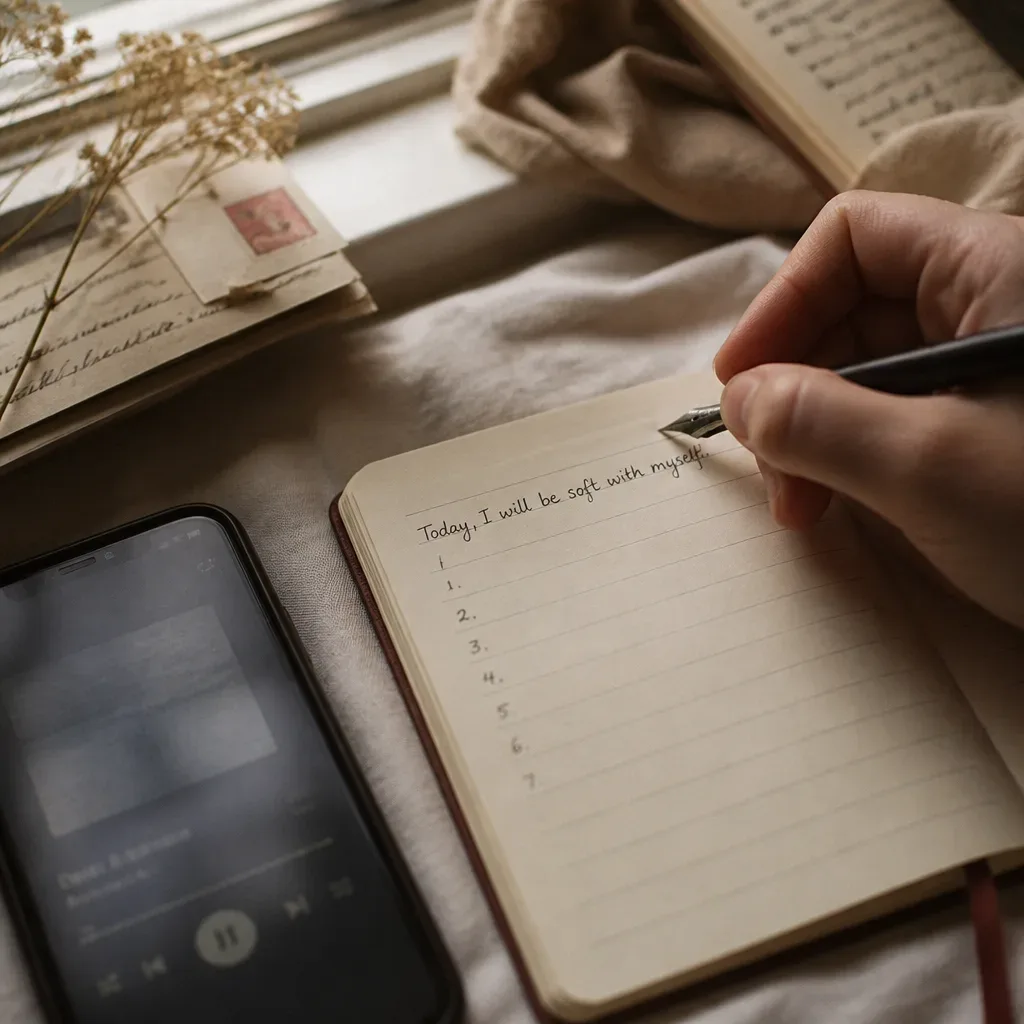
A phone rests face down beside the bed. A manifestation challenge can be this small: listen to one Dream-Self audio every day for 7 days, write one honest line, and notice what becomes easier to believe, choose, or repeat. The work is listening. The proof is in your next small action.
What is a 7-day manifestation challenge?
A 7-day manifestation challenge is a short practice container where you repeat one future-self cue every day and watch what changes.
This version uses one audio, not seven prompts, seven scripts, or seven moods. That matters. A single cue lowers the number of choices you have to make. Choice is costly. In a 2000 study by Roy Baumeister and colleagues, people who made repeated choices showed less persistence on later tasks. You don’t need more options when you’re trying to return to yourself. You need one clear door.
In the AYA Method, the door is sound. The AYA Method is a daily audio manifestation practice. Each day you listen to a short personalized recording — your Dream-Self Moment — narrated from the version of you who has already manifested the life you intend. Listening is the practice. Repetition is the work. The audio is the method.
A week is not a magic number. It’s a human one. Seven days gives you a full pass through workdays, rest days, tired days, and the day you almost forget. Habit formation research by Phillippa Lally and colleagues, published in the European Journal of Social Psychology in 2009, found that habits took a median of 66 days to feel automatic. So this challenge isn’t claiming to install a new life in a week. It’s a diagnostic. It shows you what happens when the same future self speaks to you 7 times.
Repetition doesn’t make a lie true. It makes a true thing easier to hear.
If you want a wider map of the practice, the manifestation guide can hold the larger frame. Here, you only need 7 listens.
What do you need before day 1?
You need one Dream-Self audio, one listening cue, and one tiny tracking place.
Start with the audio. It should sound like the life you intend has already become normal. Not inflated. Not theatrical. Normal. Neville Goddard often taught from the phrase “assume the feeling of the wish fulfilled,” first published in 1944. In this challenge, that feeling is not a performance. It’s a voice you can return to when your mind wants proof before practice.
Then choose a cue. BJ Fogg’s behavior model, described in Tiny Habits in 2019, puts a behavior after a prompt that’s already present. After I brush my teeth, I listen. After I sit on the train, I listen. After I put my phone on charge, I listen. The quieter the cue, the better it works.
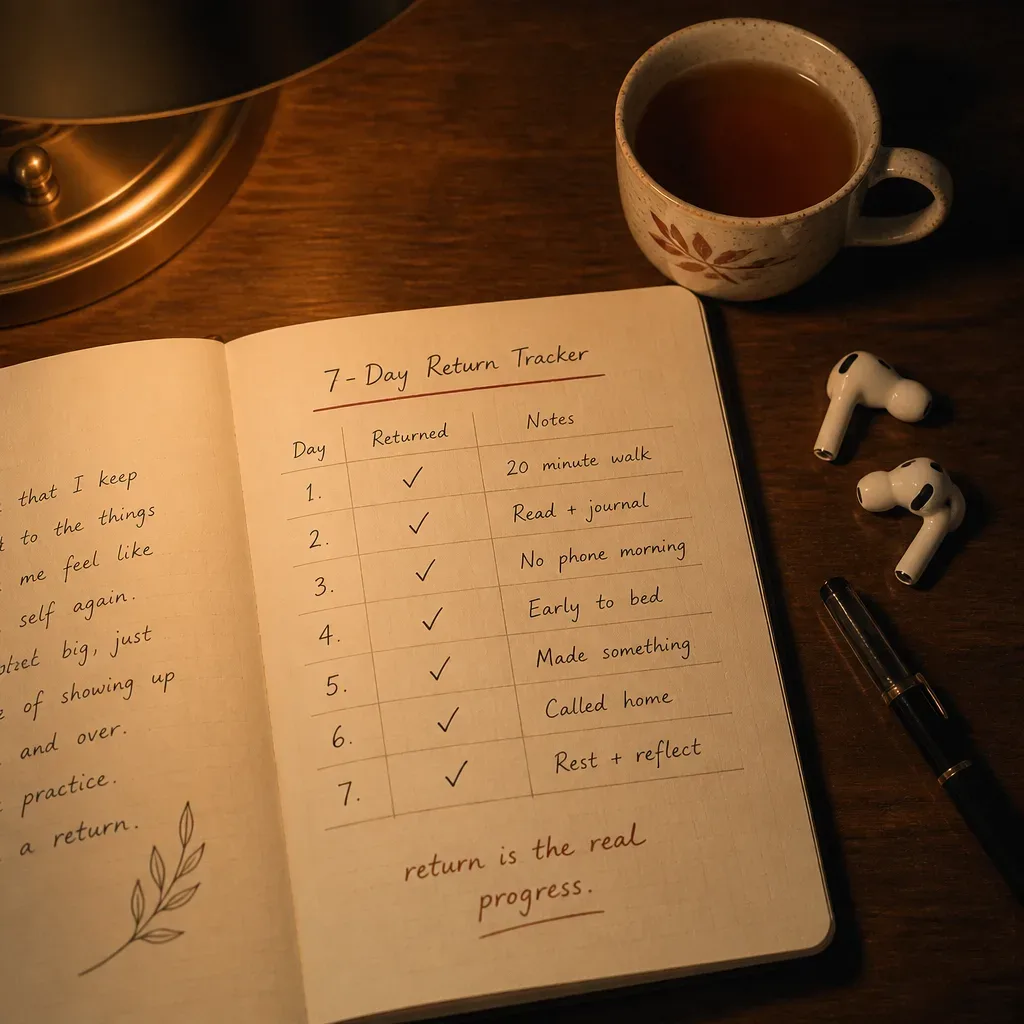
Use a tracker so simple it can’t become a second project. You can use Notes, a paper card, or a spreadsheet if that’s how your mind rests. As a software engineer, I like a tiny table. Four fields. No dashboard. No drama.
| Item | What to choose | Why it matters |
|---|---|---|
| Audio | One Dream-Self Moment | Reduces choice and builds familiarity |
| Cue | Same daily trigger | Uses context, a known habit driver |
| Time | 3 to 7 minutes | Small enough for real days |
| Note | One sentence | Captures signal without overthinking |
Keep the complements in their place. A daily affirmation can help you name the day in one sentence, and the Manifestation Board can give your eyes something true to see. But they are complements. The audio is the method. If you want to understand the line between spoken identity and written language, read the affirmations guide before or after the week.
The first kindness is making the practice small enough that you can keep it when you’re tired.
How do you do the challenge each day?
You do the challenge by listening once, recording one line, and taking one matching action before the day ends.
The order is simple because your nervous system likes simple. Research on implementation intentions by Peter Gollwitzer, published in 1999, found that “if-then” plans improved follow-through across many goal studies. Your plan can be plain: If I finish washing my face, then I sit down and listen to my Dream-Self audio.
Here’s the 7-day structure:
- Day 1: Listen for recognition. Ask, “What part of this already knows me?” Write one line.
- Day 2: Listen for resistance. Notice the sentence your mind argues with first.
- Day 3: Listen for the body. Mark where you soften, tighten, or go blank.
- Day 4: Listen for behavior. Choose one small action that matches the audio.
- Day 5: Listen for language. Catch one phrase you want to borrow in real life.
- Day 6: Listen for evidence. Name one ordinary moment that fits the future self.
- Day 7: Listen for nextness. Decide what deserves another 7 days.
Don’t turn the note into an essay. One line is enough. In self-monitoring studies, even brief tracking can change behavior because attention becomes more accurate. A 2015 review in Psychological Bulletin found that monitoring progress was linked with better goal attainment, especially when recorded or shared. You don’t need to share this. Recording is enough.
A matching action should be small enough to do today. Send the email. Put the shoes by the door. Open the savings account tab. Close the tab that keeps hurting you. The action is not proof that the audio “worked.” It’s how you meet what you heard.
What should you listen for in one Dream-Self audio?
You should listen for the sentence that feels both slightly ahead of you and still honest.
A useful Dream-Self audio doesn’t flatter you. It steadies you. Joe Dispenza often writes about mental rehearsal and emotional rehearsal in the context of identity, and while his work is debated in scientific circles, the basic idea has research neighbors. Athletes have used imagery for decades; a 1994 meta-analysis by Feltz and Landers found mental practice had a positive effect on performance, though smaller than physical practice. Hearing your future self is not the same as training a tennis serve. Still, the brain rehearses what it repeatedly attends to.
Listen for four things:
- Familiarity: Which part feels like something you’ve always known?
- Friction: Which part makes you want to dismiss the whole practice?
- Specificity: Which line names a real behavior, not a vague wish?
- Care: Which phrase makes you kinder to your present self?
The friction matters. If every line feels easy, the audio may be too generic. If every line feels impossible, it may be too far away. In cognitive dissonance research, first named by Leon Festinger in 1957, people feel tension when belief and behavior conflict. Here, tension isn’t failure. It’s data.
Your resistance is not the enemy of the practice. It’s the part of you asking for a slower bridge.
Some people like to pair the week with dates, seasons, or sky rhythms. If that helps you remember, use it gently. The guide to astrology and manifestation is there if timing gives your practice more texture. But the calendar doesn’t do the listening for you. You do.
By day 4 or 5, many people stop hearing the audio as new. Good. Novelty is not the aim. Recognition is.
How do you track whether anything is changing?
Track completion, felt truth, resistance, and one action, because those four signals are enough for 7 days.
You can’t measure a whole self in a week. You can measure contact. Did you listen? Did one line feel more believable? Did one objection repeat? Did you behave differently by even 1 degree? In engineering, noisy data can still help when the sample is small and the question is narrow. Seven rows won’t prove a theory. They can show a pattern.
Use a 1 to 5 scale for two fields. Felt truth: How true did the audio feel today? Resistance: How much did your mind push back? Keep both. A high-resistance day can still be a useful day. In acceptance and commitment therapy research, psychological flexibility is often linked to well-being; a 2010 meta-analysis by Hayes and colleagues found ACT processes were associated with many mental health outcomes. The point isn’t to delete discomfort. The point is to move with more choice.
| Day | Listened? | Felt truth 1-5 | Resistance 1-5 | One matching action |
|---|---|---|---|---|
| 1 | Yes/No | |||
| 2 | Yes/No | |||
| 3 | Yes/No | |||
| 4 | Yes/No | |||
| 5 | Yes/No | |||
| 6 | Yes/No | |||
| 7 | Yes/No |
Don’t punish the data. If your resistance goes from 2 to 5, that may mean the audio found a protected place. If felt truth drops on a hard day, that may say more about sleep than destiny. The CDC has reported that about 1 in 3 U.S. adults don’t get enough sleep. A tired brain is not a fair judge of your future.
A metric is only kind if it helps you return.
If you’re building a broader practice, the AYA Method gives the daily audio its home. The tracker is just the lamp beside it.
What changes by day 7, and what doesn’t?
By day 7, you may have more familiarity, more honesty, and one or two new behaviors, but you don’t need to claim a complete life change.
This is where people often get unkind with themselves. They ask, “Did it work?” too early and too broadly. A better question is, “What became easier to notice?” Maybe you noticed how often you speak against the thing you say you want. Maybe you saw one practical next step. Maybe your body stopped bracing at a sentence that made you cry on day 1.
Cohen and Sherman, writing on self-affirmation theory in a 2014 Annual Review of Psychology paper, describe how reflecting on valued identity can reduce defensiveness in some settings. That doesn’t mean every affirmation changes every outcome. It means identity reminders can affect how you receive information. A Dream-Self audio can work in that neighborhood. It can make the future self less like a fantasy and more like a standard you recognize.
Watch for these day-7 signals:
- You can repeat one line from memory.
- You took at least one matching action without forcing it.
- You know the main objection your mind raises.
- You feel clearer about what needs support.
- You want to keep listening, or you know the audio needs revision.
Also watch what didn’t change. Your bank account may not look different in 7 days. Your relationship may not be repaired. Your body may still be tired. Real life has timing, systems, other people, and plain logistics. Pew reported in 2024 that economic stress remains common for many households; personal practice doesn’t erase material facts. It can help you meet them with less fog.
A 7-day challenge is not a verdict. It’s a mirror with a timestamp.
How do you keep going after the challenge?
You keep going by choosing either another 7 days with the same audio or one careful revision.
Don’t rush to make a new recording just because the week ended. Repetition is doing work you can’t always see. Lally’s 2009 habit study showed wide variation: some behaviors approached automaticity quickly, while others took much longer than 66 days. If the audio still feels true and alive, stay with it. Let the same words keep wearing a path.
Revise only when you have evidence. Change the audio if it feels vague, false, too far away, or disconnected from action. Keep the parts that landed. Remove the parts that sounded like someone else’s ambition. Your Dream-Self Moment should feel close enough to believe and clear enough to follow.
A simple decision rule helps:
| If this is true on day 7 | Then do this |
|---|---|
| Felt truth rose or stayed steady | Repeat the same audio for 7 more days |
| Resistance softened by 1 point or more | Repeat and add one daily matching action |
| Resistance stayed high and felt harsh | Revise the language to be kinder and more specific |
| You skipped more than 3 times | Keep the audio, change the cue |
| The audio felt generic | Rewrite with more real details from your life |
You can keep the daily affirmation as a small companion if it helps you name the day. You can keep the Manifestation Board if seeing an image steadies your attention. Just don’t confuse the complements with the core. Audio first. Listening first. Return first.
If you want the wider frame again, return to manifestation, then come back to the 3 to 7 minutes you can actually do. Practice becomes real at the size of your day.
Put the phone down softly, and let the voice be yours.