aya method deep dive
Personalized Manifestation App for Future-Self Audio
A personalized manifestation app can turn future-self practice into daily audio. See how AYA uses repetition, identity cues, and quiet design.

Your phone is face down on the table. You have three quiet minutes. A personalized manifestation app should use those minutes to help you hear the self you are practicing becoming, in words shaped around your real life. In AYA, that means one short daily audio. Not more noise.
What does a personalized manifestation app actually do?
A personalized manifestation app turns a general intention into a repeatable cue that sounds, looks, and feels specific to you.
Most manifestation tools begin with a statement: I am calm, I am ready, I receive. That can help. But the mind knows when a sentence is borrowed. In cognitive psychology, the self-reference effect has been studied since Rogers, Kuiper, and Kirker published their 1977 paper showing that information processed in relation to the self is often remembered better than information processed only for meaning or appearance. The closer the cue is to you, the more likely it is to stay.
A personalized manifestation app should not simply place your name inside a template. It should ask what you intend, who you are becoming, what daily evidence would show that change, and what language you can believe today. Pew Research Center reported in 2024 that about 90% of U.S. adults own a smartphone. That matters because the phone is already close to the body. The question is whether it pulls you away from yourself or brings you back.
AYA is built around that return. The AYA Method is a daily audio manifestation practice. Each day you listen to a short personalized recording — your Dream-Self Moment — narrated from the version of you who has already manifested the life you intend. Listening is the practice. Repetition is the work. The audio is the method.
That definition matters. It keeps the practice simple. The app also includes a daily affirmation and a Manifestation Board, but those are complements. They are not the pillars. If you only have one moment, you listen.
Personalization is not decoration. It is the brain hearing, that sounds like me.
The best manifestation tool does not ask you to become louder. It helps you become more exact. A general wish says, I want a better life. A personal audio says, I answer the message I used to avoid. I speak slowly in the meeting. I go home before I lose myself. Specificity is what turns mist into a handle.
Why does future-self audio feel different from text?
Future-self audio feels different because spoken language reaches attention in time, not only as an idea on a screen.
Reading is active. You hold the line with your eyes. You may skim. You may edit while you read. Listening is different. It moves forward. You receive one sentence, then the next. Auditory neuroscience has shown that speech processing is tightly linked with timing, prediction, and memory. Nina Kraus and Bharath Chandrasekaran wrote in Nature Reviews Neuroscience in 2010 that the auditory system is shaped by repeated sound patterns across development and training. Repetition teaches the ear what to expect.
That is why a future-self recording can feel close. It is not only content. It is cadence. A pause can carry safety. A phrase can become familiar after 7 listens, then almost home after 30. Behavioral studies rarely agree on a magic number, but habit research gives a useful frame. In a 2010 European Journal of Social Psychology study, Phillippa Lally and colleagues found that habit automaticity took 18 to 254 days, with an average of 66 days. The range is the point. Repetition is personal.
Text still has a place. Written affirmations can help you name a thought and choose a new one. A visual board can help you see the life you are practicing. But audio asks less from a tired nervous system. You can listen while the room is dark. You can listen before the day has words.
Here is a simple comparison:
| Tool | What it gives you | What it asks of you | Best use |
|---|---|---|---|
| Written affirmation | A clear sentence | Reading and repeating | Naming one belief |
| Vision board | A visual reminder | Looking and choosing images | Keeping symbols visible |
| Future-self audio | A timed self-cue | Listening daily | Rehearsing identity |
| Journal prompt | Reflection | Writing honestly | Finding patterns |
Audio makes the future self harder to skip, because the voice arrives in time, not just on a page.
This is also why generic audio can fall flat. If the voice says words you would never say, the brain may file them as performance. The cue is more useful when it is believable enough to enter, and slightly ahead of where you are now.
What should personalization include if the app is doing it well?
Good personalization includes your intended life, your present friction, your believable language, and the smallest signs of follow-through.
A manifestation app can personalize at many levels. Some levels are shallow. Name insertion is shallow. Goal category is a little better. Real personalization listens for the texture of your aim. You do not just want confidence. You want to stop apologizing before you ask a fair question. You do not just want love. You want to stay present when someone kind is near. In a 2001 study in Personality and Social Psychology Bulletin, Laura King found that writing about one’s best possible self was associated with increased positive mood. The useful detail was not fantasy for its own sake. It was structured self-imagining.
The same care belongs in an app. It should help you move from abstract want to lived evidence. A future-self audio becomes stronger when it contains moments you can recognize.
A quiet personalization checklist:
- It uses your own name only when that helps, not as a trick.
- It names the area of life with care: work, love, money, body, home, creativity, repair.
- It includes actions small enough to do today.
- It avoids claims your body rejects.
- It lets your language be plain.
- It gives you a way to revise when the intention becomes clearer.
There is a reason this matters. Gabrielle Oettingen’s research on mental contrasting, later described in Rethinking Positive Thinking, suggests that desired futures work better when paired with present obstacles. Dreaming alone can soften effort. Dreaming with reality can sharpen it. Peter Gollwitzer’s work on implementation intentions, first formalized in the 1990s, also shows that if-then planning can increase follow-through across many domains.
The AYA app does not need to turn into a planner to honor that research. It can do something quieter. It can help your Dream-Self Moment include the friction. If I wake up and want to disappear into my phone, I sit up and listen first. If the old thought comes, I let the sentence finish before I answer it.
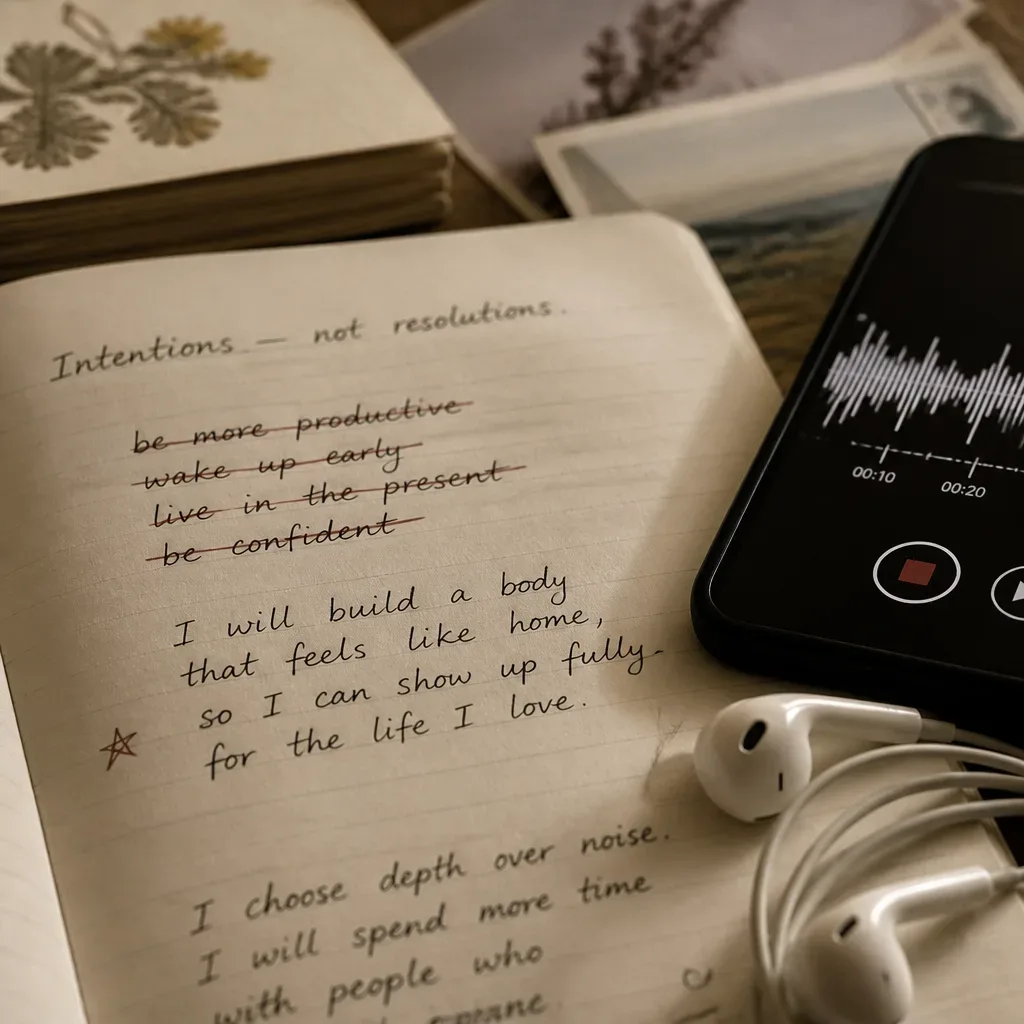
Manifestation gets quieter when it becomes specific.
A generic app says, You are successful. A personal one might say, You send the proposal before noon, and you do not reread it ten times. The second sentence has a door in it.
How does the AYA Method keep manifestation from becoming noise?
The AYA Method keeps manifestation quiet by making the audio the center and reducing the number of things you have to manage.
Many wellness apps ask for streaks, badges, lessons, community posts, metrics, and reminders. Some of that can help. Too much can make the practice feel like another inbox. The AYA Method is deliberately narrower. You come to listen to your Dream-Self Moment. The app may hold a daily affirmation and a Manifestation Board, but they support the audio. They do not compete with it.
This matters because attention is limited. In 2015, Microsoft Canada published a widely cited consumer attention report, though its exact claims about shrinking attention spans have been criticized. The safer point is simpler and better supported: task switching has costs. Research by Gloria Mark and colleagues at the University of California, Irvine has found that interruptions can increase stress and make attention more fragmented. A manifestation app should not create more fragments.
The practice asks for one daily return:
- Open the app at a time you can repeat.
- Listen to your Dream-Self Moment without multitasking, if you can.
- Let one sentence stay with you.
- Notice one small action that matches it.
- Come back tomorrow, even if today was messy.
This is not a promise that thought alone changes matter. It is a way to train attention toward the identity you are rehearsing. Neuroscientist Andrew Huberman often speaks about the role of attention and repetition in neuroplasticity. The broad claim is well accepted: repeated attention helps shape learning. The manifestation claim should stay honest: your audio can support the behavior. It is not a substitute for the behavior.
There is also a softer reason to keep it simple. When a practice has too many parts, missing one part can feel like failing. A single audio is easier to forgive and easier to resume. If you missed yesterday, you still have today.
Listening is the door. Repetition is the room.
For a wider frame on belief, action, and intention, the manifestation guide can sit beside this practice. But the daily act stays small. You listen. You remember. You move.
What does neuroscience say about hearing your future self?
Neuroscience supports pieces of the practice, especially self-relevance, mental rehearsal, prediction, and repetition, while it does not prove every manifestation claim.
That distinction is important. As a neuroscience researcher, I get careful here. There is evidence that self-related information is processed differently from neutral information. There is evidence that mental rehearsal can change performance in certain settings. There is evidence that repeated cues can influence habits. There is not evidence that an app can guarantee a specific outcome through listening alone.
Future-self work has a growing research base. Hal Hershfield and colleagues have studied future-self continuity for more than a decade. In one 2011 line of work, people who felt more connected to their future selves tended to make more future-oriented financial choices. The idea is simple: if your future self feels like a stranger, it is easier to sacrifice her. If she feels close, you may care for her sooner.
Audio can make that closeness feel more immediate. Not mystical in a vague way. Practical. You hear sentences from the self who already lives with the result of repeated choices. This is related to episodic future thinking, the ability to simulate personal future events. Research in psychology and neuroscience has linked episodic future thinking with decision-making, including reduced delay discounting in some studies. Small studies have even tested it in health behavior and addiction contexts, with mixed but promising results.
Self-affirmation research adds another piece. Cohen and Sherman reviewed decades of self-affirmation work in Annual Review of Psychology in 2014. The strongest findings do not say that saying nice words makes life easy. They suggest that reflecting on valued parts of the self can reduce defensiveness and help people stay open under threat. That is smaller than the internet often promises. It is also more useful.
Some manifestation traditions use different language. Neville Goddard wrote about living in the end. Joe Dispenza speaks about rehearsing a new self. These ideas are not the same as peer-reviewed evidence, but they point to a human pattern researchers also study: the mind practices identity before behavior becomes stable.
The honest bridge is this: future-self audio is a repeated identity cue. It may help you notice, choose, and act from a self you have rehearsed. That is enough ground to stand on.
How do you choose a personalized manifestation app without being sold a fantasy?
Choose the app that gives you clarity, repetition, and honest limits instead of dramatic promises.
A transactional search can make you feel hurried. Every app says it is the one. Slow down. The right question is not, Which app can make my life happen fastest? The better question is, Which app can I return to daily without betraying what I know is real? The American Psychological Association has repeatedly noted that behavior change is more likely when goals are specific, realistic, and supported by repeated cues. That is plain. It is also enough.
Use this buying guide before you download:
| Question | Green sign | Red sign |
|---|---|---|
| Is it personal? | It uses your words and goals | It gives everyone the same script |
| Is it repeatable? | The daily act is short | The practice feels like homework |
| Is it honest? | It supports action | It promises instant results |
| Is it calm? | The design helps you listen | The app keeps pulling you to scroll |
| Is it revisable? | You can update your intention | You get trapped in one old goal |
You can also ask what kind of manifestation you believe in. If you see manifestation as attention plus identity plus action, you will want a tool that respects all three. If astrology is part of your symbolic life, astrology and manifestation can help you understand timing and meaning. But symbols still need a daily practice. A calendar can point. It cannot listen for you.

Be wary of any tool that makes suffering sound like user error. Some outcomes involve other people, health systems, money systems, grief, chance, and time. A manifestation app should never shame you for being human. Princeton’s Global Consciousness Project and earlier Princeton Engineering Anomalies Research are sometimes cited in manifestation circles, but they do not provide a clinical basis for personal guarantees. Treat big claims gently. Ask for the daily mechanism.
AYA’s mechanism is simple: personalized future-self audio, repeated. It is not a spectacle. It is a practice you can do when your tea is still warm.
Who is AYA best for, and who should use something else?
AYA is best for someone who wants a quiet daily audio practice and does not need manifestation to be loud, social, or complicated.
You may like AYA if you already know that written affirmations help, but you do not always want to read them. You may like it if vision boards appeal to you, but you need something you can use with your eyes closed. You may like it if you have tried goal apps and found that tracking alone did not reach the way you speak to yourself. In 2023, DataReportal estimated that the average internet user spends more than 6 hours online each day. A practice that asks for only a few minutes has to be very clear about why it deserves that space.
AYA may not be right if you want a large course, a public community, or detailed productivity tools. It may not be right if you want hard scientific certainty that a specific result will arrive by a specific date. No ethical app should sell that. It may also not be enough if you are in acute distress. In that case, care from a qualified person matters. A manifestation practice can sit beside care. It should not replace it.
For many people, the value is the repeated meeting with a self they can almost believe. Not a perfect self. Not a distant self. A near self. The one who answers differently once today. The one who pauses before saying yes. The one who sends the message. The one who rests without earning it first.
There is a practical way to test fit. Use the app for 14 days. That number is not magic, but it is long enough to notice friction. Ask three questions on day 15:
- Did I actually listen most days?
- Did any sentence follow me into ordinary life?
- Did I take one action I might have avoided?
If the answer is yes, the practice is doing something real enough to keep. If the answer is no, revise the intention before you blame yourself. Sometimes the audio is not yet close enough. Sometimes the goal is borrowed. Sometimes your nervous system needs softer words.
A personalized manifestation app should leave you more honest than it found you.
Stay close to the voice that feels true.