aya method deep dive
28-Step Manifestation Intake for Dream-Self Audio
A quiet guide to the 28-step manifestation intake that shapes personalized Dream-Self audio, with prompts, timing, and listening tips.

Your phone is face down. The room is not asking for much. A 28-step manifestation intake is a guided set of prompts that turns your desire into a personalized Dream-Self audio, so the recording can speak in your language, your details, and your believable future.
What is a 28-step manifestation intake actually doing?
It gathers the exact material a personalized audio needs: desire, scene, language, resistance, and daily proof.
A good intake does not ask you to sound certain. It asks you to be specific. There is a difference. Certainty can become performance. Specificity gives the practice a place to land. One sentence like, “I answer the email without shrinking,” can say more than 300 words about confidence.
The AYA Method is a daily audio manifestation practice. Each day you listen to a short personalized recording — your Dream-Self Moment — narrated from the version of you who has already manifested the life you intend. Listening is the practice. Repetition is the work. The audio is the method.
That is why the intake matters. It is not the method itself. It is the quiet form before the voice. It helps the audio know whether your future self sounds steady or soft, whether the scene happens in a kitchen or a studio, whether the desire is about money, love, health, home, or work. In product terms, 28 prompts create enough signal without making you fill out a life thesis.
Personalization is not decoration. In a 2021 McKinsey report, 71% of consumers said they expected personalized interactions from digital products. Rituals are not shopping carts, but the principle still holds: what feels made for you is easier to return to. A manifestation practice becomes more repeatable when it sounds like something you would actually believe on a Tuesday morning.
The intake is where the future stops being vague and starts becoming audible.
You can read the wider practice context in the manifestation guide, but keep this close: the intake serves the audio. The audio carries the repetition.
Why 28 steps instead of three quick questions?
Twenty-eight steps give enough detail for depth without asking you to explain your whole life.
Three prompts can name a desire. They rarely catch the texture. A personalized Dream-Self audio needs more than “new job” or “better relationship.” It needs the meeting room after you speak clearly. It needs the way your shoulders drop when the payment arrives. It needs the line your future self can say without sounding like someone else wrote it.
There is a practical reason for the number. In behavior design, friction matters. BJ Fogg’s Tiny Habits model, published in 2019, argues that repeatable behavior depends on making the action small enough to do. The intake should be complete, but not heavy. At about 28 minutes for 28 steps, you can give one clear answer per minute and still finish before the mind turns it into homework.
Research on mental imagery also supports detail. A 2016 review in Current Directions in Psychological Science described imagery as emotionally active because the brain treats imagined sensory scenes differently from abstract thought. A future you can see, hear, and feel is usually more useful than a future you can only name.
| Intake size | What it usually captures | What it often misses |
|---|---|---|
| 3 questions | Desire, goal, broad feeling | Voice, resistance, daily proof |
| 10 questions | Desire plus some context | Sensory detail, language preferences |
| 28 questions | Scene, tone, pattern, proof, next action | Very little, if answers stay honest |
Twenty-eight is not sacred. It is a container. One lunar cycle has about 29.5 days, which is why 28 can feel naturally complete without becoming ornate. The number says: enough to listen closely, not so much that you leave the room.
What are the 28 steps in the manifestation intake?
The 28 steps move from desire to proof, then from proof to daily listening.
Use these prompts slowly. One or two sentences are enough for most of them. The goal is not to impress the intake. The goal is to make the Dream-Self Moment true enough that you can hear it every day for 7, 14, or 28 days without flinching.
- Name the desire in plain words.
- Choose the life area: love, work, money, home, health, creativity, or self-trust.
- Set a time horizon: near, middle, or longer.
- Describe one ordinary scene where it is already real.
- Add 3 sensory details from that scene.
- Name the emotional tone you want to hear.
- Write one sign that change has already begun.
- Name the old pattern that tends to return.
- Describe the new response you want to practice.
- Write one first-person line from your future self.
- List words that feel false or too loud.
- List words that feel true and easy to hear.
- Define what enough looks like.
- Describe a morning after the desire is real.
- Describe an evening after the desire is real.
- Name who is near you, or who benefits.
- Name the body cue that tells you it is safe.
- Describe one decision you make differently.
- Name one boundary you now keep.
- Name one devotion you keep choosing.
- Choose the audio pace: slow, steady, or gently bright.
- Choose the narrator feel: tender, direct, warm, or calm.
- Add one memory that proves you have changed before.
- Add one future proof from ordinary life.
- Choose one next action for the next 24 hours.
- Choose your daily listening time.
- Choose whether an affirmation or Manifestation Board will support the audio.
- Read everything once and remove what is not yours.
Psychologist Gabriele Oettingen’s WOOP research separates wish, outcome, obstacle, and plan; her 2014 book and related studies made that 4-part structure widely known. This intake has more steps, but it keeps a similar respect for reality. You name what you want. You also name what gets in the way.
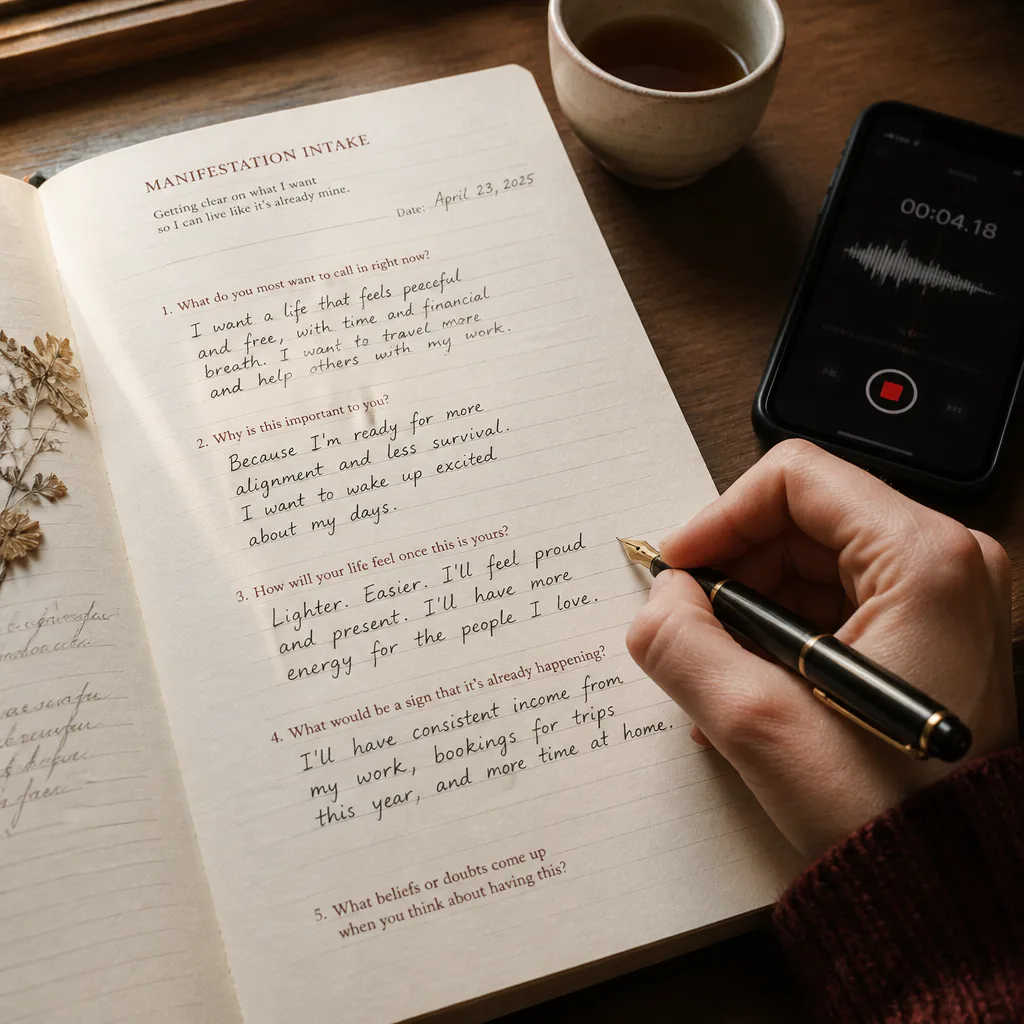
How do you answer without overthinking every prompt?
You answer by making each response small, concrete, and close to daily life.
Start with the first true thing. If the prompt asks what your manifested life looks like, do not begin with a mansion, a title, or a perfect body unless that is actually the honest image. Begin with the cup in your hand. The message you no longer dread. The way you walk into the room. In a 2006 meta-analysis in Psychological Bulletin, goal progress was linked to monitoring and feedback across 138 studies. Specific details give you something to notice later.
A useful answer often has 3 parts:
- A scene: where you are, what is happening, who is there.
- A felt shift: what is softer, clearer, steadier, or less tense.
- A proof: what you do differently because this is now true.
If you get stuck, use the 10-second rule. Write the first honest sentence, then stop. You can edit for accuracy, not beauty. This matters because people often abandon reflective tools when the blank field feels too wide. A 2022 Pew Research Center report found that 31% of U.S. adults said they were online “almost constantly.” Your attention is already being asked for. The intake should give it a room, not another demand.
You do not have to be positive in every answer. A real intake has room for resistance. You can write, “I am afraid this will not last,” and still build a strong audio. In self-affirmation research, Cohen and Sherman’s 2014 review in Annual Review of Psychology notes that values-based reflection can support openness under threat. Honesty is not a flaw in manifestation. It is the place the practice can meet you.
Belief grows better when it is not forced to lie.
How does the intake become a personalized Dream-Self audio?
The intake becomes audio by turning your answers into a short future-self narration you can listen to daily.
Think of the intake as raw material. The Dream-Self Moment is the edited voice. It does not need to include all 28 answers word for word. It needs to carry their essence: the desire, the scene, the emotional tone, the old pattern, the new response, and the proof that life has started to answer you.
For example, if you write that you want a steadier creative practice, the audio might not say, “You complete 90 minutes of design work.” It might say, “You sit down before the day gets loud. The file opens. Your hands know where to begin.” The second line is easier to hear because it contains motion, place, and body. It gives the nervous system a smaller door.
Dr. Andrew Huberman has often spoken about dopamine as a molecule tied to motivation, pursuit, and reward prediction, not just pleasure. The science is more complex than a single quote, but the practical point is useful: repetition works better when it stays connected to action. That is why step 25 asks for one next action in the next 24 hours. The audio should not float above your life. It should touch the next reachable thing.
The app may also include a daily affirmation and a Manifestation Board, but they are complements. They are not the pillars. The center is the listening. If the intake makes the words true, the daily recording makes them familiar. After 7 days, you may notice the same line differently. After 28 days, you may hear less strain in it.
You can learn how affirmation language works in the affirmations pillar, especially if you tend to reject lines that sound too shiny. The best wording is not the loudest. It is the one your system lets in.
Where do affirmations, boards, and astrology fit around the intake?
They fit as supports around the audio, not as replacements for it.
A daily affirmation can hold one clean sentence from the intake. It might be the sentence you most need to remember at 3 p.m., when your attention is frayed. A Manifestation Board can hold the visual evidence: the room, the texture, the object, the ordinary proof. Both can be useful. Neither carries the full method by itself.
This distinction keeps the practice simple. Audio is temporal. It meets you in time, one listening after another. A board is spatial. You see it all at once. An affirmation is verbal. You repeat it like a small bell. In a 2018 Nielsen report, U.S. adults spent over 11 hours per day interacting with media across devices. A practice that adds more looking may not always be what you need. Sometimes you need to close your eyes and listen.
Astrology can also be used gently, if it helps you choose timing or language. A new moon might be a natural day to complete the intake. A Saturn transit might make boundaries feel more relevant. Keep it grounded. The chart can frame a question; it should not take your agency. If you like that lens, the astrology and manifestation guide keeps the relationship clear.
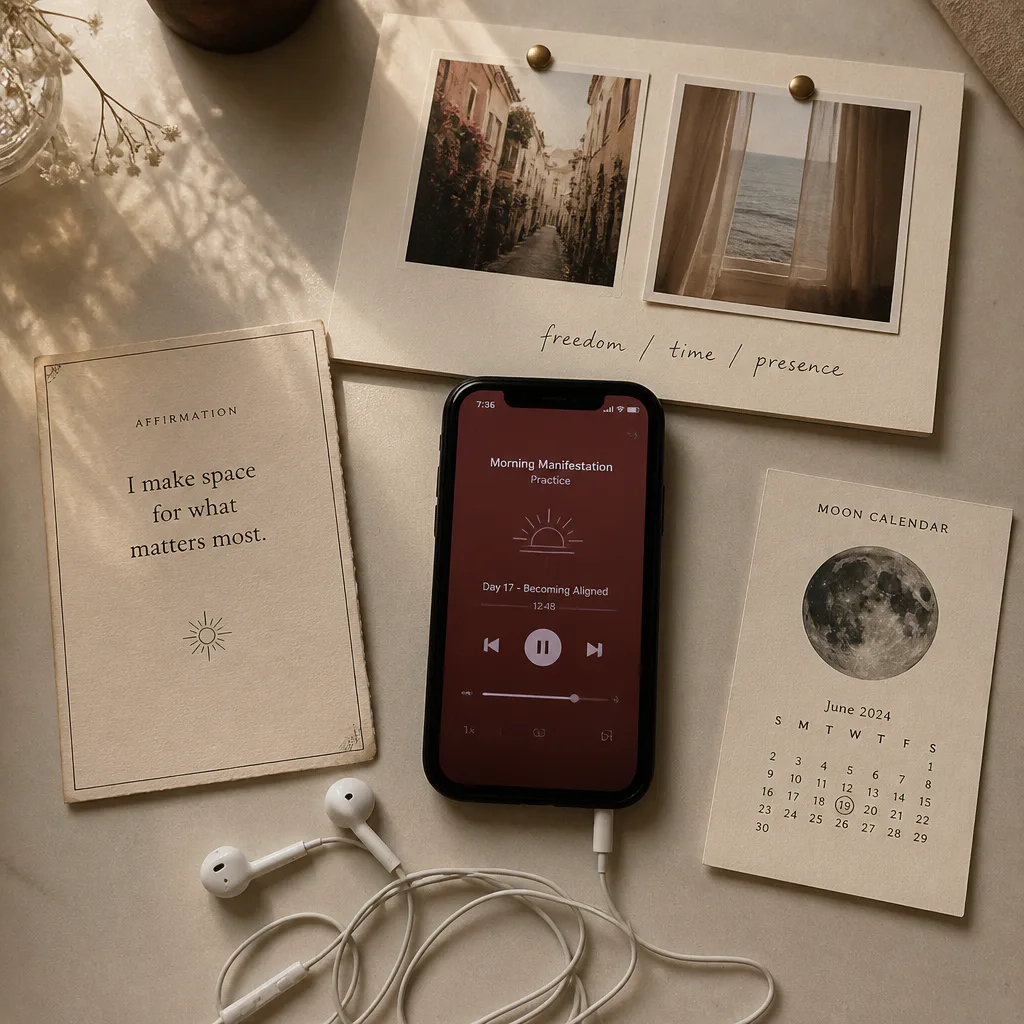
The best support is the one that brings you back without making the practice bigger than your life. One sentence. One image. One listening. Small enough to repeat is often strong enough to last.
How do you use the audio after the 28-step intake is done?
You listen once a day, at the same natural point in your routine, and let repetition do its quiet work.
Choose a listening time you already have. Before getting out of bed. After brushing your teeth. During the first cup of coffee. Before sleep. Habit researchers often point to context stability because cues help behavior repeat; a 2012 study in the British Journal of General Practice described habit formation as a process where context and repetition make actions more automatic over time. You do not need a perfect routine. You need a repeatable one.
Try this simple 7-day listening rhythm:
- Day 1: listen once without editing yourself.
- Day 2: notice one line that feels true.
- Day 3: take the next 24-hour action from the intake.
- Day 4: listen for the old pattern without judgment.
- Day 5: repeat the line your body accepts most easily.
- Day 6: add one visual proof to your Manifestation Board, if useful.
- Day 7: write 3 changes you can actually see.
After 7 days, do not ask only, “Did it happen?” Ask better questions. Did I respond differently once? Did I remember faster? Did the desire become more specific? Did my body soften around the future I named? In small studies on expressive writing, including Pennebaker’s early work from 1986 onward, measurable shifts often came from repeated, honest language over several sessions. The exact mechanism is debated, but the pattern is worth respecting: repetition gives language a body.
If the audio starts to feel false, return to the intake. Change the scene. Make the desire closer. Remove any borrowed words. You are not failing the practice when you revise it. You are telling the truth more cleanly.
A manifestation you can repeat is stronger than one you only admire from far away.
The next line can be quiet, and still be yours.