audio manifestation
Manifestation Music vs Future-Self Audio Daily
Manifestation music can help you settle, but future-self audio gives the mind a specific identity to rehearse. Here's how to choose for daily practice.
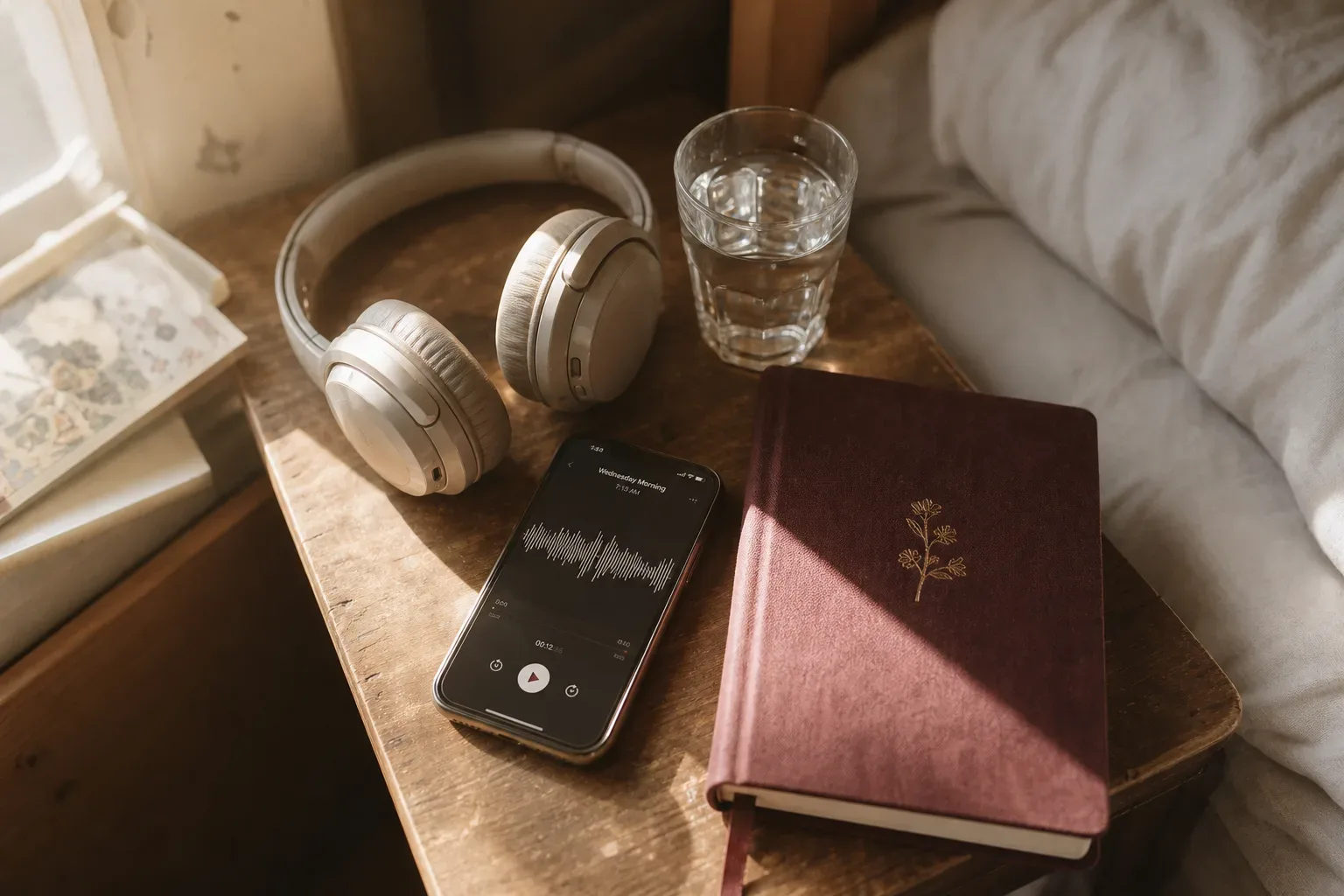
Your headphones are already on the table. Manifestation music helps you settle into a receptive state; future-self audio gives that state a clear identity to rehearse. For daily practice, music is atmosphere. Future-self audio is instruction. The better choice is the one you’ll repeat when your day is ordinary.
What is the real difference between manifestation music and future-self audio?
The real difference is that manifestation music changes the room around the practice, while future-self audio changes the words inside it.
Manifestation music is usually instrumental or lightly vocal. It may use slow tempo, drones, binaural beats, nature sound, or spacious piano. The promise is simple: you press play, your breathing slows, and your mind stops gripping so tightly. Research on music and the nervous system is not small. Chanda and Levitin’s 2013 review in Trends in Cognitive Sciences connected music listening with measurable changes in stress, immunity, social bonding, and reward chemistry, though results vary by person and setting.
Future-self audio is more specific. It gives you a narrated scene of the self you’re practicing. The voice says what you now choose, how you now move, what feels normal now. That distinction matters because the brain doesn’t only respond to calm. It also responds to rehearsal. Driskell, Copper, and Moran’s 1994 meta-analysis of 35 mental practice studies found that mental rehearsal improved performance compared with no practice, especially when the task had a cognitive component.
A useful way to see it:
| Format | Primary input | Best for | Main risk |
|---|---|---|---|
| Manifestation music | Sound and mood | Settling, soft focus, habit cue | Staying vague |
| Future-self audio | Voice and identity | Self-concept rehearsal | Too many words |
| Both together | Voice supported by sound | Gentle daily repetition | Music covering the message |
A calm mind is not the same as a clear direction. Music can open the door. A future-self recording tells you which room you’re entering.
When is manifestation music enough for daily practice?
Manifestation music is enough when your main barrier is tension, not uncertainty.
Some days you don’t need a sentence. You need the body to stop bracing. A 60 to 80 beats-per-minute tempo can sit close to a resting heart rate, and many relaxation playlists are built around that range. Small clinical studies often find that slow music before a stressful task can reduce self-reported anxiety, though the effect depends on preference. The track you dislike will not become medicine because a title says so.
Music is also useful when language feels crowded. If you’ve spent nine hours reading, replying, deciding, and explaining, more words may not help. In that case, manifestation music can become a low-friction cue. You press play. You breathe for five minutes. You remember the intention without forcing it into a paragraph.
It helps to give the music a job:
- Use one track for morning focus, not twenty.
- Keep the length short enough that you don’t negotiate with it.
- Pair it with one visible cue, like a glass of water or a notebook.
- Stop using tracks that make you chase a feeling.
Habit formation research is clear about repetition. In a 2009 study by Phillippa Lally and colleagues in the European Journal of Social Psychology, participants took 18 to 254 days to make a new behavior feel automatic, with 66 days as the average. That range is humbling. It means your practice needs to survive boring mornings.
If manifestation music helps you show up on day 14, it matters. Not because sound is magic. Because the cue became kind.
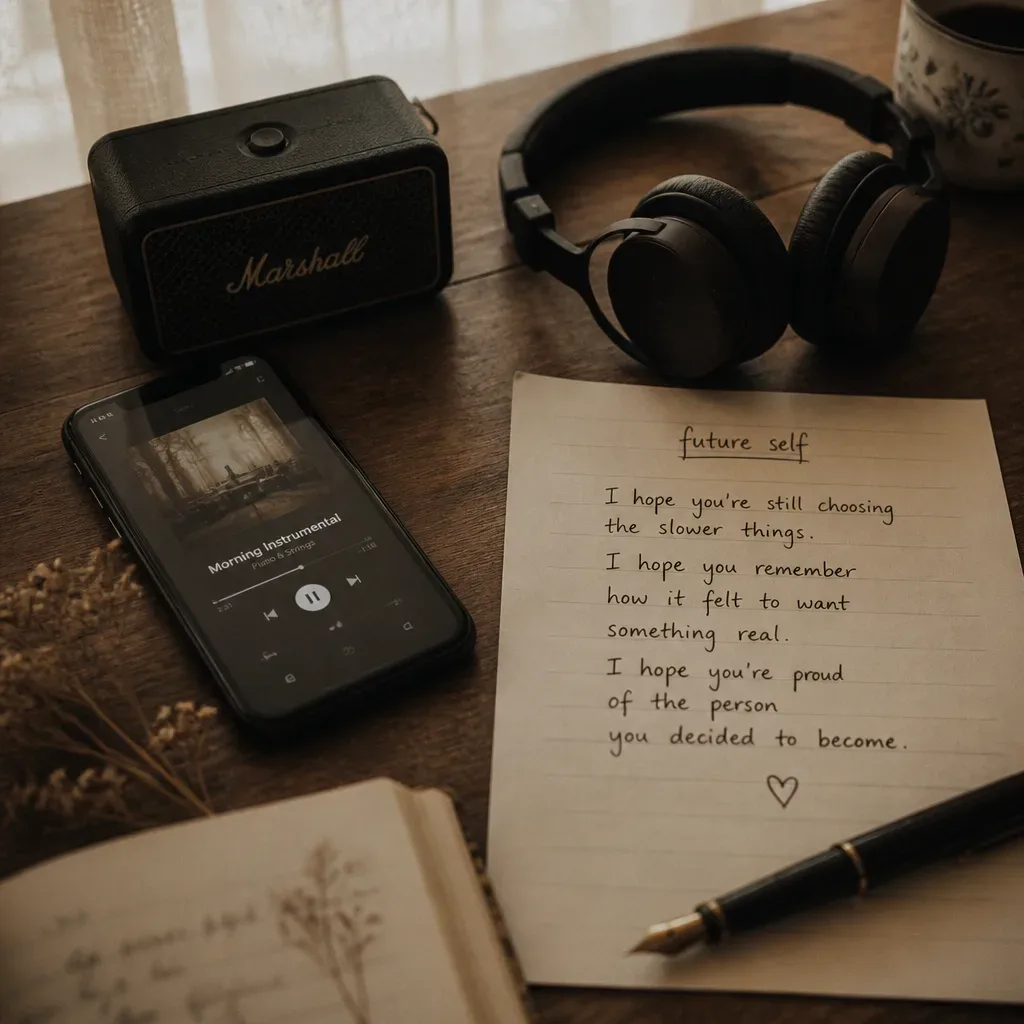
When does future-self audio work better than music?
Future-self audio works better when you need the practice to name who you’re becoming, not only how you want to feel.
Music can soften the edges. It cannot usually say, You now ask for the rate that reflects your work, or You now speak to your body without apology, or You now choose the apartment that feels like home. A future-self recording can. It gives your attention a script to repeat, and repetition is where identity gets its quiet structure.
For Aya, the AYA Method is named with care:
The AYA Method is a daily audio manifestation practice. Each day you listen to a short personalized recording — your Dream-Self Moment — narrated from the version of you who has already manifested the life you intend. Listening is the practice. Repetition is the work. The audio is the method.
That is not the same as putting soft music under a wish. The Dream-Self Moment is personal. It speaks from the version of you who already knows the shape of the desired life. The app also includes a daily affirmation and a Manifestation Board, but those are complements. The audio is the method.
This is where future-self audio connects with self-talk research. Ethan Kross and colleagues have shown in multiple studies that the way you address yourself can change emotional distance and performance under stress. In one 2014 paper in Journal of Personality and Social Psychology, using non-first-person self-talk helped people regulate before challenging tasks. Voice matters. Distance matters. The words you hear about yourself matter.
Future-self audio is not louder than music. It is more precise. It gives your nervous system a sentence it can return to when the day tests the practice.
How do they compare in the first ten minutes of the day?
In the first ten minutes, manifestation music helps you begin gently, while future-self audio helps you begin deliberately.
Morning is often overdesigned. People add breathwork, journaling, stretching, gratitude, sunlight, cold water, and then wonder why the ritual collapses by Thursday. A daily audio practice has to fit inside an actual life. The Centers for Disease Control and Prevention reported that about 1 in 3 American adults don’t get enough sleep, so advice that assumes a perfect morning is already missing many people.
If you’re choosing between manifestation music and future-self audio, don’t ask which one sounds more spiritual. Ask which one changes the next ten minutes.
- If you wake anxious, start with music for two minutes.
- If you wake scattered, use future-self audio first.
- If you wake numb, use a voice that names one small true desire.
- If you wake rushed, choose the shorter format.
- If you wake resistant, lower the ask until you can do it.
The best daily practice is not the most impressive one. It is the one you can repeat without performing devotion to it.
For a broader view of the practice, the Manifestation pillar is useful because it separates intention from fantasy. Intention needs contact with action. Fantasy can stay untouched all day. Future-self audio can be the bridge because it doesn’t only say what you want. It rehearses how you act from there.
Manifestation music may be the better first step if mornings feel sharp. Future-self audio may be the better first step if your old identity starts speaking before your feet touch the floor.
What does the research actually support?
The research supports music for state change and mental rehearsal for behavior change, but it doesn’t prove that every manifestation track does what its title claims.
This matters. Many tracks are named with large promises. The evidence is smaller and more useful. Blood and Zatorre’s 2001 brain-imaging study found that intensely pleasurable music activated reward-related regions, including areas linked with dopamine. That doesn’t mean every listener will manifest a result after one song. It means music can measurably affect attention, pleasure, and bodily state.
There is also evidence that music can help with stress. A 2013 Cochrane review on music interventions for preoperative anxiety found that music listening may reduce anxiety, though study quality varied. This is enough to take music seriously. It is not enough to treat a playlist as a full practice.
Future-self audio rests on a different stack of evidence: mental imagery, narrative identity, self-talk, and habit repetition. Peter Gollwitzer’s work on implementation intentions, beginning in the late 1990s, found that if-then planning can increase follow-through across many behaviors. A future-self recording is not the same as an if-then plan, but it can contain one: When the meeting starts, I speak slowly. When money comes in, I choose clearly. Specificity helps.
The Affirmations pillar explains a nearby point: language works best when it is believable enough to repeat. A sentence that feels false can create friction. A sentence that feels slightly ahead of you can become a handle.
So the honest comparison is this: manifestation music may help you enter the practice. Future-self audio may help the practice enter your day.

How do you choose without making the ritual bigger?
You choose by matching the format to the smallest honest need in front of you.
Start with the problem, not the tool. If your body is tight, music may be enough. If your mind is vague, voice may be kinder. If your intention changes every week because you never hear it clearly, future-self audio will probably serve you better than another playlist. Specificity is a mercy. It stops you from asking your mood to do the work of a method.
Use this simple check for seven days:
| Your signal | Choose | Why |
|---|---|---|
| I feel tense | Manifestation music | Settles the body first |
| I feel unclear | Future-self audio | Gives words and direction |
| I feel avoidant | Shorter future-self audio | Reduces negotiation |
| I feel lonely in the practice | Spoken audio | Offers a steady voice |
| I feel overtalked | Music | Lets the mind rest |
Seven days is enough to notice friction. It is not enough to declare the whole practice failed. In behavior design, BJ Fogg has long argued that small actions anchored to existing routines are more reliable than large actions powered by motivation. You don’t need to become a different kind of person before breakfast.
The Astrology and manifestation guide can be a gentle companion if timing matters to you. Pew Research Center reported in 2018 that 29% of U.S. adults said they believe in astrology. If you use lunar or astrological timing, let it support the ritual. Don’t let it replace the listening.
A ritual gets heavier when every tool asks to be the center. Let one thing be the center. For Aya, that thing is the Dream-Self Moment. Music can sit beneath it. An affirmation can echo it. A board can hold its images. The voice leads.
Can manifestation music and future-self audio belong together?
Yes, they can belong together when music supports the spoken practice instead of swallowing it.
Think of music as the room tone. It can make the recording feel safer, warmer, less clinical. But if the track is too dramatic, your attention may follow the swell instead of the words. For daily practice, clarity wins. A voice you can hear at low volume is better than a beautiful mix that turns the message into mist.
A simple structure works well:
- Thirty seconds of quiet music.
- Three to seven minutes of future-self audio.
- One daily affirmation, if it helps you carry the phrase.
- One glance at the Manifestation Board, if you want a visual reminder.
- Then stop.
That last step matters. Stop before the ritual becomes a search for a better feeling. A daily practice should leave you more available to your life, not more dependent on preparing for it.
If you’re new to this, read the Manifestation pillar for the larger frame, then return to the smallest action: listening. If language is your doorway, the Affirmations pillar can help you choose words that don’t fight your body. If rhythm and timing help you keep the promise, Astrology and manifestation can offer a calendar without making the sky responsible for your choice.
The quiet rule is simple. Music helps you arrive. Future-self audio helps you remember who arrived.
Put the headphones on. Listen for the self that already knows.