audio manifestation
Lunch Break Meditation: 5-Minute Future-Self Reset
A lunch break meditation using future-self audio can steady attention, renew intention, and fit inside five ordinary minutes at work.

Monday, 12:18. A lunch break meditation can be a five-minute future-self audio reset: sit down, listen to a short personalized recording, breathe with it, and choose one next action. I use it to interrupt the workday before the afternoon hardens around the morning.
What is a lunch break meditation when I only have five minutes?
A lunch break meditation is a short, deliberate pause that changes the next part of the day rather than trying to repair the whole day.
I am writing this from the kitchen table at the institute, beside a container of rice I packed too late last night. Five minutes sounds almost rude when people are selling thirty-day plans and ninety-minute morning routines. But the nervous system lives in shorter intervals than our plans do. A 2010 Science paper by Killingsworth and Gilbert found that people reported mind-wandering in 46.9% of sampled moments, and they were often less happy when their minds had left the present task. That number stays with me at lunch because I can feel it. I can be eating and still arguing with an email from 9:07.
For this practice, I do not try to empty my mind. I give it a narrow path. The path is audio, breath, one sentence, one next action. If you are new to the wider language of naming a wanted life, the Manifestation pillar gives the broad map. At lunch, I need less map and more door handle.
Five minutes is enough when the aim is state change, not personality change. In small laboratory studies, even brief paced-breathing or mindfulness exercises have been linked with short-term reductions in anxiety and improved attentional control. I am careful with that sentence. It does not mean a sandwich-length practice fixes burnout. It means the body can receive a new cue quickly.
Five minutes is not small when it is the first honest interruption of the day.
Why does future-self audio work differently from silent sitting?
Future-self audio adds self-relevant language to the pause, so attention has something specific to rehearse.
Silent sitting is beautiful when I can do it. At work, I often cannot. My mind opens twelve tabs before I have finished the first breath. A short recording gives me a track to return to. In the AYA Method, the definition is precise: The AYA Method is a daily audio manifestation practice. Each day you listen to a short personalized recording, your Dream-Self Moment, narrated from the version of you who has already manifested the life you intend. Listening is the practice. Repetition is the work. The audio is the method.
That matters to me as a neuroscience researcher because self-referential language is not neutral. Reviews on self-affirmation, including Cohen and Sherman in 2014, suggest that values-based self-statements can reduce defensiveness under stress in some contexts. The effects vary by person and design, but the mechanism is plausible: the self is easier to practice when it is named.
I keep the audio concrete. Not grand. Not shiny. My lunch recording does not say that everything is perfect. It says: I answer the afternoon from steadiness. I choose the next clean task. I do not keep proving my worth with urgency. Those lines are boring on purpose. The brain trusts repetition more than drama.
Future-self audio is not magic language. It is a repeated cue attached to identity. If silent meditation is a clear bowl of water, future-self audio is a small label on the bowl that says what I came here to remember.
How do I do the five-minute reset at my desk or outside?
I do the reset by using the same order every time: place, breath, audio, one written line, return.
The order matters because decisions are expensive at lunch. By 12:00, I have already chosen words for messages, reviewed data, and tried not to spill coffee on the keyboard. A 2009 study by Lally and colleagues found that habit formation took a median of 66 days, with a wide range from 18 to 254 days depending on the behavior. I do not use that number to scare myself. I use it to forgive the first awkward week.
Here is the five-minute version I kept this week:
- Minute 0:00 to 0:30: Sit down somewhere ordinary. Put both feet on the floor if possible.
- Minute 0:30 to 1:00: Take three slower exhales. Let the shoulders drop without making a project of it.
- Minute 1:00 to 4:00: Listen to the future-self audio once. No multitasking.
- Minute 4:00 to 4:30: Write one line: This afternoon, I will…
- Minute 4:30 to 5:00: Look at one real object, then go back.
I have done this in a stairwell. I have done it on the bus with one earbud. I have done it in the bath on a day I worked from home and lunch arrived at 14:35. The setting is less important than the repeated cue. Dr. Andrew Huberman often describes the nervous system in terms of state shifts and protocols. I borrow the plain part: the body learns from repeated conditions.

What should the future-self audio actually say?
The audio should say believable, sensory, behavior-linked sentences from the self you are practicing becoming.
I do not put impossible claims in my lunch recording. If the sentence makes my jaw tighten, I cut it. Neville Goddard wrote often about living from the wish fulfilled, and I understand why people love that phrase. Still, in a workday reset, I need language my nervous system does not reject. I prefer the near future to the theatrical future.
A useful script has three parts:
- A body cue: My breath has slowed. My hands are unclenched.
- An identity cue: I am someone who answers with care instead of speed.
- A behavior cue: I send the next message after reading it once more.
Research on implementation intentions by Peter Gollwitzer, developed across the 1990s and reviewed later with Paschal Sheeran, found that if-then planning can improve goal follow-through across many behaviors. I think of my audio as softer than an if-then plan, but related. It gives the afternoon a pre-decided shape.
I also keep one sentence that sounds almost like an affirmation, because some days the mind needs a handle. The daily affirmation is not the whole practice for me. It is a complement, a small written line beside the audio. Today mine was: I can be exact without being harsh.
Here is the difference I notice:
| Weak lunch audio | Strong lunch audio |
|---|---|
| Everything is working out perfectly. | I take the next step without rushing my body. |
| I am the most successful person in the room. | I speak clearly in the 2 p.m. meeting. |
| Nothing can bother me. | I can feel pressure and still choose my tone. |
A good future-self sentence does not flatter me. It gives me instructions I can live by before 3 p.m.
How do I keep it from becoming another productivity task?
I keep the practice humane by measuring return, not performance.
This is the part I have had to learn twice. I can turn anything into a task if I am tired enough: water, stretching, prayer, even rest. Lunch becomes another place where I try to be impressive. So I made one rule. I do not grade the reset. If I listened, it counted. If I cried during it, it counted. If I felt nothing, it counted. Repetition is allowed to be plain.
The American Psychological Association reported in recent Work in America surveys that a large share of workers describe work-related stress and emotional exhaustion. The exact percentage changes by year and sample, but the pattern is not subtle. Many people arrive at lunch already carrying too much. A lunch break meditation should not ask them to become a better employee in five minutes. It should return them to being a person.
I use these boundaries:
- I do not check messages during the audio.
- I do not use the practice to force a mood.
- I do not rewrite my whole life at lunch.
- I do not compare today with yesterday.
- I do not make the recording longer just because I feel guilty.
There is a related reason I keep astrology out of the actual five minutes, even though I sometimes read astrology and manifestation notes at night. Lunch is not where I interpret the sky. Lunch is where I notice my pulse, my sandwich, my next honest action.
What should I expect after one week of lunch break meditation?
After one week, expect small signs: quicker recovery, clearer choices, and less automatic afternoon speech.
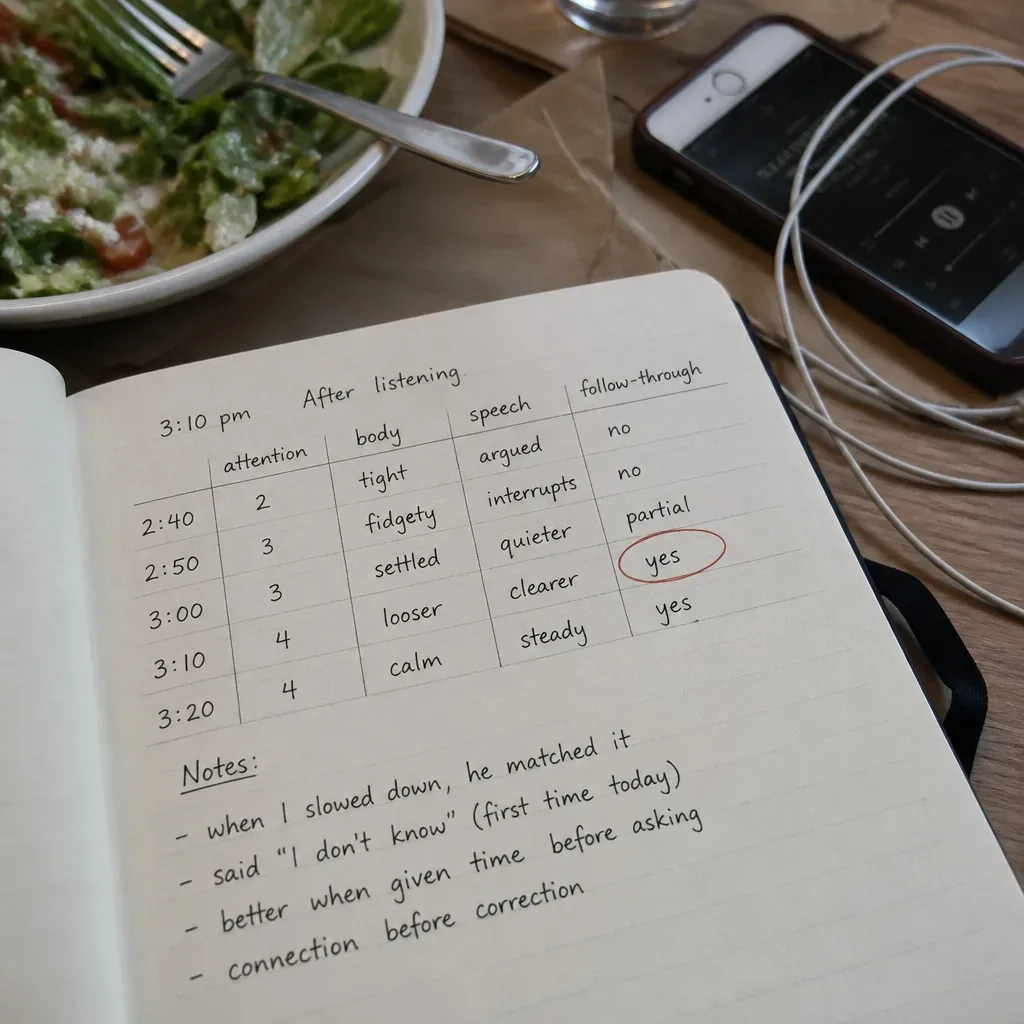
Seven days is not long enough to promise a new self. It is long enough to collect data. I tell students in the lab to distinguish between measurement and interpretation. The same applies here. Do not ask, Did my whole life change? Ask, Did I interrupt one loop that usually runs without me?
In my notebook, I track four plain things with a 0 to 2 score. Zero means absent. One means partly. Two means yes. It takes under 30 seconds.
| Signal | Question I ask at 16:00 |
|---|---|
| Attention | Did I return to one task faster after lunch? |
| Body | Did I notice tension before it became behavior? |
| Speech | Did I answer one person more carefully? |
| Follow-through | Did I do the next small action I named? |
A 2013 study by Mrazek and colleagues found that two weeks of mindfulness training improved working memory capacity and reduced mind-wandering during a reading task in undergraduates. That was not a five-minute lunch audio study, so I do not overclaim it. I cite it because attention is trainable under repeated conditions.
The first week may feel unimpressive. That is not failure. Habit often arrives without music. On day three, I noticed I did not reopen a difficult email six times. On day five, I took my lunch away from the screen. These are small measurements, but small measurements are how a life stops lying to itself.
The practice is working when the afternoon has one fewer automatic reaction.
How does this fit with a longer manifestation practice?
The lunch reset works best as a midday return to a practice that already has a daily anchor.
For me, the anchor is audio in the morning. I listened to my Dream-Self Moment before brushing my teeth today. That is the order I keep because I do not want to negotiate with myself while half-awake. The lunch break version is not a replacement for the full daily practice. It is a return visit. The morning names the self. Lunch asks whether I am still listening.
If you are building a broader practice, keep the parts in proportion. The audio is the method. A daily affirmation can help. A Manifestation Board can remind the eyes. But the repeated listening is the spine. I wrote more notes on audio-based practice in the audio manifestation guide, especially for people who respond better to sound than to long journaling sessions.
The evidence base is uneven, as it is for many contemplative and self-change practices. Brief meditation research is stronger for attention and stress than for claims about life outcomes. Self-affirmation research is context-dependent. Future-self visualization has promising adjacent work in psychology, including studies on future self-continuity and saving behavior, such as Hershfield and colleagues’ 2011 work using aged avatars. I hold all of that warmly and lightly.
Here is my most honest sentence as both practitioner and researcher: plausible is a compliment. A five-minute future-self audio reset is plausible because it combines repetition, self-relevant language, attention, and a concrete behavioral next step. That is enough for me to keep testing it in the middle of an ordinary day.
Tuesday now. The blue container is still by the sink.