audio manifestation
Guided Manifestation Audio vs Your Own Voice
Guided manifestation audio and self-recorded voice both work, but they compound differently. I compare attention, emotion, repetition, and ease.

Monday, 7:10 a.m. Guided manifestation audio compounds faster for most people because it removes decisions and makes repetition easier; your own voice can deepen belief later, once the listening habit is already steady. I use guided audio first, then test my voice only if the practice survives ordinary mornings.
Which one compounds faster when I am tired?
Guided manifestation audio compounds faster on tired days because it asks for fewer choices.
I noticed this in the kitchen, not in a notebook. The kettle clicked, my phone was at 18 percent, and I had already answered 6 messages before brushing my teeth. A self-recording would have required me to like my script, tolerate my voice, and remember where I saved the file. The guided track only asked me to press play. That is not a small difference. In habit design, the action that survives fatigue is usually the action with the fewest gates.
Phillippa Lally and colleagues at University College London found in a 2009 study that new habits took a median of 66 days to become automatic, with a range from 18 to 254 days. I write that number down often because it makes me kinder to the part of me that quits on day 9. The question is not which practice sounds more special. The question is which one can repeat long enough to matter.
I keep returning to the AYA Method because the audio is not an accessory there. The AYA Method is a daily audio manifestation practice. Each day you listen to a short personalized recording, your Dream-Self Moment, narrated from the version of you who has already manifested the life you intend. Listening is the practice. Repetition is the work. The audio is the method.
That definition matters because it keeps me from over-building the ritual. I do not need a candle, a perfect mood, or a 40-minute gap. I need the chair, the headphones, and one short piece of sound. A practice that fits inside a hard morning has a better chance of becoming part of my actual life.
The ritual that compounds is not the one I admire most. It is the one I can repeat when I am ordinary.
What does my own voice do that guided audio cannot?
My own voice can make the future feel closer because it carries identity, memory, and bodily recognition.
There is something strange about hearing myself say a sentence in the present tense. I hear the room tone behind it. I hear the small nasal edge I get when I record after coffee. I hear the person who paid rent, called my mother back, and sat through boring meetings. A guided voice can soothe me. My own voice can accuse me, in the useful sense, of already knowing what I want.
Neuroscience research on self-referential processing often points to the medial prefrontal cortex as active when we think about ourselves. A 2012 review by Northoff and colleagues described self-related processing as distributed, not a single neat switch. I take that cautiously, but personally: self-relevance changes attention. My own voice makes a statement harder to treat as decorative.
Still, the first week I tried recording myself, I deleted 11 takes. I adjusted the microphone. I disliked the pauses. I turned a morning practice into a small production problem. That is where guided manifestation audio won back the room. In design terms, my own voice increased emotional salience, but it also increased setup cost.
Here is the comparison I keep in my notes:
| Practice | Strongest advantage | Common friction | Best use |
|---|---|---|---|
| Guided manifestation audio | Low effort, steady pacing | May feel less personally raw | Building the daily loop |
| Your own recorded voice | High self-recognition | Self-consciousness and editing | Deepening an established loop |
| Silent reading | Fast and private | Easy to skim | Backup on public transport |
| Written scripting | Clear thinking | Requires time and energy | Weekly clarification |
If you are new to manifestation, I would not start with the most emotionally intense version. I would start with the version that lets you come back tomorrow. Intensity is not the same as compounding. Compounding is repetition with less leakage each time.
Why does guidance make repetition easier?
Guidance makes repetition easier because it carries the structure for me when my attention is thin.
This morning, I listened before opening my laptop. That order has become important. Dr. Andrew Huberman often talks about attention as state-dependent, and while he is speaking from neuroscience rather than manifestation practice, the practical point lands: the first inputs of the morning can shape what I rehearse next. If my first input is panic, I rehearse panic. If my first input is a clear future-facing recording, I rehearse direction.
Guided audio also solves pacing. Left alone, I rush. I read an affirmation like I am clearing a notification. A voice with pauses makes me wait inside the sentence. In cognitive behavioral and mindfulness research, guided audio practices are often used because timing, breath, and attention are hard to self-administer while learning. A 2014 JAMA Internal Medicine review by Goyal and colleagues found moderate evidence that mindfulness meditation programs improved anxiety, depression, and pain, though the effects were not magic and varied by study.
That last part is important to me. I do not need magic claims. I need a repeatable container. A guided recording gives me:
- a beginning, so I do not negotiate with myself;
- a middle, so I do not drift into planning emails;
- an ending, so I do not keep checking whether I am done;
- a tone, so my body knows how to settle;
- a script, so the words are not rebuilt every day.
I still use written affirmations sometimes, usually on the page beside my coffee. But the page is a complement. It is not the main practice for me. When I am busy, the page gets skipped first. The audio survives because it has a fixed duration and a voice outside my own scattered thinking.
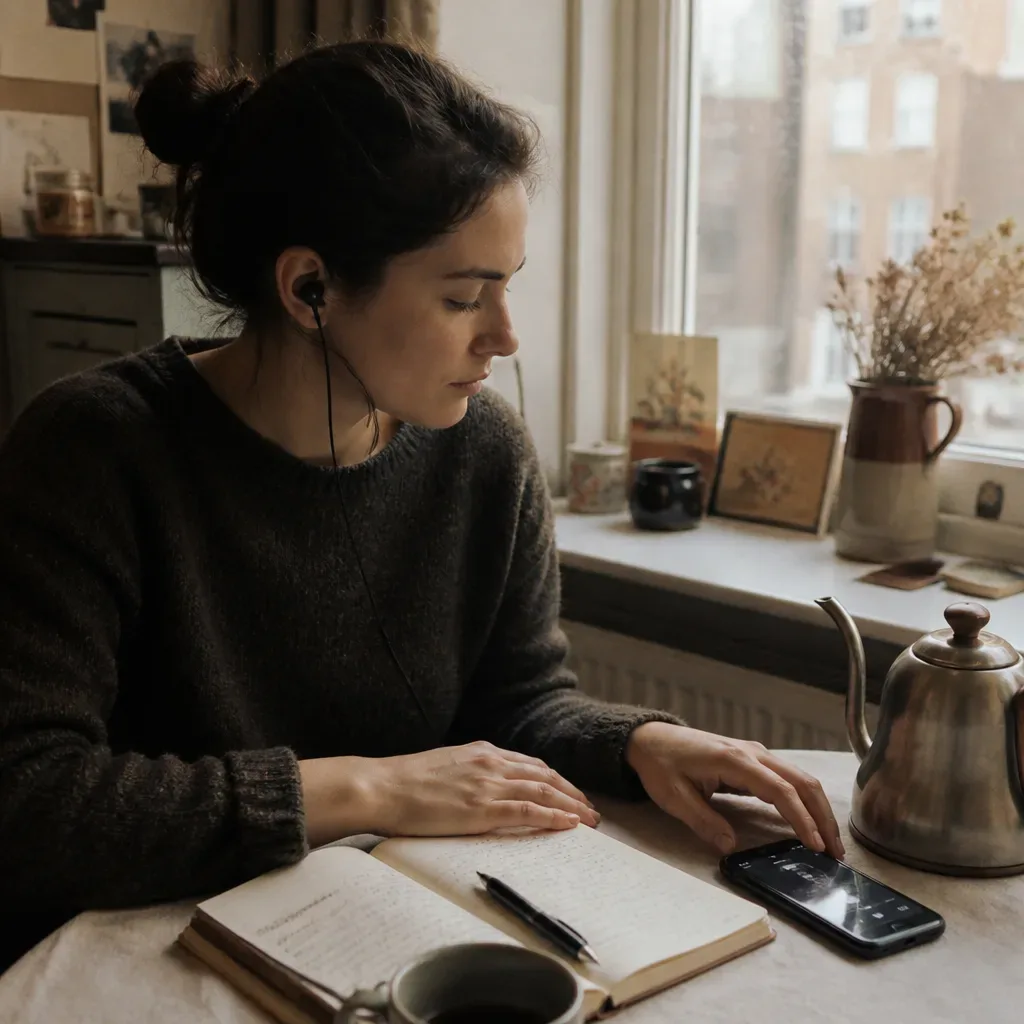
A guided voice can become a handrail. I still have to walk, but I stop inventing the stairs.
When does a self-recording become the better tool?
A self-recording becomes better when the habit is already stable and the sound of your own voice increases belief instead of resistance.
I would not use my own voice as the first test of seriousness. That feels backwards. I would use consistency as the test. If I have listened to guided manifestation audio for 21 mornings, and I am no longer bargaining with the practice, then I might record a 3-minute version in my own voice. Not before. I have ruined too many habits by making them meaningful too early.
There is a useful number from behavior science here. In BJ Fogg’s Tiny Habits model, the behavior needs motivation, ability, and a prompt at the same moment. Ability is often the neglected piece. A self-recording may raise motivation because it feels personal, but it can lower ability if I have to write, record, store, and tolerate the file. The balance decides whether the loop holds.
My own voice worked better for me after I had a script I trusted. I took lines from my Dream-Self Moment, shortened them, and recorded one version without editing. One take only. I kept it at 2 minutes and 40 seconds because anything longer made me start performing. I listened to it for 14 days, not forever, because a test needs edges.
This is the small protocol I used:
- I listened to guided audio for 30 days first.
- I wrote down 5 sentences that still felt true after the 30 days.
- I recorded them once, in the same chair, without fixing my voice.
- I listened for 14 mornings and rated resistance from 1 to 5.
- I kept the version only if resistance stayed at 2 or lower.
The line I kept from that test was simple: I do not need to become someone else to live differently. That sentence sounded plain in my own mouth. Plain was why it worked.
How do belief, emotion, and sound change the result?
Belief grows fastest when the audio is emotionally believable, easy to repeat, and specific enough for the body to recognize.
This is where I think comparison gets too loud online. People ask whether guided audio or a self-recorded voice is more powerful, as if power were a single dial. I have seen, in myself, at least 3 dials: emotional charge, repetition, and specificity. If one is high and the others collapse, the practice does not compound well. A beautiful self-recording that I avoid is weaker than a plain guided audio I finish 26 mornings in a row.
Self-affirmation research helps me stay grounded. Claude Steele introduced self-affirmation theory in 1988, and later reviews, including Cohen and Sherman in 2014, found that affirming valued aspects of the self can reduce defensiveness in some contexts. But the details matter. If a statement feels too distant, it may create argument instead of support. I have felt that argument in my chest.
Sound adds another layer. Audio carries tone, timing, and breath, which text does not. That is why I like using it near lunar dates too, though I keep that gently. My Notion moon calendar is load-bearing, not decorative, and I sometimes pair listening with what I am tracking through astrology and manifestation. The moon does not do my practice for me. It helps me date it.
Here is the practical way I separate the dials:
| Dial | Question I ask | What I measure |
|---|---|---|
| Ease | Can I start in under 30 seconds? | Number of completed listens |
| Emotion | Do I feel softened or defensive? | Resistance score from 1 to 5 |
| Specificity | Can I picture an ordinary scene? | One detail remembered later |
| Continuity | Did I return after missing a day? | Restart time in hours |
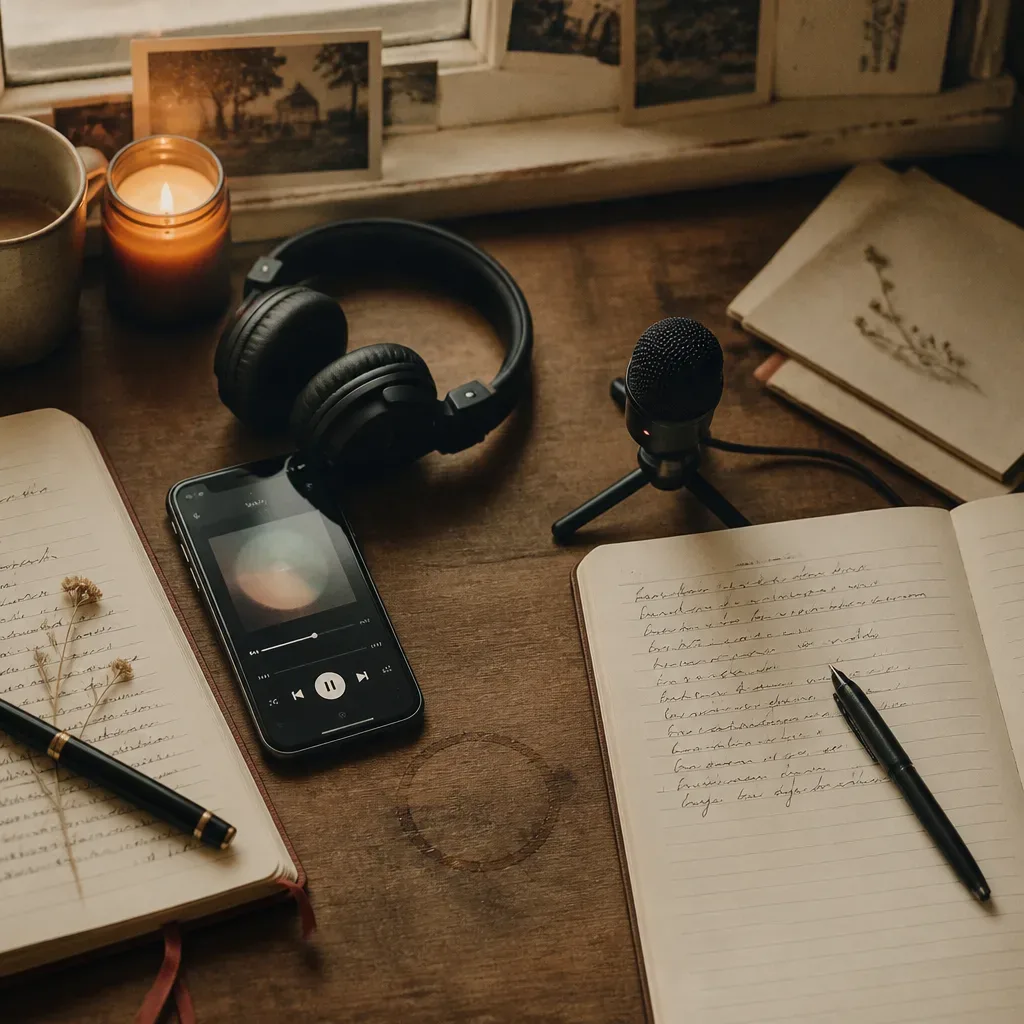
Belief is not a mood I wait for. It is a relationship I build by keeping the appointment.
What should I choose for the next 30 days?
Choose guided manifestation audio for the next 30 days if you want faster compounding, then add your own voice as a controlled experiment.
I am saying 30 days because it is long enough to reveal friction and short enough not to become a personality. Many studies use 4-week interventions because a month can show early adherence patterns, even when deeper change takes longer. Lally’s 66-day median still sits behind this, reminding me that 30 days is not a finish line. It is the first useful sample.
My recommendation is plain. Start with guided audio, especially if you are busy, skeptical, grieving, parenting, commuting, or carrying a week that keeps changing shape. The guided version protects the loop. Once the loop exists, your own voice can personalize it. I would not confuse personalization with superiority. Sometimes the most personal thing is the thing that lets you keep going.
If you want a fair comparison, use this 30-day plan:
- Days 1 to 14: listen to guided manifestation audio at the same daily cue.
- Days 15 to 21: keep listening, and write down any sentence that stays with you.
- Day 22: record a short self-voice version using only the strongest sentences.
- Days 23 to 30: alternate guided audio and your own voice.
- Day 30: choose based on completion rate, not fantasy.
I would track 4 numbers only: listens completed, minutes listened, resistance score, and missed-day recovery. No elaborate dashboard. No perfect graph. The best ritual data is the kind I can keep when my sink is full.
I still read the broader manifestation pillar when I need the larger frame, and I return to the AYA Method when I need the actual practice. That distinction has saved me time. Reading can orient me. Listening changes the morning.
Tuesday now. The kettle is clean, and the headphones are where I can reach them.