morning rituals
No Phone Morning Routine With Dream-Self Audio
A no phone morning routine using 3 minutes of Dream-Self audio, quiet cues, and simple boundaries so your day begins before the scroll.

The phone is on the dresser. The room is not fully bright yet. A no phone morning routine works when it gives your attention one clear place to go first: body, breath, and a 3-minute Dream-Self audio before messages, news, or the scroll can name the day for you.
What makes a no phone morning routine actually work?
A no phone morning routine works when it’s short, visible, and easier than checking the screen.
Most morning advice asks too much. Wake at 5. Journal for 20 minutes. Stretch. Meditate. Read. Make tea slowly. This is fine for a person with a quiet house and no child asking for socks. For the rest of us, the better question is smaller: what can happen before the phone happens?
Pew Research Center reported in 2024 that 90% of U.S. adults own a smartphone. The device is not a rare temptation. It’s furniture now. That’s why a strict anti-phone identity often fails. You don’t need to become someone who never touches the phone. You need a first rule so simple it can survive sleep.
The rule is this: no input before intention. No messages, feeds, news, email, or work chat until you’ve heard your own morning cue. One cue is enough. In this routine, that cue is a 3-minute Dream-Self audio, supported by water, a sentence, and one small action.
Attention is most tender before it has been claimed. The first thing you repeat in the morning becomes a vote for who gets to speak inside your head.
Here’s the shape:
- Put the phone out of reach the night before.
- Wake and touch something physical: floor, glass, window, face.
- Listen to your 3-minute Dream-Self audio.
- Write one true sentence.
- Do one small action before opening the world.
Behavior scientist BJ Fogg writes that tiny habits work best when they’re anchored to an existing cue and made easy enough to do even on a hard day. This routine borrows that wisdom. Waking is the cue. Listening is the action. The reward is quiet. Not performance. Not a perfect life. Just a morning that begins with you.
Why use 3-minute Dream-Self audio before touching the phone?
Three minutes is enough because the point is repetition, not length.
The AYA Method is a daily audio manifestation practice. Each day you listen to a short personalized recording — your Dream-Self Moment — narrated from the version of you who has already manifested the life you intend. Listening is the practice. Repetition is the work. The audio is the method.
This matters in the morning because audio enters differently than text. You don’t have to look down. You don’t have to decide what to read. You don’t have to negotiate with a feed built to keep you there. You listen. The body stays in the room. The screen stays quiet.
Dr. Andrew Huberman has often noted that early-day light, movement, and timing cues help set the body’s clock. The CDC also reports that about 1 in 3 U.S. adults doesn’t get enough sleep. A morning practice should respect that tiredness. It should not punish you for being human. Three minutes asks less and repeats better.
In manifestation language, this is not about forcing belief. It’s rehearsal. Neville Goddard called imagination a way of occupying a state before the outer facts have changed. Joe Dispenza often teaches that mental rehearsal can condition the body toward a remembered future. You can hold those ideas lightly. You don’t need to swallow anyone’s whole system to test one small practice.
A 3-minute audio gives the mind a script before the phone gives it a thousand fragments. The first voice you hear can be yours, not the market’s.
If you want a wider frame for the practice, the Manifestation pillar explains how intention, repetition, and identity work together without turning the morning into theater. The app may also include a daily affirmation and a Manifestation Board, but those are complements. The audio is the method.

How do you set up the night before so the morning is easier?
You set up the morning by making the phone less available and the first cue more visible.
Night is where the routine is won softly. Not with discipline. With placement. Put the phone across the room, in a drawer, or outside the bedroom if your life allows it. If you use it as an alarm, place it far enough away that you have to stand. One Stanford sleep researcher, Dr. William Dement, helped show how regular sleep timing supports alertness; your morning begins long before the alarm.
Remove the bright invitations. Turn off lock-screen previews. Use Do Not Disturb until a chosen time. If possible, set the Dream-Self audio so it can be reached without opening a home screen full of apps. A shortcut helps. A widget helps. Airplane mode helps if you don’t need calls.
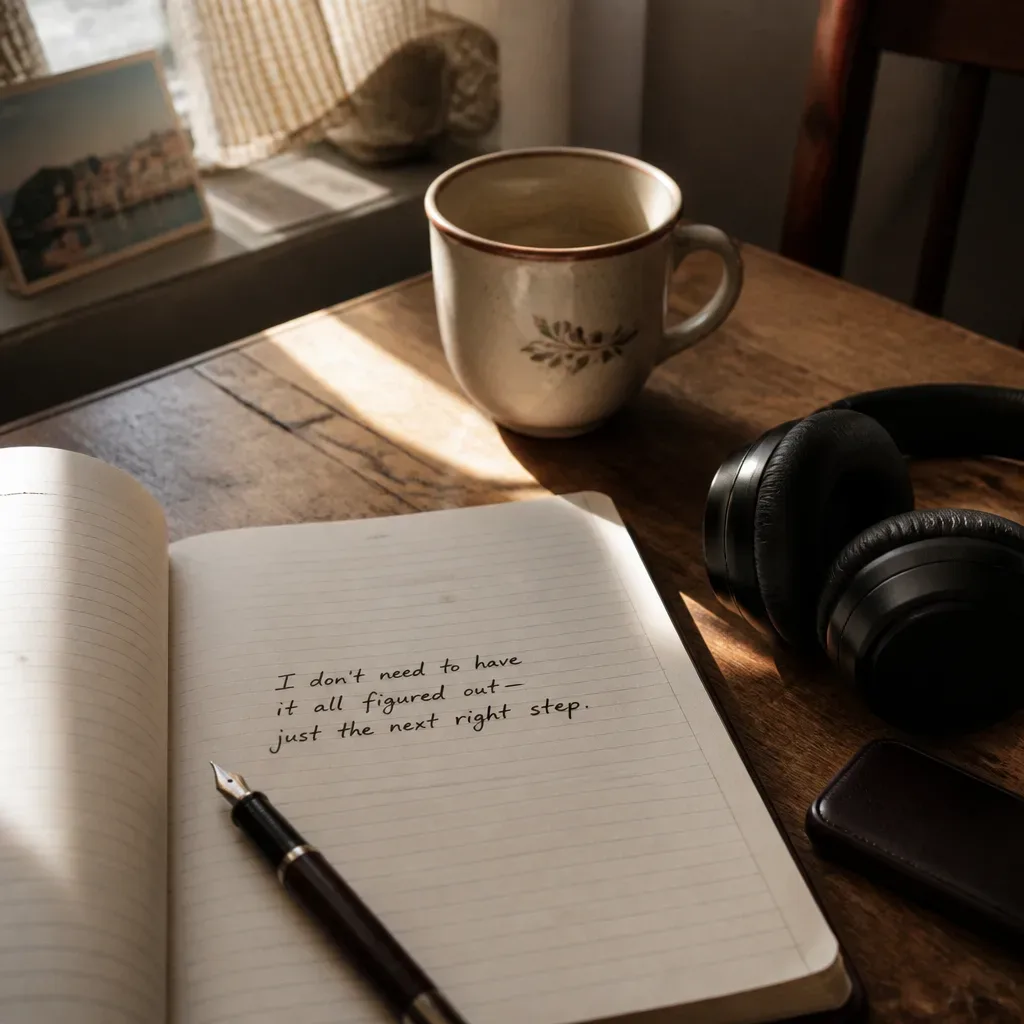
Then place one physical cue beside the bed. A glass of water. A paper card. A pen. A small notebook open to a blank page. Keep it plain. If it looks like a lifestyle photograph, it may start asking for maintenance. You want an object that says: begin here.
| Setup choice | Why it helps | Time needed |
|---|---|---|
| Phone across the room | Adds friction to the reflex | 10 seconds |
| Do Not Disturb on | Keeps other voices out | 20 seconds |
| Water by the bed | Gives the body a first action | 15 seconds |
| Audio shortcut ready | Keeps the phone in tool mode | 1 minute |
| Notebook open | Makes reflection smaller | 10 seconds |
Phillippa Lally’s 2010 study in the European Journal of Social Psychology found that automaticity often took more than 2 months on average, with a range from 18 to 254 days. That range is comforting. It means you don’t need instant ease. You need a setup kind enough to repeat while the habit is still young.
Make the phone slightly farther away than your better self thinks necessary. Morning-you will tell the truth.
What are the exact steps for an 8-minute no phone morning routine?
The routine is eight minutes because it leaves room for slowness without becoming a project.
Start before you sleep. Set the phone where your hand can’t find it without thought. In the morning, don’t bargain. Sit up. Put both feet on the floor. Drink water. This can take 60 seconds. It gives the body a fact: you’re here.
Minute 1 is physical. Minute 2 to 4 is listening. Open only the Dream-Self audio. If you’re using Aya, go straight to the recording. Don’t check the daily affirmation first unless it appears after the listening. Don’t adjust the Manifestation Board. Those can wait. This is important because choice is expensive in the morning. A 2022 review in Nature Reviews Psychology noted that habits reduce the need for active decision-making once cues become stable.
Minute 5 is a sentence. Write one line, not a page. It might be: “I move through today without rushing my own mind.” Or: “I answer what matters before I answer what calls.” The sentence should sound true enough that your body doesn’t reject it.
Minutes 6 to 8 are for one matching action. Choose something ordinary. Open the curtains. Wash your face. Step outside for light. Put on walking shoes. Start the kettle. The action matters because identity needs contact with matter. A sentence in a notebook is lovely. A hand on the curtain is proof.
Try this sequence for 7 mornings:
- Stand before screen. Turn off the alarm, then put the phone back down.
- Drink water. Let the first input be physical.
- Listen once. Play the 3-minute Dream-Self audio without multitasking.
- Write one sentence. Keep it under 15 words if that helps.
- Take one action. Choose the smallest act that matches the person you heard.
In the Journal of Behavioral Medicine, brief self-regulation practices have been associated in small studies with better follow-through when they’re tied to specific cues. The cue here is not grand. It’s waking. The practice is not long. It’s listening.
What should you do instead of scrolling?
Replace scrolling with low-friction actions that return you to the room you’re in.
The scroll works because it’s easy, variable, and socially loaded. You might see a message. You might see a problem. You might see praise. Behavioral researchers have studied variable rewards for decades; B.F. Skinner’s work on reinforcement schedules is old, but the mechanism still explains why unpredictable feeds are hard to leave.
So don’t replace the phone with a moral lecture. Replace it with something easier to start and easier to stop. The first substitute should be sensory. Water. Light. Air. Sound. Paper. The body is slower than the feed, and that’s the gift.
Good substitutes are small:
- Open a window for 30 seconds.
- Drink water before coffee.
- Step into morning light for 2 minutes.
- Write one line in a notebook.
- Touch the floor with your feet and count 5 breaths.
- Listen again if the morning feels sharp.
If your practice includes words, keep them brief. The Affirmations pillar can help if you want language that doesn’t sound fake. An affirmation is most useful when it supports the audio, not when it becomes another task to perfect.
You may also like a visible cue. The Astrology and manifestation guide is useful if timing and symbolic seasons help you remember your practice. Use it gently. A sign, moon phase, or date can be a bell. It doesn’t need to become a verdict.
One quiet replacement done daily is better than ten beautiful rituals done once. The nervous system trusts what returns.
How do you keep the phone from taking over after the audio?
You keep the phone from taking over by deciding the first allowed use before the morning begins.
The danger point is not always waking. Sometimes it’s after the audio, when you feel good and think, just one message. That phrase is a small door. Decide in advance what counts as the first permitted use. Maybe it’s checking transit. Maybe it’s texting one person. Maybe it’s opening the calendar. Name it clearly.
Create a phone re-entry rule. For example: “After water, audio, sentence, and shower, I can check messages for 5 minutes.” A 2019 report from RescueTime, based on app usage data, found people averaged around 3 hours and 15 minutes of phone use daily, with frequent pickups. Even if your number is lower, the pattern is familiar. Boundaries need edges.
Use the phone like a tool with a handle. Open the thing you came for. Close it when it’s done. If you can’t do that yet, remove the most magnetic apps from the home screen. Put social apps in a folder with a boring name. Log out at night. These are not punishments. They’re design choices.
If you want to connect this routine to a broader daily practice, return to the AYA Method page and notice the order: listening first. The Dream-Self Moment is the core. The daily affirmation and Manifestation Board can support it later, especially when you have more time and less sleep in your eyes.
Try a simple re-entry menu:
| If you need the phone for… | Open only… | Stop after… |
|---|---|---|
| Work schedule | Calendar | 2 minutes |
| Family logistics | Messages from starred contacts | 5 minutes |
| Weather | Weather app | 30 seconds |
| Music | One playlist or audio | 1 tap |
| Navigation | Maps | When route is set |
A boundary is kinder when it tells you what yes looks like. Total denial often breaks. A named yes can hold.
What if you fail on the first morning?
If you fail on the first morning, make the next repetition smaller instead of making the promise bigger.
This is where many routines become secretly cruel. You check the phone once, then decide you’re undisciplined, then abandon the whole thing. Don’t do that. The repair is part of the routine. Put the phone down. Listen anyway. Write the sentence anyway. The order may be imperfect, but the return still counts.
James Clear popularized the phrase “never miss twice,” but the deeper idea is older: repeated behavior becomes identity when it survives interruption. Lally’s habit study also found that missing one chance didn’t significantly affect long-term automaticity for many participants. The body learns through return, not through shame.
If the routine keeps failing, reduce it to 3 minutes total for a week. Wake. Play the audio. Done. No notebook. No water rule. No extra meaning. Once that becomes real, add one sentence. Then add one physical action. This is not lowering the standard. It’s making the standard repeatable.
You can also use friction honestly. If you keep scrolling in bed, the phone may need to sleep in another room. If you turn off Do Not Disturb every night, schedule it automatically. If you open email by habit, move the icon. Your environment is not a side note. It’s the quiet architecture of your choices.
For more language around belief and repetition, the Manifestation pillar gives a steadier frame than most loud advice online. Manifestation doesn’t have to mean pretending life is easy. It can mean practicing the inner posture you’ll need for the life you’re building.
Tomorrow’s routine does not need your guilt. It needs a glass of water, a quiet phone, and three minutes of listening.
Put the phone down. Hear the day arrive.