mindset
People Pleasing Manifestation: Listen Before Yes
People pleasing manifestation starts with listening before you answer, so your yes comes from intention rather than fear, guilt, or habit.

Friday. The kettle clicked off before I answered the message. People pleasing manifestation means practicing the life I say I want while interrupting the reflex to please first. I listen before I say yes, because a yes given from panic teaches my days to belong to someone else.
What is people pleasing manifestation, really?
People pleasing manifestation is the gap between the future I name and the automatic yeses that keep me arranged around other people.
I am writing this at the kitchen table with my phone face down. The request was small, technically. A quick review. A quick call. A quick favor. Quick is a dangerous word for me because it hides the setup time, the emotional cost, and the hour I spend afterward feeling borrowed. The Manifestation pillar helped me notice that naming a desire is not separate from how I spend Tuesday afternoon.
The pattern is old enough that I do not need to dramatize it. In psychology, people often describe appeasing under stress as a fawn response, a survival pattern that became popularized in trauma writing by Pete Walker in 2013. It is not a formal DSM diagnosis, but it names something many bodies know. Social pain is also not fake pain. Eisenberger, Lieberman, and Williams reported in Science in 2003 that social exclusion activated parts of the brain associated with distress, including the dorsal anterior cingulate cortex.
That is why a yes can feel safer than honesty. Cialdini wrote about reciprocity in Influence, first published in 1984, and marketers have used that principle for decades. Someone asks warmly. Someone once helped me. Someone sounds disappointed. My hand reaches for yes before my own intention has put on its shoes.
Consent that arrives too fast is often fear wearing good manners. I keep that sentence near my desk because it is not cruel. It is accurate. People pleasing manifestation is not solved by becoming hard. It is practiced by making the pause real enough that my answer can catch up with my life.
Why do I say yes before I know what I want?
I say yes too early because my nervous system treats approval as safety before my values have had time to speak.
This week, I watched it happen in under 12 seconds. A teammate asked if I could take one more ticket before a release. My shoulders rose. My mouth started forming yes. The body often answers first; Joseph LeDoux has written for decades about fast threat pathways in the brain, and although workplace requests are not predators, the speed feels familiar. By the time the thinking mind arrives, I may already be performing kindness.
The problem is not kindness. I want to be generous. I want to help my mother with forms, my friends with edits, my team with ugly bugs. The problem is the absence of consent inside the help. Gallup’s 2024 Global Emotions report found that 41 percent of adults said they experienced worry during a lot of the previous day. In a worried body, approval can feel like oxygen.
I made a small table in my notes app. It looked plain, which helped.
| Signal | Old interpretation | New question |
|---|---|---|
| Tight chest | I must help right now | What am I afraid will happen if I pause? |
| Fast yes | I am being good | Did I hear my own answer yet? |
| Resentment later | They asked too much | Where did I abandon my capacity? |
| Relief after delaying | I am selfish | Did the pause give me truth? |
Neville Goddard wrote often about assuming the feeling of the wish fulfilled, and I take that carefully, not as denial, but as rehearsal. If the version of me I am practicing is steady, she probably does not answer every request from a spike of cortisol. Dr. Andrew Huberman has often explained that deliberate breathing can shift autonomic state within minutes, especially through extended exhales. I use one breath because sometimes one breath is the only tool I will actually use.
The pause is not a delay; it is a boundary with a heartbeat.
How do I listen before I say yes?
I listen before I say yes by making the audio the first voice I hear, then letting one sentence slow the request down.
I use the AYA Method as my daily audio manifestation practice. Each day I listen to a short personalized recording, my Dream-Self Moment, narrated from the version of me who has already manifested the life I intend. Listening is the practice. Repetition is the work. The audio is the method. I listened this morning before brushing my teeth. That is the order I do them in.
Here is the small protocol I kept on an index card for 21 days. Twenty-one is not magic; it is just three weeks, and three weeks is long enough for me to see patterns in a spreadsheet without pretending I have become a new person.
- I listen to the Dream-Self Moment before messages when possible.
- I write the request in one plain sentence.
- I ask, What would this cost in time, attention, and recovery?
- I take one slow exhale before replying.
- I use a delay sentence if I feel rushed.
- I answer after the body is less desperate to be liked.
Gollwitzer and Sheeran’s 2006 meta-analysis of implementation intentions reviewed 94 studies and found a medium-to-large effect on goal attainment, commonly reported around d = .65. That matters to me because vague courage has not been reliable. If-then scripts are kinder. If someone asks while I am pressured, then I say, I need to check my day before I answer.
Some mornings I also write one daily affirmation after the audio. Today it was: I can be warm and still be unavailable. I keep it believable because Wood, Perunovic, and Lee found in 2009 that positive self-statements may make some people with low self-esteem feel worse. The Affirmations pillar says this better than my sticky note: words work best when they are honest enough to enter the body.
A yes becomes cleaner when it has survived one honest breath.

What should I listen for in the moment before answering?
I listen for the difference between willingness, fear, duty, and the old ache to be chosen.
The body gives data, not commandments. My work in healthcare software taught me that a metric can be useful and incomplete at the same time. A racing heart does not always mean no. Sometimes it means the request matters. Sometimes it means I drank coffee too fast. Still, after 30 logged requests, the pattern was visible. The yeses followed by resentment had usually come with jaw tension and a feeling of time collapsing.
I use four checks because more than four becomes theater.
- Capacity: Do I have the time, or am I stealing it from sleep, food, or the work I already named?
- Desire: Is there any real yes here, even a quiet one?
- Fear: Am I answering to avoid disappointment, silence, or a changed tone?
- Pattern: Have I said yes to this person three times in a row while saying no to myself?
The American Psychological Association’s 2023 Stress in America report noted that 27 percent of adults said stress kept them from functioning on most days. I think about that when I treat capacity as optional. A calendar is not only a productivity object. It is a record of the nervous system’s agreements.
This is where Astrology and manifestation sometimes enters my week, quietly. I do not use a transit to outsource my answer. I use timing practices the way I use weather: as context, not command. If I am already tender, I do not need a cosmic excuse to be careful with my yes.
What I listen for is not a grand signal. It is often small. My hands stop gripping the mug. My breath lowers. The sentence becomes simple. I can do Thursday, not today. Or, I cannot take this on. The cleaner answer usually has fewer decorations.
How do I say no without making it a performance?
I say no by giving a true sentence, a kind tone, and fewer explanations than my fear wants to provide.
This was the hardest part for me. My first noes arrived with footnotes, apologies, weather reports, and emotional receipts from 2009. I wanted the other person to approve of my boundary, which meant I had not quite made one. Brené Brown has often defined boundaries as what is okay and what is not okay; the simplicity of that definition irritates me because it leaves me nowhere to hide.
I keep a short list in my notes. I copied it here before I forget.
- I cannot take that on this week.
- I am not available for that, but I hope it goes well.
- I can do 20 minutes, not the full project.
- I need to say no so I can keep what I already committed to.
- I will not be able to help this time.
Boundary scripts work because decision fatigue is real, even if some older ego-depletion claims have been debated. A 2016 multi-lab replication raised questions about the size and reliability of the classic ego-depletion effect, which made me more careful with the term. Still, anyone who has answered requests after 6 p.m. knows that tired choices get sloppy. Prepared language is not a hack. It is mercy.
I also watch for the repair impulse. If someone says, Oh, okay, and their tone changes, I want to fill the silence with a smaller yes. That is the old contract. Social baseline theory, developed by James Coan and colleagues, argues that humans regulate emotion partly through expected social closeness. Of course disconnection stings. But a sting is not an instruction.
The clean no is shorter than the frightened no. It does not audition for innocence. It lets the other person have their feeling without handing them the steering wheel.
How do I track people pleasing without turning it into self-criticism?
I track the pattern with a few kind data points, because numbers can reveal a loop without becoming a weapon.
My tracker has five columns: date, request, first body signal, answer, feeling three hours later. That is all. I tried adding sleep, cycle day, workload, and moon phase, and then I became unbearable to myself. The useful version took under 90 seconds. Lally and colleagues found in the European Journal of Social Psychology in 2010 that habit formation took an average of 66 days, with a range from 18 to 254 days. I keep that range visible so I do not mistake slow learning for failure.
Numbers can notice a pattern, but they cannot scold me into freedom. After 42 entries, my cleanest yeses had two things in common: I had listened in the morning, and I had used a delay sentence before answering. My worst entries clustered after late deploys. This is not universal truth. It is one stressed engineer, one small sample, one kitchen table. But a humble dataset can still save a morning.
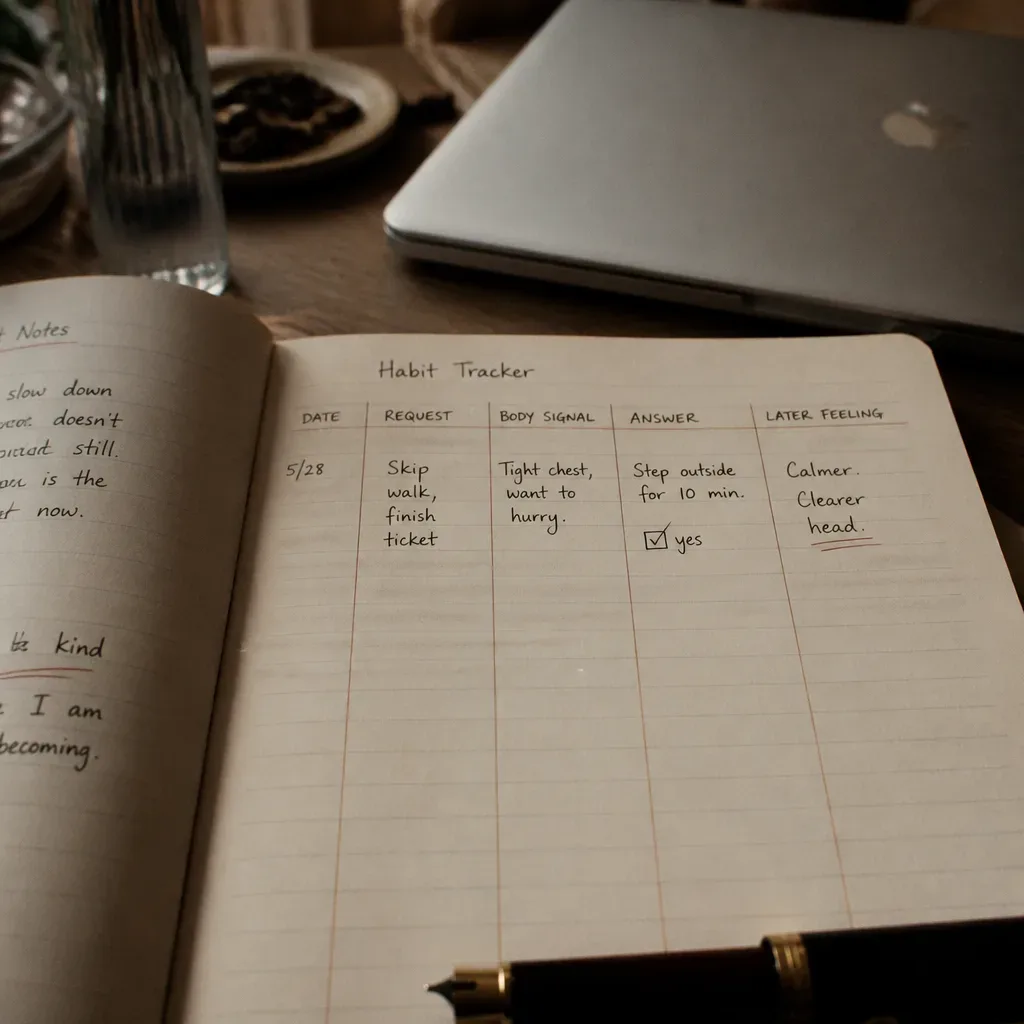
I compare this practice with people who start from general manifestation principles, because the danger for me is staying abstract. I can write the desired life beautifully and still give away the afternoon. Tracking makes the contradiction visible without making it a moral failure.
I also mark one boolean each night: Did I speak to myself decently today? Yes or no. It sounds too simple. It has become the most honest field in the system. On the days I say no kindly to someone else, that field is more likely to be yes. On the days I betray my capacity and call it love, it is usually no.
What if manifestation starts feeling like one more obligation?
I make the practice smaller, because pressure is not proof that the practice is working.
There are mornings when I do not want to listen. I want coffee, silence, and the old pleasure of being needed. On those days I do not turn the AYA Method into a test of worth. I listen while the kettle comes on. If I cannot listen then, I listen on the bus. The audio is short enough to return to without ceremony.
This matters because perfectionism often wears the same coat as people pleasing. The requirement becomes another audience. The future self becomes another person I am trying not to disappoint. Kristin Neff’s work on self-compassion, including research published in 2003, links self-compassion with lower anxiety and depression markers. I take that seriously. A practice that makes me crueler to myself is giving me bad data.
I keep the Manifestation Board as a small visual reminder, not as a second job. I glance at it after the audio sometimes. I move nothing if I am tired. The board and the affirmation are complements. The listening is the method. The repetition is where my body learns that I can be loved without being endlessly available.
If I miss a day, I do not restart the person. I return to the chair. I press play. I answer the next request a little less automatically than the last one.
Friday evening. One message still unanswered, and my hands are quiet.