love manifestation
Secure Attachment Affirmations With Future-Self Audio
Secure attachment affirmations can steady dating anxiety when paired with future-self audio. Learn a 15-minute daily practice for safer love patterns.

November 6th. I made coffee before the sun was properly up, then listened in the kitchen with one hand on the counter. Secure attachment affirmations work best when they become repeated audio cues for safer behavior, not pretty sentences you write once and abandon when someone takes four hours to text back.
What are secure attachment affirmations actually practicing?
Secure attachment affirmations are short statements that rehearse how safety speaks, waits, asks, and receives.
I used to think an affirmation had to be a sentence I believed completely. That made the whole thing brittle. If I wrote, I am perfectly safe in love, my body argued within 3 seconds. Attachment research has never described human bonding as a slogan problem. Mary Ainsworth’s Strange Situation studies in the 1970s observed how infants used a caregiver as a secure base, and later adult attachment research by Hazan and Shaver in 1987 found similar patterns in romantic relationships across hundreds of participants.
So I stopped writing sentences that sounded like a poster. I began writing sentences that sounded like practice. A secure sentence does not need to be grand. It needs to be usable at 9:42 p.m., when the message bubble has not appeared and my thumb wants to reopen the thread for the 12th time.
The sentence that works is the one that changes the next small action.
For me, secure attachment affirmations fall into 4 plain categories:
- Receiving: I can let care arrive without testing it.
- Asking: I can ask directly instead of making someone guess.
- Waiting: A pause is not proof of abandonment.
- Self-return: I can come back to my body before I reach for the phone.
If you are new to this, the Affirmations pillar is useful because it keeps the practice grounded in repetition and wording, not fantasy. I keep the wording narrow. One sentence. One behavior. One place in the day where I can hear it again. In a 2016 Social Cognitive and Affective Neuroscience paper, Cascio and colleagues found that self-affirmation activated brain regions linked with self-related processing and valuation. I do not treat that as magic. I treat it as a clue that repeated self-relevant language can matter.
Why does future-self audio help more than writing the words once?
Future-self audio helps because attachment patterns live in timing, tone, and repetition, not only in language.
I still write things down. I like the page. I like a black pen. But the page cannot speak back to me while I am brushing my teeth, and it cannot lend me a steadier voice when my own voice has gone thin. That is why I use the AYA Method: The AYA Method is a daily audio manifestation practice. Each day you listen to a short personalized recording, your Dream-Self Moment, narrated from the version of you who has already manifested the life you intend. Listening is the practice. Repetition is the work. The audio is the method.
I listened this morning before opening my messages. That order matters. Dr. Andrew Huberman often describes the nervous system as highly state-dependent, and while a podcast is not a clinical protocol, the practical point tracks with habit research: the cue before the behavior matters. A 2009 study by Phillippa Lally and colleagues in the European Journal of Social Psychology found that habit formation took an average of 66 days, with wide variation from 18 to 254 days.
Future-self audio gives the affirmation a social shape. I hear the secure version of me say, I do not chase closeness by abandoning myself. I hear the pacing. I hear the ordinary calm. It is not a command. It is a reference recording.
I think of future-self audio as rehearsal with a witness, even when I am alone.
There is also a friction issue. During my two years reviewing wellness apps, the practices that failed usually required a better morning than real mornings provide. Audio survives worse mornings. I can listen while the kettle heats. I can listen on the bus. I can listen when the page feels like too much. If you want the broader frame for this kind of practice, the Manifestation pillar explains why repetition and identity cues sit at the center.
How do I write secure attachment affirmations that my body does not reject?
Write secure attachment affirmations as believable behavior cues, not as declarations your nervous system cannot yet trust.
I start with the moment, not the sentence. Tuesday night, the moment was simple: someone I like sent a shorter reply than usual. My old pattern wanted to read the whole relationship from 7 words. Adult attachment researchers Mikulincer and Shaver have written for decades about hyperactivating strategies in anxious attachment, where the system amplifies threat signals to regain closeness. Naming that helped me feel less ridiculous and more responsible.
Here is the 15-minute writing process I use before recording audio:
- Name the trigger in one line. When a reply feels colder, I start scanning for loss.
- Name the old move. I reread, perform, check, or withdraw.
- Name the secure move. I pause, breathe, ask clearly, or wait.
- Write one affirmation that points to the secure move. I can wait without making a story.
- Make it present tense and physical. My feet are on the floor while I let this be unknown.
The more physical the line is, the less it floats away. In small mindfulness studies, even 8 weeks of repeated attention training has been associated with improved emotion regulation, though results vary by design and sample size. I do not need a perfect citation to know this part from my own kitchen: a sentence with hands, feet, breath, and timing works better than a sentence made of clouds.
A good secure affirmation does not flatter you. It gives you something to do.
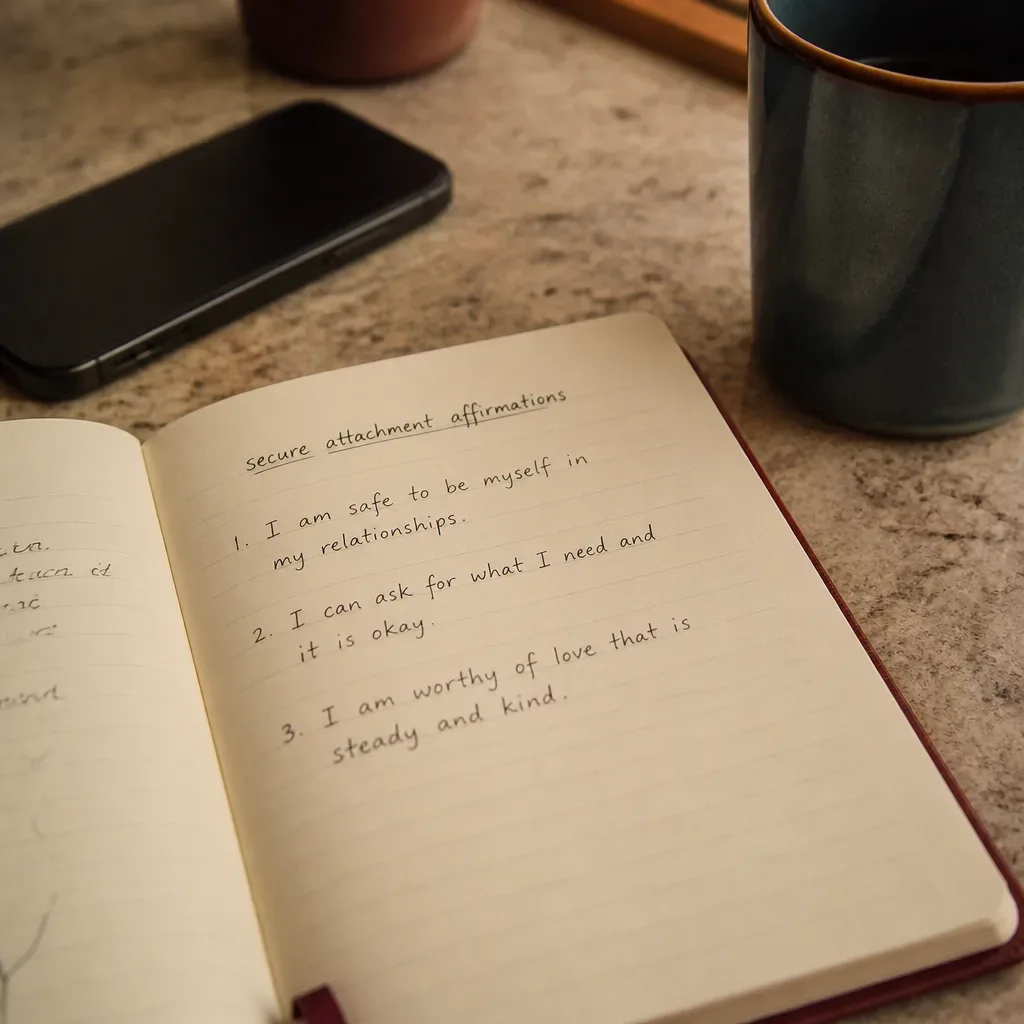
I keep 3 lines at a time. More than that turns into decoration. My current 3 are these: I can ask without apology. I can wait without punishment. I can receive care without testing it. If astrology is part of how you time reflection, I would still keep the words practical; Astrology and manifestation can be a calendar, but the sentence still has to meet you in behavior.
How do I turn the affirmations into a future-self audio practice?
Turn the affirmations into future-self audio by writing a short scene where secure-you narrates one ordinary day with safer responses already in place.
I keep the script under 250 words. That is usually 2 to 3 minutes when spoken slowly. Longer recordings sound impressive and fail the Tuesday test. I want something I can finish before the coffee cools. In behavior design, BJ Fogg’s Tiny Habits model emphasizes making the action small enough to repeat; the point is not intensity, it is reliability.
My script has 5 parts:
| Script part | What I write | Example |
|---|---|---|
| Present setting | A real daily place | I am in the kitchen, holding the blue mug. |
| Future-self identity | Who I am practicing being | I am someone who lets love be steady. |
| Secure behavior | The next visible action | I ask clearly when I need clarity. |
| Body cue | A physical anchor | My jaw softens before I answer. |
| Closing line | A sentence I can carry | I do not have to earn what is freely given. |
I record it in my own voice when I want plainness. I use my Dream-Self Moment inside the AYA app when I want the future-self frame held for me. The audio is not background noise. I sit for it. I let it land. The daily affirmation in the app is a complement for me, like one line copied on the page after listening. It is not the main practice.
The best recording sounds like you on a day you can trust yourself.
If your attachment pattern is avoidant, the script may need different words. Instead of I can wait, it might be I can stay present for 30 more seconds. If your pattern is anxious, use words that reduce protest behavior. If your pattern is disorganized, I would keep the audio especially gentle and consider working with a trauma-informed therapist. The National Institute of Mental Health estimates that about 6 percent of U.S. adults experience PTSD at some point, and attachment work can touch old fear.
What should I listen for during the daily practice?
Listen for the one sentence that makes your next relationship behavior 5 percent safer.
I use a fixed cue. Coffee first, then audio, then messages. On bath nights, I listen there instead. The cue matters more than the mood. Lally’s 2009 habit study is overquoted, but the useful number remains this: automaticity rose through repetition in a stable context. I cannot control whether I feel secure at 7 a.m. I can control whether the headphones go on.
This is the exact daily sequence I use:
- Sit or stand somewhere ordinary.
- Play the future-self audio once without multitasking.
- Put one hand somewhere physical, chest, wrist, counter, or knee.
- Repeat one secure attachment affirmation out loud.
- Write one observable behavior for the day.
Observable matters. I do not write, be better at love. I write, wait 20 minutes before sending the second text, or ask the question directly by 6 p.m. In clinical psychology, measurement changes attention. Even simple self-monitoring has been shown across behavior-change studies to improve follow-through, especially when the behavior is specific.
Some mornings I feel nothing. I have stopped making that a problem. The practice is allowed to be quiet. In love manifestation, there is a temptation to treat every feeling as a sign. I am more interested in whether I was kinder and clearer by lunch.
Feeling safe is lovely. Acting safely is the practice.
I also keep the Manifestation Board out of this unless an image genuinely helps. A photo of two coffee cups can be sweet. It cannot replace the moment I choose not to punish someone for being busy. Audio first. Behavior next. The board can sit quietly in the corner.
What do I do when anxiety spikes between listening sessions?
When anxiety spikes, use one secure sentence as an interrupt, then choose one action that does not make the wound larger.
This is where I used to fail. Morning practice was tidy. Afternoon attachment was not. A delayed reply could still pull me into checking, editing, imagining, and rehearsing. I needed a bridge between the audio and the spike. Researchers often describe attachment activation as a proximity-seeking system, and that phrase helped me because it made the urge less mysterious. My body was trying to get close. It was just using poor tools.
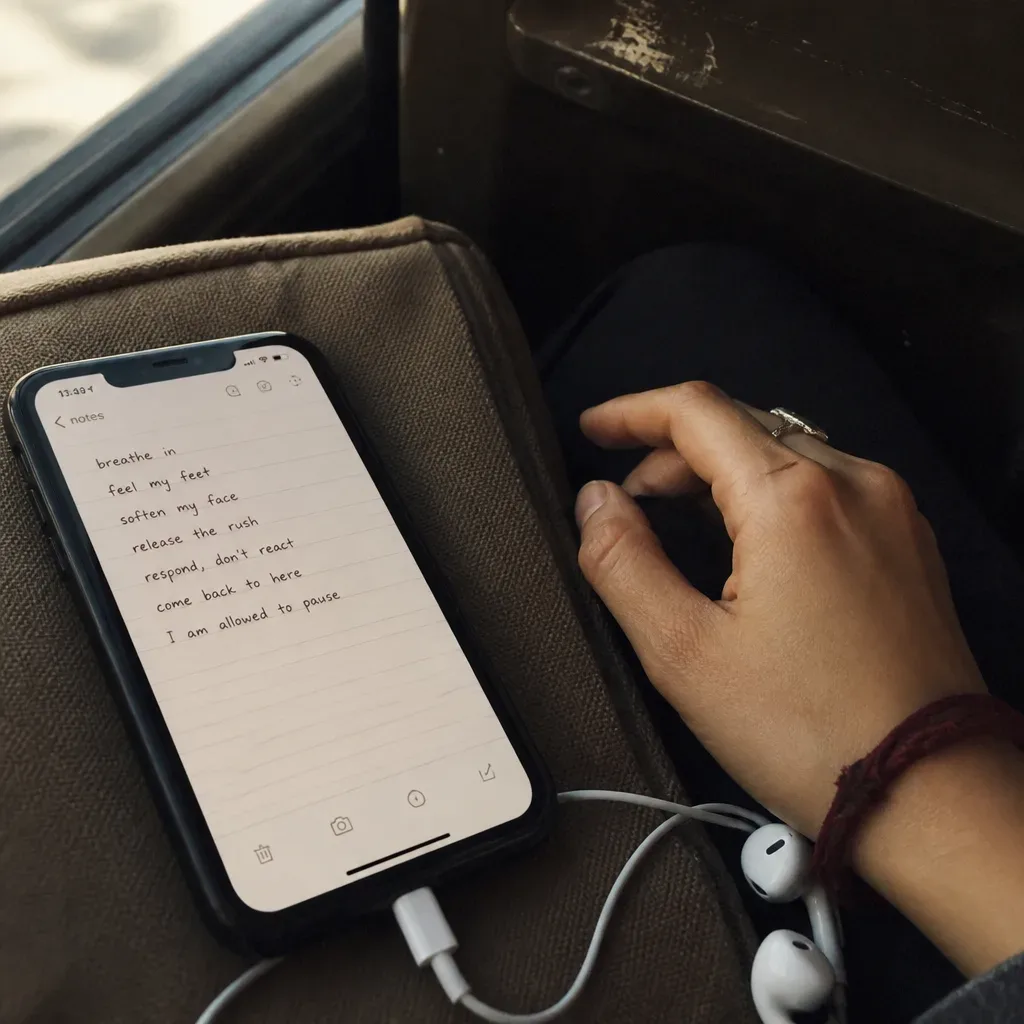
I made a small emergency card in my notes app. It has 4 lines:
- This is activation, not prophecy.
- I can want closeness and still move slowly.
- I will not audition for care.
- The next secure action is enough.
Then I choose from 3 actions. I set a 10-minute timer. I drink water. I write the direct request but do not send it until I have read it once with my feet on the floor. Ten minutes is not a sacred number. It is just long enough for the first wave to change shape. Many emotion-regulation protocols use brief pauses because affect shifts over minutes, not only through insight.
The future-self audio helps here because I have already heard the calmer version of me. I am not inventing her from scratch while flooded. I am returning to a sound I practiced this morning. If you also use written affirmations, keep them short enough to remember without opening a folder. The secure attachment affirmations that help under stress are usually 7 to 12 words, not a paragraph.
The spike is not the failure. The old automatic move is the place where practice begins.
How do I know whether secure attachment affirmations are working?
You know the practice is working when your recovery gets faster, your requests get clearer, and your checking loops lose time.
I do not measure this by whether someone chooses me. That is too much power to give another person’s nervous system. I measure what changes in mine. In a 2015 Pew Research Center report, 97 percent of smartphone owners used text messaging at least once during the study period, which means modern attachment gets plenty of tiny triggers. Read receipts, typing bubbles, and silence are now part of the lab.
Here is the scorecard I use once a week, usually Sunday night:
| Signal | Week 1 question | Week 4 question |
|---|---|---|
| Checking | How many times did I reopen the thread? | Did the loop shorten by even 10 percent? |
| Asking | Did I hint or ask? | Did I ask in one clean sentence? |
| Waiting | Did I punish the pause? | Could I let uncertainty exist for 20 minutes? |
| Receiving | Did I test care? | Did I say thank you and let it land? |
| Repair | Did I disappear after conflict? | Did I return with one honest line? |
I want boring evidence. Fewer screenshots sent to friends. Fewer drafts. Less reading tone from punctuation. More direct questions. One friend told me last month that I sounded less like I was building a legal case against being left. I wrote that down because it was data.
If nothing changes after 30 days, I revise the system before blaming myself. Maybe the audio is too long. Maybe the affirmation is not believable. Maybe the relationship is actually unsafe. Secure attachment practice should not train you to tolerate crumbs. The Journal of Behavioral Medicine has published many behavior-change studies showing that adherence drops when practices are too demanding; design failure is not a character flaw.
What should I avoid while doing this practice?
Avoid using secure attachment affirmations to deny needs, excuse poor treatment, or perform calm while your body is asking for truth.
I have done all 3. I once used I am secure as a way to avoid saying I was hurt. That is not secure. That is costume calm. Secure attachment includes protest when something matters, but the protest can be clean. John Bowlby’s attachment theory was never about becoming low-need. It was about the human need for a safe base.
These are the red flags I watch for:
- I use affirmations to stop myself from asking reasonable questions.
- I call myself anxious when the other person is inconsistent.
- I keep listening but avoid changing any behavior.
- I confuse silence with maturity.
- I make the practice so long that I skip it by day 6.
The safest practice is honest enough to disappoint you sometimes. It may show you that the issue is not your attachment pattern alone. It may show you that you need clearer boundaries, steadier friends, therapy, or a partner who does not make basic care feel like a negotiation. In attachment research, security is relational as well as internal. A nervous system can learn, but it also responds to the room it is in.
I keep returning to one line: I can be warm without abandoning the evidence.
For the next 30 days, I would keep it painfully simple. One audio. Three secure attachment affirmations. One daily cue. One weekly scorecard. If you want to pair the practice with broader timing or intention-setting, keep it secondary. The audio is the method. The rest are small supports around it.
Friday night now. The cup is empty, and I have not checked the thread again.