audio manifestation
Shower Meditation With Future-Self Audio
A quiet shower meditation for manifestation using future-self audio, breath, water cues, and one small next action after you dry off.

Steam gathers on the mirror. A shower meditation works when you pair running water with future-self audio, then leave with one small next action. You do not need a longer morning. You need a safe speaker, ten quiet minutes, a clear sentence, and repetition that your body can remember.
Why can a shower meditation help manifestation feel more real?
A shower meditation helps because it attaches a future-self script to a body cue you already repeat.
The shower is ordinary. That is its strength. You are already there most days, already undressing, already reaching for water, already moving through the same small order. Habit researchers call this a stable context. In a 2009 study in the European Journal of Social Psychology, Phillippa Lally and colleagues found that a new behavior took a median of 66 days to feel automatic, with a wide range from 18 to 254 days. A cue you already keep is a kind place to begin.
Manifestation can become too large when it stays in the head. A shower makes it physical. Warm water touches the skin. Breath slows because there is nowhere to go for a few minutes. The sound covers the house. In a 2014 JAMA Internal Medicine review, Madhav Goyal and colleagues looked at 47 meditation trials with 3,515 participants and found moderate evidence that mindfulness programs can reduce anxiety, depression, and pain. You do not have to claim more than that. Attention changes the way a moment is held.
For manifestation, the added layer is identity. You are not only calming down. You are rehearsing the way your future self speaks, chooses, and returns. Manifestation is not a demand placed on life. It is a daily pattern of attention, belief, and behavior pointed at what you are becoming.
A practice becomes real when it can survive an ordinary Tuesday.
That is why the shower matters. It is not glamorous. It is repeatable. The U.S. EPA WaterSense program has reported that the average American shower lasts about 8 minutes and uses roughly 17 gallons of water. You can fit a full practice inside the time you already spend standing there.
What do you need before you turn on the water?
You need a safe audio setup, one clear intention, and a tiny action waiting on the other side.
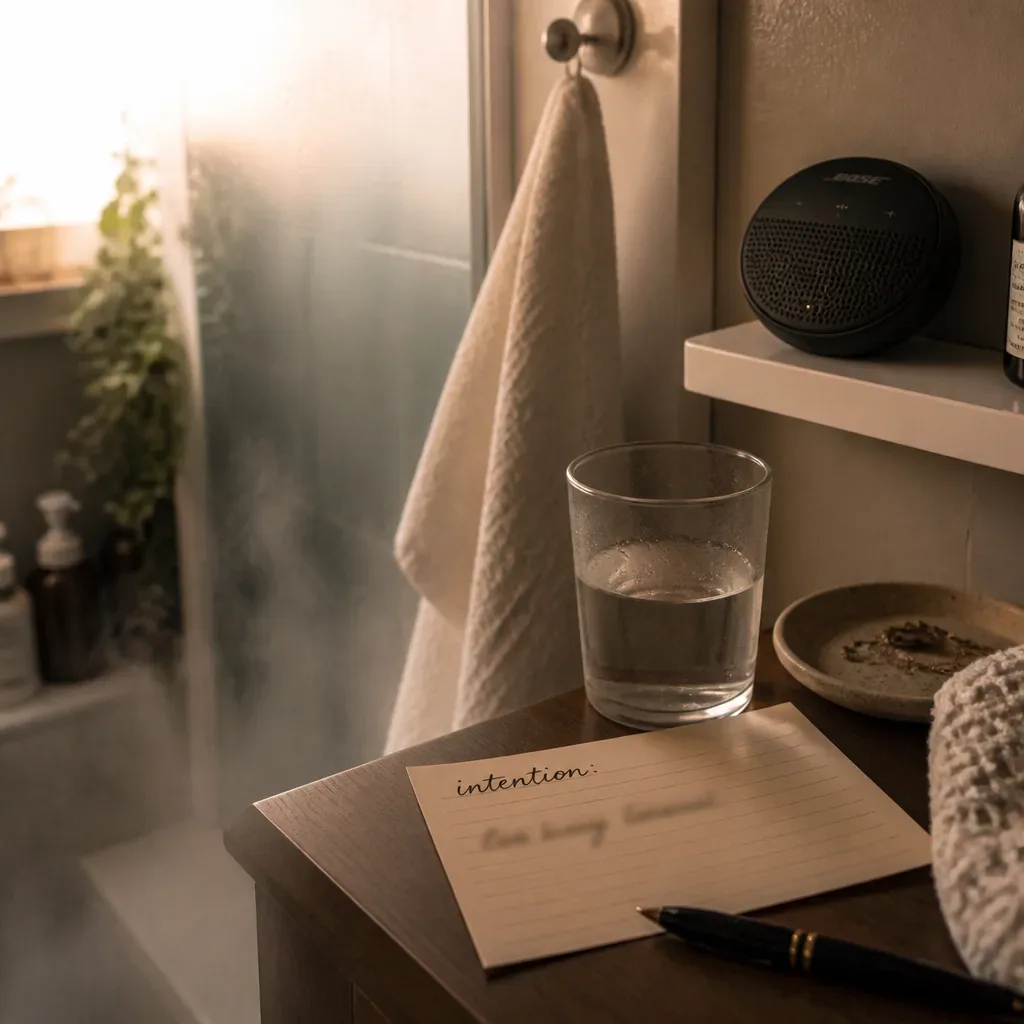
Start with safety. Do not hold your phone under running water. Place it on a dry shelf outside the shower, or use a waterproof speaker kept away from direct spray. Keep the volume soft. Your nervous system should not have to fight the sound. If your bathroom fan is loud, listen once before stepping in, then use one remembered line during the shower.
Choose your audio before you undress. Decision-making costs attention. Research on habits often points back to friction: the more steps between you and the behavior, the less likely you are to do it. B.J. Fogg’s Tiny Habits model, published in 2019, is simple here: put the new behavior after something you already do. After I turn on the shower, I press play. That is enough.
This is where the AYA Method comes in, quietly. The AYA Method is a daily audio manifestation practice. Each day you listen to a short personalized recording — your Dream-Self Moment — narrated from the version of you who has already manifested the life you intend. Listening is the practice. Repetition is the work. The audio is the method.
Keep the intention plain. Not ten goals. Not a speech. One sentence you can remember when shampoo is in your eyes. For example: “I speak to myself like someone I am staying with.” Or: “I choose the next honest step before I check my phone.” A good sentence has a behavior inside it.
Here is a simple setup table:
| Need | Quiet choice | Why it helps |
|---|---|---|
| Audio | Dream-Self Moment or short future-self recording | Gives the mind one voice to follow |
| Device | Phone outside the shower or safe waterproof speaker | Keeps the practice calm and safe |
| Intention | One sentence under 12 words | Makes recall easier |
| After-shower action | One task under 2 minutes | Turns listening into evidence |
How do you do a 10-minute shower meditation step by step?
You do it by giving each part of the shower one job: arrive, listen, rinse, and act.
Use the same order for at least 7 days. Repetition lowers negotiation. A 2020 review in Health Psychology Review found that habit formation is strongly supported by consistent context and repeated action, not by intensity alone. Ten minutes is not sacred. It is just long enough to let the body know this is not a stray thought.
- Before water: name the sentence. Stand still for one breath. Say the intention once, out loud if you can. Specific is kinder than grand.
- First minute: feel the water. Notice temperature, pressure, feet, hands. This is not decorative. It brings you back to now.
- Minutes 2 to 7: listen to the future-self audio. Let the Dream-Self Moment play. You do not have to force belief. Your job is to hear it.
- Minutes 7 to 9: wash with one repeated line. Choose the line that felt most true. Repeat it while rinsing.
- Final minute: choose the next action. Before turning off the water, decide the first small act you will take after drying off.
There is no bonus point for feeling emotional. Some days the words will land. Some days they will not. In both cases, you listened. In behavior design, the minimum viable version matters because it keeps the chain alive. A 2012 paper by Wendy Wood and David Neal in Journal of Consumer Psychology described habits as cue-response patterns shaped by repetition in stable contexts. The shower is the cue. The audio is the response.
If ten minutes feels long, use three. One minute to arrive. One minute to listen. One minute to choose. The smaller version is not failure. It is how the practice stays yours when life is crowded.
The body learns from what you repeat, not from what you meant to do once.
What should you listen for in future-self audio?
Listen for the sentence that makes your next behavior easier to choose.
Future-self audio is not background noise. It is a script for identity. You are hearing a version of yourself speak from the result as if it is already known. That structure matters. Mental rehearsal has been studied in performance psychology for decades. A 1994 meta-analysis by Driskell, Copper, and Moran reviewed 35 studies and found that mental practice improved performance, especially when paired with physical practice. The shower gives you the rehearsal. The action after gives you the physical part.
Do not chase the most dramatic line. Listen for the most usable line. If the audio says, “You answer the message with steadiness,” and you have been avoiding a message for 3 days, that is the line. If it says, “You rest before you resent,” and your calendar is packed, that is the line. Manifestation becomes less vague when it points to a behavior you can do before breakfast.
The app also includes a daily affirmation and a Manifestation Board, but they are complements. The audio is the method. If you use affirmations, let them support the line you heard rather than compete with it. One voice. One sentence. One next move.
A good future-self line usually has three traits:
- It sounds like you, not a poster.
- It names a behavior, not only a mood.
- It can be practiced in less than 2 minutes.
- It feels steady even if you do not fully believe it yet.
This is the quiet test: after the shower, what would someone who believed this do first? Open the document. Drink water before coffee. Put the card in the bag. Send the kind message. Close the app. The action can be small enough that nobody notices. You will know.
How do you keep the practice grounded instead of drifting into fantasy?
You keep it grounded by pairing every imagined future with one observable behavior today.
This is where manifestation either becomes useful or starts to float away. A future-self recording can soften fear, but it should not remove responsibility. Dr. Andrew Huberman has often discussed mental rehearsal as most useful when it is paired with action and nervous system regulation, not when it replaces effort. The same idea appears across cognitive-behavioral work: thoughts matter, and behavior gives them weight.
Use water as a boundary. While the water runs, you listen. When the water stops, you act. That simple edge keeps the practice from becoming endless thinking. The World Health Organization has reported that anxiety disorders affect hundreds of millions of people worldwide, with 301 million people estimated in 2019. For many readers, a practice that asks for more mental effort is not kind. A grounded shower meditation gives the mind fewer rooms to wander.
If you work with timing, make it visible. Set a 10-minute audio length, or choose a 5-minute version on rushed days. If you are concerned about water use, turn the water off during shaving or hair treatment and keep listening outside the stream. The practice does not require waste. It requires attention.
Use this after-shower rule:
| If the audio says | Then your action might be |
|---|---|
| ”You keep promises to your body” | Fill a glass of water |
| ”You tell the truth sooner” | Write the first sentence of the message |
| ”You are ready for the work” | Open the file for 2 minutes |
| ”You make room for love” | Put the phone down during breakfast |
| ”You trust your timing” | Check today’s calendar once, then stop |
You can also hold your practice beside other symbolic systems without letting them run the day. If you like astrology and manifestation, use it as a reflection prompt, not a permission slip. The shower still asks the same thing: what are you doing next?

What if your mind wanders or you do not believe the audio yet?
You return to the sound of water and let belief grow through repetition.
A wandering mind is not a broken practice. It is the practice. In many mindfulness studies, including the 2014 Goyal review, the training is not about never drifting. It is about noticing and coming back. The shower gives you a return point every second: water on shoulder, water on neck, water at the drain. You can come back as often as needed.
If you do not believe the future-self audio yet, lower the demand. Do not say, “I believe this completely.” Say, “I am willing to hear this once.” That is a smaller door. Neville Goddard wrote often about living in the feeling of the wish fulfilled, but a modern habit lens can keep that idea sane: feeling is supported by repetition, environment, and action. You are not trying to fake a life. You are practicing the next proof.
Here are three quiet repairs for common moments:
- If you get distracted: touch the wall, feel the tile, return to one line.
- If the audio feels too far away: change the wording later so it sounds like you.
- If you feel rushed: shorten the practice to the final rinse and one sentence.
- If sadness comes up: lower the water temperature, breathe out longer, and do not force meaning.
There is also a design reason to repeat the same audio for several days. The brain likes familiarity. A 2018 study in Scientific Reports on repetition and preference added to a long line of evidence that repeated exposure can increase liking, though context matters. In practice, that means a line may feel strange on Monday and true enough by Friday.
You do not have to believe every word before you begin. Sometimes belief is the residue of keeping the appointment.
How do you make shower meditation a daily practice without making it heavy?
You make it daily by keeping the first version almost too small to resist.
Do not build a ceremony that only works when life is tidy. Build a practice that works when towels are on the floor and someone needs the bathroom. The Fogg Behavior Model uses three parts: motivation, ability, and prompt. Motivation changes. Ability can be made easier. The prompt is already there: you turn on the shower.
For the first 14 days, track only completion. Not mood. Not signs. Not whether the day became beautiful. A check mark is enough. If you use the Manifestation pillar for deeper reading, keep the shower version practical: listen, rinse, act. If you use the app’s Manifestation Board, add only images or words that support the same future-self sentence. It is a complement, not the center.
Try this 2-week rhythm:
- Days 1 to 3: Listen to the same Dream-Self Moment in the shower.
- Days 4 to 7: Keep one line after the water stops and act on it.
- Days 8 to 10: Adjust the line if it sounds false or too ornate.
- Days 11 to 14: Notice what action has become easier.
A 2021 survey from Pew Research Center found that 31% of U.S. adults reported being online almost constantly. That matters because your first post-shower minutes are easy to lose to a screen. Protect them. Put the phone face down after the audio ends. Take the small action before checking anything else.
A shower meditation is not meant to impress your morning. It is meant to soften the space between who you have been and what you are practicing now. If all you do is listen and take one honest step, the method has done its work.
The water runs, and you return to what you already know.