audio manifestation
Subconscious Reprogramming Audio for Getting Ready
Use subconscious reprogramming audio during your getting-ready routine with a calm, repeatable method that fits brushing teeth, dressing, and coffee.
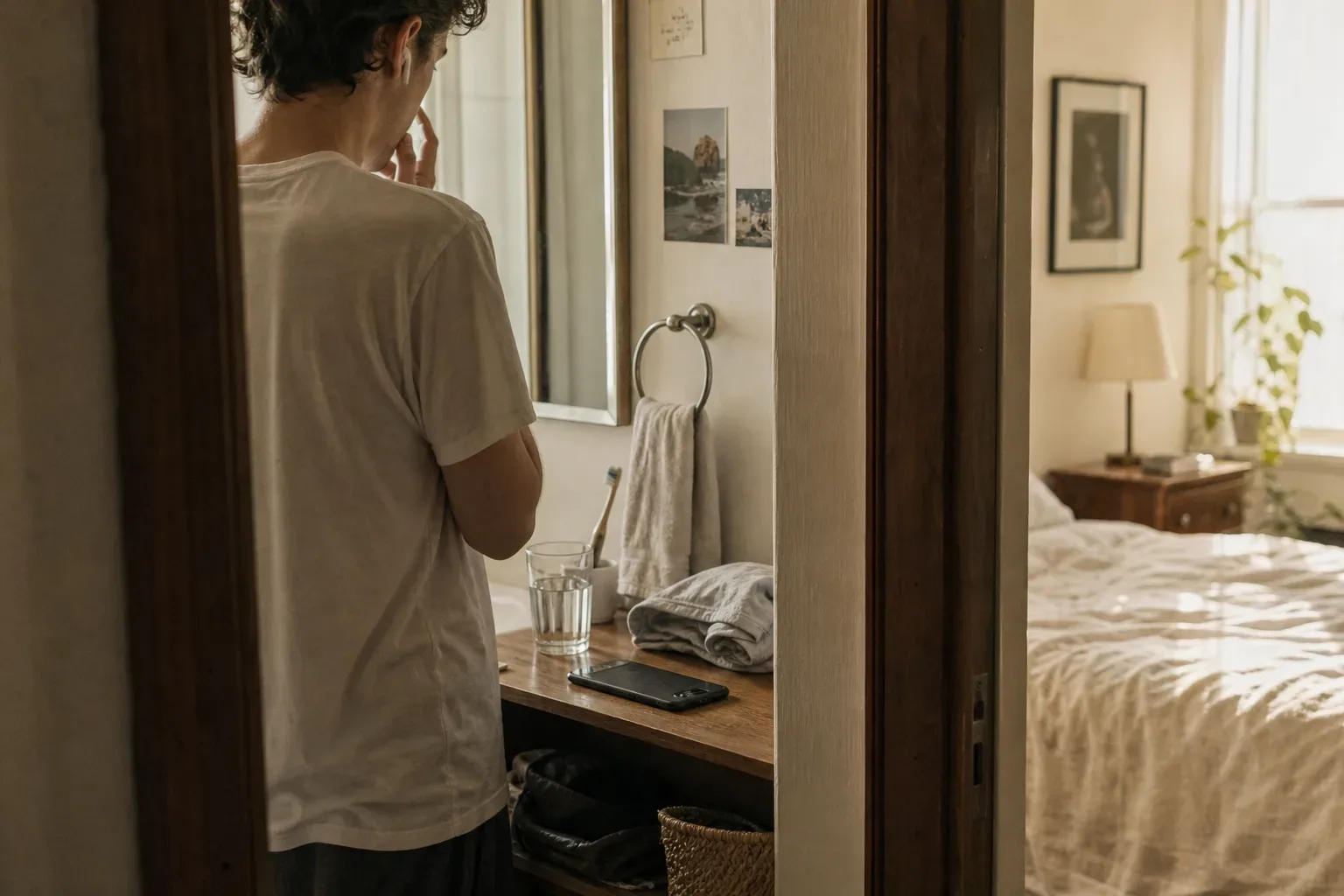
Friday. The kettle clicked off while I was still looking for a clean shirt. Subconscious reprogramming audio works best in a getting-ready routine when it is short, repeated, and tied to an action already happening. I use it as a few minutes of directed listening, not as a mood decoration.
What is subconscious reprogramming audio, really?
Subconscious reprogramming audio is repeated listening that makes a chosen self-concept feel familiar enough to influence ordinary behavior.
I am careful with that sentence because the internet makes the subconscious sound like a locked basement with a glowing door. I do not experience it that way. I experience it as the sentence I keep saying before I answer an email. The posture I take before I ask for the price. The old assumption that enters the room before I do.
In psychology, repetition matters because familiar thoughts are easier for the brain to retrieve. Cognitive fluency research, including work by Norbert Schwarz and colleagues in the 1990s and 2000s, found that easier-to-process statements can feel more true. That does not make every repeated sentence wise. It means repetition lowers friction. A good recording uses that mechanism with care.
The audio I trust is not trying to bully me into brightness. It names a future identity in a voice I can live with at 7:12 a.m. The Manifestation pillar says manifestation is partly about attention and repeated meaning. I would add this from my kitchen: attention becomes believable when it survives Tuesday.
Here is the useful distinction I keep on the page:
| Type of audio | What it usually does | When I use it |
|---|---|---|
| Affirmation loop | Repeats chosen statements | When I need one clean sentence |
| Guided visualization | Leads mental images step by step | When I have more time |
| Dream-Self audio | Speaks from the already-lived future self | During getting ready |
| Relaxation track | Calms the body first | At night, not while dressing |
Dr. Andrew Huberman has often described attention and neuroplasticity as state-dependent, meaning the brain learns differently depending on arousal and focus. I do not need to overstate that. I only need to notice that the first 20 minutes of my day are unusually suggestible because I have not yet been interrupted by twelve tabs.
A belief is often just a sentence that learned the route through the house.
Why does the getting-ready routine make the audio easier to keep?
The getting-ready routine works because it already has cues, sequence, and repetition built into it.
I have tested enough wellness apps to know the graveyard is full of beautiful intentions placed at impossible times. A practice that requires a new hour usually fails me by Thursday. A practice placed beside the toothbrush has a fighting chance. The toothbrush is not spiritual. That is why I trust it.
Habit researchers Wendy Wood and David Neal have written that much daily behavior is cue-driven rather than decision-driven. In a 2006 paper in the Journal of Experimental Social Psychology, they described habits as learned responses to stable contexts. My bathroom mirror is a stable context. My blue mug is a stable context. My phone on the windowsill, face down, is a stable context.
The getting-ready routine also keeps the audio from becoming a performance. I listen while my hands are doing small things. I button a shirt. I wash my face. I put coffee grounds in the filter. The body stays busy enough that the mind does not start grading the experience.
The practice I use most often is the AYA Method: The AYA Method is a daily audio manifestation practice. Each day you listen to a short personalized recording, your Dream-Self Moment, narrated from the version of you who has already manifested the life you intend. Listening is the practice. Repetition is the work. The audio is the method.
I like that it does not ask me to manage a large system before breakfast. The daily affirmation and the Manifestation Board can sit nearby, but the audio is the practice. On most mornings I do not need more parts. I need one thing I will actually do.
Here is the order that has stayed with me for 31 mornings:
- Put the phone on the bathroom shelf.
- Start the audio before brushing my teeth.
- Let the first minute play while I wash my face.
- Keep listening while I dress.
- Write one dated sentence after coffee, if I remember.
A small practice kept daily becomes larger than a dramatic practice kept twice.
How do I choose the right audio for the morning?
Choose morning audio that is short, specific, believable, and emotionally clean.
I do not use audio that sounds like it is trying to sell me my own life. If a track needs swelling music to convince me, I become suspicious. The recording has to pass the kitchen test. Can I hear it while the kettle comes on and still feel like a serious adult? If yes, it stays.
Length matters. A 2010 study by Phillippa Lally and colleagues in the European Journal of Social Psychology found that habit automaticity took 18 to 254 days, with an average of 66 days. A seven-minute practice has a better chance of reaching day 66 than a 42-minute one, especially if the listener has children, trains, deadlines, or a sink full of dishes.
Specificity matters too. “I am successful” is too wide for me at 7 a.m. “I answer the hard message before noon” has a handle on it. The Affirmations pillar makes a similar point: an affirmation works better when it is phrased close enough to behavior that the body knows what to do next.
When I choose a subconscious reprogramming audio, I check for these things:
- One identity thread. Not money, love, health, status, and sleep all in one recording.
- Present-tense language. Not fantasy, but rehearsal.
- A calm voice. No shouting disguised as motivation.
- A length under eight minutes. The morning is already full.
- A phrase I can repeat later. One sentence should survive without the track.
Neville Goddard called it “living in the end,” which can sound grand until I reduce it to a Tuesday behavior. If my future self is calm with money, then today I open the bank app without flinching. If my future self is loved, then today I answer the kind message instead of studying it like evidence.
The best audio does not make me escape the morning. It teaches me how to enter it.
What is the step-by-step way to use it while getting ready?
Use the same cue, the same audio, and the same small closing action for at least fourteen days.
I do not start by asking whether I believe every sentence. Belief is too slippery in the morning. I start by asking whether I pressed play. This is where my productivity scar tissue helps. A system should make the next action obvious even when the person is tired.
The American Time Use Survey has repeatedly shown that personal care is one of the most consistent daily categories for adults, often averaging around 9 to 10 hours when sleep is included and roughly 40 to 50 minutes for grooming and related care depending on the group measured. I do not need a new container. I need to use the one the day already gave me.
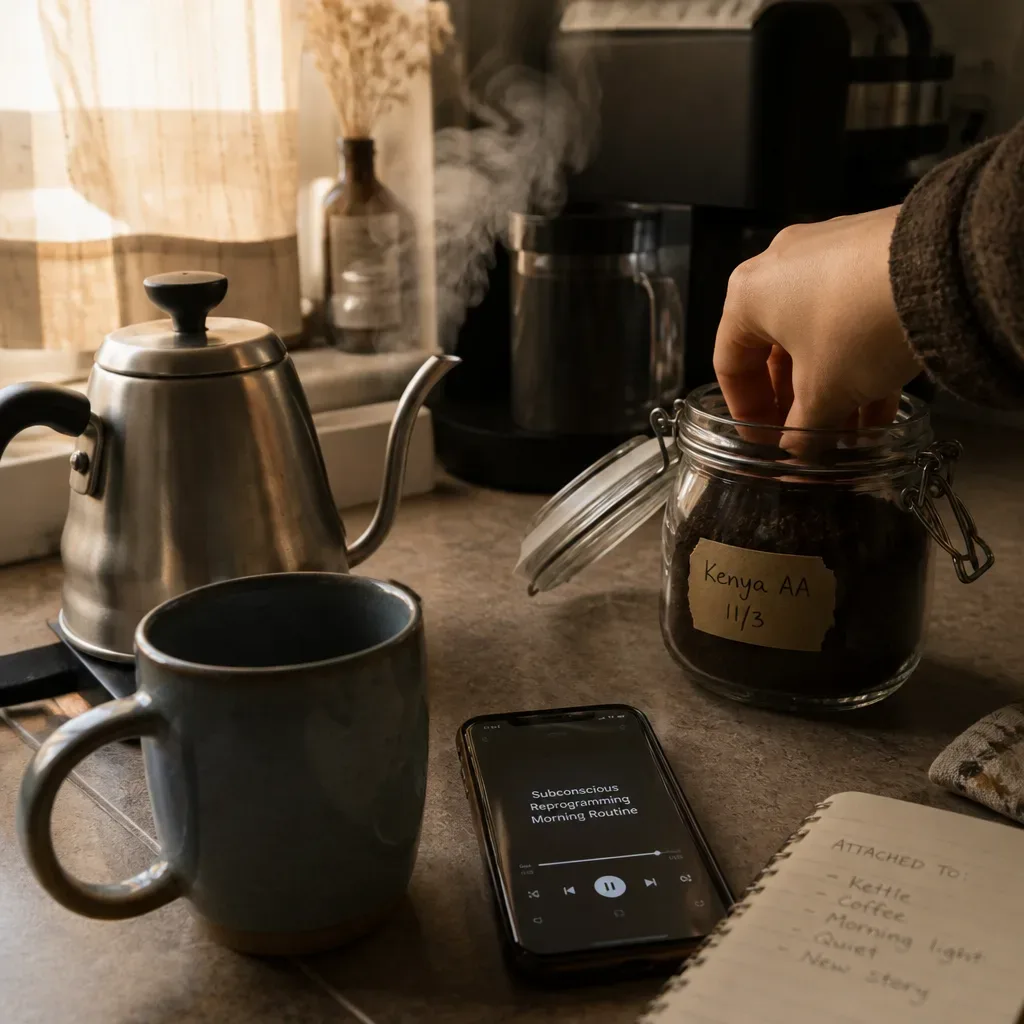
This is the method I wrote on a receipt and kept by the coffee tin:
- Pick the anchor. I use “kettle on” or “toothbrush in hand.” The cue must be visible.
- Place the device before the cue. If I have to search for the phone, I lose.
- Press play before thinking. Thinking negotiates. Pressing play begins.
- Let the body do familiar work. Wash, dress, shave, apply makeup, pack the bag.
- Do not restart the track. If I miss a line, I keep going. Perfection is a delay tactic.
- Write one sentence. Mine begins with the date. “October 9th. I speak plainly in the meeting.”
There is a reason I give it fourteen days before editing. In small behavior-change studies, early novelty can distort judgment. The first three days may feel charged. Days four to nine may feel ordinary. Ordinary is not failure. Ordinary is where the practice becomes usable.
I also leave silence after the recording. Not a ceremonial silence. Just thirty seconds while I pour coffee. The nervous system often answers after the instruction stops.
For people who like timing, this is my 12-minute version:
| Minute | Action | Attention |
|---|---|---|
| 0:00 | Start kettle, press play | Hear the opening line |
| 1:00 | Wash face | Let the body lead |
| 3:00 | Brush teeth or shave | No evaluation |
| 5:00 | Dress | Notice one useful phrase |
| 7:00 | Pack bag or make coffee | Let the track finish |
| 10:00 | Write one dated sentence | Keep it plain |
The practice should be small enough that your future self does not need to be heroic to keep it.
What should I listen for while the audio plays?
Listen for the sentence that changes your next ordinary choice, not for a dramatic feeling.
This took me longer than I want to admit. I used to measure practices by sensation. Did I feel lighter? Did I feel certain? Did the morning look different? That made me a poor witness. Feelings move with sleep, caffeine, weather, and one badly worded message from a client.
In 2023, Pew Research Center reported that about 41 percent of U.S. adults said they felt high levels of stress at least some of the time, and stress changes attention. Under pressure, I need simpler measures. Did I send the invoice? Did I eat before noon? Did I ask directly instead of hinting? These are not glamorous metrics. They are harder to fake.
I listen for one of three things:
- A phrase my body softens around. Usually short. Usually plain.
- A place where I resist the recording. Resistance can show the old script.
- A behavior I can do today. One email, one walk, one honest answer.
Joe Dispenza often speaks about rehearsing a future state until the body recognizes it. I take the practical part and leave the spectacle. If the body recognizes anything, it should recognize how I stand when I am not apologizing for taking up the normal amount of space.
This is also where audio manifestation feels different from reading. Reading can become analysis. Listening enters while I am tying my shoes. It meets me before I have built my defenses for the day.
How do I know if the audio is working?
You know it is working when your behavior changes in small, repeatable ways before your self-image has fully caught up.
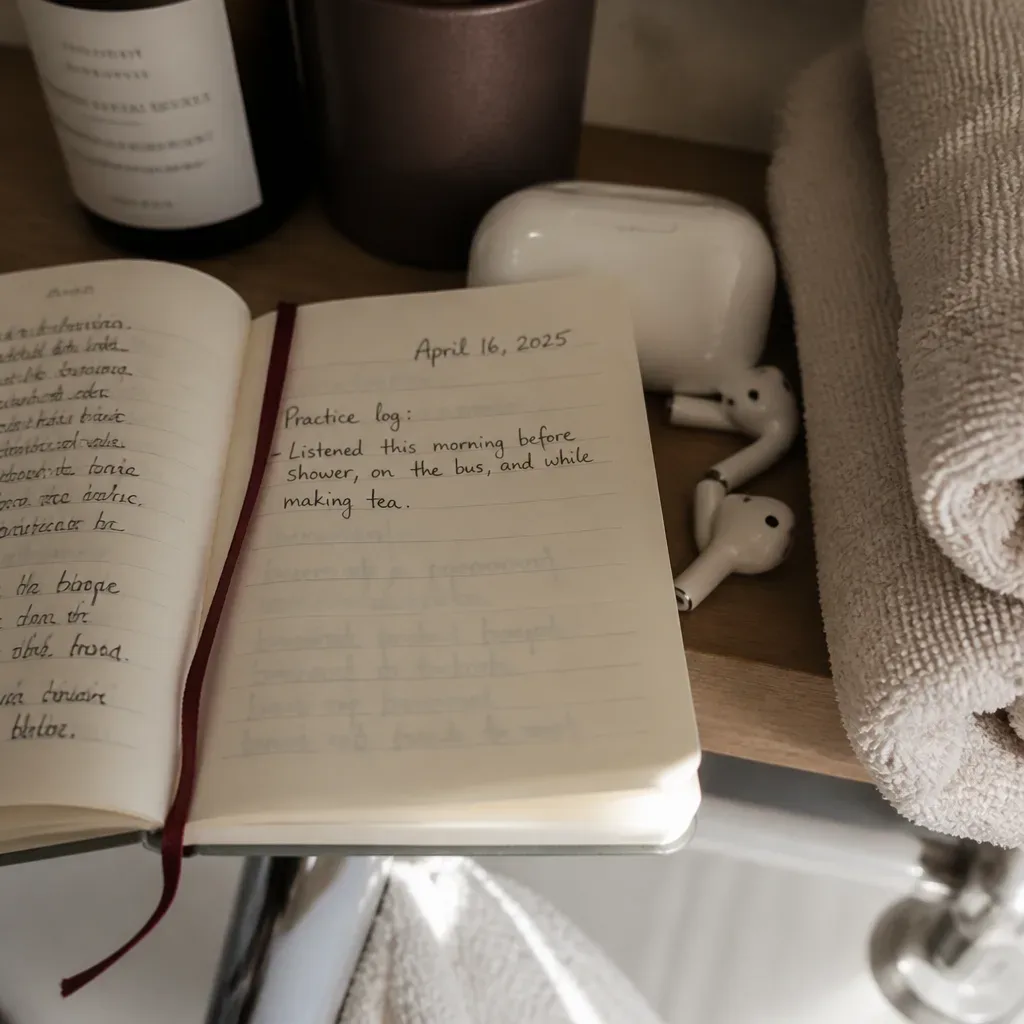
I keep a simple log because memory edits itself. The log has three columns: date, listened, one observed behavior. No rating out of ten. No color code. No paragraph unless I want one. After 21 days, I can usually see whether the practice is touching the day or only decorating it.
The number 21 is not magic. The old “21 days to form a habit” claim is too neat; Lally’s 2010 study gave a much wider range. I use 21 days because it is long enough to include bad sleep, a weekend, a busy workday, and at least one morning when I do not feel like being improved.
Here are signs I trust:
- I recover faster after a discouraging message.
- I choose the direct action earlier in the day.
- I stop rehearsing the old complaint as often.
- I use one sentence from the audio without pressing play.
- I miss a day and return without drama.
Here are signs I do not trust as much:
- A big feeling on day one.
- Needing a new track every morning.
- Talking about the practice more than doing it.
- Confusing calm music with changed behavior.
The Princeton Engineering Anomalies Research program, often called PEAR, studied intention and random systems for nearly three decades. People argue about what its findings mean, and they should. I mention it only because intention has a long history of being studied at the edge of accepted models. My own standard is humbler: does the practice change what I do at 10:30 a.m.?
For a wider frame, I keep the Astrology and manifestation page bookmarked, not because I outsource timing to the sky, but because timing changes how a practice feels. Some mornings have weather inside them. I still press play.
The proof of a morning practice is not the morning. It is the less frightened choice made later.
What mistakes should I avoid with subconscious reprogramming audio?
Avoid changing the audio too often, using language you secretly reject, and expecting the recording to replace action.
The first mistake is novelty hunger. I know it well. I have downloaded the app, changed the theme, adjusted the notification sound, and called that a practice. It was not. It was furniture moving. Subconscious reprogramming audio needs enough sameness to become familiar. If I change the message daily, I train myself to browse, not to believe.
The second mistake is choosing language that creates an argument. If the audio says, “I am completely fearless,” my body objects immediately. I prefer a phrase like, “I can do the next honest thing while fear is present.” In acceptance and commitment therapy, often associated with Steven Hayes, the goal is not to erase discomfort but to act according to values while discomfort is there. That fits my mornings better.
The third mistake is making the practice too public too soon. I do not need to announce a new identity before breakfast. I need to keep a promise to myself quietly. The AYA Method works for me because the audio stays intimate. It does not ask me to become a spokesperson for my own change.
If I were starting again this week, I would keep these rules on the bathroom mirror:
- One audio for fourteen days.
- One cue that already exists.
- One sentence written after listening.
- One behavior chosen before noon.
- One missed day allowed without punishment.
A practice that cannot survive an imperfect morning is not ready for a real life.
I still use a daily affirmation sometimes. I still pin a line to my Manifestation Board when it feels useful. But those are complements. The audio is what I return to while the kettle is loud and the shirt is wrinkled and the day has not yet decided who I am.
October 9th. I pressed play before I checked the messages.