vision boards
Vision Board Questions for Dream-Self Audio
Use vision board questions to turn images, goals, and quiet wants into Dream-Self audio that you can listen to daily without overbuilding the practice.
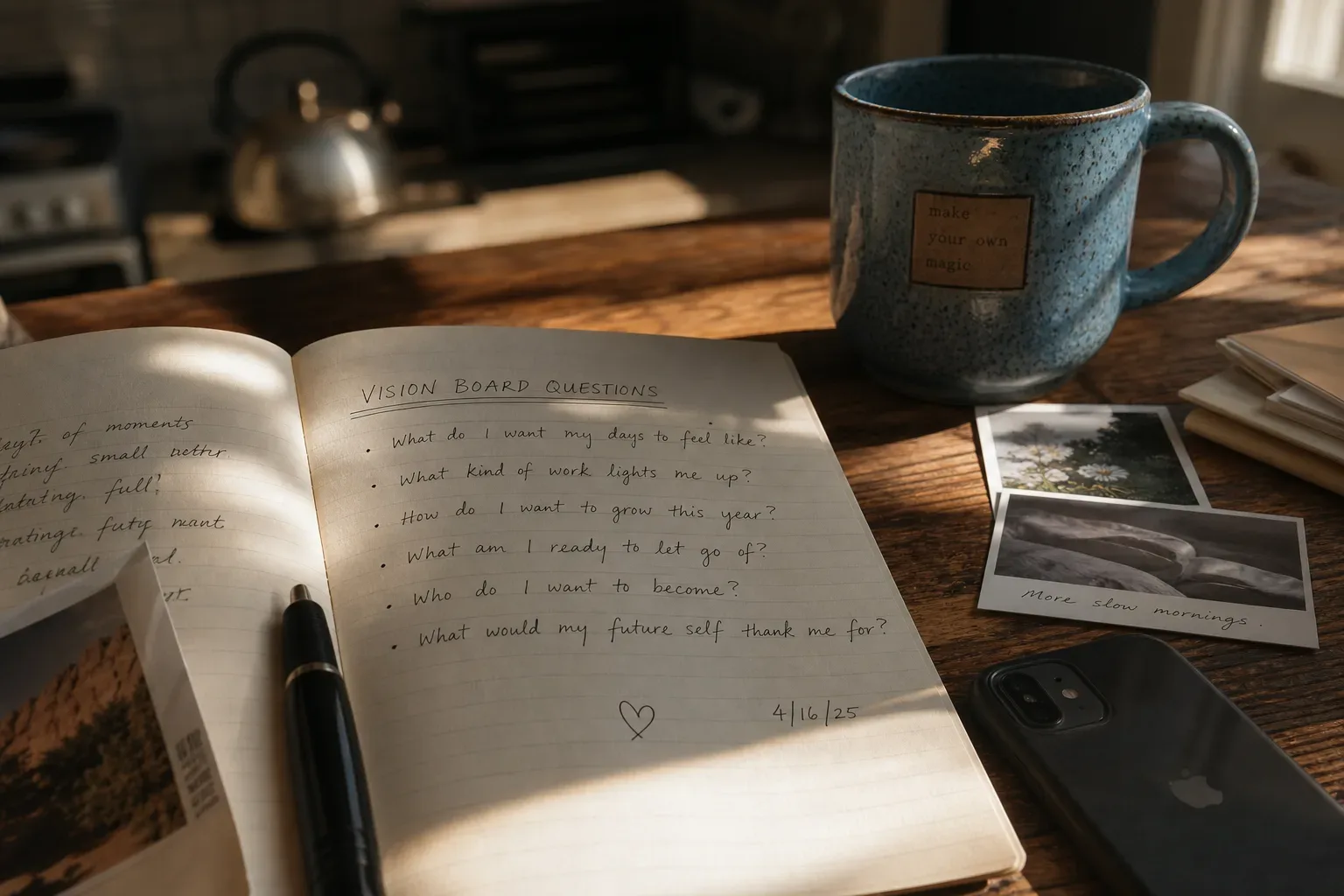
October 20. The kettle clicked off before I found my pen. The best vision board questions are the ones that turn a picture into a daily scene, then into Dream-Self audio you can hear every morning. I use them to move from wanting vaguely to rehearsing specifically.
I have built habit tools for about 14,000 people, and the numbers made me less dramatic. People do not usually fail because the goal is too small. They fail because the next action is too foggy. A vision board can be beautiful and still give the brain no instruction. A question gives it a handle.
I kept my board on the small kitchen table this week. Not a wall-sized declaration. Just six images, one blue mug, and a page dated in the corner. I listened to the AYA Method before brushing my teeth. The AYA Method is a daily audio manifestation practice. Each day you listen to a short personalized recording, your Dream-Self Moment, narrated from the version of you who has already manifested the life you intend. Listening is the practice. Repetition is the work. The audio is the method.
What should vision board questions actually do?
Vision board questions should turn desire into observable evidence.
I wrote that sentence in the margin because I needed it plain. A board that says “calm” may soothe me for 5 minutes, but it does not tell Tuesday what to do. A better question asks, “What does calm change in my 8:30 a.m. calendar?” Edwin Locke and Gary Latham’s goal-setting research, summarized in their 2002 American Psychologist paper, found that specific and difficult goals reliably improved performance more than vague encouragement. The finding is old enough to be boring, which is often a sign that it is useful.
So I start with evidence questions. Not identity as decoration. Identity as behavior. James Clear popularized the phrase “identity-based habits,” but the older behavior science behind it is sturdier than the phrase: repeat a cue, make the action easier, and let self-perception catch up. Wendy Wood and David Neal wrote in 2007 that habits are learned associations between contexts and responses. The kitchen. The chair. The same 3 minutes of audio. The same page.
A good question also removes performance from the practice. “What would my dream life look like?” can make me stiff. “What is different about my grocery receipt in 90 days?” does not. Ninety days is long enough to show a pattern and short enough to keep the answer honest. In one Dominican University of California study often cited from 2015, people who wrote goals and sent weekly progress reports showed higher completion than those who only thought about goals. The exact percentages are debated because the study was small, but the direction is practical: written specificity helps.
These are the first questions I use when the page is blank:
- What would I notice on an ordinary Tuesday if this were already normal?
- What would I stop repeating, buying, apologizing for, or postponing?
- What would someone close to me notice without being told?
- What would be on my calendar, bank statement, plate, or desk?
- What is the smallest piece of evidence I could see in 7 days?
A vision board is not proof that life changed. It is a draft of the evidence I am willing to practice noticing.
Which questions pull images into real life?
The useful questions ask what the image changes in your body, schedule, relationships, and choices.
This morning I had a photo of a quiet desk. It was not about the desk. I already have a desk, and it has three receipts under the keyboard. The question was, “What would this desk ask me to stop doing after 9 p.m.?” That gave me a better answer: I close the laptop before dinner 4 nights a week. Four is a number I can check. “Better boundaries” is a fog bank.
I like to divide vision board questions into four buckets. It keeps the board from becoming a collage of moods. Dr. Andrew Huberman often speaks about the nervous system needing clear behavioral anchors for state change; he is not talking about vision boards, but the principle travels. If I want a calmer nervous system, I need sleep timing, light exposure, breath, movement, and fewer late-night messages, not only a beige image of linen curtains.
| Image on the board | Better question | Audio-ready answer |
|---|---|---|
| A bright kitchen | What happens here before 8 a.m.? | I drink water before coffee and make breakfast sitting down. |
| A paid invoice | What number proves I am steadier? | I keep one month of expenses untouched. |
| A couple walking | What repair do I practice weekly? | I ask one honest question before I defend myself. |
| A clean desk | What do I close each evening? | I shut the laptop at six and leave tomorrow one note. |
The table looks too simple, but simple survives the morning. In habit design, friction matters. Research by BJ Fogg at Stanford has repeatedly emphasized that behavior happens when motivation, ability, and prompt converge. If a question produces an answer that requires a new personality by Friday, I cross it out.
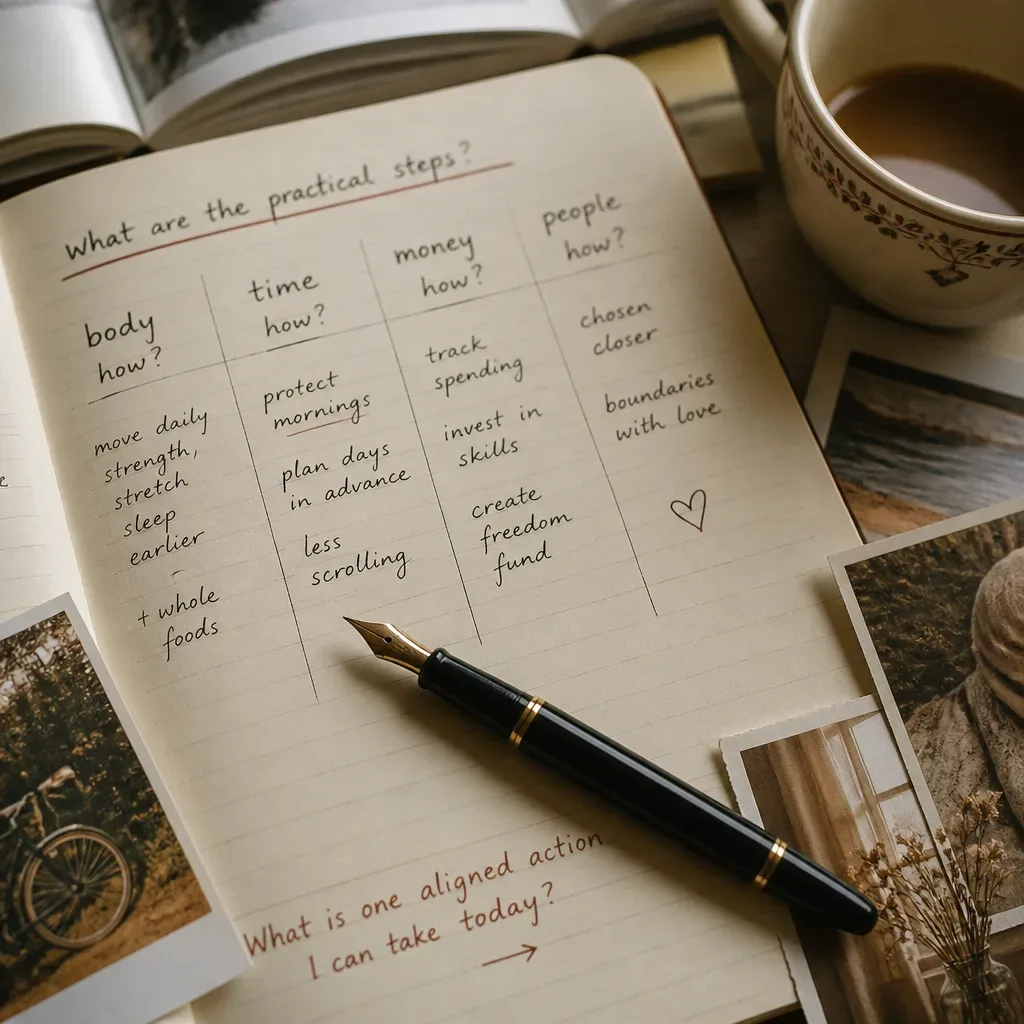
Here are the four buckets I keep returning to:
- Body: sleep, food, walking, pain, breath, clothing, the pace of my hands.
- Time: mornings, evenings, weekly reviews, what I stop squeezing into the day.
- Money: amounts, dates, receipts, saved buffers, honest spending patterns.
- People: the sentence I say, the boundary I keep, the help I accept.
The board becomes usable when every image has a verb beside it. Not a grand verb. A kitchen verb. Close. Cook. Ask. Save. Walk. Reply. Rest.
How do I turn answers into Dream-Self audio?
I turn answers into Dream-Self audio by rewriting them as present-tense scenes spoken by the future self I am practicing toward.
I do not make the voice heroic. I have tried that. It made me want to turn the volume down. Neville Goddard wrote often about assuming the feeling of the wish fulfilled, and Joe Dispenza describes mental rehearsal as a way of pairing thought with emotion. I keep the useful part and remove the theatre: the sentence has to sound like me, on a day when I am less defended.
The audio script begins with evidence. If my answer says, “I want to feel financially safe,” I ask, “What does safe do on the 3rd of the month?” Then I write, “I check the account on the 3rd. I pay the bill without bargaining with myself. I keep the buffer untouched.” The number matters. The date matters. Specific cues reduce negotiation. Peter Gollwitzer’s 1999 work on implementation intentions found that “if-then” plans improved goal attainment across multiple studies because they tied intention to a cue.
This is my 5-step conversion:
- Circle the plainest sentence. I ignore the prettiest one.
- Add a time or place. Morning, train, kitchen, Sunday night.
- Add visible evidence. A receipt, message, calendar block, glass of water.
- Write it in the first person, present tense. “I leave one clear note for tomorrow.”
- Read it aloud once. If I would not say it to myself in the bath, I rewrite it.
A Dream-Self script is not a speech. It is a short room I enter daily.
For me, 90 to 180 seconds is enough. In product analytics, I learned that length kills repetition faster than boredom. A daily practice that takes 2 minutes has a better chance of surviving travel, winter, and the day after an argument. Pew Research Center reported in 2024 that 90 percent of U.S. adults owned a smartphone, which means audio can live where attention already goes. That does not make the phone sacred. It makes it available.
I use the AYA Method here because the audio is not an accessory to the work. It is the work. My daily affirmation sometimes sits on the page afterward, and the Manifestation Board helps me remember the images, but they are complements. The listening is the repeated unit.
What questions keep the board from becoming fantasy?
Questions that ask for costs, tradeoffs, and first evidence keep the board honest.
I used to skip the cost question because it felt rude. Now I think it is the kindest one. “What does this ask me to stop protecting?” is often where the real answer lives. If I ask for a calmer home, the cost may be fewer open loops, fewer purchases made to avoid a feeling, or one difficult conversation with my mother. In behavioral economics, present bias describes the way immediate comfort often beats future benefit. The term is academic; the kitchen version is eating standing up while promising to change tomorrow.
I keep these questions near the bottom of the page:
- What will I have to stop calling “just how I am”?
- What comfort will become too expensive?
- What will I need to say no to 3 times before it sticks?
- What evidence would embarrass me because it is so small?
- What would I do if nobody praised the change for 30 days?
Thirty days is not magic. It is just long enough for the romance to thin out. A 2009 study in the European Journal of Social Psychology by Phillippa Lally and colleagues found habit automaticity took a median of 66 days, with wide variation from 18 to 254 days. That range comforts me. It means the slow weeks are not a moral failure. They are part of the data.
I also ask one anti-fantasy question: “Where will this goal be inconvenient?” A stronger body may be inconvenient at 6:45 a.m. A better relationship may be inconvenient when I want to win the argument. A steadier business may be inconvenient when I want to chase a louder idea. This is where the Manifestation pillar is useful to reread, not as a promise machine, but as a reminder that naming a future asks something of the present.
The question I trust most is this one: “What would I still choose when nobody can see the board?”
How many questions should I use before making the audio?
I use 7 to 10 questions before making the audio, then I choose only 5 to 8 answers for the script.
Too many questions make the recording crowded. Too few can leave the script thin. I learned this from app onboarding. When we asked users 12 questions, completion dropped. When we asked 3, the plan was too generic to keep. The best version was short enough to finish and specific enough to feel personal. That pattern matches cognitive load research going back to George Miller’s famous 1956 paper on the “magical number seven,” although modern researchers treat the exact number more cautiously.
Here is the set I used this week, copied from my notebook before I forget:
- What ordinary morning proves this is becoming normal?
- What do I no longer tolerate in my calendar?
- What number would make this real but not theatrical?
- What would my body do differently by noon?
- Who would notice first?
- What sentence would I say with less fear?
- What would I stop buying, scrolling, or postponing?
- What would I practice for 2 minutes even on a bad day?
- What would I forgive myself for needing slowly?
- What evidence belongs on the board next month?
From those 10, I pull the lines that have handles. “I am at peace” does not have a handle yet. “I put the phone in the drawer before lunch” does. If I am working with love, I use one relationship line. If I am working with work, I use one calendar line and one money line. If I am working with health, I use one body line and one recovery line.
I sometimes pair the audio with Affirmations pillar reading when I want cleaner language, but I do not let affirmations become the whole practice. A sentence can point me. The recording repeats me into the room. There is a difference.
What does a finished Dream-Self script sound like?
A finished Dream-Self script sounds ordinary, specific, and already lived in.
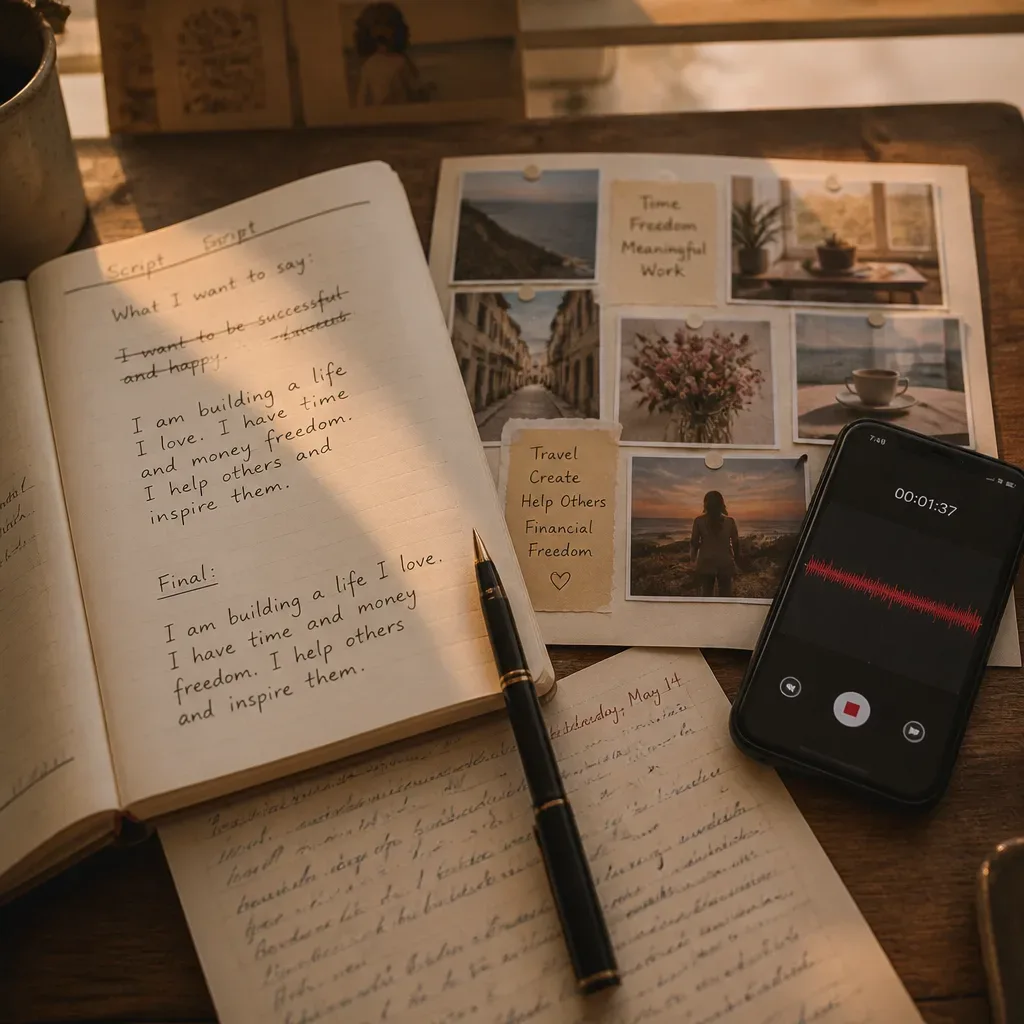
Mine never starts with fireworks. It starts with the chair. “I wake before the second alarm. I put both feet on the floor. The room is still dark, but I do not bargain with the day.” That line came from a board image of a white bedroom, but the useful part was not the bedroom. It was the bargaining. Once I named it, the audio had somewhere to stand.
Here is a short sample shaped from vision board questions:
I live with less noise now. I keep the morning narrow. I drink water before coffee, and I sit down for breakfast 4 days a week. My desk is clear enough for one priority. I do not open messages before I know what I am making. Money is no longer a foggy subject. On the 3rd, I check the account, pay what is due, and leave the buffer alone. I answer honestly. I repair faster. I go to bed without turning tomorrow into a punishment.
That is 106 words. Read slowly, it becomes about 45 to 55 seconds. A 2-minute audio might hold 250 to 320 spoken words, depending on pace. The National Center for Voice and Speech often places conversational speech around 150 words per minute, though natural pacing varies. I leave pauses because the nervous system needs space to believe the sentence belongs to me.
I also check the script against one strange test: would I be embarrassed if my closest friend heard it? If the answer is yes because it is too intimate, I may keep it. If the answer is yes because it sounds fake, I rewrite it. Fake language breaks repetition. The body knows when I am wearing someone else’s coat.
Some people like to time the script with moon cycles or birth-chart seasons. I am not strict about that, but if symbolism helps you choose timing, Astrology and manifestation can sit beside the practice without replacing the practice. I still return to the same rule: the audio must tell me what life looks like when the picture has become ordinary.
The best script does not flatter me. It recognizes me before I have fully arrived.
How do I review and revise the audio without starting over?
I review the audio by checking evidence weekly and revising only the lines that no longer fit.
Sunday night is my review slot. Ten minutes, not a ceremony. I put the phone face down, open the page, and mark each line with one of three notes: kept, softened, or sharpened. Kept means the sentence still tells the truth. Softened means it is too ambitious for the life I am actually living. Sharpened means it is too vague and needs a number, place, or cue.
This is the review grid I use:
| Mark | What it means | Example revision |
|---|---|---|
| Kept | The line is still useful. | “I leave tomorrow one note.” |
| Softened | The line asks too much too soon. | “I walk 10 minutes” becomes “I put shoes by the door.” |
| Sharpened | The line is too vague. | “I rest more” becomes “I close the laptop at six.” |
I do not revise because I am bored. Boredom is often the first sign that a practice is becoming stable. In habit tracking, we saw this constantly: users wanted novelty around day 9, but the people who stayed often made the habit less interesting, not more. They reduced decisions. They made the streak easier to resume after a miss. They stopped redesigning the system every Monday.
If a line has produced no evidence after 14 days, I do not shame it. I ask whether it was too abstract, too large, or missing a cue. A line like “I trust myself with money” may need to become “I check the account every Friday after coffee.” The Friday matters. The coffee matters. The cue carries the sentence into the day.
I keep the visual board updated slowly. One image out, one image in. I do not rebuild the whole thing unless my life has truly changed. The broader Manifestation pillar can hold the philosophy, but my board has to hold the evidence. Those are different jobs.
Tonight, the page says kept beside four lines and softened beside one. That feels like enough.
Wednesday now. The kettle is clean.