audio manifestation
Voice Notes Manifestation: Make Dream-Self Audio
Voice notes manifestation can turn one honest phone memo into daily Dream-Self audio. Here is the quiet, evidence-aware way I make it.
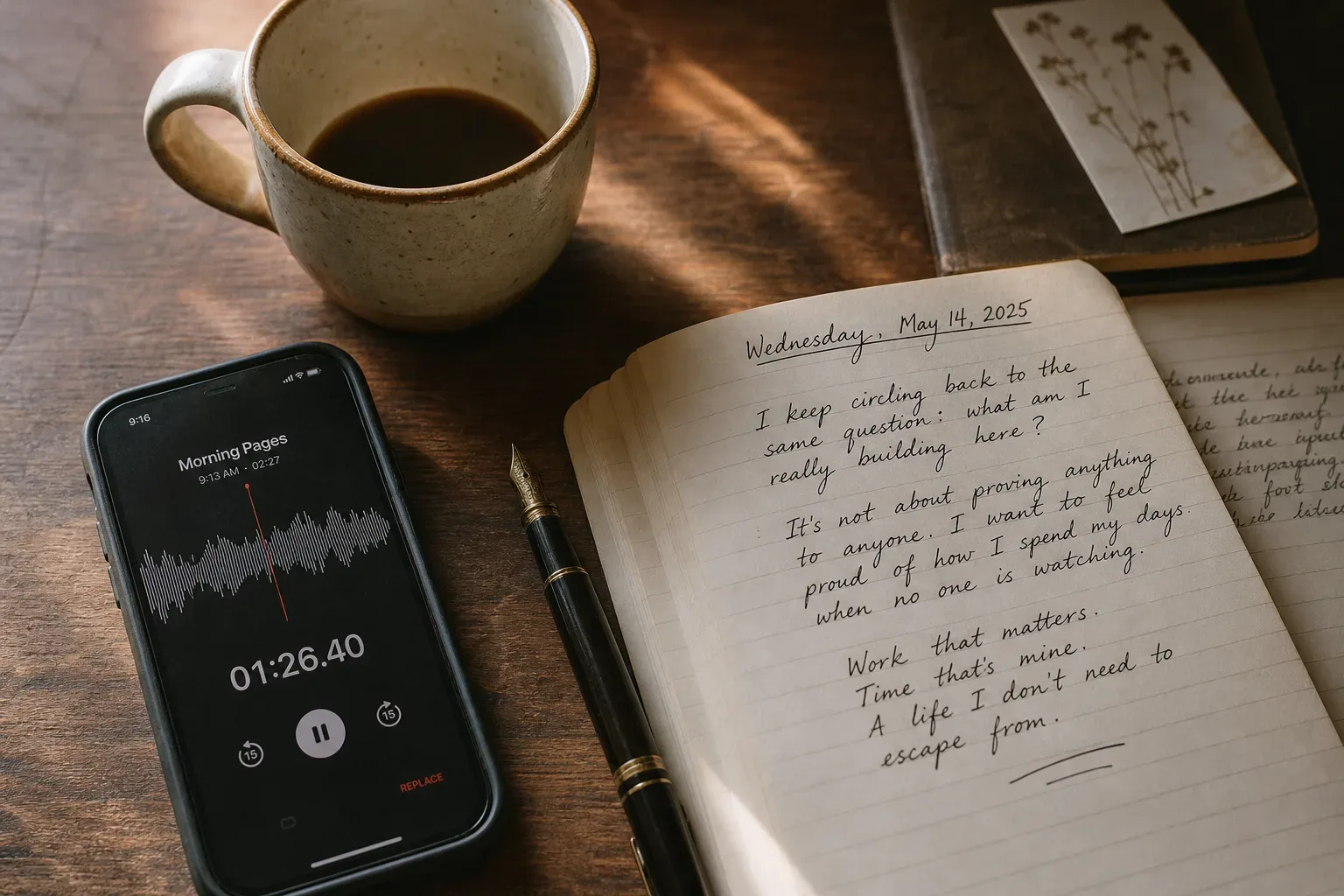
Monday, kettle on. Voice notes manifestation means recording one honest memo, shaping it into a short Dream-Self audio, then listening daily so the same identity cue meets you again. I use it as repeated self-talk with structure, not as a guarantee. The practice works best when it is specific, believable, and brief.
What is voice notes manifestation, really?
Voice notes manifestation is a daily audio cue made from your own spoken words about the self you are practicing becoming.
I wrote that down this morning before my coffee cooled. The phrase can sound bigger than the act. In my kitchen, it is just my phone on the table, my thumb on record, and one private note where I say what I want, what I am afraid to want, and what I already know how to do on my best days. Then I take the useful sentences and make them listenable.
The neuroscience word I reach for is self-referential processing. A 1977 paper by Rogers, Kuiper, and Kirker found that people remembered words better when they judged them in relation to themselves. Many later studies have kept the basic finding alive: the brain tends to tag self-relevant material as important. That does not mean every sentence becomes true. It means self-linked language can become easier to retrieve.
This is why I place voice notes inside the larger practice of the AYA Method. The AYA Method is a daily audio manifestation practice. Each day you listen to a short personalized recording, your Dream-Self Moment, narrated from the version of you who has already manifested the life you intend. Listening is the practice. Repetition is the work. The audio is the method.
My own voice note is the rough draft. The Dream-Self audio is the clean daily cue. A thought becomes more useful when it has a time, a sound, and a place to meet me. If you want the wider frame, I keep returning to the Manifestation pillar, especially when I need to separate a practice from a promise.
How do I record the first memo without making it precious?
I record the first memo quickly, because the first version is meant to reveal language, not to become the final audio.
I set a timer for three minutes. Three minutes is long enough to get past the formal voice and short enough that I do not start teaching myself a sermon. In cognitive research, working memory is limited; Baddeley described the phonological loop as brief and fragile in 1992, which is one reason I keep the first capture simple. I want the words before I start polishing them.
This is the small method I used last Thursday, sitting in the chair by the window:
- I opened the voice recorder on my phone.
- I said the date out loud.
- I named the one area I was asking to change.
- I described a normal day after the change had become familiar.
- I said what I was already doing that matched it.
- I stopped before I could explain too much.
I do not recommend starting with grand claims. My nervous system has a sharp ear for theater. It relaxes around details: the inbox closed by six, the walk after lunch, the text answered honestly, the money checked on Friday morning. Specificity is not less spiritual. Specificity is where a vague wish becomes a usable cue.
A 2006 meta-analysis by Webb and Sheeran found that implementation intentions, the if-then plans people attach to goals, had a medium-to-large effect on goal attainment across many studies. That matters here. A voice note that says, I am calm and successful, is thin. A voice note that says, When I sit down with my coffee, I open the proposal before messages, gives the brain a handle.
I keep the raw memo messy. I cough. I repeat myself. I say one sentence that embarrasses me. That is all allowed. The first recording is clay, not proof.
What should I say so it becomes Dream-Self audio?
I choose sentences that sound like a future self with a memory, not a slogan with a costume on.
After recording, I listen once with a pen. I do not transcribe the whole thing. I mark the sentences that make my shoulders drop. Sometimes there are only four. That is enough. In a 2014 review, Cohen and Sherman described self-affirmation as a way people protect a broader sense of self when facing threat. The useful sentences are not always cheerful. They are often steady.
The lines I keep usually have one of these shapes:
- A sentence about identity: I am someone who tells the truth early.
- A sentence about evidence: I have already kept this promise for four mornings.
- A sentence about behavior: I answer the hard email before lunch.
- A sentence about feeling: I can feel nervous and still act cleanly.
- A sentence about belonging: I let good people know where I am.
I treat affirmations as small companions here, not as the whole practice. A written affirmation can give me one clean line. The audio gives that line breath, pacing, and context. A sentence repeated without listening can become wallpaper. A sentence heard at the same hour can become a door.
Here is the rewrite pattern I use:
| Raw memo line | Dream-Self audio line |
|---|---|
| I want to stop panicking about money | I check my money every Friday morning, and I tell myself the truth without punishment. |
| I wish I were less scared to be seen | I send the work while it is still warm, because being seen is now part of the work. |
| I need to get my life together | I keep the morning small: water, audio, one written priority, then the first task. |
The first-person present tense helps, but only when it stays credible. If my body argues back, I lower the sentence until it meets the floor. Not I never doubt myself. More like, I notice doubt and still make the call. That difference is not cosmetic. It is the difference between fantasy and rehearsal.
How do I turn one rough memo into a clean daily recording?
I make the final recording short, paced, and ordinary enough that I can actually listen every day.
For me, the clean version is 90 seconds. Sometimes it is 2 minutes. Research on habit formation by Lally and colleagues in 2010 found that automaticity took a median of 66 days to develop, with wide variation from 18 to 254 days depending on the behavior. That number keeps me humble. If I make the recording too long, I am building friction into the practice before it has roots.
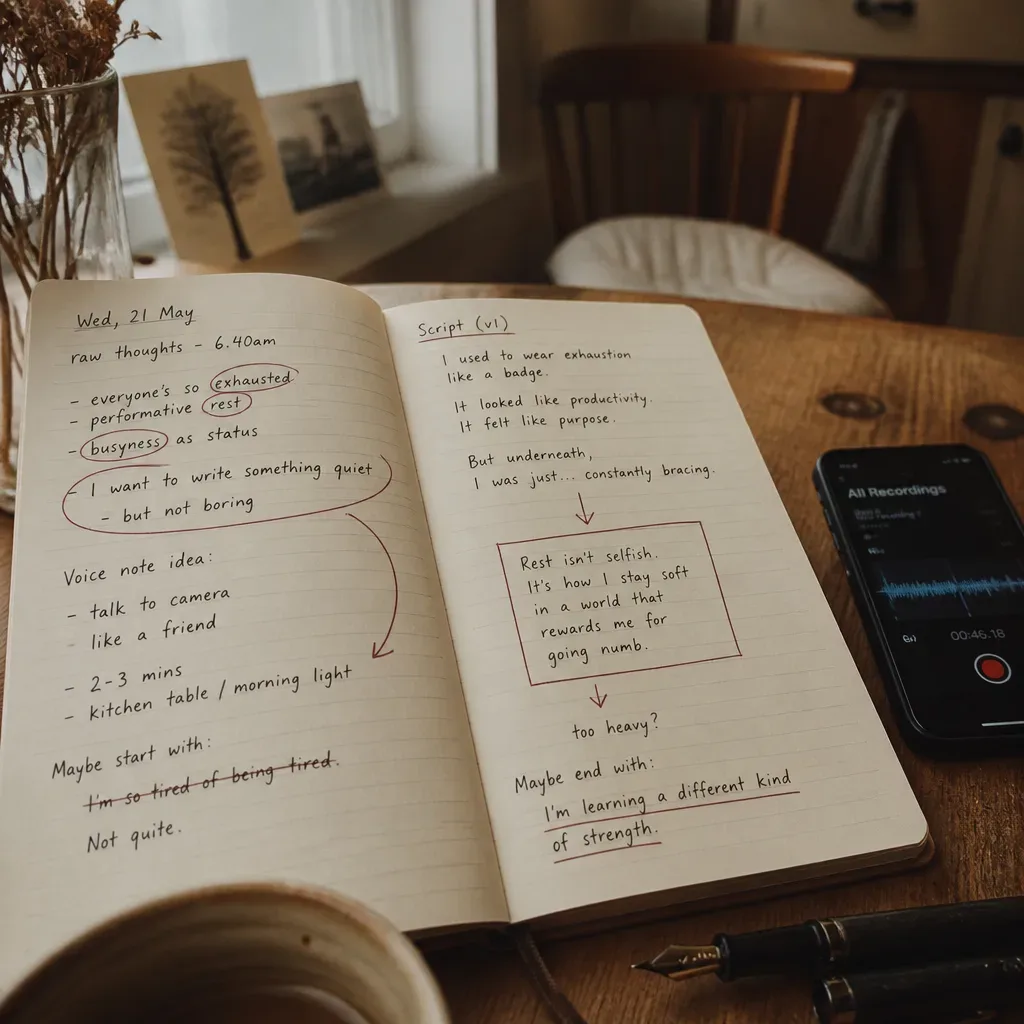
I write a script with three parts. First, I place myself in the day. Second, I speak from the Dream-Self identity. Third, I name one behavior I will practice today. I do not add music unless it helps me listen. I do not stack ten desires into one file. Attention has edges.
A simple script can sound like this:
I am in the kitchen. The morning is quiet. I have learned to begin before I negotiate with fear. I open the work that matters before I open the noise. I tell the truth sooner now. My body knows the difference between danger and discomfort. Today I take the first clean action, and then the next one.
I record it standing or sitting upright. I leave two seconds of silence at the beginning because I dislike being startled by my own voice. I speak 10 to 15 percent slower than feels natural. In audio learning studies, speech rate and clarity influence comprehension; educational research often places comfortable spoken-word learning near moderate pacing rather than rushed delivery.
Then I save the file with the date and the focus: 2026-10-12-work-courage. I do not keep twelve versions on my home screen. The chosen recording has to be easy to find. A practice hidden in folders is already asking too much of a tired morning.
When should I listen, and how often is enough?
I listen once a day, attached to something I already do, because repetition works better when it has a hook.
The hook matters more than the mood. I listen while the kettle comes on, before brushing my teeth, or on the bus if the morning has already escaped me. Wood and Neal wrote in 2007 that habits are often cued by stable contexts. I think about that when I put the phone beside the same blue mug. The chair helps. The mug helps. The hour helps.
Here is the rhythm I would give a friend who asked me over coffee:
| Moment | Why it helps | What I do |
|---|---|---|
| Morning kettle | The day has not scattered yet | Listen once, no multitasking if possible |
| Walk to transit | Movement reduces overthinking for me | Listen with one ear free and stay aware |
| Before work block | The audio points attention toward one action | Play it, then open the task immediately |
| Evening reset | Useful after a hard day | Listen gently, without trying to repair everything |
I keep one rule: the audio must lead to a real behavior within 10 minutes when possible. If my recording says I am someone who writes before noise, I open the document after listening. If it says I tell the truth early, I draft the message. Audio without action can become a beautiful hiding place.
This is also where astrology and manifestation sometimes enters my private life, though I hold it lightly. If a moon note or date gives me language for reflection, I may write it on the page. But I still let behavior be the measure. The sky can be a calendar. It cannot do my email.
Why does hearing my own voice feel different from reading the same words?
Hearing my own voice adds familiarity, timing, and emotion to the same sentence.
There is a reason a voice memo from my mother can change my whole afternoon faster than a text. Voice carries pace, breath, hesitation, and warmth. Studies of vocal emotion recognition show that listeners extract affective information from tone within very short windows, sometimes under a second. A written sentence can be true, but a spoken one tells me how to hold it.
Self-voice research is careful and not as large as the internet makes it sound. Still, auditory neuroscience has shown that the brain processes our own voice in distinctive ways compared with unfamiliar voices. I do not take that to mean my voice has special powers. I take it to mean the cue is personal in a measurable, ordinary way.
In my lab notes, I would call this a delivery vehicle. In my diary, I call it being spoken to by someone who knows where the cups are kept. Both are true. The recording does not need to be cinematic. It needs to be intimate enough that I do not feel managed by it.
I also think of Neville Goddard and Joe Dispenza here with caution. Both have shaped how many people talk about imagination and identity. As a neuroscience researcher, I separate useful rehearsal from overclaiming. The brain can distinguish imagination from perception in many contexts. The more careful statement is that imagined, remembered, and perceived experiences can share partial neural systems, and repeated rehearsal can influence attention, emotion, and behavior.
That is enough for me. Plausible is not a weak word. Plausible is a clean room with the lights on.
How do I keep voice notes manifestation from becoming magical thinking?
I keep it honest by pairing every recording with evidence, behavior, and limits.
This is the part I care about as Vera, and also as a person who has once tried to use beautiful language to avoid a hard phone call. A recording can soothe. It can also blur reality if I ask it to replace feedback. The American Psychological Association has written often about the value of evidence-based practice, which means we check whether an intervention helps in observable ways. I borrow that spirit at home.
My safeguards are plain:
- I do not use the audio to deny pain, debt, grief, illness, or conflict.
- I include one concrete action in every recording.
- I revise sentences that make me feel smaller or false.
- I track behavior for seven days, not just mood.
- I ask for human help when the issue needs human help.
This is why the broader manifestation frame matters to me. A practice can be meaningful without being all-powerful. A sentence can orient me without controlling the future. When I forget that, I become either grandiose or disappointed, and neither one helps me make breakfast.
I also avoid using the recording as a test of purity. Missing a day is not a moral failure. In habit studies, consistency matters, but perfection is not the mechanism. A 2021 review on behavior change techniques again emphasized prompts, cues, self-monitoring, and repetition across interventions. Shame was not the technology.
If the audio starts making me anxious, I lower the pressure. I shorten it. I make the language more truthful. I move from I am certain this will happen to I am practicing the person who can meet this well. The first sentence tries to control life. The second one returns me to practice.
What should I do after seven days of listening?
After seven days, I review behavior first, then feeling, then language.
Seven days is not long enough to declare a new identity finished. It is long enough to notice whether the recording fits inside a real week. In small behavior-change studies, early adherence often predicts whether people continue, though the exact numbers vary by context. I care less about the perfect metric and more about the pattern: did I listen, did I act, did I resist the words?
On the seventh day, I make tea and answer four questions in the notes app:
- Did I listen on at least five of seven days?
- Which sentence stayed with me without effort?
- Which sentence felt false or too large?
- What action happened more often because of the audio?
If nothing changed, I do not scold myself. I edit. Maybe the recording was too vague. Maybe the desire was borrowed. Maybe the next action was missing. Maybe I needed sleep more than another sentence. Data can be tender if I let it tell the truth without turning it into a verdict.
If it did help, I keep the same recording for another week. I resist the urge to make a new one every morning. Novelty feels productive, but repetition is usually the quieter worker. The AYA Method reminds me of that in its plainest form: listening is the practice, and repetition is the work.
I sometimes place one sentence from the audio on my Manifestation Board, not as a second pillar, just as a small visual note. The daily affirmation may also borrow one line. But I keep the order clear in my own head. The audio carries the practice. The other pieces are little lamps around it.
Tuesday now. I saved the file, and the kettle is clean.