aya method deep dive
Manifestation Goals: When to Update Your Audio
Learn when manifestation goals need a Dream-Self Audio update, when to keep listening, and how to change the recording without starting over.

October 8th. The kettle clicked off while I was rewriting one sentence in my Dream-Self Audio. You update manifestation goals when the direction has changed, the details have become clearer, or the old words feel false. You do not start over. You keep the practice and edit the instruction.
I have learned this the unromantic way. I built a small habit-tracking app once, and about fourteen thousand people taught me that fresh starts are often avoidance in a clean shirt. A changed goal is not always a failed goal. Sometimes it is a better measurement.
The same is true inside the AYA Method. The AYA Method is a daily audio manifestation practice. Each day you listen to a short personalized recording, your Dream-Self Moment, narrated from the version of you who has already manifested the life you intend. Listening is the practice. Repetition is the work. The audio is the method.
When do manifestation goals need an update instead of more repetition?
Manifestation goals need an update when the current audio no longer points to the life you are actually practicing toward.
I wrote that in my notebook this morning because I keep confusing boredom with evidence. Boredom is not always a sign. In behavior research, repetition is often supposed to feel plain. Wendy Wood and David Neal described habits in 2007 as learned associations between cues and responses, not as dramatic bursts of will. That sentence has saved me from replacing too many good practices too early.
The first test I use is factual. Did the facts change? A job title, a city, a relationship status, a health plan, a number in the bank account, a date on the calendar. If the answer is yes, I update the audio. If the facts did not change, I wait. I do not let mood alone hold the pen.
The second test is honesty. Sometimes I hear an old line and my hands know before my mind does. The line says, “I love speaking on stage,” and my body says, no, I love writing in quiet rooms. That is not resistance. That is a correction. Specificity is mercy. A vague goal can keep you loyal to a life you do not want.
I keep a small three-column table on the page:
| What I hear in the audio | What it may mean | What I do |
|---|---|---|
| “This feels boring” | Normal repetition | Keep listening for 7 more days |
| “This fact is wrong” | Goal detail changed | Edit the sentence |
| “This sounds like someone else” | Borrowed desire | Rewrite the goal |
| “This already happened” | Completed cycle | Record the next honest version |
Lally and colleagues found in a 2009 study in the European Journal of Social Psychology that habit formation averaged 66 days, with a wide range from 18 to 254 days. I think about that range whenever I want to abandon a recording on day 11. The question is not whether the audio still entertains me. The question is whether it still trains me.
A goal does not need fireworks to be alive. It needs a clean instruction repeated often enough that tomorrow-you can find it in the dark.
When should I keep the same Dream-Self Audio?
You should keep the same Dream-Self Audio when the identity, direction, and daily cue still feel accurate, even if the words feel familiar.
This is the part I get wrong when I am tired. On the bus, headphones in, I hear the same sentence for the twenty-third time and think, maybe I need a new one. But familiar is not broken. In learning science, familiarity is often the sign that retrieval is becoming easier. Dr. Andrew Huberman has often described neuroplasticity as requiring repetition and attention, not novelty alone. I try to remember that while my coffee cools.
I keep the same audio when three things are true:
- The future self still feels like mine.
- The goal still matters when no one is watching.
- The next behavior is still obvious enough to do today.
That third point matters most to me. Edwin Locke and Gary Latham’s goal-setting theory, summarized across decades of research and revisited in 2002, found that specific and difficult goals tend to improve performance more than vague intentions, especially when feedback exists. But “difficult” does not mean theatrical. It means clear enough to act on.
I also keep the same recording when only impatience is speaking. Impatience has a polished voice. It says the current audio is too small, too slow, too ordinary. Yet most compounding works by being ordinary for longer than the ego prefers. In my app data, the people who kept tiny routines for 30 days often beat the people who designed elaborate routines and vanished after four.
I use the Manifestation pillar as a reminder that naming a desired life is not the same as chasing a new mood every morning. A goal can stay steady while my feelings move around it. My job is not to edit every weather change into the script.
Here is the rule I taped near my desk: if the audio is true but not exciting, keep it. If the audio is exciting but not true, change it.

When should I record a new Dream-Self Moment?
You should record a new Dream-Self Moment when your old one contains completed, inaccurate, or misowned goals that now create confusion.
I recorded a new one in late spring after a consulting contract ended. The old audio kept mentioning a Tuesday call that no longer existed. It was a small line, maybe seven seconds, but it made the whole recording feel stale. The mind notices bad data. A practice built on attention should not ask you to ignore obvious errors.
There are four moments when I would record again:
- A goal was completed, and the next version is now visible.
- A goal changed because new information arrived.
- A number or date is no longer realistic or relevant.
- The emotional tone no longer matches the person you are practicing being.
Completion deserves special care. I have seen people reach a target, then immediately replace it without letting the evidence land. That is a waste. The brain learns from feedback. In 1998, Carver and Scheier wrote about self-regulation as a feedback loop: compare current state to desired state, act, compare again. If the gap closed, record the proof before naming the next gap.
I do this in three lines in my notebook. What happened. What I did consistently. What the next honest edge is. This keeps the update from becoming a hunger machine. The point is not to always want more. The point is to practice the self who can receive, adjust, and continue.
Sometimes the new audio is only 10 percent different. That counts. The Affirmations pillar makes a related point that repeated language works better when it is believable enough to enter the body. I do use a daily affirmation some mornings, but it is a complement. The audio remains the method.
A new recording should not punish the old one. It should thank it for carrying you as far as it could.
How do I update the audio without starting over?
You update the audio without starting over by keeping the habit loop intact and changing only the parts of the script that need new information.
I do not reset the streak. I do not rename the whole month. I do not announce a new era to my notebook. I listen at the same time, usually before brushing my teeth, and I let the file change while the cue stays stable. In habit design, the cue is expensive. Once the kettle, chair, or bathroom mirror has become the doorway, I try not to move the doorway.
Here is the seven-step edit I use:
- Listen to the old audio once, standing or sitting still.
- Write down every sentence that feels inaccurate.
- Circle only the factual errors first.
- Underline the identity sentence you want to keep.
- Replace vague results with observable details.
- Record one revised version, not five versions.
- Listen to it daily for seven days before judging it.
The “one revised version” rule matters. Choice can become another form of delay. Barry Schwartz popularized the paradox of choice in 2004, and while the strongest effects vary by context, I see the pattern in practice tools often: too many options make a person feel productive while preventing contact with the actual practice.
I also keep the old file for a week. Not to go back and forth each morning, but to reduce drama. Nothing is being destroyed. It is only being dated. My notes are full of dated versions: April recording, July recording, Tokyo rain version, after-my-mother-called version. A dated practice feels less final and more honest.
The Manifestation Board can help here if I use it lightly. I might remove one image or add one phrase after the recording is finished. But I do not treat the board as the engine. In the AYA Method, the daily listening is the engine. The visual cue sits beside it, like a cup beside the kettle.
Do not rebuild the house because one address line changed. Edit the label, keep the morning.
What should change in the script, and what should stay the same?
The script should change concrete details, while the core identity and daily cue should stay as steady as possible.
This morning I kept one sentence exactly as it was: “I am the kind of person who returns to the page before I check the noise.” It still fits. I changed the income number, the weekly schedule, and one sentence about being available for calls. Those details had become false. The identity had not.
I use this table before recording:
| Keep steady | Update when needed |
|---|---|
| Identity statement | Dates and deadlines |
| Listening cue | Income numbers |
| Tone of the future self | Location details |
| One daily behavior | Names, roles, contracts |
| Evidence you already trust | Completed goals |
Neville Goddard wrote often about assuming the feeling of the wish fulfilled. I read him carefully, then translate him into behavior design. The “feeling” cannot remain only a mood. It needs a repeatable cue, a sentence, and a behavior small enough to survive a bad Tuesday. Otherwise it becomes theatre, and I am allergic to theatre.
I avoid grand rewrites because the brain benefits from continuity. In memory research, context and repetition support recall. You do not need to cite a mystical mechanism to respect that. If the opening music, first sentence, and listening time stay familiar, the new details have a stable place to attach.
This is also why I do not overpack the recording. Five minutes can be enough. Two clear goals can beat twelve crowded ones. In my old app, users who tracked 1 to 3 habits were more consistent than users who began with 8 or 10. That was not a peer-reviewed study, just a very honest product dashboard, but it changed how I write every practice script.
A Dream-Self Audio is not a wish list. It is a rehearsal room.
How often should I review manifestation goals?
I review manifestation goals every 30 days, but I only update the audio when the review shows a real mismatch.
Thirty days is long enough for patterns to appear and short enough that false goals do not get a full season of my life. Many clinical and behavior-change programs use weekly or monthly check-ins because feedback timing matters. The American Psychological Association has written for years about self-monitoring as a useful part of behavior change, especially when paired with specific goals.
My review is plain. I make coffee. I sit in the chair by the window. I answer five questions:
- What sentence in the audio is now true in real life?
- What sentence is still true but unfinished?
- What sentence is factually wrong?
- What sentence feels borrowed from someone else?
- What small action did the audio help me repeat?
I do not score myself. Scores make me clever and defensive. I want evidence, not a trial. If a line led to a behavior, I keep it. If a line only produced pressure, I rewrite it. If a line did nothing for 30 days, I ask whether it was too vague to be practiced.
The Astrology and manifestation page talks about timing as a reflective tool, and I understand the comfort of a calendar with meaning. Still, I do not wait for perfect timing to correct bad data. If the audio says Paris and I have moved to Kyoto, I change the word today.
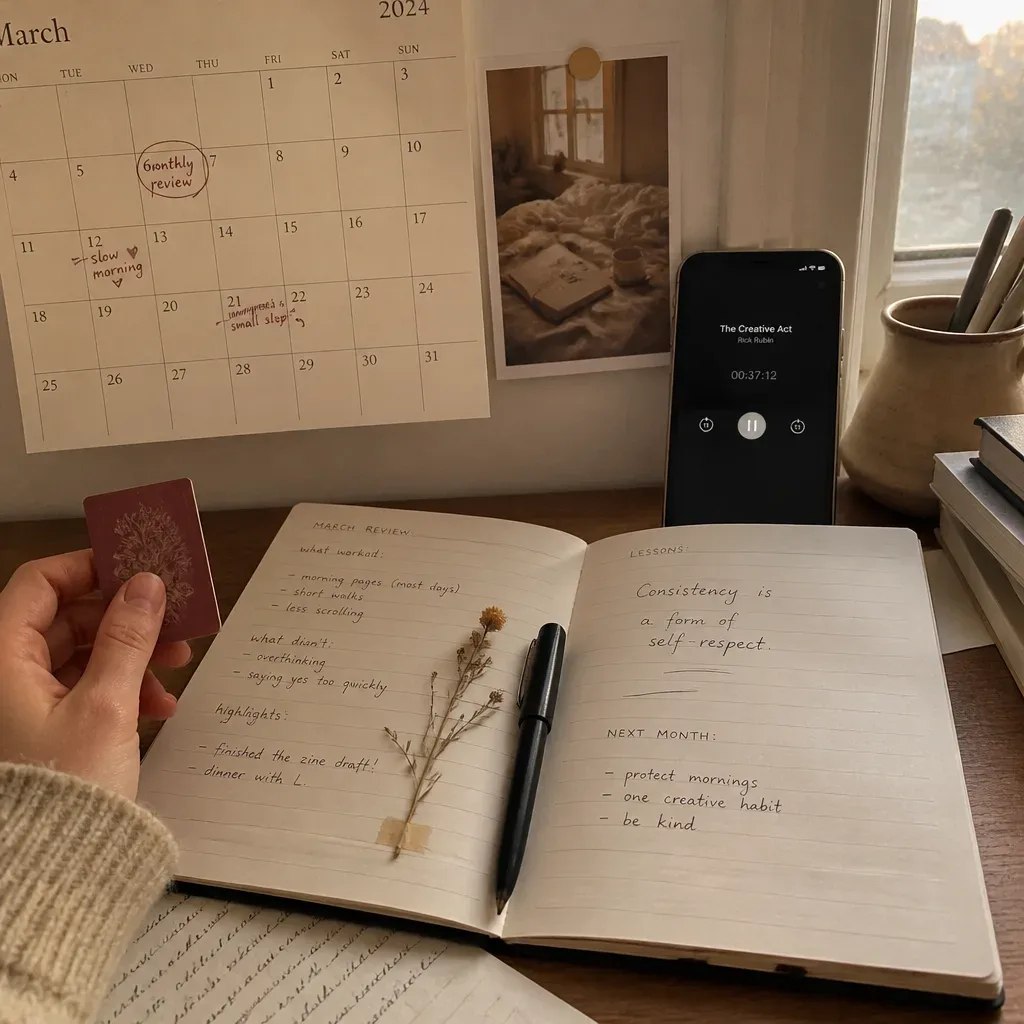
Quarterly reviews can be useful for larger themes. I like 90 days for checking whether the whole direction still belongs to me. Companies use quarters because 13 weeks are long enough for meaningful work, but human lives are softer than dashboards. I hold the quarter lightly.
A review is not a verdict. It is a maintenance appointment for desire.
What if the old audio feels wrong, but I do not know the new goal yet?
If the old audio feels wrong and the new goal is not clear, record a bridge version that names the next faithful behavior instead of a final destination.
I needed this after my father got sick. The old recording sounded too bright. Not false exactly, but badly lit. I did not know what I wanted for work, money, or the year. I only knew that I wanted to stay steady, sleep more than six hours, and write before my phone took the morning. So I recorded that. It was not smaller. It was closer.
A bridge audio can last 7 to 21 days. I borrowed that range from habit experiments more than doctrine. Short enough not to become a hiding place, long enough to gather data. Research on implementation intentions by Peter Gollwitzer, including work from the late 1990s, showed that “if-then” plans can improve follow-through by linking situations to actions. A bridge script uses the same idea: if it is morning, I listen; after listening, I do the next faithful thing.
For a bridge version, I avoid big claims. I write sentences like these:
- “I am listening every morning while the next shape becomes visible.”
- “I keep my body fed, my page open, and my promises small.”
- “I do not need to fake certainty to practice devotion.”
- “I notice what gives me life and what drains it.”
That last sentence is allowed to be enough for a while. The Manifestation pillar is useful here too, because it separates intention from fantasy. Intention can be humble. Fantasy usually demands costume changes.
When clarity returns, I record the next full Dream-Self Moment. I do not apologize to the practice for needing a bridge. Life changes faster than scripts do. The work is to keep the listening alive while the language catches up.
The quieter the edit, the more likely I am to keep it.
October 8th, night now. The new sentence is in the recording, and the kettle is dry.