aya method deep dive
Future Self Prompts: 9 Lines for Dream-Self Audio
Use these future self prompts to write a Dream-Self audio that feels believable, specific, and easy to return to each morning.
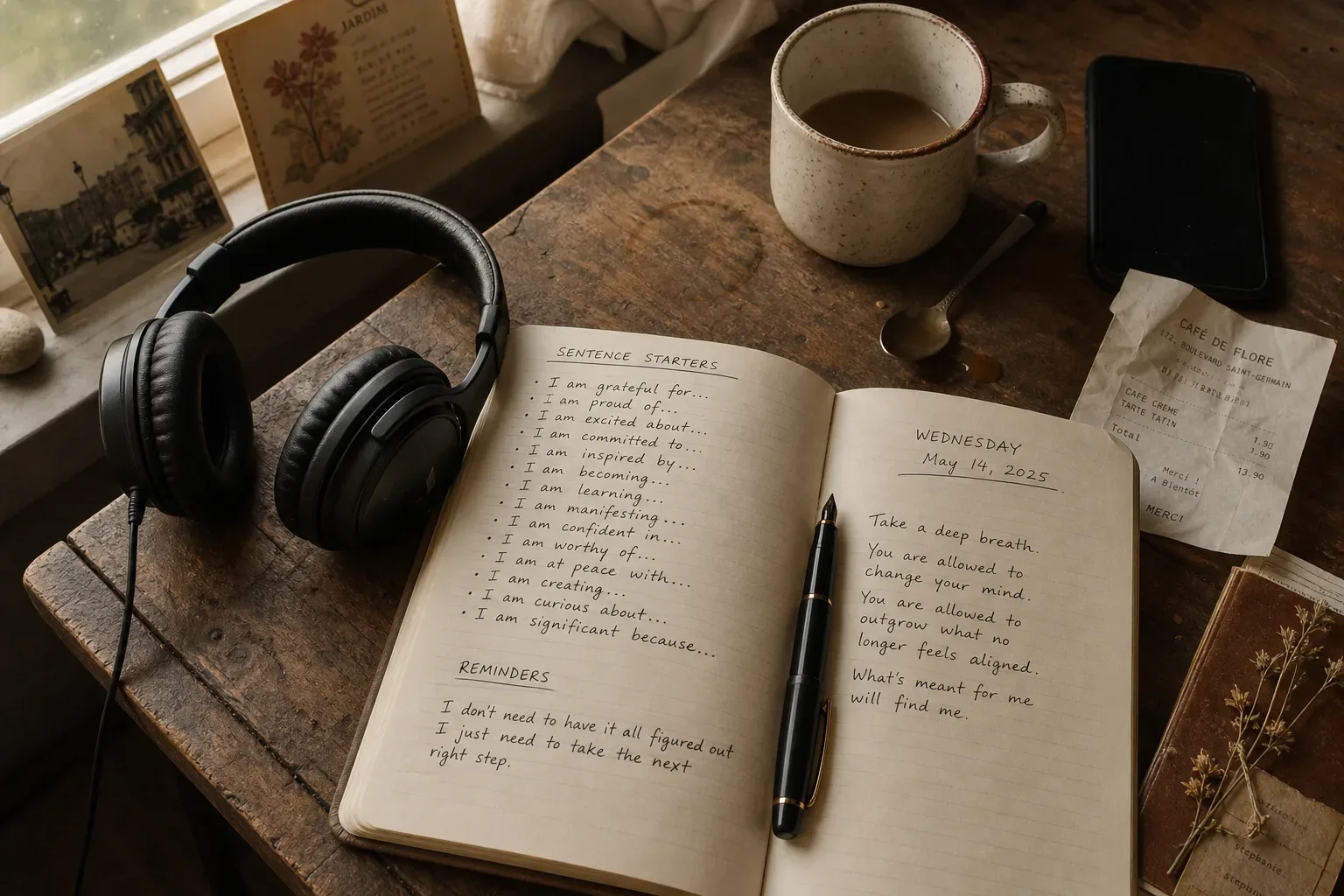
September 2nd. The future self prompts that work best are specific, calm, and evidence-based: what I do now, what I no longer rehearse, what changed in my Tuesday, and what I trust myself to repeat. I use them to write a short Dream-Self audio I can hear daily without arguing.
What should I actually say in a Dream-Self audio?
Say what your future self notices, does, chooses, and no longer needs to prove.
This morning, the kettle clicked off before I opened my laptop. I had 19 minutes before a call, which is usually when I pretend I can improve my whole life in one sitting. I did not. I opened the page where I keep my future self prompts and wrote one plain line: I answer the email before I make it a story about my worth.
That is the kind of sentence I trust. It has a scene. It has behavior. It has a little internal weather. It is also testable by lunch. Peter Gollwitzer’s work on implementation intentions, including a 2006 meta-analysis of 94 studies, found that if-then planning reliably improves goal follow-through. A Dream-Self audio is not the same as a lab intervention, but the pattern is useful: behavior gets stronger when it knows where to land.
In the AYA Method, the audio is the practice. The AYA Method is a daily audio manifestation practice. Each day you listen to a short personalized recording, your Dream-Self Moment, narrated from the version of you who has already manifested the life you intend. Listening is the practice. Repetition is the work. The audio is the method.
I keep that definition close because it stops me from adding too much. A written affirmation can help, and a Manifestation Board can hold the image, but the audio is the thing I return to while my hands are still damp from washing the coffee cup. If you want the broader frame, I keep notes beside the Manifestation pillar, but the script itself has to survive ordinary life.
A future self prompt should sound less like a victory speech and more like a voice note from someone who kept going.
How specific should future self prompts be?
Future self prompts should be specific enough that your body recognizes the day they belong to.
I used to write lines like, I am successful, and then feel vaguely accused by them. They were not wrong. They were just too large to hold. In 2009, Joanne Wood and colleagues published research in Psychological Science showing that positive self-statements can make some people with low self-esteem feel worse, especially when the statement feels far from current belief. I think about that every time a line sounds glossy.
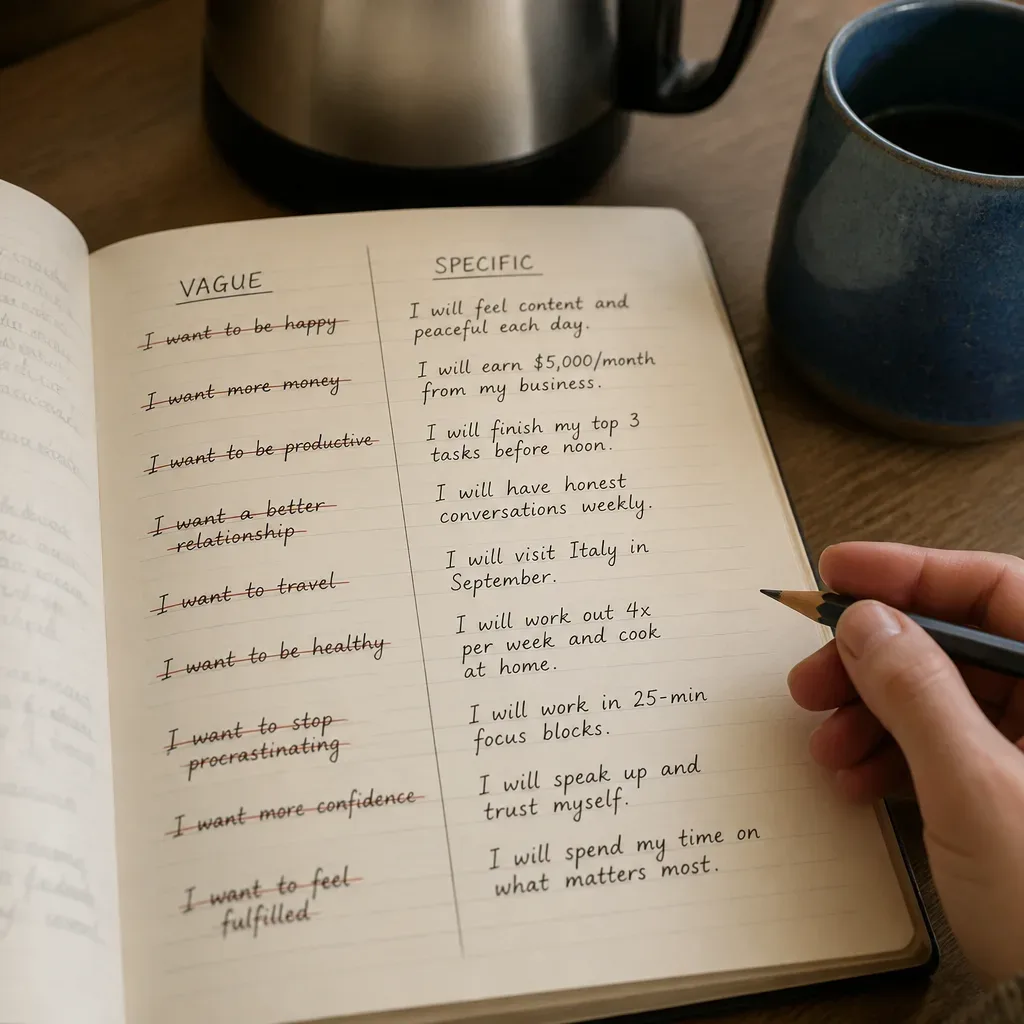
Specificity is not pessimism. It is mercy. Instead of I am confident, I write, I send the proposal before 10:30 and do not reread it six times. Instead of I am loved, I write, I let the text sit for 12 minutes before answering from fear. Instead of I am rich, I write, I open the banking app on Friday and make one clean decision.
Here is the little test I use in the chair by the window:
| Vague line | Better Dream-Self line |
|---|---|
| I am disciplined | I start before the room feels ready |
| I am magnetic | I ask clearly and stop overexplaining |
| I am wealthy | I review money on Friday without flinching |
| I am healed | I notice the old reaction and choose the next breath |
Gabriele Oettingen’s work on mental contrasting, summarized across decades of research, suggests that desired futures work better when paired with present obstacles. That does not mean making the audio heavy. It means letting the future self tell the truth. The sentence becomes stronger when it knows what it had to stop doing.
Which 9 future self prompts work best?
The 9 prompts that work best cover scene, evidence, choice, identity, resistance, repair, relationships, body, and repetition.
I wrote these on a receipt first, outside a pharmacy, because my notebook was at home and I knew I would forget. I have tested versions of them for clients, friends, and myself. Not in a randomized controlled trial. In the less glamorous trial of 30 mornings, missed trains, and one week where my sleep average was 5 hours and 42 minutes, according to my watch.
-
Where am I, and what ordinary thing tells me life has changed?
I am in the kitchen before 8, and the counter is clear because I stopped treating my mornings like a debt collection. -
What do I do first now?
I choose the one task that would make the day honest, then I begin before checking for approval. -
What evidence would someone close to me notice?
My mother would hear it in my voice. I answer slower. I do not sound like I am bracing. -
What did I stop repeating?
I no longer rehearse the worst version of the conversation while making coffee. -
What do I believe now because I practiced it?
I believe I can be consistent without becoming hard. -
What do I do when the old pattern appears?
I name it, take one breath, and choose the next small action instead of building a case. -
How do I receive love, money, or attention differently?
I let good things arrive without making myself smaller to pay for them. -
What does my body feel like in this life?
My shoulders drop before I speak. My jaw is not doing the work of my whole history. -
What do I return to every day?
I return to the audio, to the page, to the one clean promise I can keep today.
Neville Goddard often wrote about assuming the feeling of the wish fulfilled, and I understand why that line has lasted for decades. Still, I need the feeling to have furniture in it. A chair. A calendar. A bank tab. A quiet Tuesday. Feeling without detail can float away by noon.
Believability is not a smaller dream. It is the bridge the nervous system agrees to cross.
How do I turn the prompts into a script I can record?
Turn the prompts into a 250 to 500 word script by keeping one clear scene, three pieces of evidence, and one daily return line.
I learned this after making a 1,400 word audio that sounded like a founder pitch. Six years in venture did not prepare me for hearing myself oversell my own healing. I deleted it. A good Dream-Self audio should not need a deck. At a natural speaking pace of about 130 to 160 words per minute, a 400 word script becomes roughly 3 minutes. That is long enough to settle, short enough to repeat.
Here is the order I use:
- Open with the scene. One place, one time of day, one object.
- Name the changed behavior. Say what you do now.
- Name the old pattern gently. Say what no longer runs the room.
- Add one relationship detail. Let another person notice the change.
- Close with the return. Say what you practice today.
If I am writing about work, the opening might be: It is Tuesday morning, and I am at the table with the blue mug. The proposal is already sent. I do not wait for the perfect mood to begin. Then I add evidence: I keep my calendar lighter. I charge the rate without apologizing. I answer from the facts.
This is where Affirmations pillar can help if I am stuck. I borrow the shape of a simple affirmation, then give it a room to live in. I do not record every line I write. I cut at least 30 percent. Editing is part of care.
Joe Dispenza often speaks about rehearsing a future state until it becomes familiar. I take the practical part and leave the performance. The recording should make repetition easier, not turn the morning into theater.
What should I avoid putting in the audio?
Avoid lines that are too absolute, too abstract, or secretly unkind to the person you are now.
This is the page I wish I had when I started. I thought the future self had to sound certain. She does not. Certainty can be another costume for panic. In behavior change research, habit formation is uneven: a 2010 study by Phillippa Lally and colleagues in the European Journal of Social Psychology found that it took participants an average of 66 days for a new behavior to feel automatic, with a wide range from 18 to 254 days. So I distrust any script that demands instant permanence.
I cut these kinds of lines quickly:
- Never lines: I never doubt, never struggle, never procrastinate.
- Purity lines: I only attract good things, I only make perfect choices.
- Punishment lines: I am finally worthy because I work harder now.
- Fog lines: Everything is aligned, everything flows, everything is meant for me.
- Comparison lines: People finally see I was right all along.
The replacement is usually smaller and more honest. I do doubt, but I no longer let doubt make the whole decision. I do get tired, and I rest before I start bargaining with my standards. I do want to be seen, but I do not spend the morning prosecuting everyone who missed me.
Dr. Andrew Huberman has often noted, in his public teaching on behavior and the nervous system, that states of alertness shape what the brain can learn. I hear that as a writing instruction. Do not create a script that spikes the body and calls it faith. The better script lets the body stay in the room.
The line that shames your current self will not carry your future self very far.
How do I record and use it with the AYA Method each day?
Record it slowly, listen daily, and revise only after the audio has met your real mornings for at least a week.
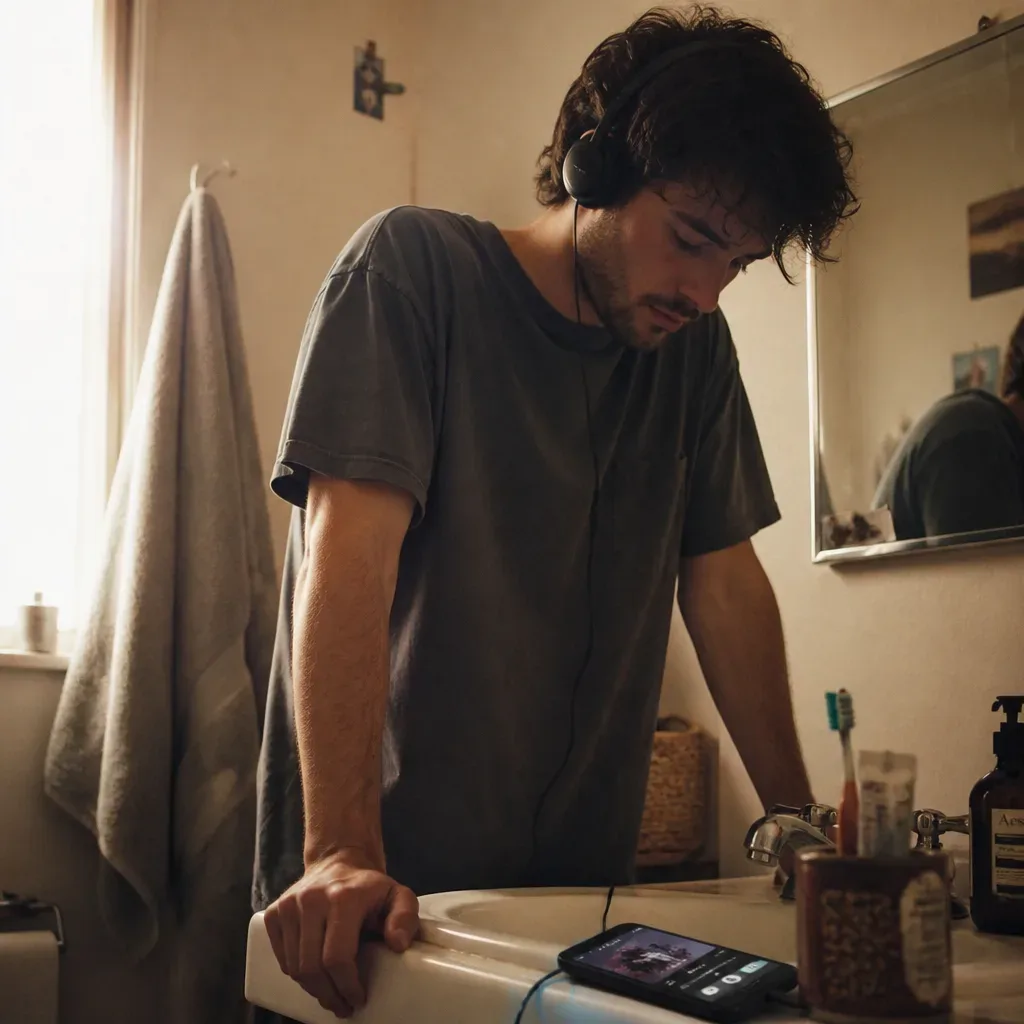
I listened to my Dream-Self Moment before brushing my teeth today. That is the order I do them in. I do not make it ceremonial. I put in the headphones, press play, and stand by the sink. Some days I feel moved. Some days I mainly notice toothpaste on my shirt. Both days count.
For my own use, I follow a 7 day testing rule. I listen once daily for a week, then mark three things: the line I believed most, the line I resisted most, and the line I forgot as soon as it passed. That last one matters. If a sentence leaves no trace after 7 listens, it may be too generic. The American Psychological Association has published summaries showing that repetition and environmental cues support habit formation; I take that seriously and keep the listening cue boring.
A simple schedule works:
| Day | What I check |
|---|---|
| 1 | Does the audio feel safe enough to hear again? |
| 3 | Which line is starting to follow me into the day? |
| 5 | Which sentence makes me argue? |
| 7 | What needs cutting, softening, or sharpening? |
I keep one written daily affirmation beside the audio sometimes, especially if a single sentence keeps asking to be written down. I also keep a Manifestation Board for images, mostly interiors, invoices, and one photograph of a train platform. Those are complements. The listening is still the practice.
On Sundays, I sometimes read Astrology and manifestation with coffee, mostly as a timing ritual. But I do not let timing replace action. If the recording says I send the proposal, then the proposal needs a timestamp. If the recording says I speak clearly, then my next message gets fewer apologies.
If you are new to manifestation, do not start by trying to believe everything. Start by listening without leaving. The audio will show you which parts of the future already feel near and which parts need kinder language.
Repetition is not proof that nothing is happening. Repetition is often how the change learns your address.
How will I know the prompts are working?
The prompts are working when they change what you notice, what you choose first, and what you recover from faster.
I do not measure this by whether every desire arrives on my preferred schedule. That would make me unbearable by breakfast. I measure it by friction. Did the line come back when I needed it? Did I make the call 11 minutes sooner? Did I stop narrating one old story before it hardened into a mood? Small evidence counts because the nervous system lives in increments.
In small studies on self-affirmation, including work by Claude Steele’s theory of self-integrity and later neuroscience research from Cascio and colleagues in 2016, values-based reflection has been linked with activity in brain regions associated with self-processing and valuation. That does not mean a sentence fixes a life. It means language can change what becomes available to attention.
My own signs are embarrassingly plain:
- I stop editing a text after the third read.
- I notice the clean version of the decision before the dramatic one.
- I recover from a bad morning before dinner.
- I keep the audio in rotation after the novelty wears off.
- I take one action that matches the recording before I feel fully ready.
This is also why I keep the AYA Method in the low-friction category. I have reviewed too many wellness apps that ask for 14 inputs before breakfast. A practice earns trust when it survives the day you forgot to be impressive. On day eight, I was still listening without reminding myself I was testing it. That is the metric I respect.
Tonight the page is still open, and the kettle needs wiping.