vision boards
2027 Vision Board: Build It Around Dream-Self Audio
Build a 2027 vision board around Dream-Self audio so the images support daily listening, clearer goals, and a practice you can keep.
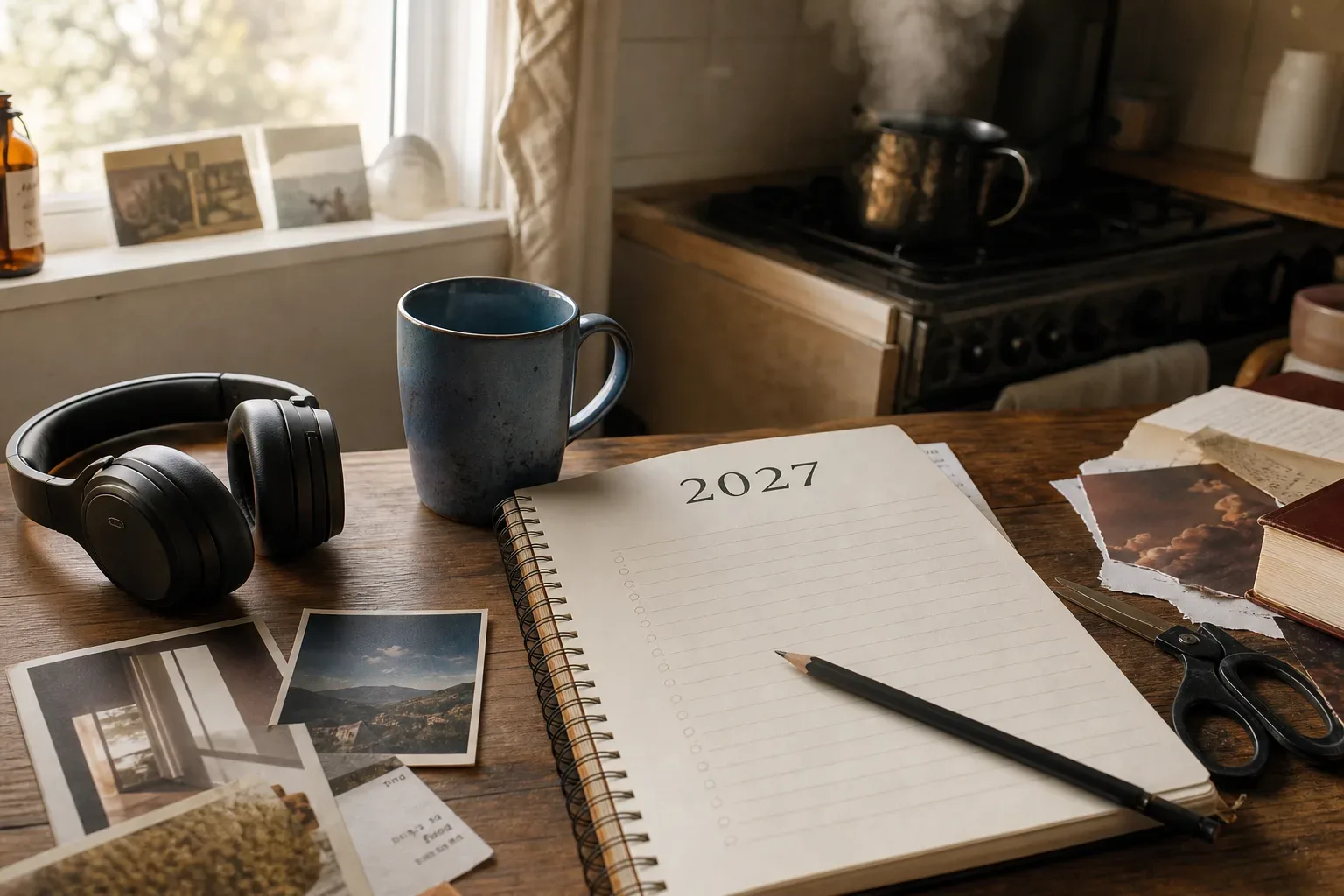
November 1. My kettle clicked off while I wrote “2027” at the top of a blank page. A 2027 vision board works best when it is built around Dream-Self audio first, because the listening gives the images a daily job: to remind the body who I am practicing becoming.
Why should my 2027 vision board begin with audio?
A 2027 vision board should begin with audio because listening creates the repeated cue that a static board often cannot hold by itself.
I learned this the unglamorous way. In 2024, I made a board that looked beautiful and did almost nothing. It lived on my phone wallpaper for 18 days before I stopped seeing it. That is not a moral failure. The brain adapts to familiar visuals quickly; in attention research, this is often called habituation. A thing can be meaningful and still become background.
Audio interrupts that softness differently. It arrives in time. It has a beginning, a middle, and an end. When I listen to my Dream-Self Moment, I am not asking an image to do all the work. I am giving my nervous system a short rehearsal. Dr. Andrew Huberman has often described the brain as changing through repeated attention and behavior, not through one grand decision. I think about that when I put in my headphones before brushing my teeth.
The AYA Method is a daily audio manifestation practice. Each day you listen to a short personalized recording — your Dream-Self Moment — narrated from the version of you who has already manifested the life you intend. Listening is the practice. Repetition is the work. The audio is the method.
That definition matters because it keeps my 2027 board from becoming a collage of wanting. Wanting is noisy. Practice is quieter. My board becomes an interface for returning, not a shrine for wishing.
A vision board is not powerful because it is pretty. It is powerful when it is easy to return to on an ordinary Tuesday.
What do I listen for before choosing images?
I listen for identity, behavior, and emotional texture before I choose a single picture.
This morning, I sat in the chair by the window and played the audio once without taking notes. Then I played it again and wrote down verbs. Not nouns. Verbs tell me what the board needs to show. I wrote: write, invoice, swim, call, save, cook, sleep, ask, finish. Eight words. They gave me more direction than 80 saved images ever have.
Neville Goddard wrote often about assuming the feeling of the wish fulfilled. I take the useful part plainly: the future self has a tone. She does not only own things. She moves through a day. She answers email differently. She leaves the party earlier. She books the medical appointment. She sends the proposal on Thursday, not someday.
I use three listening passes before I build the board:
- First pass: body. What does my body feel like when this life is normal?
- Second pass: behavior. What does this self do before noon, after work, and before bed?
- Third pass: evidence. What would I see in the room if this were already my ordinary life?
The third pass is where images start to appear. Not a generic luxury kitchen. My kitchen, with a clear counter and my blue mug. Not a vague career photo. A calendar with protected design hours. Not a stranger running at sunrise. My shoes by the door, used three times a week.
In a 2009 study by Phillippa Lally and colleagues at University College London, new habits took an average of 66 days to become automatic, with wide variation from 18 to 254 days. That number makes me gentler with the board. If my 2027 identity needs repetition for months, then the images must be humble enough to repeat.
How do I choose images that do not turn into decoration?
I choose images that show proof of daily behavior, not images that only perform the final result.
This is where my designer brain becomes useful. A good interface shows the next action. A weak interface only shows the dream state. For a 2027 vision board, I want images that make the next action visible enough that I can do one small thing today.
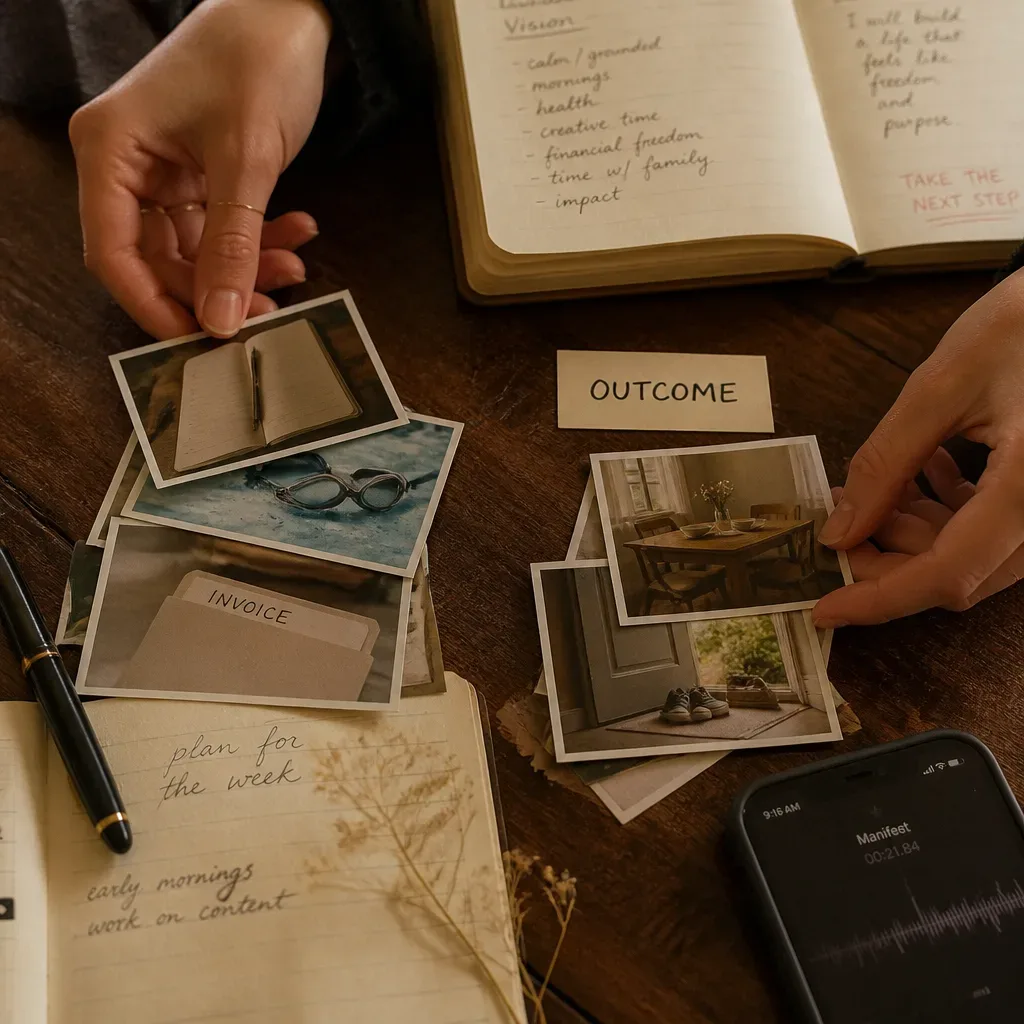
I keep a simple rule: at least 70 percent of the board must show process. The remaining 30 percent can show outcome. That ratio is not sacred, but it keeps me honest. If every image is a finished apartment, a finished body, a finished bank balance, my nervous system has nowhere to enter. If the board includes the notebook, the walking route, the standing desk, the grocery receipt, the open invoice, the chair where I listen, then I can begin.
Research on mental simulation supports this. In one often-cited UCLA study from the late 1990s, students who visualized studying for an exam tended to do better than students who only visualized getting a high grade. Process imagery changed behavior more reliably than outcome imagery. I think vision boards need the same correction.
Here is the table I used on the page before I opened Pinterest:
| 2027 area | Process image | Outcome image | Daily cue |
|---|---|---|---|
| Work | Laptop with one open draft | Published essay page | After morning audio |
| Money | Spreadsheet and invoice folder | Debt-free note | Friday review |
| Body | Swimsuit drying in bathroom | Strong posture photo | Tuesday pool slot |
| Home | Clear table after dinner | Warm apartment corner | Ten-minute reset |
| Love | Two mugs on a small table | Weekend trip photo | One honest message |
| Practice | Headphones beside bed | Calm face in mirror | Dream-Self Moment |
I also add one written line under each cluster. Short lines work better for me than quotes. The Affirmations pillar has helped me make them plain. “I keep my promises in small units.” “I invoice on time.” “I answer love while it is still here.”
The image should not impress the old self. It should instruct the next self.
Where should the Dream-Self audio sit on the board?
The Dream-Self audio should sit at the center of the board, because it is the daily practice that gives the rest of the board its rhythm.
On my draft, I draw a small circle in the middle before I place anything else. In that circle I write: listen first. Not because the board is secondary in a dismissive way. The board matters. But it is a complement. The audio carries the repetition. The images hold the evidence.
I do not make the daily affirmation and the Manifestation Board equal pillars beside the audio. I have tried that kind of system before, and it became heavy by week three. Three pillars became three chores. One practice with two quiet supports is kinder. The listening is the method. The affirmation is a note in the margin. The board is a visual receipt.
The Manifestation pillar describes the wider practice, but on my desk I need fewer words. I need an order I can keep when I am tired. For me, the order is:
- Put on headphones.
- Listen to the Dream-Self Moment.
- Look at the board for one minute.
- Choose one action small enough to do today.
- Write the action on the page before I leave the chair.
That takes about 6 minutes. The Centers for Disease Control and Prevention often uses 150 minutes a week as a benchmark for moderate physical activity; I think about that number because we accept repetition for the body more easily than we accept it for identity. Six minutes a day is 42 minutes a week. It is not dramatic. That is why it survives.
When the audio sits at the center, the board stops asking, “Do you still want this?” It starts asking, “What would match what you just heard?” That is a better question at 7:10 in the morning, with coffee cooling beside my wrist.
A practice that respects my attention has a better chance of still being there in six months.
How do I make the board specific to 2027 instead of someday?
I make the board specific to 2027 by giving it dates, seasons, thresholds, and review points.
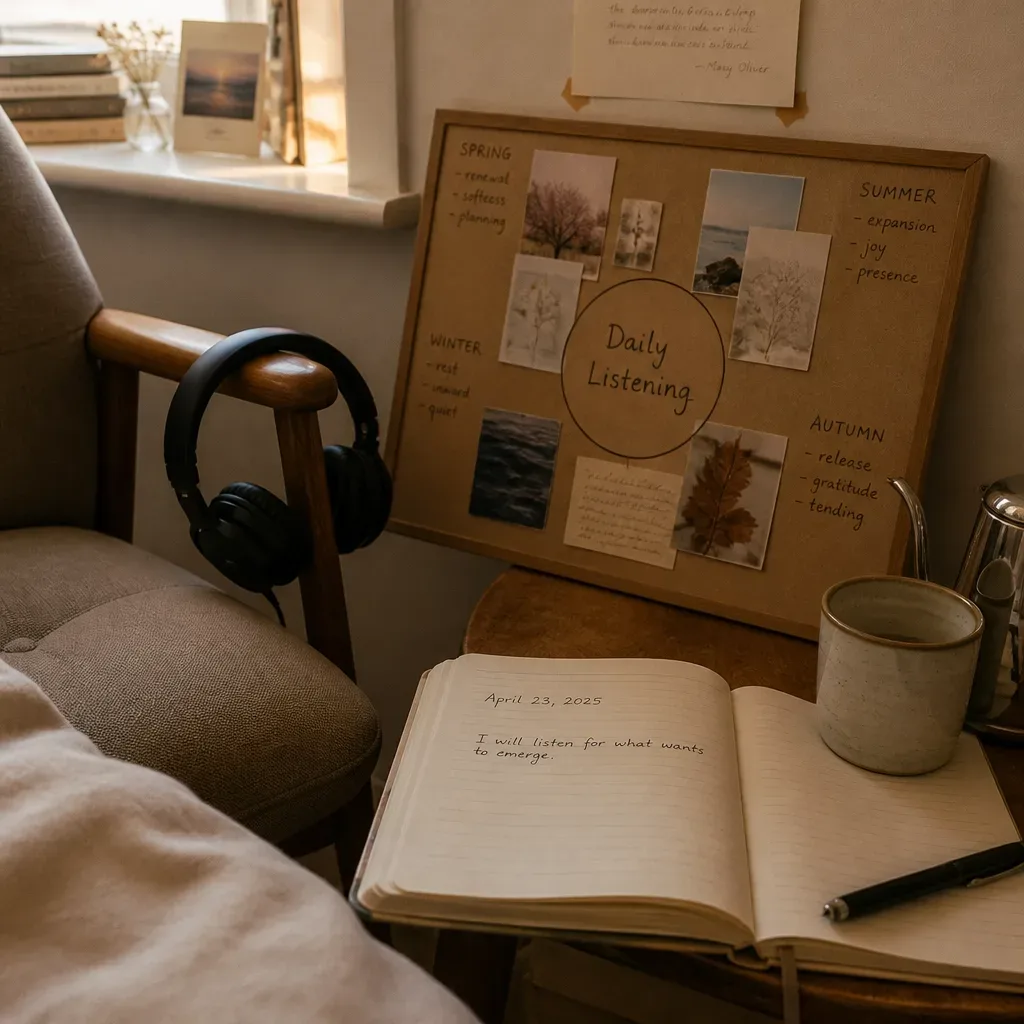
A year is not a mood. It is 12 months, 52 weeks, and 365 days. If I do not place time on the board, the images float. I want them to land. For 2027, I am dividing the board into four seasonal bands: January to March, April to June, July to September, and October to December. I learned this from product roadmaps, which become less frightening when they are quartered.
I do not fill every band evenly. Some goals need a start date. Some need a maintenance season. Some need a single visible checkpoint. A money goal might need a monthly review. A body goal might need three pool sessions a week. A writing goal might need a submission deadline by May 31. Specificity gives the future self a calendar.
Pew Research Center reported in 2023 that roughly 90 percent of U.S. adults own a smartphone. I am not in the U.S., but the point travels: most of us carry the cue machine in our hands. So I add two digital supports only. I make a phone album called “2027 board,” and I set one recurring calendar note for the first Sunday of each month. No elaborate dashboard. No tracking sheet that becomes another unpaid job.
I also use moon dates because I am that person, and I am at peace with it. My astrology and manifestation notes sit in Notion, mostly as a timing ritual. The moon calendar does not decide my life. It gives me a regular evening to sit down and ask what still feels true.
Here is the seasonal map I wrote today:
- Winter: make the board, protect sleep, set up invoices, listen daily.
- Spring: publish the first long piece, swim twice a week, clear one debt category.
- Summer: travel lightly, review relationships, practice saying no sooner.
- Autumn: revise the board, archive what has become normal, name 2028 gently.
Someday is where practices go to disappear. A dated board gives the future a door handle.
What daily routine keeps a 2027 vision board alive?
The routine that keeps a 2027 vision board alive is short, attached to an existing habit, and pleasant enough to repeat when life is plain.
I attach mine to coffee because coffee already happens. The kettle is my cue. While it heats, I put my headphones on the table. After I pour, I listen. Then I look at the board. Then I write one line. The whole thing fits before the first message of the day, which matters because attention becomes more expensive after the inbox opens.
Behavioral design often uses the cue-routine-reward loop described by Charles Duhigg in 2012, though the science behind habits is older and more complex. My version is simple: kettle, audio, board, one action, sip. The reward is not a badge. The reward is that the listening feels good enough that I do not resent the practice.
I keep the routine this small:
- Cue: kettle, bus seat, bath water, or bedside lamp.
- Practice: listen to the Dream-Self Moment.
- Visual return: look at the 2027 board for 60 seconds.
- Action: choose one behavior that fits today.
- Record: write one dated line in the notebook.
On difficult days, I remove step five. On very difficult days, I only listen. That is not a broken version. That is the minimum viable ritual. In design, the best system is not the fullest one. It is the one that still works under low battery.
A vision board does not need more intensity. It needs a smaller door back in.
I also keep the board physically near the listening place. If it lives in a drawer, it becomes a memory of a workshop. If it sits near the chair, it becomes part of the morning. The difference is not spiritual. It is spatial.
How do I review the board without turning it into a scorecard?
I review the board by asking what still creates action, what has become normal, and what was never mine to begin with.
On the first Sunday of each month, I give it 10 minutes. I do not grade myself. I do not write a dramatic audit. I put the board on the table, play the audio once, and mark three things with small sticky notes: keep, revise, release. Three categories are enough.
There is good reason to keep reviews gentle. A 2011 meta-analysis by Harkin and colleagues found that monitoring goal progress can improve attainment, especially when progress is recorded or made public. But monitoring can also become self-punishment if the tone is wrong. I want accountability without theater. A dated note is enough: “March 3. Swimming image still works. Apartment image feels borrowed. Replace.”
I release images for several reasons:
- The image made me perform instead of practice.
- The goal belonged to someone else’s approval.
- The picture was too vague to guide behavior.
- The desire changed after I listened for a month.
- The outcome arrived, and the image can become an archive.
I like archiving. It teaches me that some images are not failures; they are finished. The clear desk might become normal by April. The invoice folder might stop needing emotional support. The board should be allowed to age.
For a wider view, I sometimes return to the Manifestation pillar when I notice I am making the practice too tight. Manifestation, at its best, is not a panic project. It is repeated attention, honest desire, and behavior that begins to match. The board is one tool inside that, not the whole house.
The quiet test is this: after reviewing the board, do I know one kinder action to take today? If yes, it is still working.
What should I do today if I only have 45 minutes?
If I only have 45 minutes, I make a rough board, not a perfect one, and I let the audio refine it over the next month.
I am writing this before I forget, because perfection is the most elegant way I avoid beginning. Forty-five minutes is enough. Set a timer for each part. I use 5 minutes to listen, 10 minutes to write verbs and life areas, 15 minutes to collect images, 10 minutes to arrange them, and 5 minutes to choose tomorrow’s cue.
The Princeton Engineering Anomalies Research program, often discussed in manifestation circles, ran from 1979 to 2007 and studied mind-matter questions with controversial interpretations. I do not build my board on claims I cannot personally verify. I build it on something plainer: repeated attention changes what I notice, what I choose, and what I am willing to practice. That is enough to begin.
If you are making yours today, keep the first version almost embarrassingly simple:
- Write “2027” at the top of a page.
- Listen to your Dream-Self audio once.
- Write five verbs you heard or felt.
- Choose five life areas, no more than seven.
- Find one process image for each area.
- Put the listening cue in the center.
- Place the board where tomorrow will find it.
If you need language for the written pieces, borrow from the Affirmations pillar, then make the lines sound like you. If a phrase would embarrass you on a sticky note, it probably will not last. My best lines are plain enough to survive the bathroom mirror.
The 2027 vision board I trust is not the one that dazzles me tonight. It is the one I can return to when the kettle clicks off tomorrow.
November 1, evening. The headphones are back beside the blue mug.