manifestation 101
369 Manifestation Method With 3-Minute Audio
Learn the 369 manifestation method with a 3-minute future-self audio, simple timing, writing prompts, and a quiet way to repeat what you intend.
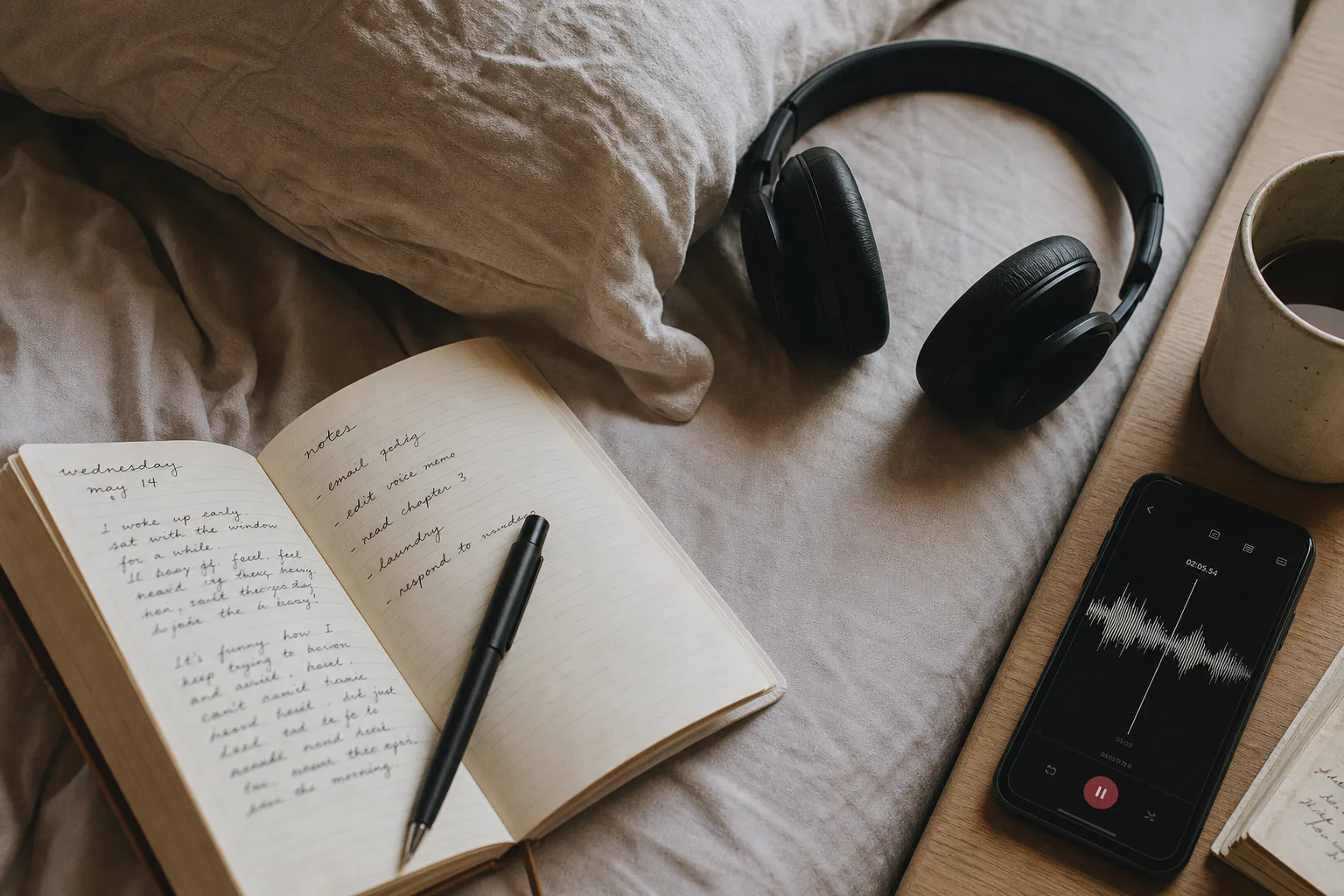
A notebook sits open beside your phone. The 369 manifestation method can be done in 12 quiet minutes: write one intention 3 times, listen to a 3-minute future-self audio, return at midday for 6 repetitions, and close the night with 9. The audio gives the words a place to live.
What is the 369 manifestation method really doing?
The 369 manifestation method gives one intention a repeatable daily shape.
The method is simple on the surface. You write the same sentence 3 times in the morning, 6 times later in the day, and 9 times at night. That is 18 written repetitions a day. Over 7 days, it becomes 126 contacts with one chosen future. The numbers are memorable. That matters. A practice you can remember has a better chance of being repeated.
No number works without attention. If you write the sentence while your mind is elsewhere, you have copied words. If you write and briefly feel the identity inside the words, you have practiced. Neville Goddard wrote in Feeling Is the Secret in 1944 that the felt state matters more than the outer phrase. You do not have to agree with every claim in his work to use that one useful distinction.
A clean version of the method has three parts:
- One present-tense sentence.
- Three writing sessions each day.
- One small action that matches the sentence.
That last part keeps the practice real. Manifestation is not waiting with prettier language. It is attention, repetition, and behavior starting to face the same direction. In habit design, the smallest reliable action often matters more than the largest imagined change. BJ Fogg at Stanford has taught for years that tiny behaviors work because they lower the cost of starting.
A sentence becomes useful when it changes what you notice next.
So the 369 manifestation method is not a charm. It is a counting frame. It asks you to return to the same truth before the day begins, while the day is moving, and before sleep makes it soft again.
Why add a 3-minute future-self audio?
A 3-minute future-self audio helps the written sentence feel less like a task and more like a remembered self.
Writing is active. Listening is receptive. You need both if your mind tends to argue with new language. A 2020 review in Frontiers in Psychology noted that mental imagery can influence emotion and motivation because the brain often responds to imagined scenes with some of the same systems used for perception. That does not make imagination magic. It makes it practice.
This is where the AYA Method enters quietly: The AYA Method is a daily audio manifestation practice. Each day you listen to a short personalized recording — your Dream-Self Moment — narrated from the version of you who has already manifested the life you intend. Listening is the practice. Repetition is the work. The audio is the method.
The 369 method gives your hand a rhythm. The Dream-Self Moment gives your ear a voice. If your written sentence says, I speak clearly in the meeting and leave proud of myself, the audio can hold the fuller scene: your breath steady, your body seated, your words simple, the meeting ending without the old collapse.
Three minutes is short enough to keep. In app behavior research, completion rises when a practice feels finishable. You can also look at meditation adherence: studies often find that brief daily practices, sometimes 5 to 10 minutes, are easier to maintain than long sessions for beginners. Short does not mean thin. Short means repeatable.
The daily affirmation and Manifestation Board can support this. They are complements, not the pillars. If you use affirmations, let the affirmation echo the same intention. If you use a board, let it show the same future with one true image. Do not turn one practice into five jobs.
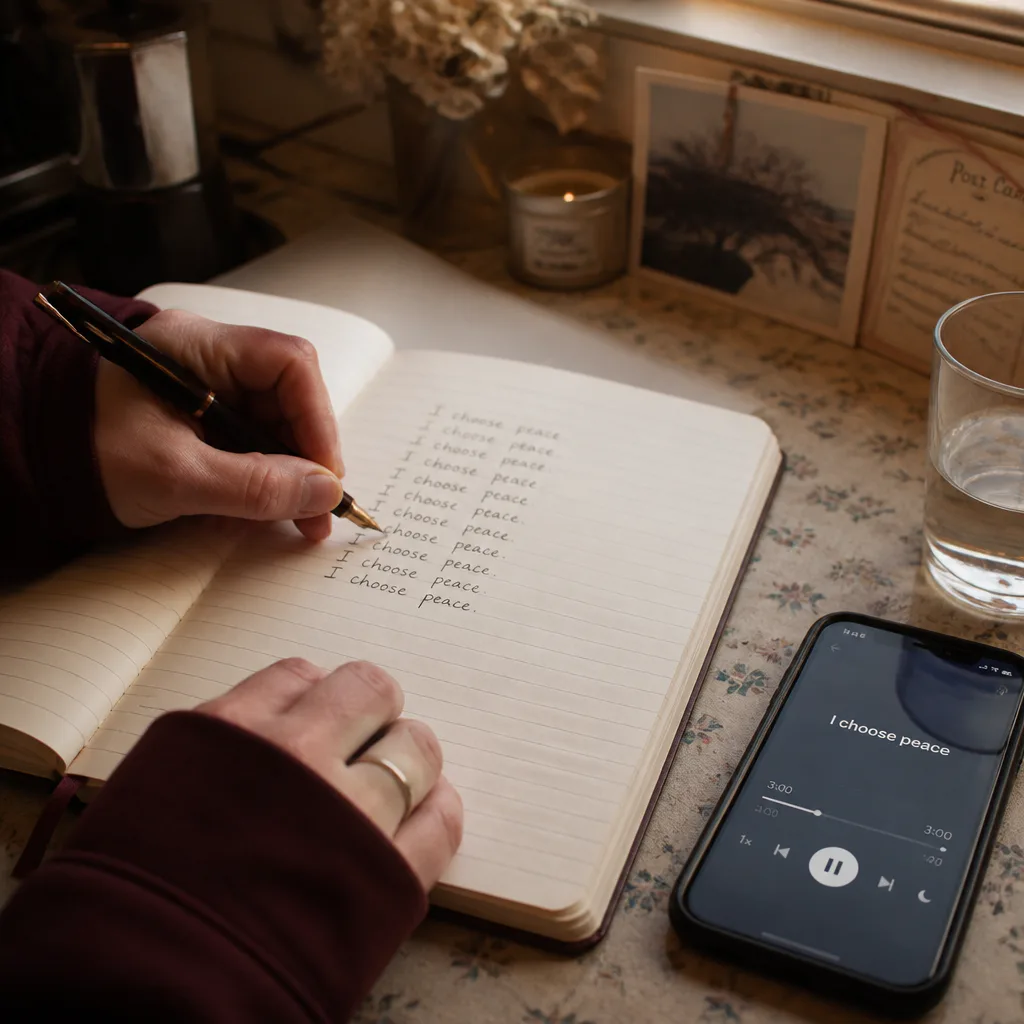
How do you set up the practice before day one?
Set up the practice by choosing one sentence, three daily anchors, and one audio that speaks from the future self you are practicing.
Start smaller than your ambition. The University College London habit study by Phillippa Lally and colleagues, published in 2009, found that habit automaticity took a median of 66 days, with a wide range from 18 to 254 days. That study is often simplified online, but the useful point is plain: repeated context matters. You are not trying to win the first morning. You are building a place to return.
Choose an intention that has a real edge but does not make your body reject it. I am a billionaire by Friday is not a practice for most people. I handle money with clarity for 10 minutes each morning is closer to the ground. It gives the nervous system a behavior to recognize.
Use this setup table before you begin:
| Practice piece | Quiet rule | Example |
|---|---|---|
| Intention | One sentence, present tense | I finish my workday with focus and leave on time. |
| Morning anchor | Attach to something already real | After brushing teeth. |
| Midday anchor | Choose a stable pause | After lunch. |
| Evening anchor | Close before your phone scroll | Before charging the phone. |
| Audio | 3 minutes from the future self | A Dream-Self Moment about calm focus. |
| Action | One behavior that agrees | Open the hardest file for 10 minutes. |
The sentence should be short enough to write 18 times without becoming punishment. Twelve words is often better than thirty. In writing research, cognitive load rises as a task becomes more complex; you do not need a lab to feel this. A sentence you can hold in one breath is easier to repeat with attention.
If you are curious about timing and symbols, astrology and manifestation can be used as a reflective calendar. Keep it secondary. The practice still needs your hand, your ear, and your next action.
What exactly do you write 3, 6, and 9 times?
Write one believable present-tense sentence that names who you are being and what you are doing.
The best 369 sentence sits between fantasy and a to-do list. It is not only, I send the proposal. It is also not, Everything I want is already mine. A stronger line might be: I send clear proposals and trust myself to be seen. That sentence has behavior and identity. It tells you what to do, and it tells you who is doing it.
Use the 3 morning repetitions to set direction. Your brain is especially sensitive to first inputs after waking because attention has not yet been spent on messages, choices, and other people. Sleep researchers often describe the morning as a transition window, not a sacred portal. That is enough. You are less defended for a few minutes.
Use the 6 midday repetitions to interrupt drift. A 2010 study by Killingsworth and Gilbert in Science found that people reported mind wandering in about 47 percent of sampled moments. Midday is where your intention can get buried under tabs, errands, and mood. Six repetitions are not there to impress anyone. They are there to bring you back.
Use the 9 evening repetitions to close the loop. Memory consolidation is linked with sleep, and many studies show that what you rehearse before rest can become easier to retrieve later. Do not make grand claims from that. Simply give your mind one clean sentence before it goes dark.
Here are sentence forms that tend to work:
- I am becoming the kind of person who ____.
- I choose ____ even when ____.
- I receive ____ by practicing ____ daily.
- I move through ____ with ____ and ____.
- I let ____ be simple, steady, and mine.
Repetition is not proof. Repetition is placement.
One warning. Do not rewrite the sentence all day. Editing can become avoidance in nicer clothes. Pick the line. Keep it for at least 7 days. Change only if it feels false in a way that makes you shut down.
How do you use the 3-minute audio inside the 369 rhythm?
Use the 3-minute audio after the morning writing, and again at night if your mind needs help settling into the sentence.
The order matters less than the consistency, but this order works for most people: write 3 times, listen once, live the day. The writing opens the door. The audio walks you through it. In the AYA app, your Dream-Self Moment is narrated from the version of you who has already manifested the life you intend. That future voice can make the sentence feel known instead of forced.
You can listen with headphones, on a walk, or sitting at the edge of your bed. Do not multitask at first. Three minutes is 180 seconds. That is shorter than many songs and shorter than the average social feed check reported in several app analytics studies. You have time. The question is whether the practice feels small enough to keep.
Try this 12-minute day:
- Morning, 4 minutes: Write the sentence 3 times. Listen to the 3-minute audio.
- Midday, 3 minutes: Write the sentence 6 times. Take one matching action.
- Evening, 5 minutes: Write the sentence 9 times. Listen again if the day felt noisy.
The matching action is what protects the practice from becoming decorative. If your sentence is about calm communication, send one clean message. If it is about health, put the shoes by the door. If it is about creative work, open the file for 10 minutes. Specific action gives the brain evidence it can recognize.
Joe Dispenza often speaks about rehearsing a future state before it appears in outer life. You do not have to adopt his full framework to use rehearsal well. Athletes have used mental practice for decades; meta-analyses on imagery in sport have found small to moderate benefits when imagery is paired with physical practice. Pairing is the important word.
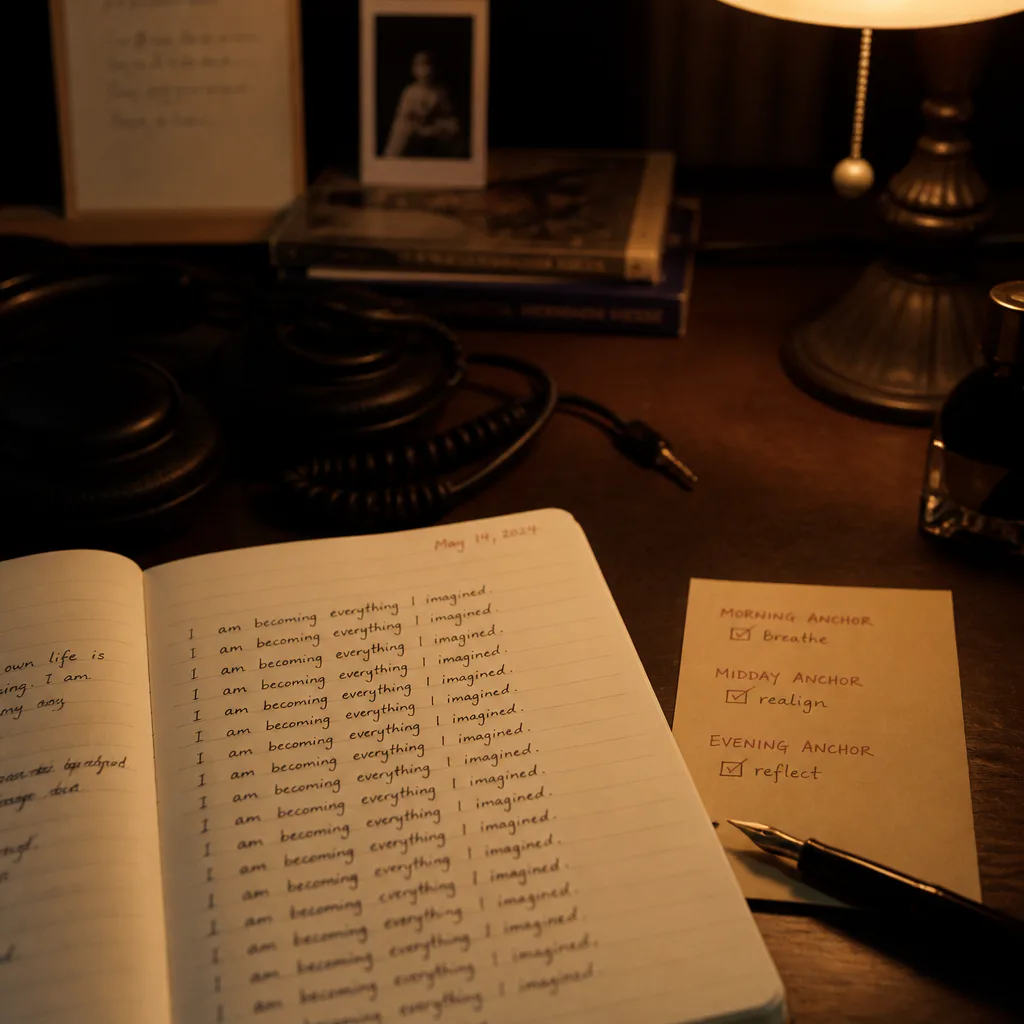
What mistakes make the 369 manifestation method feel fake?
The method starts to feel fake when the sentence is too grand, the practice is too heavy, or no behavior changes afterward.
The first mistake is choosing a sentence your body cannot enter. If you feel a hard no every time you write it, soften it. Change I am completely free from fear to I meet fear and still take the next honest step. The second sentence has room for being human. It does not demand a personality transplant before breakfast.
The second mistake is stacking too much around the method. You do not need candles, a perfect notebook, a one-hour morning routine, and a silent house. You need a sentence, a pen, a listening window, and a next action. In behavior design, friction is one of the main reasons people quit. Remove friction before you add beauty.
The third mistake is treating numbers as a substitute for attention. Writing 3, 6, and 9 times can become automatic in the wrong way. If you notice that happening, slow down for the first and last repetition of each set. Put your hand on the page. Read the sentence once out loud. It takes about 10 extra seconds.
The fourth mistake is changing intentions too quickly. Give the sentence 7 days before you judge it. In many small intervention studies, including expressive writing and gratitude practices, effects are often measured over 1 to 4 weeks, not 1 afternoon. Your nervous system deserves a fair sample size.
The fifth mistake is using the method to bypass grief, debt, medical care, conflict, or hard decisions. A manifestation practice is not a replacement for therapy, legal help, treatment, or a conversation you need to have. It can sit beside those things. It can help you meet them with a steadier self.
The practice is not here to make life unreal. It is here to make your next true step easier to take.
How do you know if it is working?
You know it is working when your attention, choices, and tolerance for the new identity begin to change.
Do not measure only the outer result. Measure the inner and behavioral signals too. After 7 days, ask: Did I remember the intention during the day? Did I take at least one matching action? Did the sentence feel less strange by the end of the week? Did I recover faster when I forgot? These are practical signs.
Use a simple scorecard for 14 days. Give yourself 1 point for each completed writing set, 1 point for listening to the audio, and 1 point for a matching action. The maximum is 5 points per day, or 70 points across 2 weeks. If you score 40 or higher, you are building contact. If you score lower, reduce the friction rather than blaming your will.
You can also track one outcome that belongs to the intention. If the sentence is about focused work, track minutes of focused work. If it is about dating, track honest messages sent. If it is about money, track days you looked at the numbers. Keep the metric plain. A clear number tells the truth without drama.
After 14 days, adjust one thing only. Change the anchor, the sentence, the action, or the audio theme. Not all four. Product designers call this isolating the variable. It is how you learn what is helping. It is also how you keep the practice from turning into self-criticism.
The 369 manifestation method works best when it stays quiet enough to repeat. The audio keeps it intimate. The numbers keep it structured. Your action keeps it honest.
Return to the sentence that still feels true.