manifestation 101
Act As If Manifestation With Future-Self Audio
A quiet how-to for act as if manifestation: use future-self audio before small choices, with neuroscience, steps, examples, and grounded practice.

Thursday. The kettle clicked off while I was still holding my phone. Act as if manifestation works best when I use future-self audio before one small choice, then take the next matching action. Not a grand performance. A cue, a pause, and one decision my future self would recognize.
What does act as if manifestation actually mean?
Act as if manifestation means choosing from the identity you are rehearsing before your outer life has fully caught up.
I write that carefully because I have seen this phrase become theatrical. It is easy to make it sound like costume. Spend as if rich. Speak as if certain. Walk as if nothing hurts. That is not how I use it, and it is not what I would recommend as a neuroscience researcher finishing a PhD in cognitive neuroscience at the University of Helsinki. The useful version is smaller. It asks what kind of person I am practicing being, then lets that answer touch one behavior.
Neville Goddard wrote often about assuming the feeling of the wish fulfilled, and his language still shapes much of Manifestation pillar writing today. I read him beside a different shelf: Hazel Markus and Paula Nurius introduced the term possible selves in 1986, describing future-oriented self-images that can motivate behavior. That paper has been cited more than 20,000 times, which tells me the idea did not stay inside one spiritual corner.
The brain does not blindly mistake imagination for reality. That sentence is repeated too often, and it is false as stated. What is true is more interesting: repeated self-relevant images and words can shape attention, emotional prediction, and readiness to act. In self-referential processing studies, the medial prefrontal cortex is reliably involved when people think about themselves, and meta-analyses over the last 15 years keep returning to that region.
A future self is not a fantasy if it changes how I answer a message at 8:12 in the morning.
This is where act as if manifestation becomes practical. I do not need to believe I am already finished. I need to know the next honest behavior. If I am becoming someone who keeps her word to herself, I answer the email before refreshing the news. If I am becoming someone who receives love calmly, I do not punish the slow reply. If I am becoming someone who earns steadily, I open the invoice folder before the mood arrives.
Why place future-self audio before small choices?
Future-self audio works before small choices because timing turns an identity idea into a behavioral cue.
This morning I listened to my Dream-Self Moment before brushing my teeth. That is the order I do them in. The recording was under 3 minutes. I stood by the sink, one foot cold on the tile, and heard a version of me describe how she handles money without panic. Then I opened the banking app and moved one overdue receipt into the right folder. It took 90 seconds. It counted.
In the AYA Method, the AYA Method is a daily audio manifestation practice. Each day you listen to a short personalized recording, your Dream-Self Moment, narrated from the version of you who has already manifested the life you intend. Listening is the practice. Repetition is the work. The audio is the method. I like that plainness. It keeps me from turning the practice into a mood I have to chase.
Peter Gollwitzer and Paschal Sheeran’s 2006 meta-analysis of implementation intentions looked at 94 independent tests and found a medium-to-large effect on goal achievement. The mechanism was simple: people linked a situation with a response. If X happens, I will do Y. Future-self audio can sit just before the X. It warms the identity before the situation asks for a choice.
A small choice is where the self becomes measurable.
I have tried listening only at night, and it was gentle, but it stayed too far away from behavior. Before sleep, I could believe many things. Before sending a difficult message, I learned what I believed enough to practice. The closer the cue is to the action, the less room I have to decorate the idea and avoid the decision.
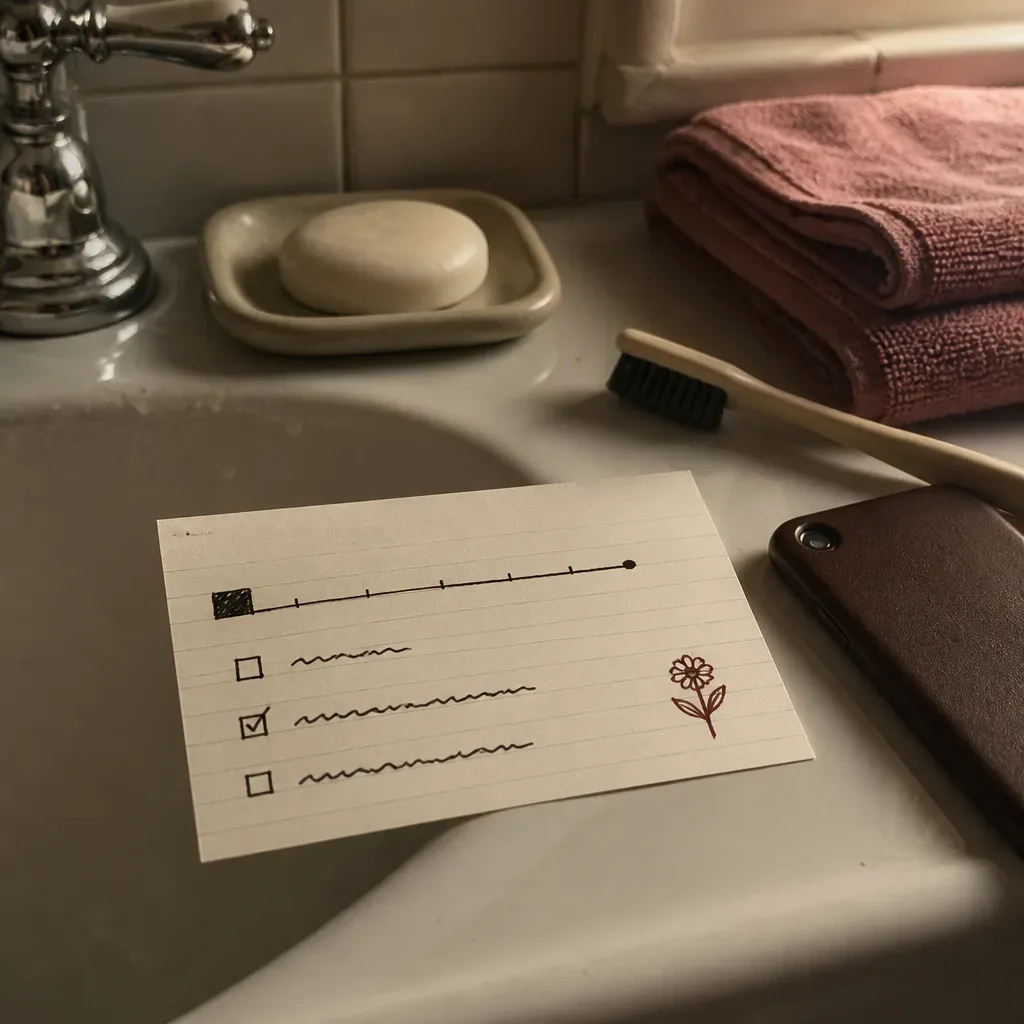
Here is the simple sequence I kept on a card this week:
- Name the choice that keeps repeating.
- Listen to the future-self audio before that choice.
- Ask what the future self would do in the next 2 minutes.
- Do only that.
- Mark the repetition, not the outcome.
How do I set up the practice in 12 minutes?
You set it up by choosing one recurring decision, pairing it with audio, and making the response too small to avoid.
I start with one decision point, not a whole life category. Whole life categories make me vague. A decision point has a time and a place. The kitchen counter after coffee. The chair before opening the laptop. The bus stop before sending a text. According to a 2009 study by Phillippa Lally and colleagues, habit formation took an average of 66 days, with a range from 18 to 254 days depending on the behavior. That range comforts me. It means slow does not mean broken.
For the first 12 minutes, I use a page and write only what I can observe. If the practice needs a new personality, I will abandon it by Tuesday. If it needs one chair, one audio, one choice, I may keep it.
| Minute | What I do | Why it matters |
|---|---|---|
| 0 to 2 | Pick one repeating choice | Specific cues beat vague intention |
| 2 to 5 | Write the future-self sentence | Identity needs language before behavior |
| 5 to 8 | Listen to the audio once | The cue becomes sensory, not abstract |
| 8 to 10 | Choose the 2-minute action | Small actions reduce resistance |
| 10 to 12 | Mark a tracking line | Repetition becomes visible |
I keep the future-self sentence plain: I am someone who answers money with records, not panic. Or: I am someone who tells the truth before resentment grows. Claude Steele’s self-affirmation theory began in 1988, and later reviews, including Cohen and Sherman in 2014, suggest that values-based self-statements can reduce defensiveness under threat. I do not treat that as proof of every affirmation claim. I treat it as a reason to use language with care.
The smallest action is not a lesser action. It is the action close enough to repeat.
Some days my tracking line says only: listened, filed one receipt. Other days: listened, did not send the old reply. I do not rate the practice by whether I felt inspired. I rate it by whether the cue met the choice.
What should I say in the future-self audio?
The audio should speak in concrete first-person language from the future identity, with details your nervous system can recognize.
I avoid grand sentences because my body does not believe them. If a recording tells me I am completely free, completely healed, completely certain, I tense. If it says, I open the blue notebook before checking my messages, I can feel the chair. I can do that. Research on mental simulation has long distinguished outcome visualization from process visualization. In a 1999 study, Shelley Taylor and colleagues found that students who visualized the process of studying tended to prepare more than those who focused only on the desired grade.
So I write the audio like a diary entry from a future Tuesday. It has objects in it. The kettle. The clean file name. The way my shoulders drop when I tell the truth early. It names the life I intend, but it spends more time on the ordinary behaviors that hold it.
I use this structure when I write a future-self script:
- One sentence naming who I have become in this area.
- One sentence describing a normal place where I live this out.
- Three sentences showing small behaviors.
- One sentence naming how I recover when I forget.
- One closing sentence that feels steady, not inflated.
A believable future self gives instructions, not applause.
If I am working with love, I may also read Astrology and manifestation for timing language, though I keep causality separate in my notes. If I am working with speech, I may keep one sentence from the Affirmations pillar beside the audio. The daily affirmation helps me name the identity. The Manifestation Board, when I use it, gives me a visual reminder. But the listening is still the practice.
There is also a safety line I include. I do not ask the future self to shame the present self. Shame is a poor teacher when the task requires repetition. In behavioral research, dropout is one of the quietest findings; people do not keep practices that make them feel punished. My audio has to sound like someone I would allow into the kitchen.
How do I use it before choices without pretending?
You use it without pretending by asking for the next honest action, not by denying the present facts.
This distinction matters. If I have 40 euros until Friday, acting as if I am financially steady does not mean buying the expensive coat. It may mean checking the account without flinching, sending the invoice, cooking what is already in the cupboard, and not making fear the household manager. The future self is not reckless. She is regulated.
Dr. Andrew Huberman often describes behavior change in terms of state, attention, and repetition. I am cautious with podcast science, but those three words are useful enough to test. A short audio shifts state. A specific question directs attention. A repeated cue builds repetition. None of this requires pretending the rent is paid if it is not. It requires choosing the next behavior from the identity I am strengthening.
The practice has helped me most in choices that are too small to impress anyone:
- Whether I open the document or rearrange the desk.
- Whether I answer kindly or wait until I am sharp.
- Whether I check the number or avoid the number.
- Whether I take the walk before the second coffee.
- Whether I keep the promise when no one sees it.
The future self is not proven by the size of the gesture. She is proven by the direction of the next choice.
For more general framing, I sometimes return to manifestation methods and ask which parts involve attention, repetition, emotion, and action. Those four pieces are easier to evaluate than mystical certainty. Pew Research Center reported in 2024 that 91 percent of U.S. adults own a smartphone, which means the cue device is usually already in the pocket. The question is not access. The question is whether I place the cue before the choice.

What can go wrong with act as if manifestation?
The practice goes wrong when acting as if becomes avoidance, spending, performance, or self-blame.
I have done the performance version. I wrote confident sentences in a notebook while leaving the difficult message unanswered for 6 days. It looked like faith from the outside. It was avoidance with better handwriting. A future-self practice has to bring me closer to the truth, not farther from it.
There are four common mistakes I watch for:
- Using the practice to skip planning. If the goal involves money, health, study, or repair, the future self needs a plan.
- Choosing symbols over behavior. The candle is fine. The call still matters.
- Making the audio too grand. If the recording embarrasses me, I will stop listening.
- Measuring by mood only. Mood can change in 20 minutes. Repetition is the better measure.
In clinical and behavioral studies, adherence often predicts outcome more than initial enthusiasm. For example, physical activity interventions routinely find that the hard part is not knowing exercise helps; it is repeating it beyond the first weeks. The same principle applies here. The practice that survives a dull Wednesday is more useful than the one that thrills me on Sunday night.
I also keep one ethical rule: I do not use act as if manifestation to override grief, illness, debt, or other people’s consent. Naming a future self is not a license to deny reality. If I am sad, the future self may be the one who books the appointment, drinks water, and tells the truth. That counts. It may count more than pretending serenity.
A grounded practice does not ask me to lie. It asks me to stop rehearsing the old self when a new choice is available.
Sometimes I put a related image on a vision board for manifestation, but I keep the board quiet. One photograph. One phrase. If the board becomes a substitute for the action, I take it down for a week. The page is allowed to help. It is not allowed to hide me from my life.
How will I know it is working?
You will know it is working when your repeated choices begin to change before your mood or circumstances fully do.
I look for small evidence. Did I listen before the choice 5 days out of 7? Did the same decision feel 10 percent less charged? Did I recover faster after missing a day? In habit research, consistency is often more informative than intensity. Lally’s 2009 study showed that missing one opportunity did not erase habit formation, which is a mercy I have written in the margin of my notebook.
I use a seven-day review because one day is too dramatic and one month can become vague. On Sunday evening, I make tea and draw three columns:
| Question | My note | Next adjustment |
|---|---|---|
| Where did I listen? | Kitchen, desk, bus | Keep the kitchen cue |
| What choice changed? | Opened invoice folder twice | Make the first file easier |
| Where did I avoid? | Friday message | Write a future-self line for repair |
This is not glamorous, but it is honest. If the practice is working, I become less dependent on a special feeling. The action starts to arrive with less argument. I still have ordinary resistance, but the resistance no longer gets the final vote.
The sign of change is not constant certainty. The sign is a shorter distance between remembering and doing.
I also watch my language. At first I say, I am trying to become someone who keeps records. Later I notice myself saying, I keep records on Mondays. That grammatical shift matters. It suggests the behavior has moved closer to identity. In self-concept research, repeated self-description can become part of the accessible self, especially when paired with confirming action. I do not need to exaggerate that finding. I only need to respect it.
Tonight, before I forget, I will set the phone by the blue mug. Tomorrow’s choice will be waiting there, small as a spoon.
Friday soon.