sleep hypnosis affirmations
Affirmations Before Bed: Dream-Self Audio at Night
Affirmations before bed work best in the drowsy window. Use Dream-Self audio, low friction timing, and simple tracking without forcing belief.

Friday, 10:42 p.m. Affirmations before bed work best when I use the drowsy window, play my Dream-Self audio quietly, and let the words land without arguing with them. The practice is not to think harder. It is to listen at the edge of sleep, when effort is already leaving.
Why do affirmations before bed feel different?
Affirmations before bed feel different because the body is already preparing to reduce alertness, and a softer mind often resists less.
I noticed this first in the kitchen, not in bed. The kettle clicked off, my phone was already on low volume, and I did not have the strength to improve myself. That was useful information. A practice that requires my best mood is not a nightly practice. The CDC has reported that roughly 1 in 3 American adults do not get enough sleep, which means a bedtime routine has to respect tired people, not ideal people.
The common mistake is treating night affirmations like a speech. I used to stack ten statements and then check whether I believed them. That turned the pillow into a courtroom. Self-affirmation theory, described by Claude Steele in 1988 and later reviewed by Sherman and Cohen in 2006, is not really about shouting positivity. It is about protecting a wider sense of self so the nervous system does not have to defend so hard.
At night, fewer tabs are open in me. That is the honest version. In a 2016 Social Cognitive and Affective Neuroscience paper, Cascio and colleagues found that self-affirmation activated brain regions linked with self-related processing and valuation. I do not use that as proof that every sentence changes a life. I use it as a clue that personally meaningful words are processed differently than random slogans.
A bedtime affirmation should feel like a hand on the shoulder, not a demand for a new personality.
The drowsy window helps because it lowers the performance cost. I am not trying to become convincing. I am letting a sentence become familiar. That distinction matters after 11 p.m., when even brushing my teeth can feel like a negotiation.
What is the drowsy window, exactly?
The drowsy window is the short stretch when I am still awake, but my attention has begun to loosen its grip.
Sleep scientists describe the first sleep stage, N1, as light sleep, often lasting only 1 to 7 minutes in a healthy adult sleep cycle. I am not trying to practice inside N1 exactly, because by then I may already be gone. I am looking for the doorway before it: warm face, slower blinking, less interest in my phone, and the sense that thoughts are becoming less linear.
The Sleep Foundation often gives 10 to 20 minutes as a typical sleep onset range for many adults. That number helped me because it made the practice small. If I need 45 minutes of perfect ritual before sleep affirmations, the routine is badly designed. If I need 6 minutes of audio inside a natural 10 to 20 minute slope, the routine has a chance.
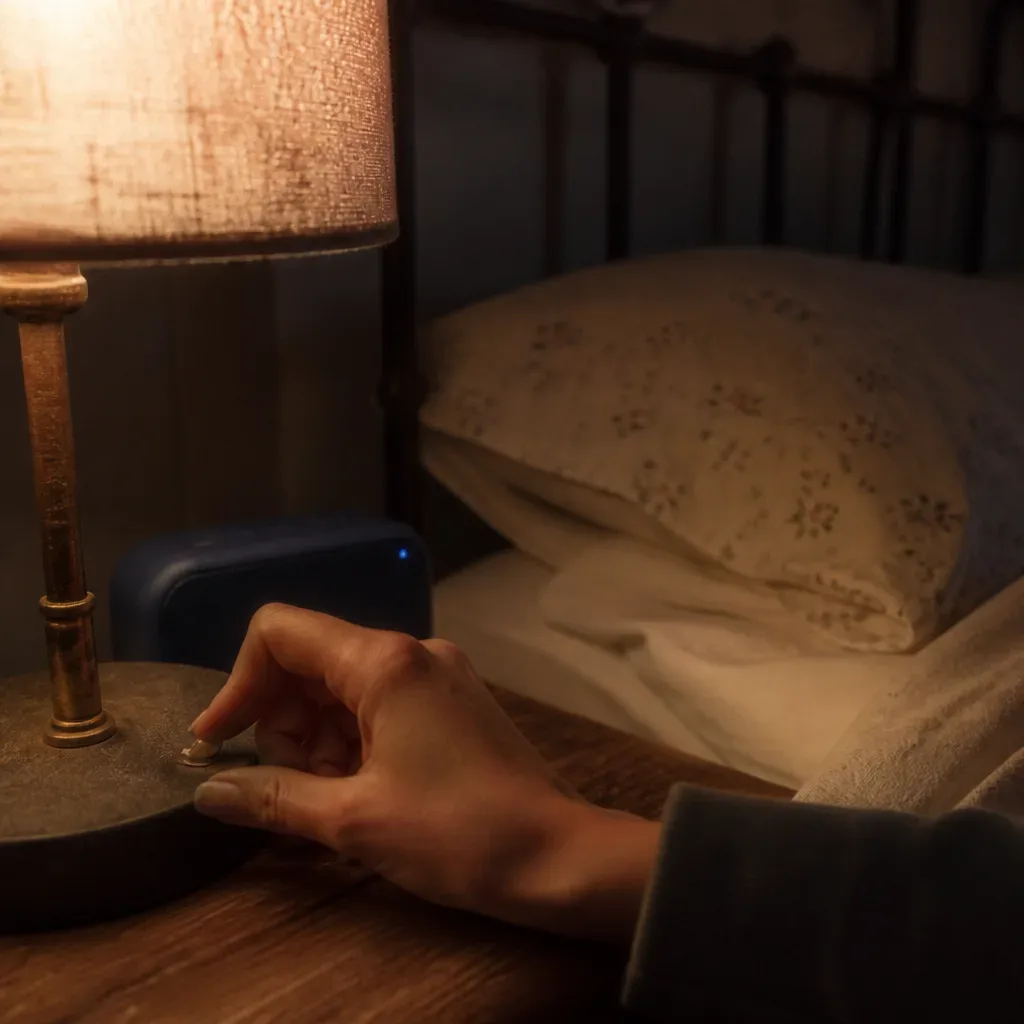
I keep the cues ordinary. Lamp off. Phone face down after pressing play. One hand under the blanket. No scrolling after the audio starts. Dr. Andrew Huberman has often emphasized morning light and evening light reduction as strong signals for circadian timing; I take the simple part from that, which is that bright input late at night asks the brain to stay on duty.
| Signal | Too early | Drowsy window | Too late |
|---|---|---|---|
| Body | Restless, task-oriented | Heavy, warm, slower | Already asleep |
| Mind | Planning tomorrow | Loose, receptive | Fragmented or gone |
| Phone use | Still tempting | Audio only | Dropped on blanket |
| Best practice | Prepare room | Listen | Sleep |
I sometimes read Astrology and manifestation pieces when I am thinking about timing, but at night I keep the rule more physical than symbolic. If the lamp is bright, I am early. If I cannot remember pressing play, I am late. If I can listen without effort, I am on time.
How do I use Dream-Self audio for affirmations before bed?
I use Dream-Self audio by making listening the whole practice, then keeping every other part of the routine almost boring.
This is where the AYA Method became useful for me. The AYA Method is a daily audio manifestation practice. Each day you listen to a short personalized recording, your Dream-Self Moment, narrated from the version of you who has already manifested the life you intend. Listening is the practice. Repetition is the work. The audio is the method.
I tested it the same way I tested wellness apps when I reviewed them for work: 30 days, one note file, same questions. Did it happen daily? Did it get easier or harder by week three? Would I notice if it disappeared? Habit researcher Phillippa Lally and colleagues found in a 2009 European Journal of Social Psychology study that habit formation averaged 66 days, with wide variation. I do not expect certainty in a week. I do expect friction data.
Here is the version I use when I am already tired:
- I lower the lights before I get into bed, not after.
- I put the phone where I can press play without opening anything else.
- I start the Dream-Self Moment at a low volume.
- I let the first sentence arrive before deciding whether I feel ready.
- I breathe normally. I do not perform calm.
- When the audio ends, I do not add a second practice unless I genuinely want to.
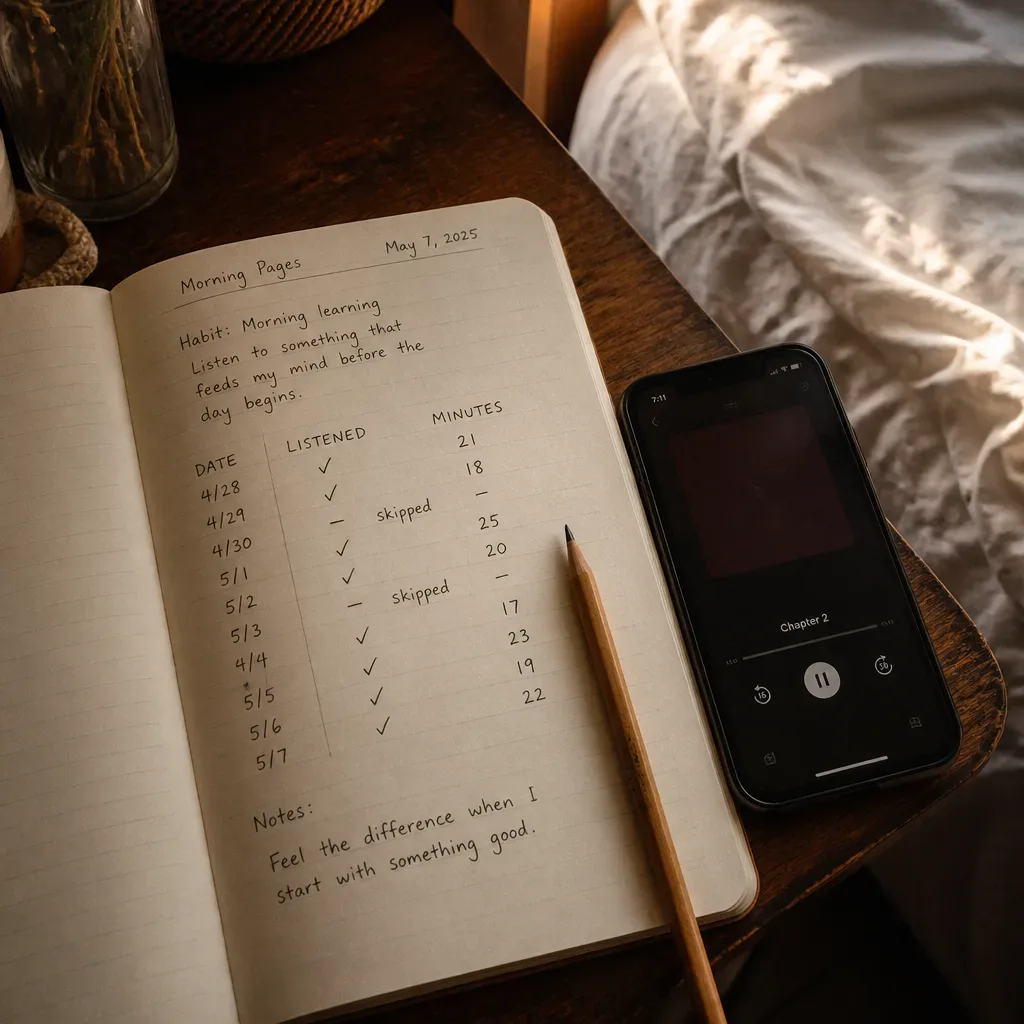
- In the morning, I mark one line: listened or skipped.
That last line matters. A streak can become theater. A single mark is quieter. The practice either happened or it did not. By night 19, I cared less about being good at affirmations and more about making the start easy enough that I could not talk myself out of it.
The best routine is the one that still works when the day has been badly designed.
Should I repeat spoken affirmations, or just listen?
I usually just listen, because repeating every line can turn a low-friction audio practice into bedtime homework.
There is nothing wrong with spoken affirmations. I keep one daily affirmation on the page some mornings, especially when I need a sentence I can carry on the bus. But before bed, speech can wake me up. It asks for posture, breath, and a tiny bit of performance. The Affirmations pillar is helpful for building better sentences, but the night version has to be more merciful than the desk version.
Working memory is limited. Psychologist Nelson Cowan has argued that about 4 chunks is a practical estimate for the focus of attention, revising older ideas about holding 7 items. At 11:18 p.m., I do not want to hold a paragraph in my head. I want one feeling, one direction, and a voice that keeps going when my own attention wanders.
I decide by checking the cost:
- If repeating lines makes me calmer, I repeat one or two.
- If repeating lines makes me monitor belief, I stop speaking.
- If silence after the audio feels good, I let silence do its part.
- If I feel the urge to add more, I ask whether more is wisdom or anxiety.
The daily affirmation is a complement for me, not the pillar. The Manifestation Board is the same. I may look at it earlier in the evening, the way I might set clothes on a chair for morning, but I do not make it compete with sleep. The audio carries the night.
Joe Dispenza often talks about rehearsing a future state until the body knows it, and Neville Goddard wrote about the state akin to sleep. I read both with a product designer’s suspicion and still found the same practical instruction inside: reduce strain. A sentence repeated with clenched teeth is not more true because it is louder.
What should I say if my mind argues back?
When my mind argues back, I use a bridge sentence that is believable enough to keep me in the practice.
This part matters because some affirmations before bed can backfire. In a 2009 Psychological Science study, Joanne Wood, W. Q. Elaine Perunovic, and John Lee found that repeating very positive self-statements made some people with low self-esteem feel worse. That study gets flattened online, but the useful warning is simple: if a sentence humiliates your current self, it is not kind enough for bedtime.
I used to choose sentences that were too far away from me. Then I would lie there proving them wrong. Now I keep a small ladder beside the bed, not literally, but in the note file. If the Dream-Self line feels too bright, I answer with one bridge line and return to listening.
Examples I have used:
| If the mind says | I answer with |
|---|---|
| This is not true | I can practice hearing it tonight |
| I always ruin this | I have kept small promises before |
| Nothing is changing | I am tracking the small evidence |
| I do not believe this | I do not have to force belief to listen |
A believable sentence is not smaller than a bold one. It is better built.
The Manifestation pillar helped me separate naming an intention from trying to control the whole route. At bedtime, that distinction becomes practical. If I try to solve my life at 11:36 p.m., I lose sleep. If I listen to one future-tense scene and let the body rest, I have done the work assigned to that hour.
I also use a 3-breath rule. If I am still arguing after 3 slow breaths, I stop editing and return to the audio. If the argument is important, it will be there in the morning, when my prefrontal cortex has had some sleep and my pillow is no longer pretending to be a strategy room.
How do I know whether affirmations before bed are working?
I know the practice is working when it becomes easier to start, easier to believe a little, and noticeable when missing.
I do not use fireworks as evidence. I use logs. The American Academy of Sleep Medicine often recommends sleep diaries in cognitive behavioral approaches for insomnia because perception gets fuzzy at night. I borrow that humility. My note is small: date, listened or skipped, start friction from 1 to 5, and one sentence about the morning after.
After 14 nights, patterns usually show. Maybe I skip when I charge my phone across the room. Maybe I listen when the audio is under 6 minutes. Maybe a certain sentence makes me tense. This is not failure. This is design feedback. In product work, a drop-off point is not a moral flaw. It is where the system is asking for too much.
I track 4 things:
- Start friction: How hard was it to press play, from 1 to 5?
- Sleep interference: Did the practice wake me up or settle me down?
- Sentence resistance: Which line caused argument?
- Next-day residue: Did any phrase return during the day?
If I am using the AYA Method consistently, I expect the words to become less theatrical by week three. Not bigger. More familiar. A 2015 review in the Journal of Behavioral Medicine found self-affirmation interventions had small but meaningful effects across some health behavior contexts, especially when tied to values. Small matters here. Small is what survives Tuesday.
I keep one more test from my app-review years: would I notice if it disappeared? Most routines fail this question. They feel good while novel, then leave no absence. With bedtime Dream-Self audio, I noticed the missing nights because my mind went back to bargaining with itself. The audio had been doing more carrying than I realized.
Saturday now. The chair has my sweater on it, and the phone is already face down.