sleep hypnosis affirmations
Sleep Affirmations Anxiety: After Dream-Self Audio
A gentle sleep affirmations anxiety routine to use after Dream-Self audio, with words, timing, and a quiet bedside structure for anxious nights.
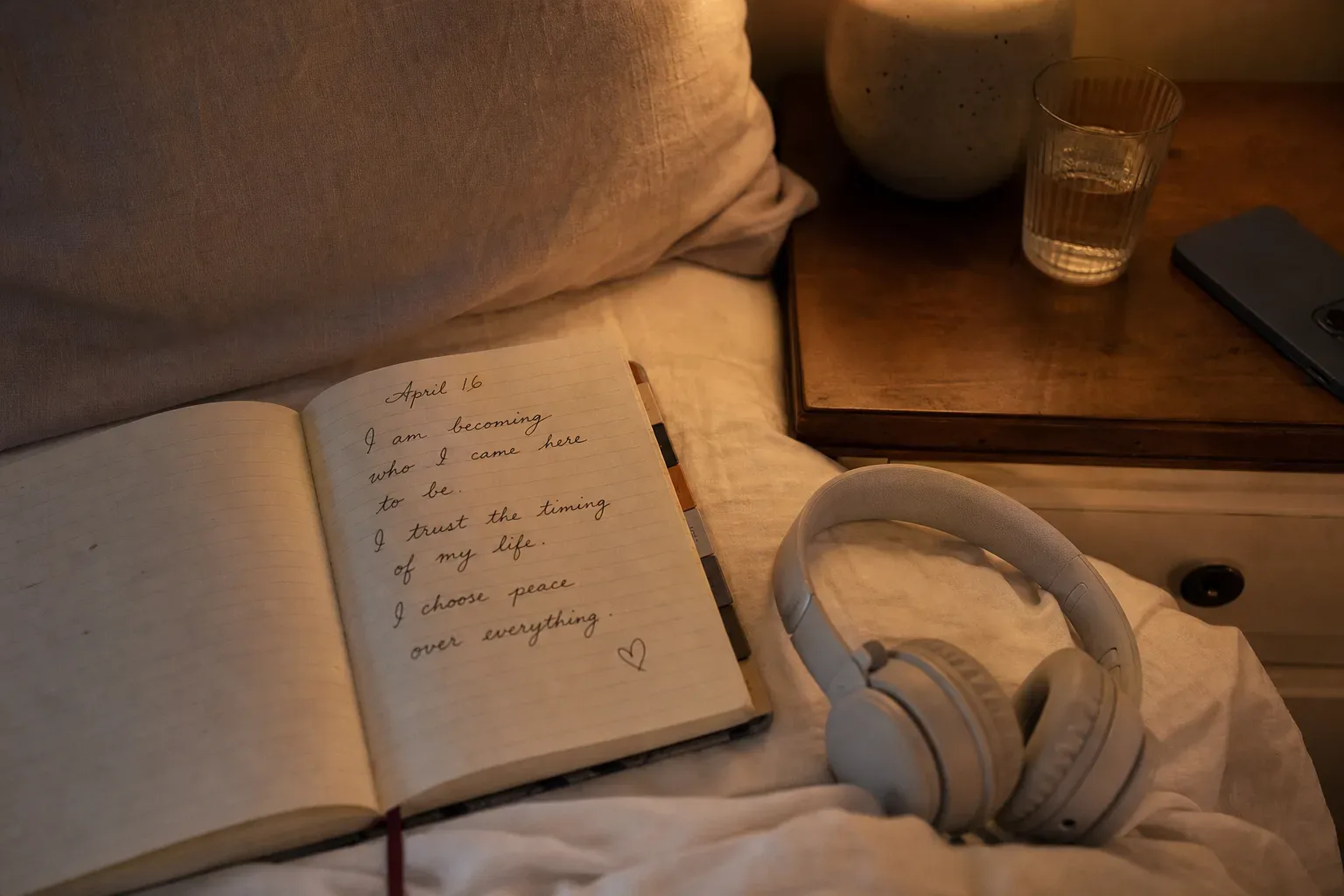
Friday, 10:14 p.m. Sleep affirmations for anxiety work best after Dream-Self audio when they are short, believable, and used as a landing ritual, not a performance. I listen first, then repeat two or three calming lines for a few breaths, so my body can enter sleep without arguing with my mind.
Why do I put sleep affirmations after Dream-Self audio?
I put them after the audio because the Dream-Self Moment gives the direction, and the affirmations help my nervous system settle enough to receive it.
Tonight I listened in the chair by the window before I brushed my teeth. That is the order that keeps working for me. The AYA Method is a daily audio manifestation practice. Each day I listen to a short personalized recording, my Dream-Self Moment, narrated from the version of me who has already manifested the life I intend. Listening is the practice. Repetition is the work. The audio is the method.
Anxiety at night can make even kind words feel like instructions. The National Institute of Mental Health estimates that 31.1% of U.S. adults experience an anxiety disorder at some point in life, and the Centers for Disease Control and Prevention has reported that about 14.5% of adults have trouble falling asleep most days or every day. I write those numbers down because they remind me that my 11:38 p.m. worry is not a personal failure.
The order matters. I do not ask the affirmation to carry the whole ritual. First, the audio lets me hear the future self clearly. Then the sleep affirmation brings me back into my body. A good nighttime sentence does not shout over fear. It sits beside it.
I think of the sequence like this:
| Part of the night practice | What it does | How long I give it |
|---|---|---|
| Dream-Self audio | Names the intended self and lets me hear from her | 3 to 7 minutes |
| Sleep affirmations | Calms the anxious loop after listening | 2 to 5 minutes |
| Silence | Lets the body stop trying | Until sleep comes |
The Manifestation pillar has more language for intention, but at night I need fewer words, not more. The sentence that helps is usually plain: “I can stop for today.” That is not small. That is a gate closing gently.
What should I say when anxiety is loud at night?
I say phrases that are believable at 1 a.m., because the body rejects sentences that feel too far from the truth.
I learned this the hard way in June. I had written a beautiful line on the page, something about perfect safety and complete trust. It looked good in daylight. At night it made me tense. My body knew I was not in complete trust. It felt corrected, not comforted. In a 2009 study by Joanne Wood and colleagues in Psychological Science, positive self-statements helped some people but made people with low self-esteem feel worse when the statements were too unbelievable. I keep that study in mind when I choose nighttime words.
These are the lines I return to when my chest is tight:
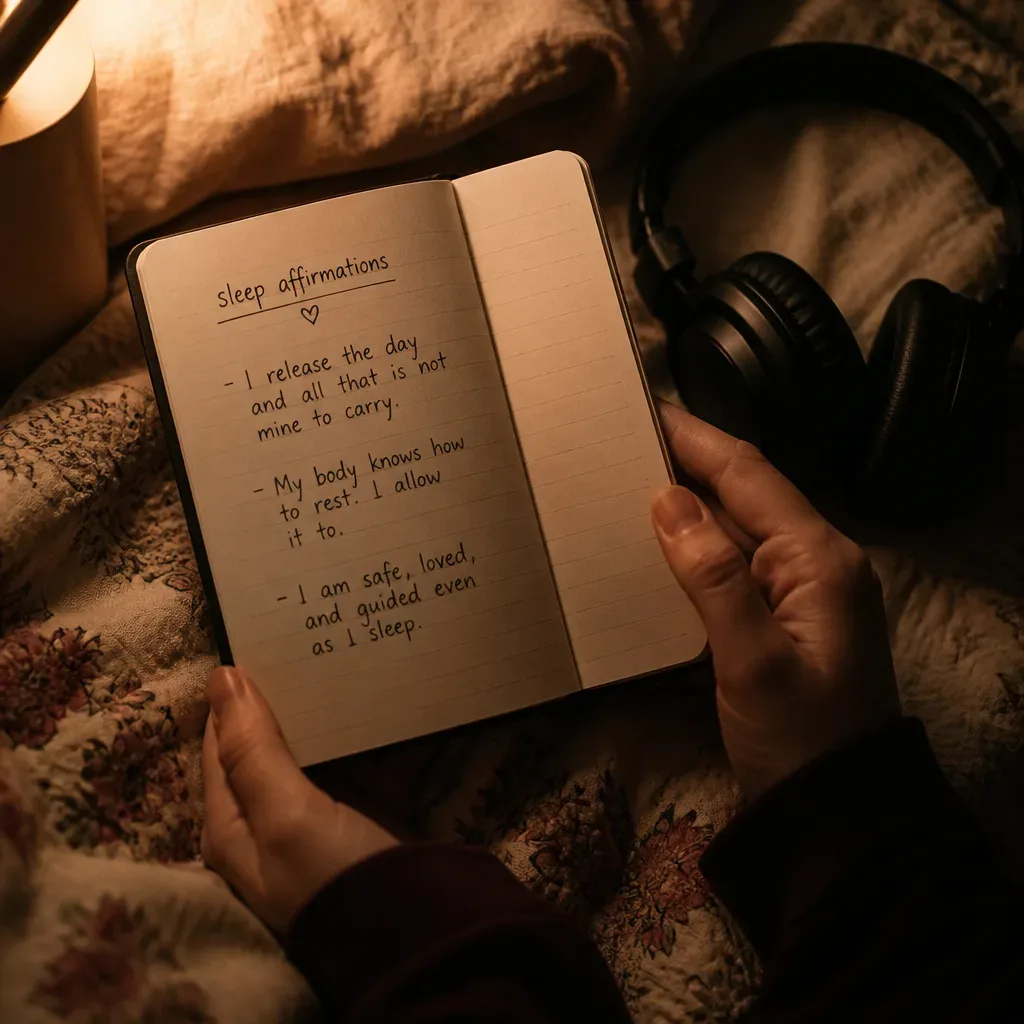
- “I am safe enough for this one breath.”
- “Tomorrow can hold tomorrow.”
- “My body may soften by one percent.”
- “I do not have to solve this in bed.”
- “The part of me that worries is trying to protect me.”
- “I can listen again in the morning.”
The number matters less than the fit. I choose three lines at most. Dr. Andrew Huberman often talks about physiological sighs, usually two inhales followed by a long exhale, as a fast way to reduce arousal. I sometimes pair one affirmation with three of those breaths. The breath gives the sentence a body. Without the body, words can become another tab open in the mind.
For more sentence craft, I use the Affirmations pillar in daylight, not in bed. Bedtime is not when I workshop my personality. Bedtime is when I lower the volume. A sleep affirmation is not a speech. It is a cup of water placed beside the part of me that is thirsty.
How do I practice in bed without turning it into work?
I make the practice small, timed by breaths, and finished before my mind starts checking whether it is working.
Here is the version I used this week. I write it as a list because anxious nights make me forget simple things.
- I play my Dream-Self Moment while sitting or lying down, not scrolling.
- I turn the phone face down when the audio ends.
- I choose one to three affirmations I already know.
- I repeat each line on an exhale for ten slow breaths.
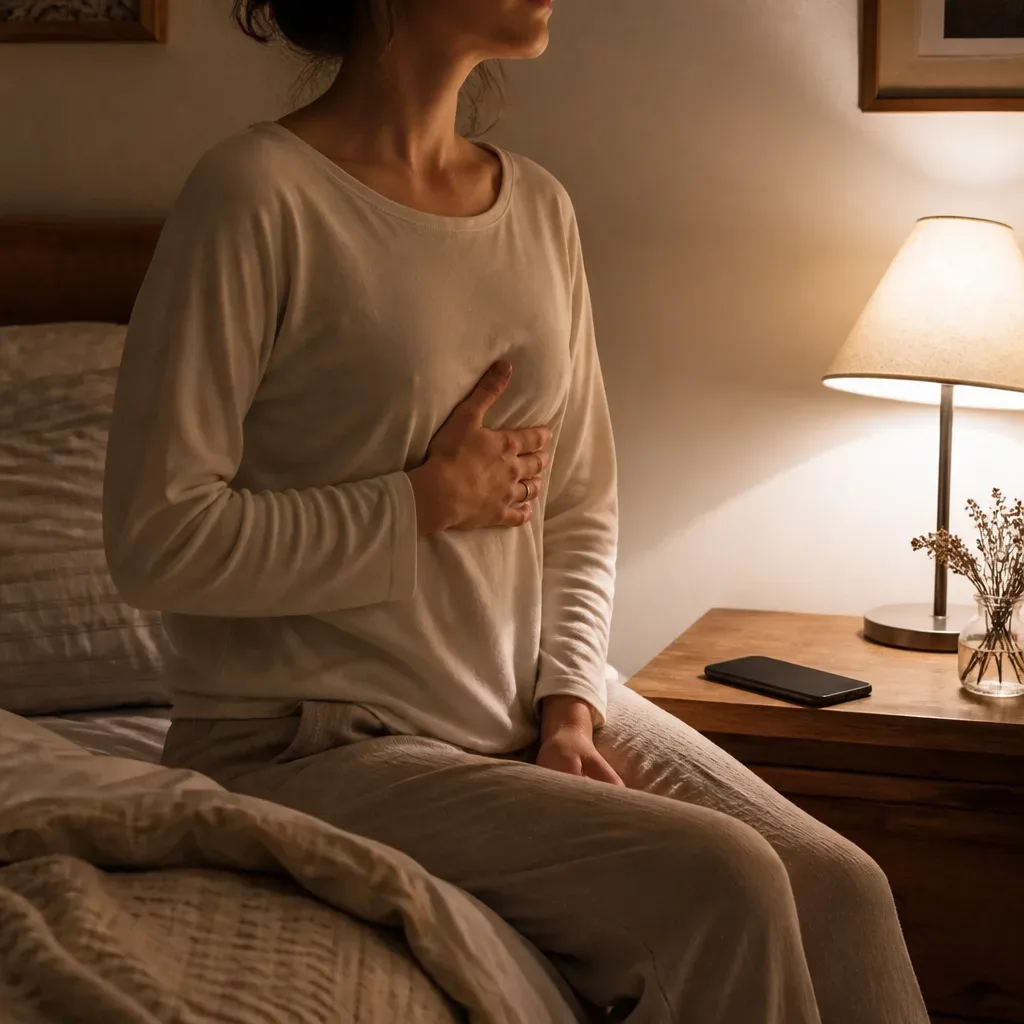
- I place one hand on my ribs and loosen my jaw.
- I stop while it still feels incomplete.
The last step is the one I resist. I want to keep doing the thing until I feel certain. But certainty is the trap. In cognitive behavioral therapy for insomnia, one common principle is stimulus control: keep the bed associated with sleep and rest, not problem-solving. The American Academy of Sleep Medicine’s 2021 clinical practice guideline recommends CBT-I as a primary treatment for chronic insomnia in adults. That does not mean my little ritual is therapy. It means I try not to make bed a desk.
I also keep the materials boring. No new playlist. No fresh notebook at midnight. No elaborate tracking. Product design taught me that every extra step is a place for the loop to break. A 2009 habit study by Phillippa Lally and colleagues in the European Journal of Social Psychology found that automaticity took a median of 66 days, with a wide range from 18 to 254 days. Small has a better chance of surviving that range.
This is my current bedside rule: if I cannot do it while half-tired, it is too complicated. The AYA Method keeps the core practice in the audio, so the after-practice can stay light. The nightly affirmation is a complement. It is not the pillar. I do not want to build a tower at bedtime.
How long should sleep affirmations for anxiety take?
My best window is 3 to 10 minutes, including the breath practice after the Dream-Self audio.
When I go longer, I start evaluating myself. Am I calmer now. Did the sentence land. Why is my stomach still tight. That kind of measuring wakes me up. Sleep has a shy quality in my house. It does not like being watched. The Sleep Foundation often describes healthy adult sleep need as at least 7 hours for most adults, and I notice that stealing 40 minutes for a perfect ritual is not a kindness if it shortens the actual sleep.
I use a soft structure rather than a strict timer:
| If I feel | I do | I avoid |
|---|---|---|
| Mildly tense | 3 affirmations, 10 breaths | Changing the words |
| Very anxious | 1 affirmation, 20 breaths | Searching for meaning |
| Sleepy already | 1 line only | Finishing the whole routine |
| Awake after 20 minutes | Get up briefly, low light | Staying in bed to fight |
The 20-minute note comes from common CBT-I sleep guidance: if wakefulness stretches on, many clinicians suggest leaving the bed briefly until sleepiness returns. I do not use it as a law. I use it as a mercy. Sometimes I sit in the kitchen, drink water, and refuse to rehearse my life.
There is also a design reason for keeping the practice short. A routine that takes 8 minutes can be repeated on an ordinary Tuesday. A routine that takes 45 minutes needs ideal conditions. Ideal conditions are rare. Repetition prefers ordinary doors.
If I am working with moon timing or reflective prompts, I keep that for earlier in the evening. I like the way Astrology and manifestation can give a date a mood, but I do not bring a whole chart to bed. Night anxiety is literal. It wants a hand, a breath, a sentence.
What if my body does not believe the affirmation?
I soften the sentence until my body can stop bracing against it.
This has become the most useful part of the practice for me. I used to think resistance meant I needed a stronger affirmation. Now I think resistance is information. If “I am calm” makes my shoulders rise, I change it to “A calm moment is allowed.” If that is still too much, I change it to “I can notice the bed under me.” The body tells the truth faster than the page.
A meta-analysis by Manzoni and colleagues in BMC Psychiatry in 2008 found that relaxation training had a medium to large effect in reducing anxiety across controlled studies, though methods varied. That matters here because the affirmation is not magic language. It works best when attached to relaxation cues: longer exhales, unclenched hands, warm socks, a darker room. I am not trying to win an argument with my nervous system. I am trying to lower the evidence of danger.
I use this repair ladder:
- Too big: “Everything is working out perfectly.”
- Softer: “Something can be okay without my knowing it yet.”
- Softer still: “This breath is here.”
- Smallest: “In. Out.”
The smallest sentence is sometimes the truest one. A phrase does not need to be impressive to be useful. It only needs to be repeatable when the mind is tired.
I also try not to mix the Dream-Self audio with frantic checking. If I listen and then immediately ask whether I believe every word, I have turned a gentle practice into a debate. The better question is quieter: did I return. Tonight, I returned. That is data too.
How do I keep this gentle for more than a week?
I keep the cue fixed, the reward immediate, and the routine too small to resent.
My cue is the same most nights: lamp low, phone on the charger, Dream-Self Moment before brushing my teeth. Not after emails. Not after one more message. Before brushing my teeth. Habit researchers often describe a loop of cue, routine, and reward, and although that model was popularized in books, the underlying behavioral point is old: repeated context reduces decision-making. I need less decision-making at night, not more.
The reward is not a gold star. It is the felt relief of being done. Avery the designer wants to underline this. The practice that respects attention is the one still running in six months. If the nighttime ritual bills me with effort, I will eventually stop paying. If the listening is pleasant, and the affirmations are brief, the loop gives something back right away.
I keep a tiny record in the morning, not at night. One mark on the page. No score. No paragraph unless I want one. In one sleep diary study format used by clinicians, people track bedtimes, wake times, and awakenings for 1 to 2 weeks to notice patterns. I borrow the gentlest version of that idea. I do not audit my soul at midnight.
These are my maintenance rules:
- I do not rewrite affirmations in bed.
- I do not use the practice to force sleep.
- I do not make a missed night mean anything dramatic.
- I return the next evening without a speech.
- I let the audio remain the center.
There is a difference between devotion and pressure. Devotion returns quietly. Pressure keeps receipts. I want the first one. So I make the practice almost plain: listen, breathe, say the small true line, stop.
The kettle is already set for morning.