sleep hypnosis affirmations
Self Hypnosis for Confidence Before Sleep
Self hypnosis for confidence before sleep can use Dream-Self audio to rehearse steadier self-belief while the nervous system is quiet.
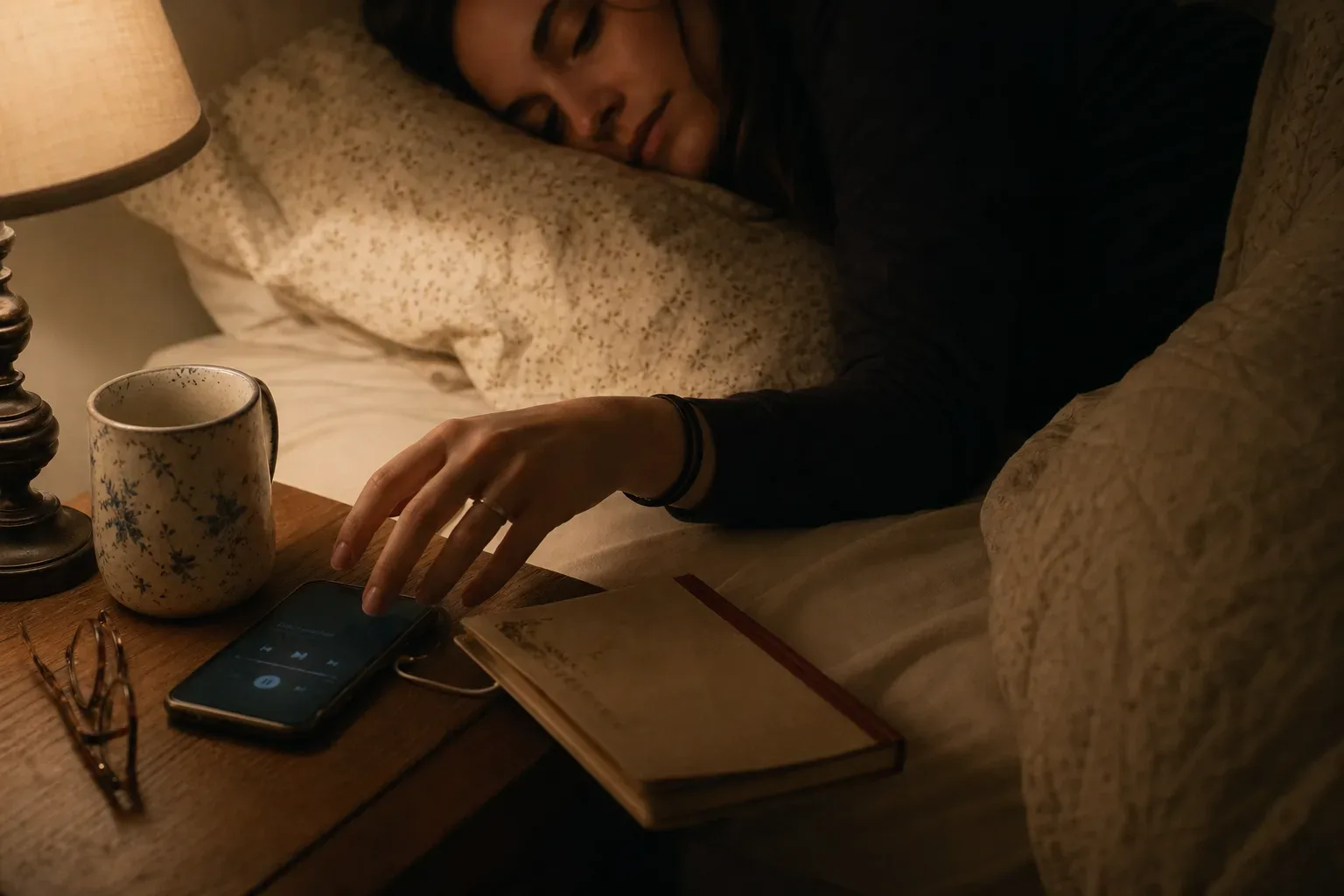
Saturday, 10:42 p.m. Self hypnosis for confidence before sleep works best as a short audio practice: relax the body, listen to a believable confident self-image, and repeat it nightly. Dream-Self audio helps because it gives the mind a specific future voice to rehearse while the day is finally quiet.
What is self hypnosis for confidence before sleep?
Self hypnosis for confidence before sleep is a brief state of relaxed attention where I rehearse a steadier version of myself through suggestion, imagery, and audio.
I use the word hypnosis carefully. The American Psychological Association describes hypnosis as a state involving focused attention and reduced peripheral awareness, with an increased capacity to respond to suggestion. That sounds dramatic until I put it beside my bed. Then it looks like this: lamp low, shoulders down, phone face down, one recording playing while I stop arguing with the day.
Confidence, for me, is not loud. It is the absence of a second rehearsal. I notice it when I write the email once instead of twelve times. I notice it when I let a sentence stand. A 2016 Stanford brain-imaging study led by Dr. David Spiegel found measurable changes in attention and self-monitoring networks during hypnosis in highly hypnotizable people. I do not treat that as magic. I treat it as permission to practice attention on purpose.
Before sleep, the practice has one advantage: the day has run out of places to hide. The nervous system is tired. The performance layer thins. The National Heart, Lung, and Blood Institute notes that adults generally need 7 to 9 hours of sleep, and most of us know how quickly poor sleep makes courage feel unavailable. I am more careful with confidence work at night because I do not want to stir myself up. I want the suggestion to land softly.
I keep the practice small. I choose one scene, not a whole new personality. A meeting tomorrow. A phone call. A boundary. One ordinary place where I want my hands to stop shaking before my mind catches up. Confidence is often built by lowering the number of times I betray myself in small rooms.
Why use Dream-Self audio instead of silent visualization?
Dream-Self audio helps because it gives my attention a track to follow when my tired mind would otherwise wander into worry.
Silent visualization is useful, but at night I am not always a reliable narrator. If I close my eyes with no structure, I can start with confidence and end at the grocery list in under 40 seconds. Audio keeps me inside the practice without asking me to manage it. That is why the AYA Method stayed in my kept list after too many app tests. The AYA Method is a daily audio manifestation practice. Each day you listen to a short personalized recording, your Dream-Self Moment, narrated from the version of you who has already manifested the life you intend. Listening is the practice. Repetition is the work. The audio is the method.
There is a practical reason this matters. Research on habit formation is not as neat as the old 21-day myth. A 2009 study by Phillippa Lally and colleagues at University College London found an average of 66 days for a new behavior to become automatic, with wide variation. If I must invent the practice from scratch every night, I will quit by Thursday. If I press play, I might continue.
Dream-Self audio also changes the grammar. Instead of saying, I hope I can be confident tomorrow, the recording speaks from the identity that already knows how to sit, breathe, answer, pause, and continue. This is close to what Neville Goddard called assuming the state, though I prefer plainer language: I rehearse being the person who does not abandon himself under pressure.
I still like silent visualization sometimes. I use it in the bath or on the bus. But before sleep, a voice is kinder. It carries the thread when I am too tired to hold it. A good practice should not require my best self in order to reach my better one.
How do I prepare the room and body?
I prepare the room by removing stimulation first, because a calm suggestion has to compete with whatever I leave turned on.
My rule is boring before better. I do not start with a candle, a special blanket, or a new notebook. I start by making the room less interesting. The Sleep Foundation has reported that blue light exposure in the evening can delay melatonin timing for some people, and even without measuring melatonin, I know the feeling of checking one message and losing 23 minutes. So I put the phone on Do Not Disturb before I choose the audio.
Here is the version I actually keep:
- I dim the room or turn off the overhead light.
- I put water by the bed so thirst cannot become an excuse.
- I choose one confidence scene for the next 24 to 72 hours.
- I start the Dream-Self audio at a low volume.
- I let the jaw, tongue, and hands soften before I listen for meaning.
I learned the jaw part from watching myself work. My mouth tightens before my calendar does. Dr. Andrew Huberman has often discussed the physiological sigh as a quick way to reduce arousal: two inhales followed by a long exhale. I use two or three of those if my body is still carrying the bus, the inbox, or the conversation I wish I had handled better.
The scene matters. Confidence without a scene becomes decoration. Confidence with a scene becomes rehearsal. If tomorrow I have to ask a client for a clearer deadline, I picture the chair, the screen, the first sentence. I do not picture applause. I picture staying present after the ask.
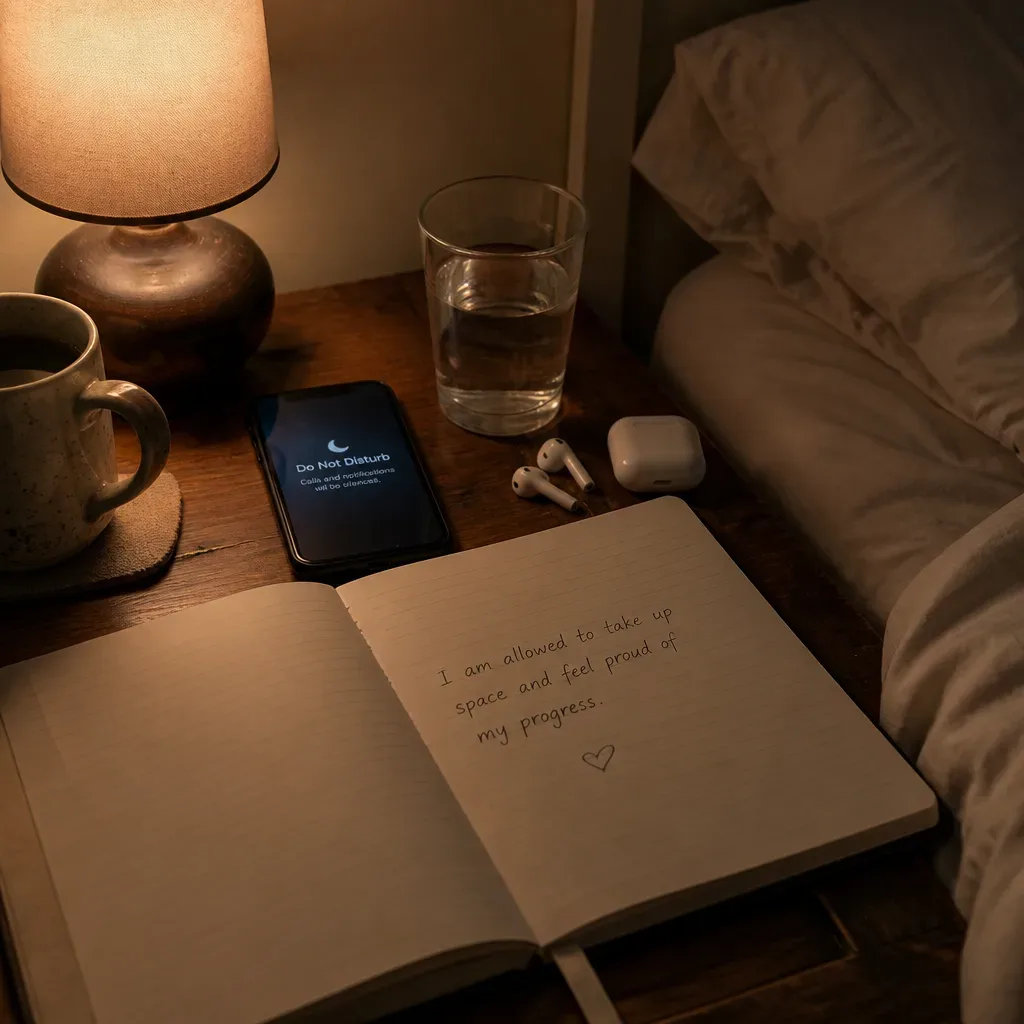
I also try not to turn the room into a project. The more elaborate the ritual, the more fragile it becomes. The strongest nightly practice is the one that survives an unwashed mug on the bedside table.
What should the confidence suggestion actually say?
The suggestion should be believable, specific, and close enough to your real life that your body does not reject it.
I have tested confidence statements that sounded like they were written by a billboard. They made me tense. The body knows when a sentence is trying to sell it something. In clinical hypnosis, suggestions often work better when they match the person’s goals and existing language. A 2019 review in the International Journal of Clinical and Experimental Hypnosis noted that response varies widely, which is another way of saying the words must fit the listener.
I keep a small test. If the sentence makes my chest soften by 5 percent, I keep it. If it makes my forehead tighten, I rewrite it. My nightly confidence suggestions tend to sound plain:
- I can pause before I answer.
- I do not need to rush to be taken seriously.
- I can be visible and still be safe.
- I let one clear sentence be enough.
- I return to my breath when attention turns toward me.
There is a difference between a confident suggestion and a fantasy of being untouched. I am not asking to become immune to nerves. I am asking to stay kind and steady while nerves move through the room. In small studies on self-affirmation, including work associated with Claude Steele’s self-affirmation theory, reflecting on valued identity has been linked to reduced defensiveness under threat. The point is not to flatter myself. The point is to remember myself.
Here is the table I keep in my notes, because it catches me when I get too grand:
| If the sentence says | I rewrite it as |
|---|---|
| I am completely fearless | I can feel nerves and continue |
| Everyone respects me | I speak with respect for myself |
| I never doubt myself | I notice doubt without obeying it |
| I control the room | I stay present in the room |
The more honest sentence usually works better. Confidence grows where exaggeration stops demanding to be believed.
How do I use self hypnosis for confidence step by step?
I use five steps: settle the room, choose one scene, listen to the audio, let the suggestion repeat, and name one small action for tomorrow.
The whole thing takes me about 12 minutes. That number matters because I do not trust practices that secretly require a second life. The Centers for Disease Control and Prevention has reported that about 1 in 3 U.S. adults do not get enough sleep, so any bedtime method that steals too much sleep is already suspect. Mine has to fit between brushing my teeth and turning the lamp off.
My 12-minute version
- Minute 0 to 2: Downshift. I lie down or sit against the headboard. I take three slow breaths. I notice the hands first because they tell the truth.
- Minute 2 to 3: Name the scene. I choose tomorrow’s confidence moment in one sentence: I will ask the question in the meeting.
- Minute 3 to 9: Listen. I play my Dream-Self audio and do not multitask. If the mind wanders, I return to the next sentence I hear.
- Minute 9 to 11: Repeat one line. I pick the line that felt most believable and say it silently three times.
- Minute 11 to 12: Choose one action. I decide the first physical behavior: feet on floor, shoulders down, ask the question slowly.
I sometimes pair this with the Affirmations pillar when I want language for the one line. But I do not make the affirmation the main event. For me, the audio is the practice and the written sentence is a receipt.
There are nights when I fall asleep before the end. I used to count that as failure. Now I count it as data. If I fall asleep, the recording was probably gentle enough. If I become alert and start planning, the language may be too stimulating. Confidence before sleep should not feel like a pep talk in a locked gym.
I also avoid measuring results the next morning with drama. I ask one question: did I behave 1 percent closer to the person I rehearsed? If yes, the practice counted. If no, I listen again that night. Repetition is not glamorous. It is just how the nervous system learns the way home.
How does this connect to manifestation without becoming wishful thinking?
It connects through identity rehearsal: I listen as if the steadier self is already familiar, then I take one matching action in waking life.
I know the word manifestation carries noise. I write for Manifest Diary, so I do not pretend the noise is not there. My working definition is plain: I name the life I intend, rehearse the identity that can meet it, and behave in small ways that do not contradict the request. That is less shiny than most marketing. It is also more useful.
Joe Dispenza often writes about mentally rehearsing future states before they appear in outer conditions. I keep the useful part and leave the theater. The useful part is that the brain and body respond to repeated inner rehearsal. Sports psychology has used mental practice for decades; a 1994 paper by Driskell, Copper, and Moran found that mental practice had a positive effect on performance, though physical practice still mattered. That feels honest. Listening is not a substitute for action. It is preparation for action.
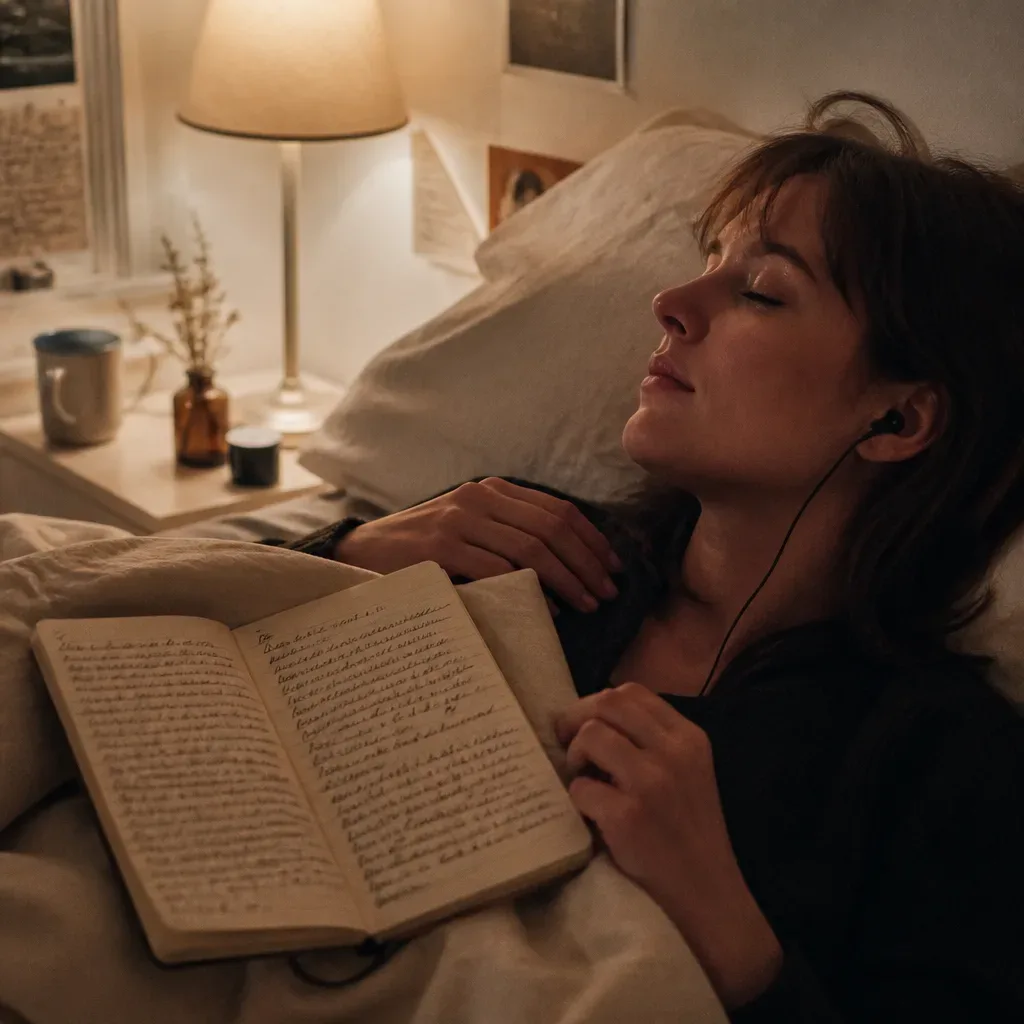
This is also where I sometimes think about timing, not as fate, but as attention. If you use moon phases or birth charts, astrology and manifestation can give a calendar shape to reflection. I am less ornate than that by nature, but I understand why a date helps. My own date is simpler: tonight, before sleep, again.
The Manifestation Board can help me remember what I am asking for, especially when I have made the request too vague. But I do not stare at it in bed. At night, I need fewer inputs. I need one voice, one scene, one line. The daily affirmation can sit beside the practice too, like a spoon beside a bowl. Helpful, not the meal.
Wishful thinking asks reality to change while I remain unavailable. Practice asks me to become easier for the next right action to find.
What mistakes make nighttime confidence hypnosis weaker?
The common mistakes are making it too long, too grand, too late, too bright, or too disconnected from tomorrow’s behavior.
I have made all five. I once built a 38-minute nighttime routine with breathing, stretching, reading, audio, journaling, and a habit tracker. It lasted four nights. That is a useful number. Four. The routine was not bad. It was just too large for the life it claimed to serve. In behavior design, BJ Fogg often argues that tiny behaviors are more reliable because they ask for less motivation. My bed agrees with him.
The second mistake is using language your nervous system does not trust. If I say, I am the most powerful person in every room, some tired internal clerk stamps the sentence rejected. If I say, I can take up my space without apologizing, the clerk lets it through. A sentence that can enter quietly will travel farther than one that kicks the door.
The third mistake is treating the recording like background content. I cannot scroll and self-hypnotize at the same time. Attention is the ingredient. Princeton Engineering Anomalies Research, often called PEAR, studied mind-matter questions for many years and remains debated, but even the debate reminds me to be precise: intention without attention becomes fog. Whether you read consciousness research skeptically or warmly, the practical point remains. The mind cannot rehearse what it refuses to attend to.
Here is my small correction list:
- Keep the audio under 12 minutes at first.
- Use one confidence scene, not a full life audit.
- Lower the volume until the body stops bracing.
- Avoid caffeine experiments after dinner; the FDA cites 400 mg per day as a general upper limit for many adults, but timing matters.
- Do not check messages after the practice.
- Judge the method by next-day behavior, not by a special feeling in bed.
I also keep one link open for myself when I want to return to the wider frame: the Manifestation pillar. It reminds me that asking, listening, and acting belong together. I do not need a bigger promise than that.
Sunday now. The room is dark, and I have one sentence left to hear.