audio manifestation
Cleaning Meditation With a 5-Minute Dream-Self Audio
Try a cleaning meditation using a 5-minute Dream-Self audio, one small chore, and a quiet habit loop that fits into an ordinary morning.
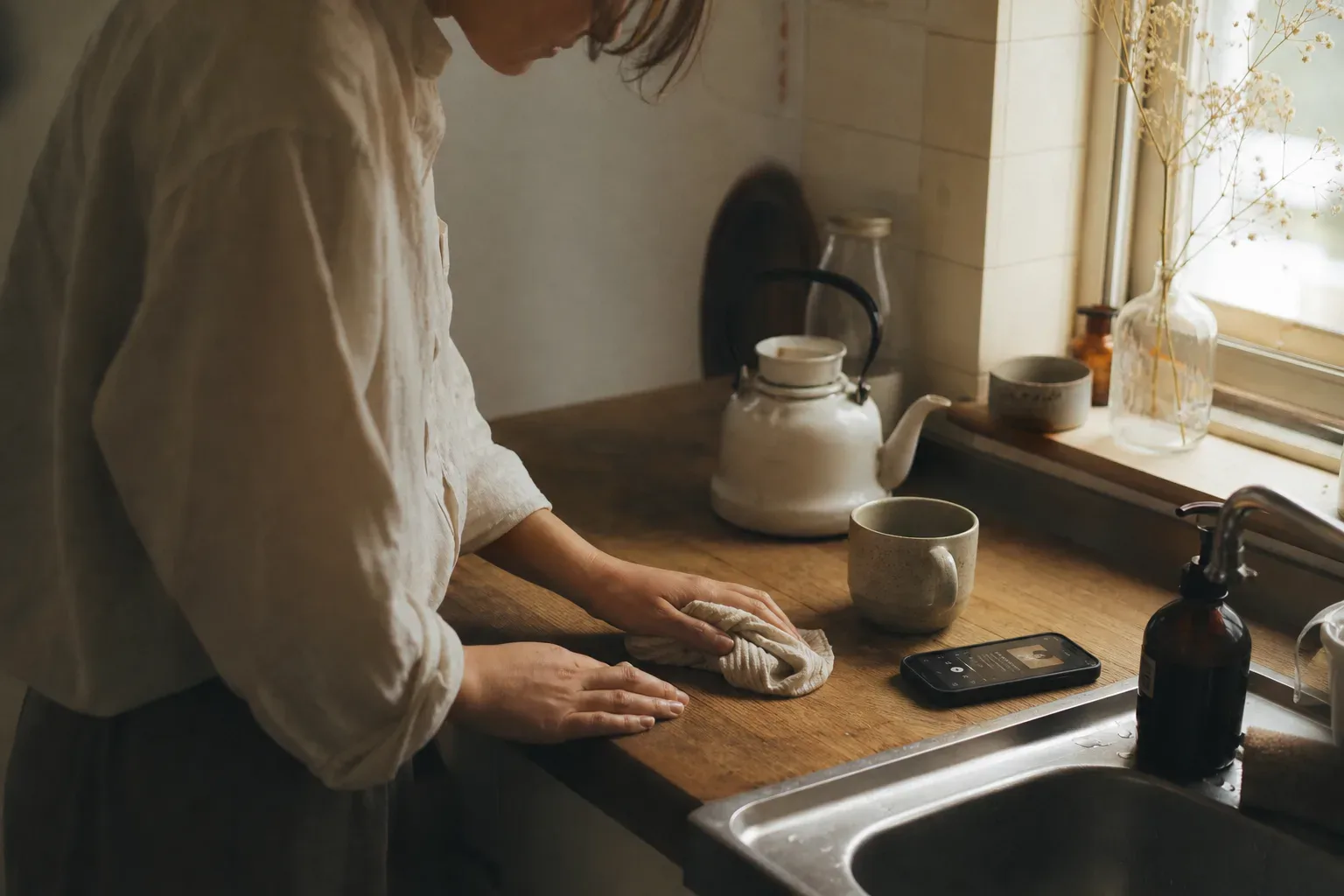
Tuesday. The kettle clicked off while I wiped the counter, and that was the whole practice: a cleaning meditation is one small chore paired with steady attention and a 5-minute Dream-Self audio. I listen, clean one visible thing, stop when the audio ends, and let repetition do the quieter work.
What is a cleaning meditation when the audio is only five minutes?
A cleaning meditation is a short attention practice where the chore gives my hands something simple to do while the audio gives my mind one clear direction.
I used to make cleaning either too practical or too symbolic. Practical meant I rushed, blamed myself, and tried to fix the whole kitchen before coffee. Symbolic meant I made the task heavy, as if one clean sink had to explain my entire life. Five minutes is kinder than both. The timer gives the practice a fence.
In habit research, context matters more than most people want to admit. Wendy Wood and colleagues have written that a large share of daily behavior is repeated in stable contexts, and one often cited diary study found about 43% of everyday actions were habitual. That number follows me around the apartment. If the sink is already part of my morning, I do not need a new personality. I need a cleaner cue.
For me, the cue is the audio. The AYA Method is a daily audio manifestation practice. Each day you listen to a short personalized recording, your Dream-Self Moment, narrated from the version of you who has already manifested the life you intend. Listening is the practice. Repetition is the work. The audio is the method.
I keep that definition close because it protects me from adding theatre. I do not need candles. I do not need a 47-step reset. I need the voice in my ears and one small task my hands already understand.
A practice that cannot survive an ordinary Tuesday is not yet a practice.
Why does cleaning help the mind stay with the Dream-Self audio?
Cleaning helps because light physical movement occupies the restless part of attention without asking for complex decisions.
There is a difference between moving and performing. Wiping a table, rinsing a mug, and folding a towel are low-decision actions. They keep the body from becoming a courtroom. When I sit perfectly still, I sometimes start auditing every sentence in the audio. When I wipe the stove, the listening gets less dramatic. The body has a job.
Dr. Andrew Huberman often talks about state change through physiology, especially how breath, movement, and visual attention can shift arousal. I am careful with that kind of language because the internet can turn it into a miracle. Still, the basic observation holds in my kitchen: the body can help the mind change lanes. A 5-minute chore gives enough movement to settle, not enough to exhaust.
Meditation research also supports modesty. A 2014 review in JAMA Internal Medicine looked at 47 trials and found moderate evidence that mindfulness programs improve anxiety, depression, and pain. Moderate is a useful word. It does not promise a new life by Friday. It says a repeated attention practice can help. I can live with moderate. I can repeat moderate.
I also like that cleaning gives visible evidence. After the audio ends, the counter is different. Not solved. Different. One cup is washed. One drawer closes. The room has not become a metaphor. It has become slightly easier to enter.
Here is what I notice most often:
- My breathing slows after the first minute, not before.
- My attention catches on one line from the audio.
- The task feels too small to resist.
- The visible result makes tomorrow feel less theoretical.
- I do not need to feel ready before I begin.
How do I set up a 5-minute cleaning meditation without making it complicated?
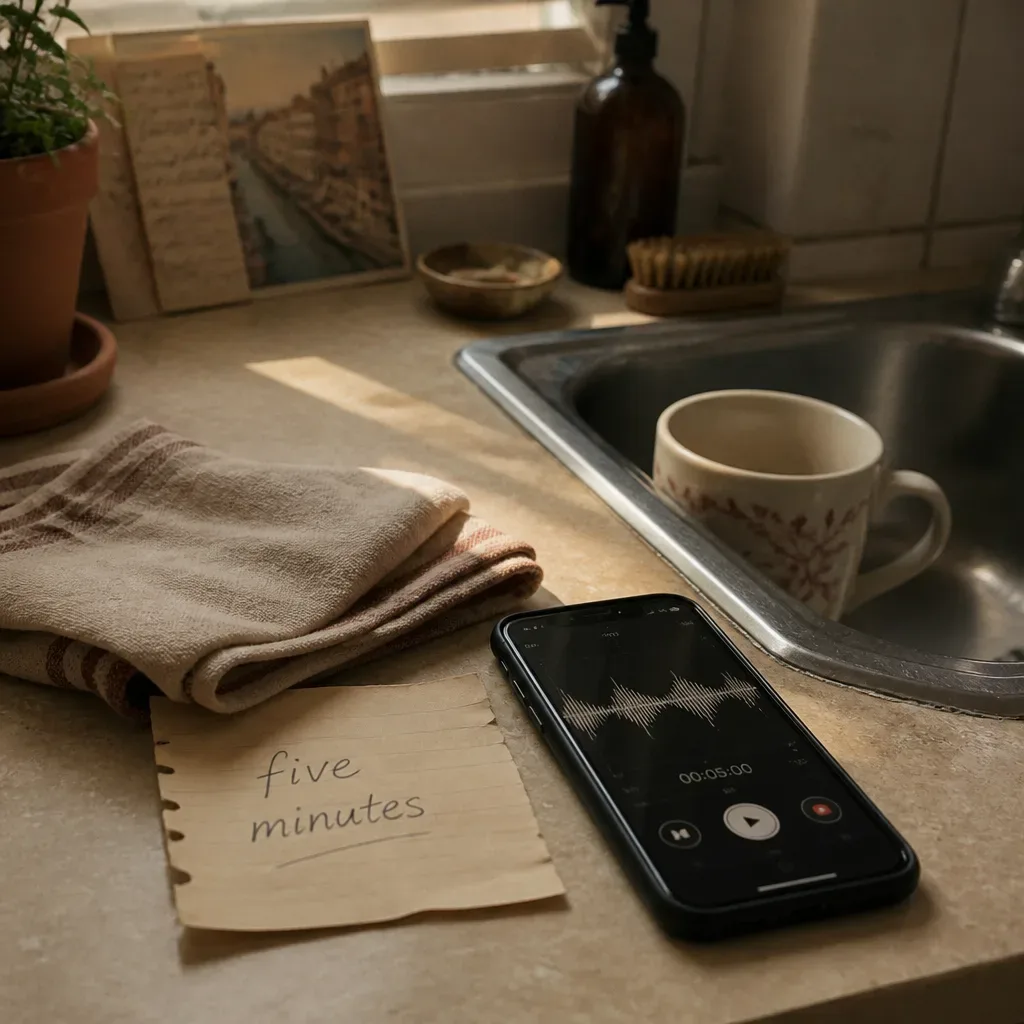
I set it up by choosing one surface, pressing play first, cleaning at ordinary speed, and stopping when the audio ends.
Before I forget, this is the exact version I kept this week. I stood in the kitchen with the blue cloth in my right hand. I chose the counter, not the whole kitchen. I pressed play before I moved anything. That order matters. If I clean first, I turn the audio into a reward. If I press play first, the audio becomes the doorway.
The behavior-design reason is simple. BJ Fogg’s Tiny Habits model uses an anchor, a tiny behavior, and immediate celebration. I do not use much celebration language myself, but the mechanism is sound. Attach the new action to an existing routine, reduce the first move until it is almost silly, and make the result noticeable. In my old habit app, the most durable routines were rarely ambitious. Fourteen thousand users taught me that the boring version survives travel, weather, and mood.
Use this small sequence:
- Choose one task that can be completed in 5 minutes.
- Put on headphones or place the phone nearby.
- Start the Dream-Self audio before touching the task.
- Clean at normal speed, without adding a second room.
- Stop when the audio ends.
- Leave one mark on the page, a date, a sentence, or a check.
| If you have | Choose this task | Avoid this task |
|---|---|---|
| 1 minute of patience | Wash one cup | Empty every cabinet |
| A tired body | Wipe one counter | Scrub the whole bathroom |
| A busy morning | Fold ten items | Reorganize the closet |
| A crowded mind | Clear one chair | Open old paperwork |
The table looks almost too plain. That is why I trust it. A good habit has less drama than the fantasy of having a habit.
I keep the Manifestation pillar bookmarked for the larger language around intention, but this practice stays very physical. Cloth. Sink. Audio. Stop.
What should I listen for while my hands are cleaning?
I listen for the sentence that my nervous system can almost believe today, not the sentence that sounds most impressive.
Some mornings the Dream-Self Moment says something that feels close to me. I can hear it without flinching. Other mornings, a line feels too far away, and I let it pass like a bus I am not taking. The point is not to force belief. The point is to spend five minutes near the identity I am practicing.
This is where manifestation and habit science touch without needing to argue. James Clear popularized identity-based habits in Atomic Habits, writing that behavior change lasts when it becomes tied to the kind of person you are becoming. The older psychological literature says similar things in different clothes: self-schema, possible selves, mental rehearsal. Hazel Markus and Paula Nurius introduced possible selves in 1986, and the idea still has teeth. We act differently when a future self is vivid enough to consult.
I usually listen for one of three kinds of lines:
- A line about how I spend my mornings.
- A line about how I speak to myself when I am behind.
- A line about what I stop doing because it no longer fits.
The daily affirmation can sit beside this, but it is not the main engine. If I write one sentence after the audio, I treat it like a receipt. The purchase was the listening. The page only proves I was there.
The Affirmations pillar is useful when I want cleaner wording, especially on days when my mind reaches for punishment disguised as discipline. Still, I do not turn the cleaning meditation into a writing session. If I do, five minutes becomes twenty, and the habit starts asking for a version of me who only exists on Sundays.
The sentence that works is often the one quiet enough to repeat tomorrow.
What if my mind wanders, or I feel foolish doing this?
If my mind wanders or I feel foolish, I return to the next physical action and let the audio keep going.
I have never met a useful practice that did not feel foolish at least once. The feeling is not evidence against the practice. It is usually evidence that I am doing something slightly new while still being myself. That is an awkward stage. It is allowed to be awkward.
Mind wandering is also normal. Matthew Killingsworth and Daniel Gilbert published a well-known 2010 Science paper using smartphone sampling and found that people’s minds wandered 46.9% of the time in their dataset. I think about that number when I miss half a sentence in the audio because I remembered the electricity bill. Wandering is not failure. Staying away forever would be the problem.
So I use the next action as the return point. Rinse the cloth. Fold the sleeve. Put the spoon in the drawer. The return is not grand. It is mechanical. That is what makes it trustworthy.
This is my repair plan:
- Notice I left.
- Name the next tiny action.
- Do that action slowly enough to feel it.
- Let the audio continue without rewinding.
- Finish at the five-minute mark.
I do not rewind because rewinding feeds perfection. The practice is not a school exam. If one line reaches me, that is enough. In small mindfulness studies, brief daily practice has shown benefits even when sessions are under 10 minutes, though effects vary by person and design. I like that variability. It keeps me honest.
On one Thursday, I laughed at myself while wiping the toaster. Then I kept wiping. That was the practice too.
How do I keep a cleaning meditation from becoming another chore I abandon?
I keep it from becoming another abandoned chore by protecting its smallness and attaching it to something that already happens.
The temptation is to improve the practice until it becomes unusable. I have done this with notebooks, workouts, sleep routines, and language apps. The first version works, then ambition arrives with a clipboard. Suddenly the five-minute cleaning meditation needs a playlist, a full reset, a perfect quote, and a room that looks ready to be photographed. That is the moment I cut it back.
Implementation intention research helps here. Peter Gollwitzer’s work on if-then planning has been supported by multiple studies and meta-analyses, with stronger goal follow-through when people specify the cue and action in advance. My version is plain: after the kettle turns on, I press play and wipe the counter for five minutes. Not sometime today. Not when I feel clear. After the kettle.
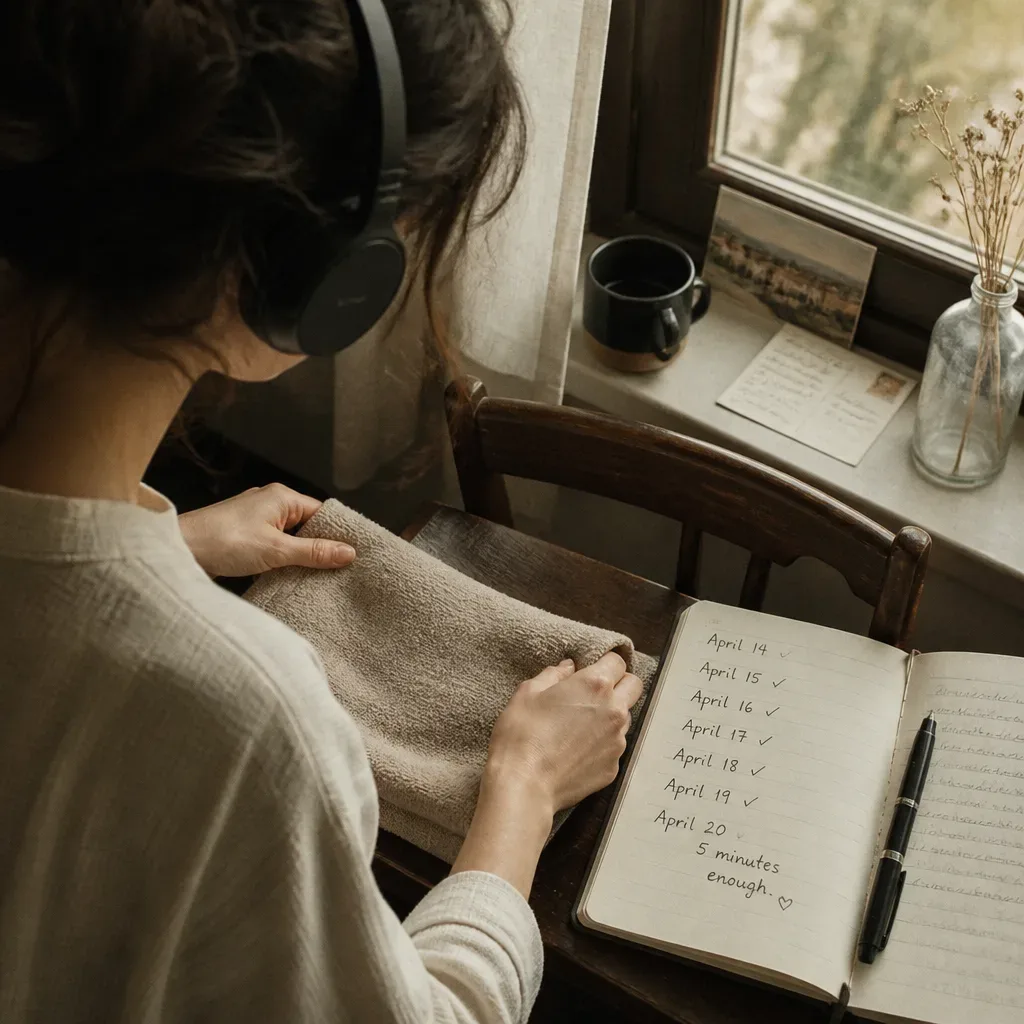
I also leave evidence where I will trip over it. A check mark on the calendar. A dated line in the notebook. A clean mug placed on the left side of the sink. Evidence matters because memory lies when I am tired. The room can tell the truth for me.
Here are the rules I keep taped inside my head:
- Five minutes is the ceiling, not the warm-up.
- One surface counts.
- A missed day is data, not a verdict.
- The audio starts before the cleaning.
- The practice should still work when I am mildly annoyed.
I sometimes look at Astrology and manifestation when I want timing language for the week, but I do not let timing become an excuse. If the moon is helpful, fine. If the sink is full, the sink is closer.
There is also a place for the Manifestation Board, but only after the audio has done its work. I might add a photo of a clear desk or a sentence about steadiness. I do not confuse the board with the practice. The board reminds. The audio leads.
The practice becomes durable when it is too ordinary to impress anyone.
When is the best time to do it, and how long should I keep going?
The best time is the first repeatable cue in your day, and I would keep the experiment for 14 days before judging it.
For me, the morning works because the kettle is dependable. For someone else, it might be after dinner, before a shower, or when the work laptop closes. The cue should already exist. I do not trust cues that require a new life. I trust doors, teeth brushing, coffee, school pickup, and the bus ride home.
Fourteen days is not magic. It is simply long enough to meet the practice in more than one mood. A 2009 study by Phillippa Lally and colleagues found that habit formation varied widely, with an average of 66 days for behaviors to reach automaticity in their sample. That number is useful because it lowers the pressure on week one. If automaticity can take weeks, I do not need to feel automatic on day three.
I run the first 14 days like a quiet test:
| Day range | What I track | What I ignore |
|---|---|---|
| Days 1 to 3 | Did I press play first? | Whether I felt calm |
| Days 4 to 7 | Did I stop at five minutes? | Whether the room was done |
| Days 8 to 14 | Did one sentence stay with me? | Whether I believed every word |
After two weeks, I ask one question: did this make returning easier? Not did it fix my home, my schedule, or my self-talk. Just returning. If the answer is yes, I keep it. If the answer is no, I change the cue or make the task smaller.
I link back to the AYA Method when I need to remember the center: listening is the practice. Repetition is the work. The audio is the method. I also return to the broader Manifestation pillar when I want the larger map, but the daily unit remains small enough to do with wet hands.
The sink is dry now. I am leaving the cloth over the tap.