audio manifestation
Manifestation Audio Script: 5 Future-Self Lines
Write a manifestation audio script that feels believable, repeatable, and calm with five future-self lines designed for daily listening.
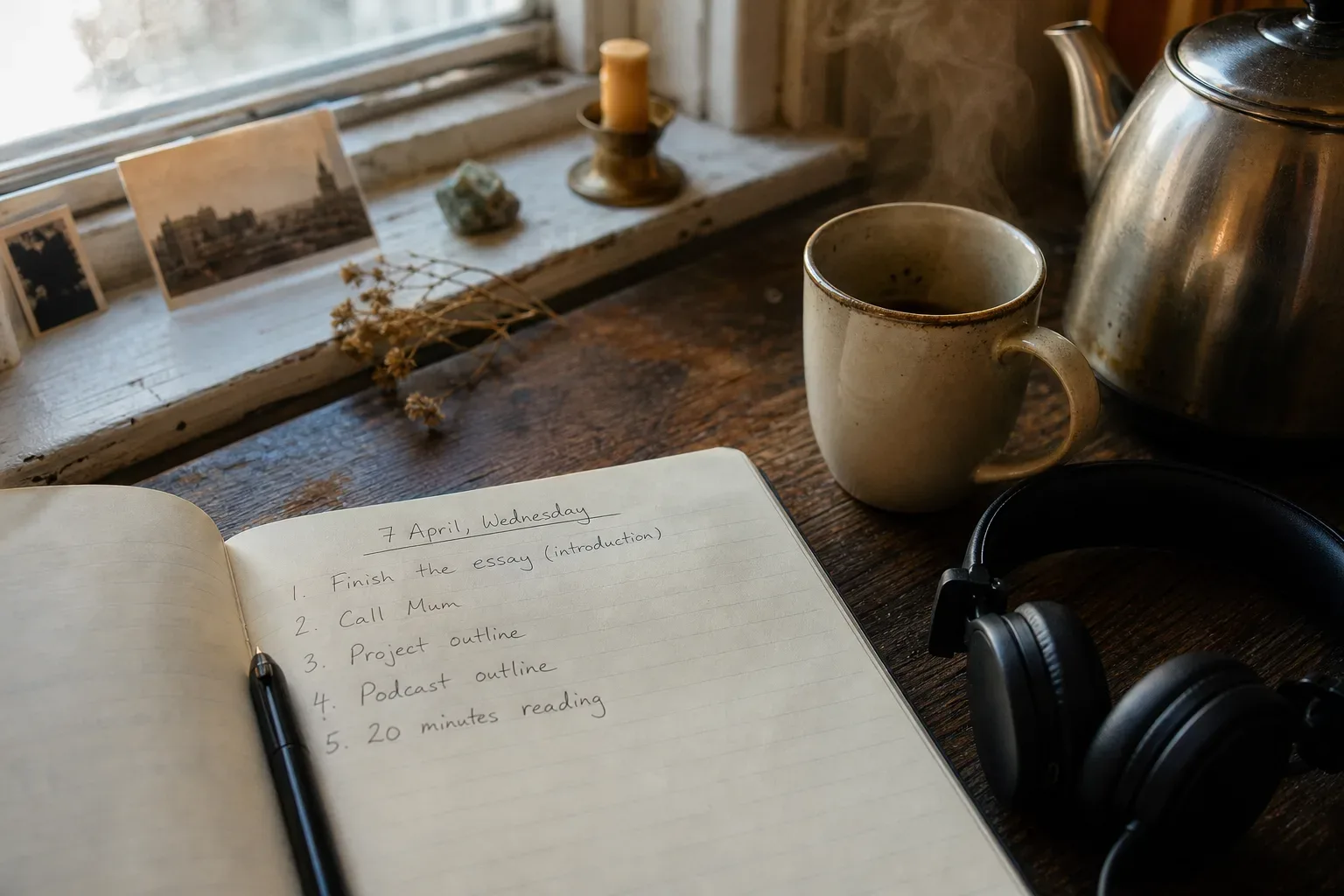
Tuesday. The kettle clicked off before I finished the first sentence. A good manifestation audio script needs five believable future-self lines: one for clarity, one for proof, one for safety, one for action, and one for familiarity. Short lines work because you can listen daily without negotiating with yourself.
I keep the definition plain because it keeps me honest: the AYA Method is a daily audio manifestation practice. Each day you listen to a short personalized recording, your Dream-Self Moment, narrated from the version of you who has already manifested the life you intend. Listening is the practice. Repetition is the work. The audio is the method.
I have tested enough routines to know the fragile ones by smell. They require the clean desk, the good mood, the long morning, the unbroken focus. By week three, most of them are gone. A short audio script has a better chance because it asks for less. The line you can hear while your coffee cools will beat the perfect paragraph you never play.
What makes a manifestation audio script work?
A manifestation audio script works when the future-self voice feels specific, emotionally safe, and repeatable enough to become familiar through listening.
This morning I wrote the five lines on the back of an envelope because my notebook was under a stack of receipts. That felt right. The script should survive a messy kitchen. It should not require a candle, a special chair, or a better personality. Research on habit formation is useful here: in a 2010 study by Phillippa Lally and colleagues in the European Journal of Social Psychology, automaticity took a median of 66 days, with a range from 18 to 254 days. So the script is not a speech. It is a cue you can return to for weeks.
I think of the audio as a small room I enter daily. The walls are made of the same words. After enough visits, my nervous system stops treating the desired life as foreign. That is the quiet value of repetition. Neville Goddard wrote often about assuming the feeling of the wish fulfilled, but the phrase only becomes useful when it has a practical container. For me, the container is audio, a short line, and a regular time.
Here is the test I use before I record anything:
| Script quality | I keep it | I rewrite it |
|---|---|---|
| Believability | My body does not argue with it | It feels like pretending loudly |
| Specificity | I can picture one ordinary day inside it | It floats above real life |
| Length | I can listen before brushing my teeth | I need motivation to begin |
| Tone | It sounds like future me | It sounds like an ad |
A future-self line should feel like evidence arriving early. Not hype. Not a command. Evidence.
I also borrow from self-affirmation research, but carefully. A 2015 meta-analysis by Epton and colleagues found that self-affirmation interventions had small but meaningful effects on health behavior. Small is not an insult. Small is how most durable things arrive. The body tends to trust what repeats without force.
Which five lines should my future self say?
Your future self should say five lines that name clarity, proof, safety, action, and familiarity in simple present-tense language.
I use these as my base script, then I change the nouns so they fit the exact thing I am asking for. If the topic is work, I make the proof about sending the proposal. If the topic is love, I make the proof about answering honestly instead of performing. If the topic is money, I make the proof about checking the account without flinching. The structure stays the same because structure lowers friction.
- I know exactly what matters today.
- I kept the promise when it was small.
- My body knows what safety feels like now.
- I choose the next honest action.
- This life is already familiar to me.
The first line gives attention a target. Dr. Andrew Huberman has often described attention as a limited resource, and the neuroscience is plain enough even without a podcast: working memory is small. Classic research by George Miller placed it around 7 items, while later estimates often put it closer to 4. A script that asks the mind to hold twenty wishes at once becomes noise.
The second line matters because identity changes more easily when it has proof. I kept the promise when it was small is better than I am perfectly disciplined because it gives my mind a memory to look for. One glass of water. One email. One honest sentence. Proof loves small containers.
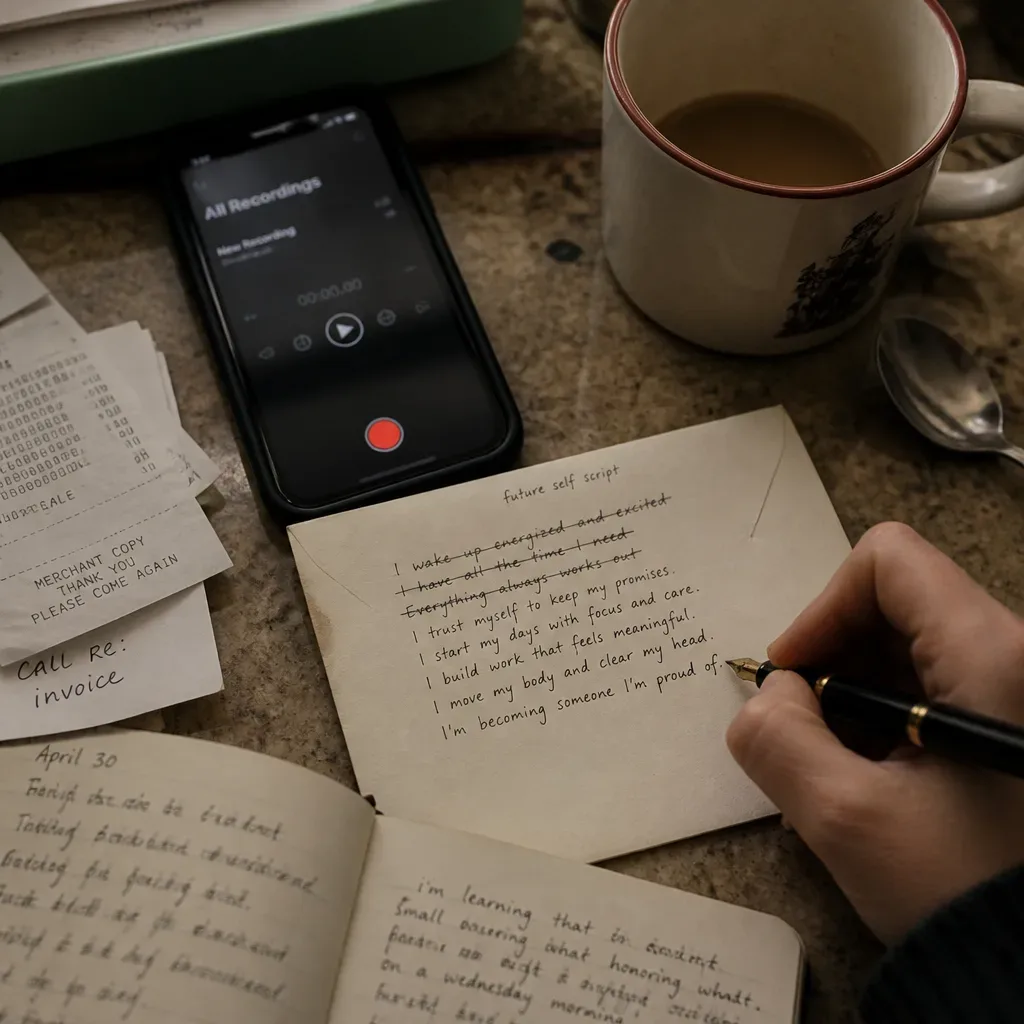
The third line is the one I do not skip. Safety is not decorative. If the desired future feels unsafe, the body will keep negotiating against it. In the Manifestation pillar, I wrote in the margin of my printed copy that the nervous system is often the gatekeeper. That is still the sentence I return to when I am tempted to make the audio grander than it needs to be.
The fourth line keeps the script from becoming passive. I choose the next honest action is not a productivity line. It is a bridge between listening and living. The fifth line is the soft landing. Familiarity is underrated. What feels familiar requires less daily persuasion.
How do I make the lines sound believable?
I make the lines believable by lowering the volume of the claim until my body stops arguing and starts listening.
There is a difference between a line that stretches me and a line that splits me. I can hear it immediately. When I write I am wildly successful, something in me goes flat. When I write I am trusted with work that fits me, my shoulders drop. That physical response is data. A 2016 paper in Social Cognitive and Affective Neuroscience found that self-affirmation can activate brain regions linked with valuation and future orientation, but the practice still has to be personally meaningful. The brain is not fooled by decoration.
I use three edits when a sentence feels too far away:
- I change certainty into learning: I am learning to receive steady love.
- I change scale into evidence: I answered one money question honestly today.
- I change fantasy into ordinary detail: I wake up in a home that feels calm.
This is where Affirmations pillar helps me, especially on days when a direct I am line feels stiff. Affirmations are useful when they are truthful enough to repeat. If they become a fight, I soften the grammar. The point is not to win an argument with myself. The point is to give attention a phrase it can practice.
I also watch for borrowed language. If a sentence sounds like something I saw on a poster, I cut it. My future self does not speak in captions. My future self knows where the spoons are kept. She knows the rent date. She knows what my mother says when she is worried. Specific life makes the script less brittle.
Joe Dispenza often talks about rehearsing a future state before it appears in the senses. I take the useful part and keep it grounded. Rehearsal works best when I can repeat it without needing a dramatic mood. A line that only works when I am inspired is not ready for audio.
How should I record the audio so I actually listen daily?
Record the audio slowly, under three minutes, with enough quiet space between lines for the body to answer.
I learned this from reviewing wellness apps for two years: the best routine is usually the one with the fewest steps. The Center for Disease Control reported that 14.2% of U.S. adults used meditation in 2017, up from 4.1% in 2012, but usage does not prove staying power. Many people try a practice. Fewer make it boring enough to keep. Boring, in this case, is praise.
My recording process is plain:
- I write the five lines by hand.
- I read them once out loud and mark where I rush.
- I record in a normal voice, not a ceremonial voice.
- I leave two breaths between lines.
- I listen once before saving it.
- I attach it to an existing habit, usually the kettle.
The voice matters less than the repeatability. I have used my own voice, a generated voice, and the personalized Dream-Self Moment inside the AYA practice. The version I keep is the one I will play on a difficult Tuesday. The the AYA Method passed that test for me because the audio did not ask me to become impressive before breakfast.
I keep the recording short because length is a tax. BJ Fogg, in Tiny Habits, built a whole behavior model around motivation, ability, and prompt. When motivation drops, ability has to rise. A one-minute recording has high ability. A fifteen-minute ritual asks for a better morning than real mornings often provide.
If I want music, I keep it low. If I want silence, I keep the room tone. I do not add anything that makes the file feel precious. Precious things are easy to avoid. Useful things get played with wet hands while the kettle clicks.
When should I listen to the script each day?
Listen at the same ordinary cue each day, preferably before your attention has been claimed by messages, tasks, or other people’s needs.
My cue is the kettle on weekdays and the bathroom sink on weekends. I tried listening in bed, but I fell asleep too often. I tried listening during walks, but the weather made the routine inconsistent. The kitchen won because I am there even when I am tired. A 2006 meta-analysis by Gollwitzer and Sheeran found that implementation intentions, the if-then plans that tie behavior to a cue, had a medium-to-large effect on goal achievement. The cue is not a detail. The cue is the hinge.
Here are cues that tend to work because they already exist:
- after starting coffee or tea
- before brushing teeth
- after putting on shoes
- on the first bus or train stop
- before opening email
- while sitting in the parked car
I do not recommend saving the audio for the perfect mood. The perfect mood is a terrible project manager. The whole point of a daily manifestation audio script is that it reaches me before I have assembled my defenses. On hard days, I just press play and let the words be steadier than I am.
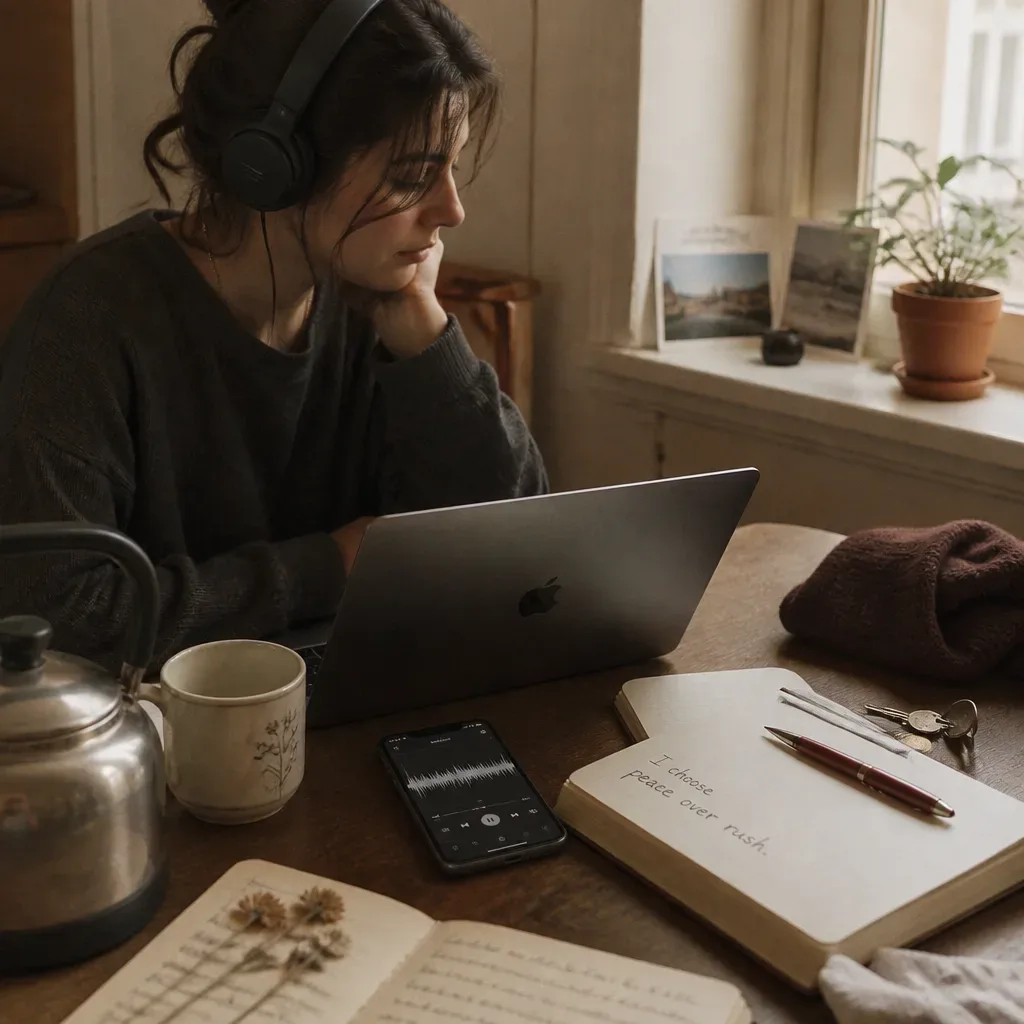
I sometimes pair the audio with one written sentence in my notebook. Not a full journal entry. Just the line that caught. If the line is I choose the next honest action, I write the action underneath it. The Manifestation Board can also help if I am working with images that remind me of the intended life, but I treat it as a complement. The audio remains the practice.
Some people time their listening with moon phases or birth chart transits. I do that sometimes because I write about Astrology and manifestation, and I like the ritual of dating things. But the daily cue matters more than the sky. If the moon helps you remember, use it. If it makes the practice complicated, leave it outside.
How do I know if the script is working?
The script is working if it becomes easier to hear, easier to believe, and easier to act from in small ordinary ways.
I give every practice thirty days before I judge it. Not because thirty is magic, but because novelty is noisy. Week one tells me almost nothing. Week two tells me whether friction is rising. Week three tells me whether I miss the practice when I skip it. That is the real test. Would I notice if it disappeared?
I track three things in a note file:
| Question | What I look for |
|---|---|
| Did I listen daily? | Number of plays, not mood |
| Did it get easier by week three? | Less resistance before pressing play |
| Did behavior shift? | One visible action connected to the script |
This is not about proving invisible forces. It is about noticing whether repeated attention changes the next choice. Princeton Engineering Anomalies Research reported small statistical deviations in random event generator studies over many years, and the interpretation remains debated. I mention it only because manifestation spaces often reach for big claims. I prefer smaller claims I can test in my own kitchen.
A good sign is when the line appears during the day without effort. Last Thursday, I was about to avoid a difficult email, and the line came up: I choose the next honest action. I did not become a new person. I answered the email. That was enough evidence for one day.
The Manifestation pillar gave me a useful phrase for this: attention becomes instruction when it is repeated. I wrote it on a page and dated it. The script is not working because it makes me feel high. It is working if it makes the next true thing easier to do.
What is the simplest script I can use today?
The simplest script is five lines, one minute long, spoken from a future self who sounds calm enough to trust.
Here is the version I would record today if I had only the kitchen table, my phone, and four quiet minutes:
I know exactly what matters today.
I kept the promise when it was small.
My body knows what safety feels like now.
I choose the next honest action.
This life is already familiar to me.
If you want to tailor it, change only one word per line at first. For love, safety might become tenderness. For money, promise might become number. For work, honest action might become clear request. Small edits keep the nervous system oriented. Too many edits create a new script every day, which removes the benefit of repetition.
I keep a daily affirmation beside it sometimes, especially if one line needs extra support. I might write, I can be steady before I am certain. Then I stop. The affirmation is a note in the margin, not the main practice. The audio is what I return to.
The script should feel almost too simple. That is usually a good sign. Complex routines give the mind more exits. Simple ones leave fewer doors. In habit design, fewer decisions usually means better adherence, and that has been my experience across apps, notebooks, and practices I abandoned by the second Friday.
If you want a wider frame for how audio, attention, and identity work together, keep the AYA Method, the Affirmations pillar, and Astrology and manifestation nearby. I use them differently, but I do not confuse their roles. Listening is the practice. The rest helps me remember what I am practicing.
Wednesday now. The cup is still warm.