audio manifestation
Manifestation Journaling vs Future-Self Audio
Manifestation journaling can help you name desire, but future-self audio may hold better on busy weeks. A practical comparison from a real routine.
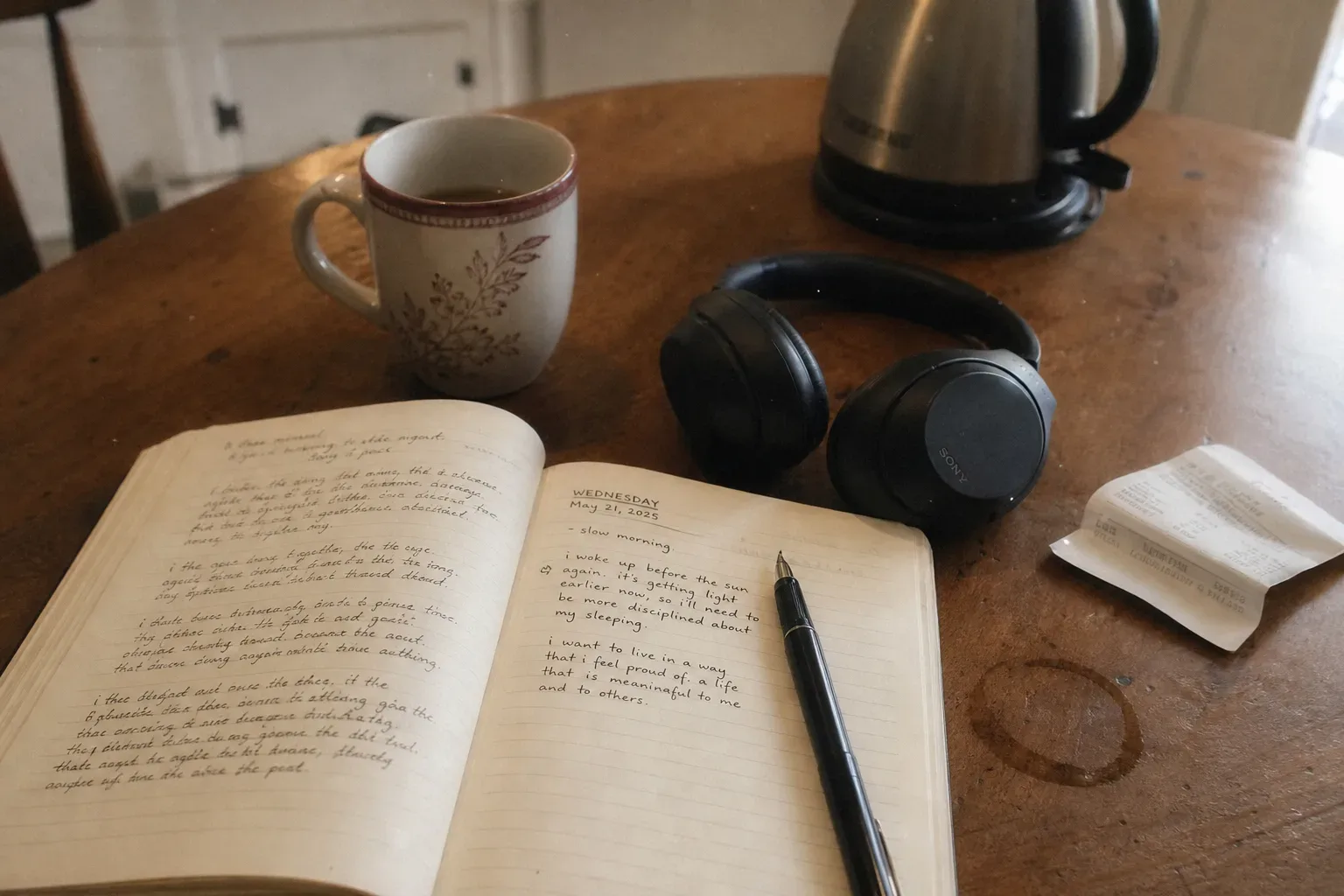
Monday. The kettle clicked off before I found a pen. Manifestation journaling helps me think, but future-self audio is easier to keep on busy weeks because it needs less setup, less time, and less decision-making. When the calendar gets mean, the practice with fewer doors to open usually survives.
What am I really comparing when I compare journaling and audio?
I am comparing two different kinds of friction, not two different levels of seriousness.
Manifestation journaling is a writing practice. I sit down, open a page, name what I am asking for, and let the sentence show me what I actually believe. It can be precise. It can also be evasive. I have filled three pages and still avoided the one honest line. Researchers have studied expressive writing since the 1980s, especially James Pennebaker’s work using 15 to 20 minute writing sessions across several days. That timing matters because the page often needs a little room before the real thought arrives.
Future-self audio is different. In the AYA Method, the practice is daily listening to a short personalized recording, the Dream-Self Moment, narrated from the version of you who has already manifested the life you intend. Listening is the practice. Repetition is the work. The audio is the method. I listened this morning before brushing my teeth. That is the order I do them in.
I kept notes for this comparison because Nico from the app-review years still lives in me. My protocol is plain: did it happen daily, did it get easier or harder by week three, and would I notice if it disappeared? Lally and colleagues at University College London reported in 2009 that habit automaticity took 66 days on average, with wide variation. A practice that collapses in week two may never reach the part where it gets quieter.
Here is the first honest difference I wrote in my notebook: journaling asks me to produce language; audio asks me to receive it. That sounds small until Thursday night, when I have already produced language for nine hours.
A practice is not better because it asks more of you. A practice is better when it can meet the day you actually have.
Which practice holds up better on a busy week?
Future-self audio holds up better for me on a busy week because it can attach to an existing action.
The Bureau of Labor Statistics American Time Use Survey reported that employed people worked about 7.9 hours on days they worked in 2023. That number does not include the small tolls around work: the bus, the messages, the grocery line, the family text that arrives exactly when the soup starts boiling. Manifestation journaling asks for a cleared pocket of attention. Future-self audio can happen inside a pocket that already exists.
On Tuesday I listened while rinsing my blue mug. On Wednesday I listened on the bus with one earbud in. On Thursday I listened in the bath, which sounds gentler than it was because I was also answering a landlord email in my head. The practice still happened. I could not have journaled in those moments without turning the moment into a task.
I still respect the page. The page catches detail. The page catches avoidance. My best entries usually begin badly: “I want more money” becomes “I want not to flinch when the rent email arrives.” That distinction belongs in writing. The Manifestation pillar is useful here because it frames manifestation as attention, identity, and action, not wishing from a chair.
But busy weeks punish practices with too many starting conditions. I need the right pen. I need the notebook. I need a surface. I need privacy. I need to know what prompt I am using. Stanford behavior scientist BJ Fogg has repeated a simple formula for years: behavior happens when motivation, ability, and a prompt meet. On my crowded weeks, journaling often loses at ability. Audio wins because ability stays high.
A busy week does not reveal your devotion. It reveals your system design.

What does manifestation journaling do that audio does not?
Manifestation journaling gives me evidence I can reread, question, and date.
This matters more than I want it to. A recording can settle into the body through repetition, but a page can show me the exact sentence I used three Fridays ago. When I reread an old entry, I can see whether I was naming desire or negotiating with fear. In one entry from April, I wrote, “I want work that does not make me disappear by dinner.” That line did more than a vague request for success. It gave the request edges.
There is a reason writing practices have stayed around in therapy-adjacent spaces. In Pennebaker’s early expressive writing studies, participants wrote about emotional experiences for short structured sessions, often 15 minutes over 3 or 4 days. The outcomes were mixed across later research, but the central mechanism still interests me: writing makes thought observable. A thought in the head can keep changing costume. A thought on the page has to sit still.
When I use the Affirmations pillar, I notice the same issue. An affirmation can be clean and useful, but if I never write my resistance down, I may keep repeating words my nervous system does not believe. Journaling lets me write the sentence beneath the sentence: “I am ready” may hide “I am afraid of being seen.” The hidden line is often the better starting point.
For me, manifestation journaling is strongest for:
- naming a desire with more accuracy
- tracking what changed over 7, 14, or 30 days
- noticing repeated fears
- separating borrowed goals from true ones
- recording evidence when something small moves
The page is a witness, but it is not automatically a practice. I have mistaken documenting for doing before. I had an old notebook full of beautiful plans and very little changed behavior. That is why I now treat journaling as an audit. It tells me what the practice is doing. It does not replace the practice.
What does future-self audio do that journaling does not?
Future-self audio gives me repetition without asking me to generate the future from scratch every morning.
That sentence is why I kept using it. I do not wake up equally articulate every day. Some mornings I wake up with the mind of a damp sock. If the practice depends on me writing a clean paragraph about my desired self, I am already behind. Audio lets the future-self language be ready before I am ready. I press play and borrow the structure.
Pew Research Center reported in 2024 that about 91% of U.S. adults own a smartphone. I am careful with that number because access is not the same as ease, but it explains why audio can be so portable. The phone is already there on the counter, next to my coffee, guilty and useful. A notebook is kinder. The phone is closer.
The difference is also cognitive. Journaling is active recall and construction. Audio is guided rehearsal. Dr. Andrew Huberman has spoken often about the nervous system learning through repetition, attention, and state, though not as a promise that listening alone changes a life. I keep that distinction. The recording does not do my work for me. It keeps a version of me in contact with the work when my attention is scattered.
Here is the comparison I wrote on a receipt because I had left my notebook at home:
| Busy-week question | Manifestation journaling | Future-self audio |
|---|---|---|
| Setup needed | Notebook, pen, surface, prompt | Phone and headphones |
| Best time | Quiet morning or evening | Existing routine cue |
| Main strength | Clarity and self-honesty | Repetition and continuity |
| Main risk | Too much effort to start | Passive listening without action |
| Best use | Weekly review or stuck feeling | Daily identity rehearsal |
The risk column matters. Audio can become background noise if I treat it like wallpaper. I have to listen. Not perfectly. Not dramatically. Just enough to notice one sentence. The sentence this morning was about answering email from calm rather than apology. That is a small thing. It is also the exact thing I needed at 9:40.
Repetition is not glamorous. Repetition is how a sentence becomes available when the old self reaches for the wheel.
How do I choose between them when my week is already full?
I choose based on the job I need the practice to do that day.
On full weeks, I use a simple rule because complicated rules are where routines go to die. If I need continuity, I listen. If I need clarity, I write. If I need both, I listen first and write one sentence after. The one sentence matters because it keeps journaling from becoming a second job. A 2022 review in the journal Healthcare noted that mobile health engagement often drops over time, which matches my app-review graveyard: people do not quit because they hate growth. They quit because the routine asks for a better version of their day than the one they actually have.
My current decision tree is short:
- If I have under 5 minutes, I listen to my Dream-Self Moment.
- If I have 5 to 10 minutes and privacy, I listen, then write one sentence.
- If I feel foggy or avoidant for more than 2 days, I journal for 10 minutes.
- If I am making a decision, I journal before asking anyone else.
- If I am tired enough to bargain, I choose audio and stop negotiating.
This is not a hierarchy. It is triage. I would rather have a small practice that repeats than a perfect ritual I keep rescheduling. The audio manifestation frame helped me here because it made listening the center, not a bonus activity I had to earn.
I also keep one guardrail from my product-design life: one primary behavior per routine. If I make the morning routine include water, stretching, journaling, audio, breathwork, and a clean kitchen, I have built a museum exhibit, not a Tuesday. One behavior gets the anchor. Everything else is optional.
Where do belief, evidence, and timing fit into this?
Belief matters, but I trust evidence and timing more than mood.
Manifestation writing can make me feel sincere. Audio can make me feel steady. Neither feeling is proof. I look for small external changes and small internal changes over a dated period. Did I send the email faster? Did I speak less defensively? Did I stop postponing the application? Did I notice the same fear but recover 10 minutes sooner? These are not fireworks. They are data.
This is where I hold a careful line with research. Princeton’s PEAR and later Global Consciousness Project work are often mentioned in manifestation circles because they studied mind-matter questions and random event generators. The findings remain debated, and I do not use them as proof that a thought controls an outcome. I use them as a reminder that attention is worth studying carefully. Claims can be interesting without becoming instructions.
I also keep astrology in its proper place for me. When I read Astrology and manifestation, I use timing as a reflective frame, not as permission to abandon responsibility. A moon phase can give me a date to review my notes. It cannot send the proposal. It cannot repair the conversation. It can put a circle around a week and say, “Look again.”
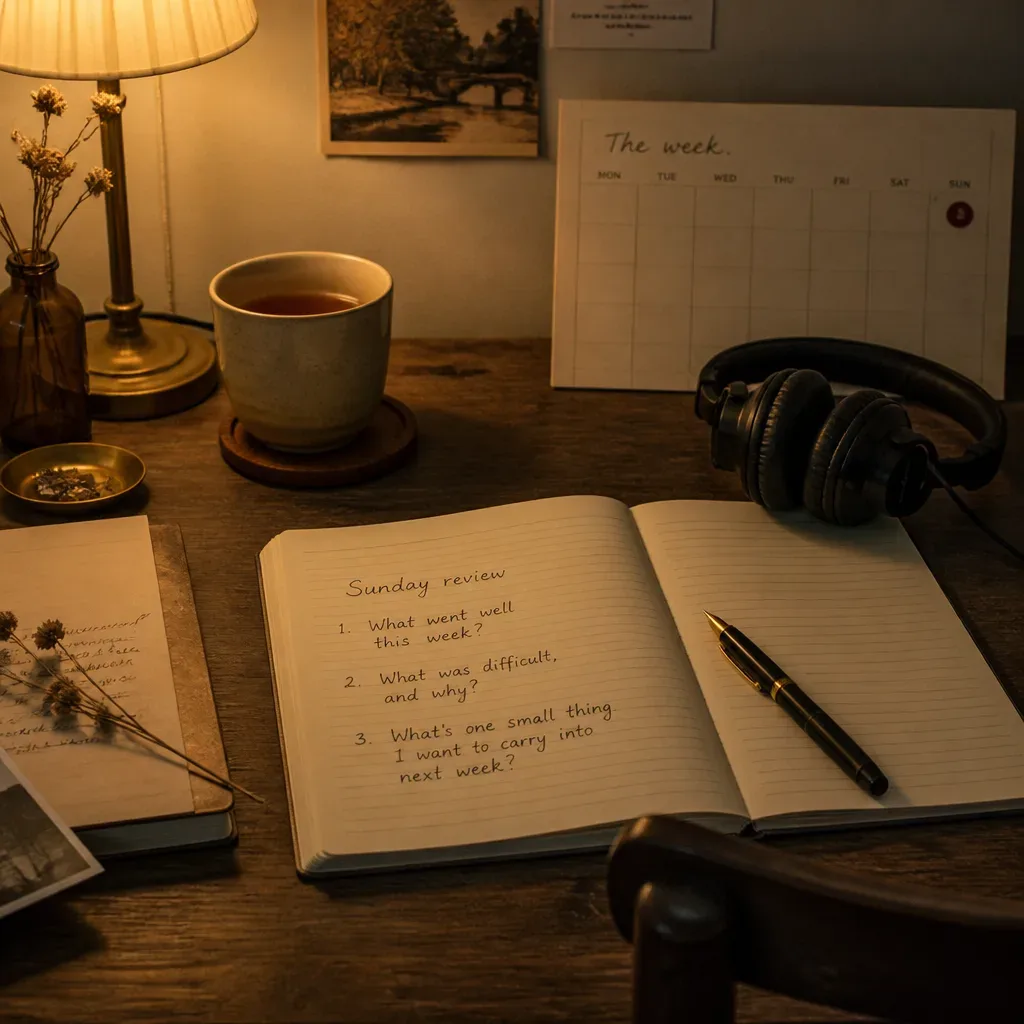
My evidence log is boring on purpose. Every Sunday, I write three lines:
- What did I listen to most clearly this week?
- What did I do differently because of it?
- What still feels like theater?
The third question saves me. Wellness culture often rewards the performance of certainty. I would rather write down the false note. If the practice cannot survive honesty, it was decoration.
A desire becomes useful when it changes what you do at 3:17 on an ordinary afternoon.
What is my final busy-week rule?
My final rule is to make future-self audio the daily practice and manifestation journaling the weekly witness.
That is the arrangement that has survived here. I listen daily because the friction is low enough for a bad morning. I journal weekly because the page deserves enough attention to tell the truth. When I tried daily manifestation journaling during a heavy work period, I lasted 11 days. When I moved it to Sunday evening and kept audio daily, I reached 30 days without needing to become a different person first.
There is habit math in this. If a practice takes 15 minutes a day, it asks for 105 minutes a week. If future-self audio takes 4 minutes a day, it asks for 28 minutes a week. Add one 12 minute journaling review and the whole system is still about 40 minutes. That difference is not laziness. It is design. Time is not the only cost, but it is one of the costs people lie about most.
I keep a small note taped inside my notebook now:
| If the week is… | I choose… | Because… |
|---|---|---|
| Crowded | Future-self audio | It can happen inside an existing cue |
| Foggy | Manifestation journaling | Writing shows me what I am avoiding |
| Tender | Audio, then one line | I need contact, not pressure |
| Decisive | Journaling | The page helps me see the tradeoff |
| Ordinary | Audio daily, journal Sunday | Continuity plus evidence |
The Manifestation pillar gives the larger map, but the daily question is smaller: what will I actually do before the kettle cools? For me, the AYA Method answers that question cleanly because the listening is already shaped. The daily affirmation sometimes helps after. The Manifestation Board sometimes reminds me what I named. But the audio is the method.
So I do not ask whether manifestation journaling or future-self audio is more spiritual, more serious, or more impressive to describe. I ask which one remains when the kitchen is messy, the inbox is loud, and my best intentions have gone quiet.
Monday night. The notebook is closed, and the headphones are by the sink.