audio manifestation
Commute Meditation with Future-Self Audio
Commute meditation can be as simple as safe future-self audio on your way to work. Learn a 12-minute routine for trains, buses, or careful driving.

The train doors close. Your hand is still around the coffee. Commute meditation is possible when it is safe, short, and audio-led: you listen to a future-self recording during a steady part of the trip, then carry one sentence into work. No earlier alarm. No performance.
What makes commute meditation different from sitting at home?
Commute meditation works because the time already exists.
A home practice asks you to create a new pocket of time. The commute does not. It is already on the calendar, whether you like it or not. The U.S. Census Bureau has reported average one-way commute times near 26 to 27 minutes for American workers in recent years. That is enough space for a 5 to 12 minute audio practice and still enough silence to look out the window.
The difference is not only location. It is friction. BJ Fogg, the Stanford behavior researcher behind Tiny Habits, has written that habits get stronger when they are attached to an existing prompt. Leaving home is already a prompt. Putting in headphones is already a prompt. The practice begins when you stop trying to build a perfect morning and use the one you have.
This is where the AYA Method fits cleanly. The AYA Method is a daily audio manifestation practice. Each day you listen to a short personalized recording — your Dream-Self Moment — narrated from the version of you who has already manifested the life you intend. Listening is the practice. Repetition is the work. The audio is the method.
A commute is not a retreat. It has brake lights, platform noise, weather, delays, and the small irritation of other people being alive near you. That is exactly why it can be useful. If your future self only exists in a quiet bedroom, the practice is too fragile. The life you intend has to survive Tuesday traffic.
A routine that works in ordinary conditions is more honest than one that only works in ideal ones.
How do you choose the safest part of the commute?
Choose the part of the trip where your body can listen without needing to decide much.
If you drive, the safest segment may be after you have merged, set the route, and settled into a familiar road. If you take transit, it may be after you have boarded and found a place to stand or sit. If you walk, it may be a quiet stretch without crossings. The point is simple: do not start a practice at the same moment your attention is needed for navigation.
Safety rules are not decorative here. The National Highway Traffic Safety Administration has warned for years that distracted driving is involved in thousands of deaths annually in the United States. AAA has also noted that looking away from the road for about 5 seconds at highway speed can mean traveling the length of a football field without full visual attention. So your commute meditation must be designed around attention, not escape.
Use this quick filter before you press play:
- Green light: seated on a train, bus, or parked car; walking on a clear path; waiting at a platform.
- Yellow light: driving a familiar route with navigation already set; walking in mild foot traffic.
- Red light: changing lanes, crossing streets, biking in traffic, looking for a platform, parking, or handling your phone.
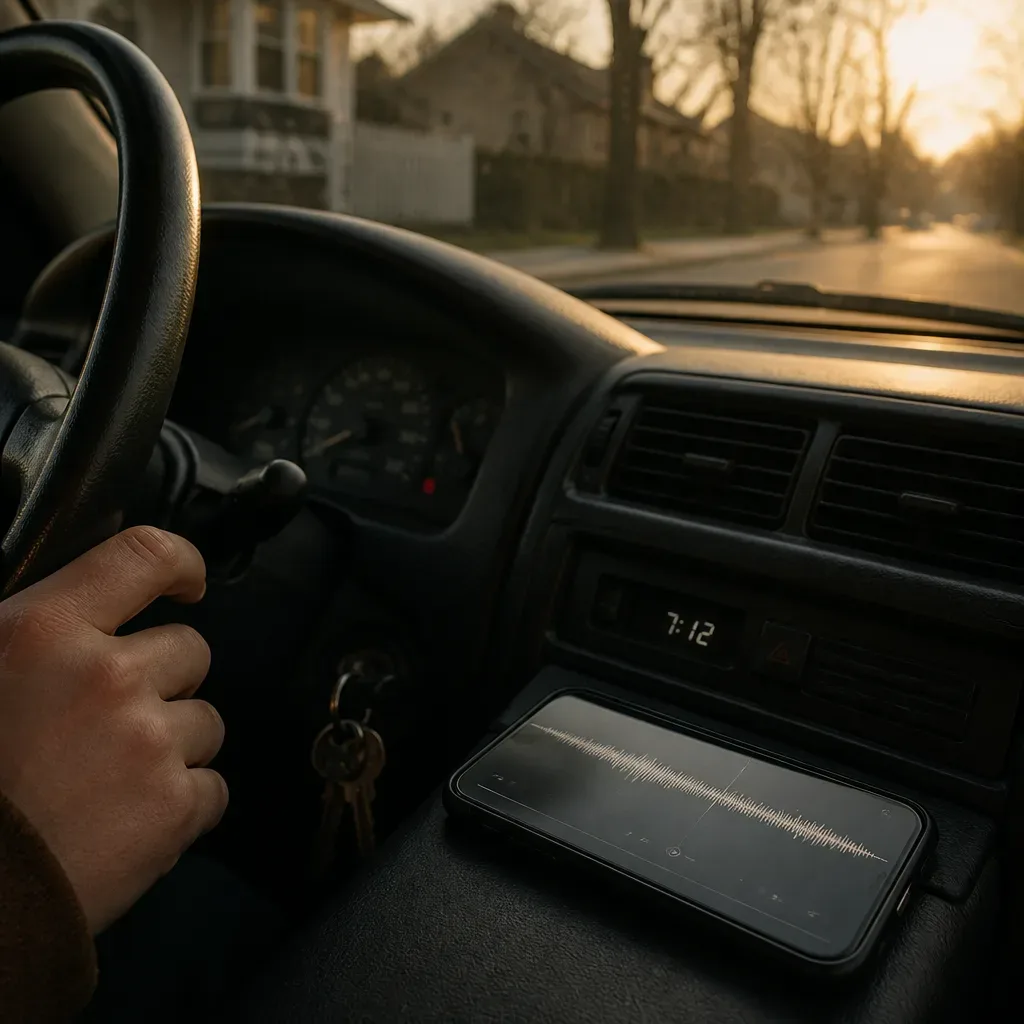
For drivers, the practice is passive listening. Eyes open. Hands free. No breath holds. No eyes-closed body scan. No visual exercise that pulls you away from the road. If the recording makes you want to shut out the world, it belongs before the drive begins or after the car is parked.
The quiet rule: a practice that asks you to become less safe is not a practice worth keeping.
What should the future-self audio say on the way to work?
The audio should speak from the identity you are rehearsing, not from the fear you are trying to fix.
A good commute recording is short, specific, and believable enough for your nervous system to stay with it. Neville Goddard wrote often about living from the wish fulfilled. In plain terms, that means the audio should not beg for a future. It should let you hear a version of yourself who already moves differently. Not grand. Not theatrical. Real.
For workdays, I like a recording that names three things: the kind of person you are becoming, the way you behave under pressure, and the first ordinary action that proves it. Joe Dispenza often links mental rehearsal with changing familiar emotional patterns; whether you take his work as spiritual teaching or personal practice, the useful part is repetition. The brain learns what is repeated with attention.
Here is a simple 12-minute structure:
| Minute | What happens | Why it helps |
|---|---|---|
| 0-1 | Settle into listening | Marks the commute as practice time |
| 1-4 | Hear the Dream-Self Moment | Gives the mind a clear identity cue |
| 4-7 | Name workday behavior | Connects the self-image to real choices |
| 7-10 | Repeat one sentence softly | Makes the audio portable |
| 10-12 | Choose the first action | Turns listening into a small decision |
The sentence matters. It should be calm enough to believe at 8:14 a.m. Try something like: I answer the first message with care. Or: I do not rush my own thinking. If you want more structure around spoken belief, the Affirmations pillar explains how short phrases can support attention when they are not used as decoration.
The best future-self audio does not flatter you. It reminds you.
How do you do a 12-minute commute meditation step by step?
Do it by removing decisions before the trip starts.
The practice fails when it becomes another thing to manage while moving. Set the audio, headphones, and volume before the commute begins. If you use AYA, open the Dream-Self Moment while you are still at home, seated on transit, or parked. The app may also include a daily affirmation and a Manifestation Board, but those are complements. The method is the audio.
Here is the simple version to use for five workdays:
- Before you move, press play. Do not search, scroll, or choose while walking into traffic or driving.
- Let the first minute be plain. Feel the seat, your shoes, the steering wheel, or the strap in your hand.
- Listen to the future-self audio once. Do not restart it to make it perfect.
- Pick one line. Keep the line you can carry without effort.
- Name the first work action. One email. One document. One conversation. One boundary.
- Stop before you arrive. Give yourself 30 to 60 seconds of ordinary awareness before work begins.
This matters because implementation intention research by psychologist Peter Gollwitzer has repeatedly found that if-then plans can improve follow-through. The cue is: if I begin the commute, then I listen. The action is not vague. It is paired with a real moment.
A small action at the end keeps manifestation from becoming private theater. For a wider frame on how desire, belief, and action meet, read the Manifestation pillar. The cleanest practice is not the one that sounds the most mystical. It is the one that changes the next small choice.
You are not trying to become someone else on the commute. You are practicing the person you already recognize.
What if the commute is loud, crowded, or stressful?
Use the noise as a boundary, not a reason to quit.
Crowded commutes are not gentle. The World Health Organization has linked chronic noise exposure to stress and sleep disturbance, and urban transit can easily sit above comfortable sound levels. So no, the practice will not always feel soft. Some mornings it will feel like a recording underneath announcements, horns, and someone watching a video without headphones.
The fix is not to force calm. It is to make the practice smaller. Lower the ambition until it fits the day. Listen to only the first 5 minutes. Keep only one phrase. Let your eyes rest on one neutral object. If you miss half the words, do not start over unless you are safe and still. Repetition over a week matters more than perfect attention on one morning.
You can also create a backup ladder:
- Full practice: 12-minute Dream-Self Moment plus one action.
- Short practice: 5-minute listen plus one sentence.
- Tiny practice: 3 breaths before opening work messages.
- Recovery practice: listen after arrival, while parked or seated outside.
This is habit design, not moral judgment. In app review work, I have seen routines fail because they assume stable moods, quiet rooms, and unlimited patience. Real routines have to tolerate friction. Pew Research Center has reported that many workers with jobs that can be done remotely still mix home and office days, which means commute patterns are often irregular. Your practice has to be flexible enough to return after a gap.
If astrology is part of how you mark timing, keep it as a calendar lens, not an excuse. The piece on astrology and manifestation can help you hold timing gently while still taking the next step.
A practice that can shrink can also survive.

How do you know if commute meditation is working?
You know it is working when your first choices at work begin to match the self you heard.
Do not measure the practice by whether the commute felt peaceful. That is too unstable. Measure behavior. Did you answer the difficult message with more care. Did you pause before reacting. Did you start the task you usually avoid. Did you remember the line from the audio at 11:30, when the morning had already become itself.
Researchers in the Journal of Behavioral Medicine and related health psychology fields have studied self-monitoring for decades. The simple act of tracking a behavior often improves awareness and follow-through. You do not need a complicated score. Use a five-day note with three marks: listened, remembered, acted.
Try this tiny tracker:
| Day | Listened | One line remembered | One matching action |
|---|---|---|---|
| Monday | |||
| Tuesday | |||
| Wednesday | |||
| Thursday | |||
| Friday |
At the end of five workdays, look for evidence, not drama. If you listened three times and acted once, that is data. If the audio felt nice but changed nothing, adjust the line or the first action. If driving made it too distracting, move the practice to the parked car before you leave or the train platform after you arrive.
You can return to the AYA Method page when you want the full shape of the practice. You can also keep manifestation simple: hear the future self, repeat the cue, take the next true action.
The commute does not have to be wasted time. It can be a threshold.
Arrive softly, and begin from there.