astrology manifestation
Dark Moon Ritual: 5-Minute Dream-Self Audio Reset
A dark moon ritual for quiet reset: five minutes of Dream-Self audio, simple steps, timing notes, and grounded reflection before the new moon.

The lamp is low, and your phone is face down. A dark moon ritual can be very small: five minutes, one Dream-Self audio, one sentence of release, and one next step. You’re using the moon’s quietest point as a cue to listen, not to fix your whole life.
What is a dark moon ritual, really?
A dark moon ritual is a short reset done in the final quiet stretch before the new moon.
The dark moon is not a separate astronomical object. It’s the name many astrologers and moon-watchers give to the nights when the moon is not visible, just before the lunar cycle begins again. NASA describes the average synodic month, new moon to new moon, as about 29.53 days. That number matters because it gives the body a rhythm larger than a week and smaller than a season.
In practice, a dark moon ritual is less about asking and more about clearing. New moon practices often carry intention. Full moon practices often carry reflection. The dark moon sits lower. It asks, quietly, “What’s complete now?” That question is useful even if you don’t track every sign, house, or transit. A ritual becomes real when it changes what you do tomorrow.
You don’t need incense, a long altar, or a perfect hour. In fact, the point here is to reduce the ceremony until it becomes repeatable. Behavioral researcher Wendy Wood has written that many habits are shaped by context cues and repetition, not by constant motivation. A five-minute practice can become a doorway because it’s small enough to enter on tired nights.
The dark moon also gives permission to do less. If you use astrology and manifestation, the moon can become a calendar for attention. Not pressure. Just attention. You notice the end of one cycle. You listen for the self who has already crossed the next small threshold.
The quietest rituals often work because they ask for almost nothing, then ask for it again.
Why use Dream-Self audio instead of more thinking?
Dream-Self audio helps because listening is simpler than trying to think your way into a new identity.
A lot of manifestation practices become writing projects. You script, list, refine, compare, and then wonder why you feel more tired. Writing can help, and affirmations can be useful when they’re believable. But at the dark moon, the mind is often already loud. Audio lets you stop producing and begin receiving.
The AYA Method is a daily audio manifestation practice. Each day you listen to a short personalized recording — your Dream-Self Moment — narrated from the version of you who has already manifested the life you intend. Listening is the practice. Repetition is the work. The audio is the method.
That distinction matters. The daily affirmation and Manifestation Board can support the practice, but they’re complements. The audio is the method. In a dark moon ritual, that means you don’t have to create a new vision from zero. You listen to the one you’ve already chosen, in a voice shaped like your future self.
There is research underneath the softness. A 1994 meta-analysis by Driskell, Copper, and Moran found that mental practice improved performance across many tasks, with stronger effects when combined with physical practice. Self-affirmation research reviewed by Cohen and Sherman in the Annual Review of Psychology in 2014 suggests that values-based statements can help people stay less defensive under stress. These studies don’t prove that a wish makes reality obey. They suggest something more grounded: repeated self-relevant cues can change attention and behavior.
Five minutes is not nothing. At a slow breathing pace of about 6 breaths per minute, often used in heart-rate variability studies, five minutes gives you roughly 30 breaths. That’s long enough for the nervous system to receive a different instruction.
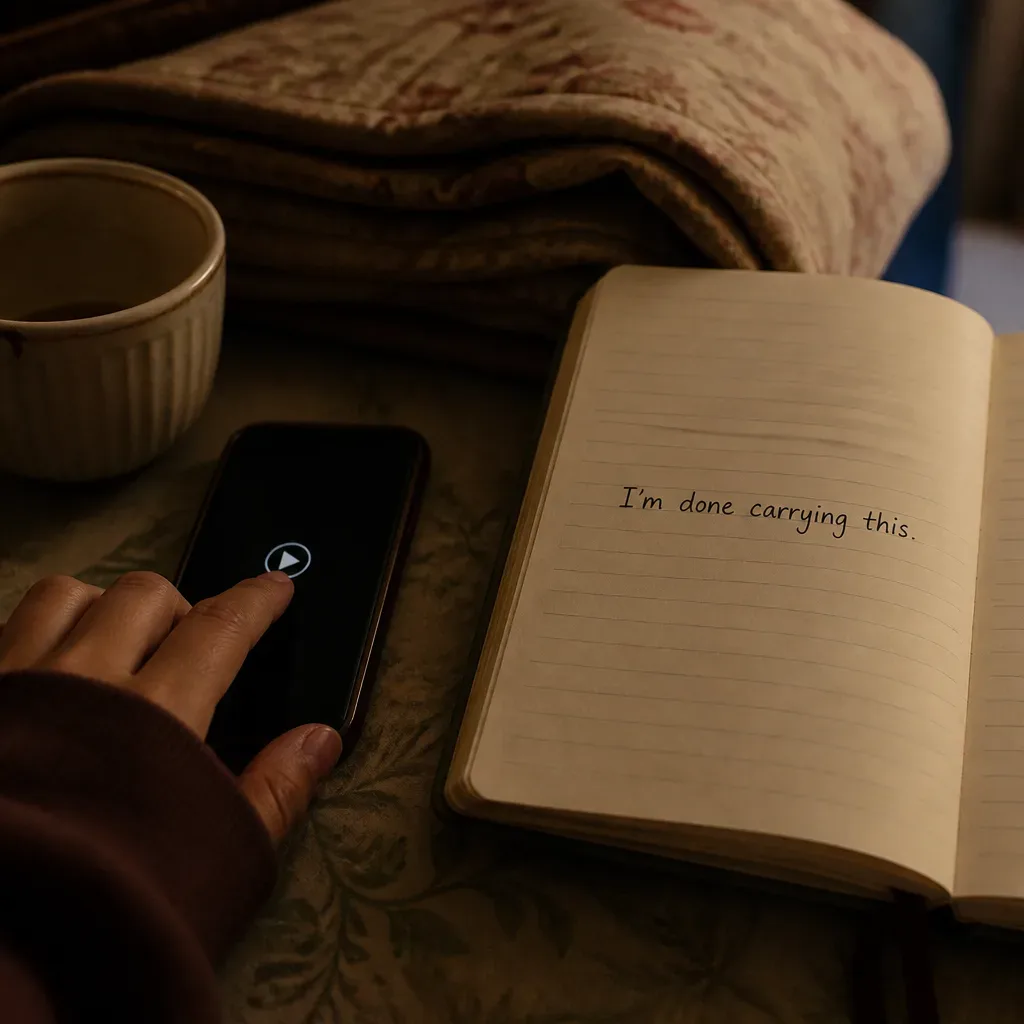
How do you do the 5-minute reset?
You do the reset by making the room quiet, listening once, and writing only what’s needed.
Set a timer for five minutes if that helps you stop adding more. The dark moon ritual works best when it stays contained. If you keep expanding it, the ritual becomes another task. If you keep it small, it can become a return.
Here is the whole practice:
- Minute 0:00 to 0:30, dim the room. Lower one light. Put your notebook nearby. Turn your phone to Do Not Disturb. The American Psychological Association has noted that environmental cues can shape stress responses; even one repeated cue can tell the body what kind of moment this is.
- Minute 0:30 to 1:00, name what is complete. Write one sentence: “I’m done carrying ___ into the next cycle.” Keep it plain. No performance.
- Minute 1:00 to 4:30, listen to your Dream-Self Moment. Let the audio speak from the version of you who has already done the thing you’re practicing. Don’t check messages. Don’t edit the words while they arrive.
- Minute 4:30 to 5:00, choose one small return. Write one action you can take within 24 hours. Make it visible and modest: send the email, drink water before coffee, close the laptop at 8:30, book the appointment.
The 24-hour part is important. Psychologist Peter Gollwitzer’s work on implementation intentions, often summarized as “if-then” planning, showed across many studies that clear cues make action more likely. You’re not asking the dark moon to do your life for you. You’re using the dark moon to choose the next honest move.
A ritual that never touches Tuesday is only decoration.
What should you say before and after the audio?
Say less than you want to say, and make every sentence testable in your real day.
Before the audio, use one release line. After the audio, use one return line. The release line clears the old pattern. The return line names the next behavior. This keeps the dark moon ritual from becoming a dramatic inventory of every failure from the last 29.53 days.
Use this table if your mind starts making it complicated:
| Moment | Say this | Keep it this small |
|---|---|---|
| Before listening | “I’m done rehearsing ___.” | One habit of thought |
| Before listening | “I release the need to prove ___ tonight.” | One pressure |
| After listening | “Tomorrow I return by ___.” | One action within 24 hours |
| After listening | “The next true step is ___.” | One visible step |
The language matters because vague language leaks. “I’m becoming my best self” is wide enough to hide inside. “Tomorrow at 9:00, I open the draft for 10 minutes” gives your attention somewhere to land. In habit research, specificity is not a cold thing. It’s mercy.
If you already work with manifestation, keep the intention in the background and the action in the foreground. Neville Goddard often spoke about assuming the feeling of the wish fulfilled. Joe Dispenza teaches mental rehearsal as a way to practice a future state. You can hold those ideas without turning your dark moon ritual into a performance.
For the AYA app, the Dream-Self Moment does the speaking. You listen. You let the future self be ordinary enough to believe. Then you write one sentence that proves you heard.
The sentence is not magic because it’s beautiful. It’s useful because you can obey it.
How do astrology and timing matter without making you tense?
Astrology helps when it gives you a rhythm, not when it makes you afraid of missing the right minute.
The dark moon usually refers to the last balsamic phase before the new moon, when the moon is near conjunction with the sun and difficult or impossible to see. Astronomically, the exact new moon is a moment. Practically, you can do this ritual any time in the 24 hours before the new moon, or the night before your calendar lists it. Precision can serve the ritual, but it doesn’t need to rule it.
That matters for people with real lives. You may be on a train. You may have a child asleep in the next room. You may be in São Paulo with summer heat pressed against the window and no appetite for a two-hour ceremony. The moon does not need you to become theatrical. It gives you a monthly bell.
Surveys suggest many people use astrology lightly, as reflection rather than doctrine. A 2022 YouGov poll found that roughly a quarter of U.S. adults said they believe in astrology. Belief levels vary by age and culture, but the more useful question is personal: does this timing help you notice what you’d otherwise avoid?
If you want a wider frame, read astrology and manifestation as a companion to this practice. If you’re working with visual cues, a Manifestation Board can hold images for the month ahead, but it should not replace the listening. For words, affirmations can name a truth you’re practicing. Still, on the dark moon, begin with the audio.
Use the moon as a clock, not a judge.
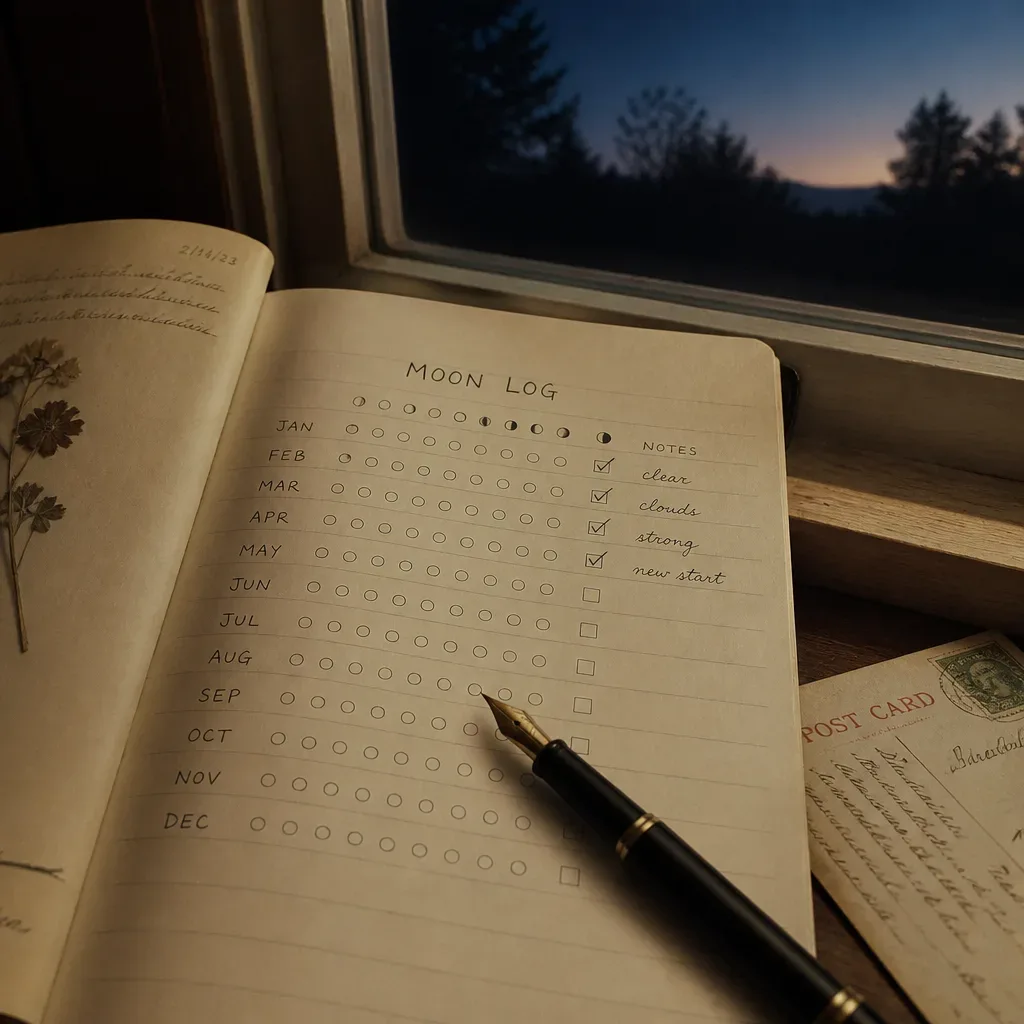
What changes if you repeat it each dark moon?
Repeating the ritual gives you a monthly record of what you’re ready to stop carrying and what you actually did next.
One dark moon ritual can feel calming. Twelve of them become data. After a year, you have 12 release lines and 12 return lines. You can see patterns without needing to shame yourself. Maybe every month you write about overworking. Maybe every month the next step is rest, money, voice, or repair. Seeing a pattern is not failure. It’s information finally becoming visible.
This is where a quiet practice becomes practical. A 2009 study by Lally and colleagues in the European Journal of Social Psychology found that habit formation varied widely, with an average of 66 days for a behavior to become automatic. That number is often simplified online, but the real lesson is kinder: repetition takes time, and different people move at different speeds.
You can keep a small dark moon log like this:
- Date of the dark moon or night before new moon
- One thing complete
- One Dream-Self phrase you remember
- One action within 24 hours
- Whether you did it, yes or no
- One note with no self-attack
If you miss a month, don’t repair the streak. Just return. The body learns from repeated cues, but it also learns from how you treat yourself when a cue is missed. Harshness may create motion for a day. It rarely creates devotion for a year.
There is also a useful boundary here with controversial research. Princeton’s PEAR and Global Consciousness Project explored small statistical deviations in random event generators, and those findings are debated. You don’t need to make claims beyond the evidence. This ritual doesn’t require proof that the moon controls events. It requires only that a monthly cue helps you listen, choose, and return.
What changes is not the sky. What changes is your relationship to the next small step.
What if you only have the audio and nothing else?
If you only have the audio, you still have the center of the practice.
This is the part I trust most as someone who has tested too many wellness apps from my flat in São Paulo. Many apps make the ritual look good. Fewer make the next day feel less scattered. The ones that last tend to reduce decisions. They don’t ask you to become a new person at 11:40 p.m. They ask you to listen for five minutes and do one true thing tomorrow.
A dark moon ritual can be bare:
- Sit down.
- Press play.
- Listen once.
- Write one sentence.
- Sleep.
That’s enough. The AYA Method survives here because it doesn’t depend on a perfect mood. You can use the app’s daily affirmation if one line helps you remember the tone. You can glance at a Manifestation Board if an image steadies you. But the method remains the audio, the Dream-Self Moment, repeated until the future self stops sounding far away.
Small studies on guided imagery and audio-based relaxation have shown reductions in stress markers, though results depend on design, sample size, and consistency. Dr. Andrew Huberman has often spoken about the value of brief downshift practices, including physiological sighing and slower breathing, for changing state in minutes. You don’t need to borrow anyone’s certainty. Test the practice over three dark moons. Three cycles is about 88.6 days, using NASA’s 29.53-day lunar month.
Keep the test honest. Did you feel clearer after listening? Did you choose a smaller next step? Did you take it within 24 hours? If yes, the ritual is doing its work. If no, make it smaller.
The moon goes dark, and you don’t have to rush to be new.