money manifestation
Debt Freedom Manifestation in 5 Minutes
A quiet debt freedom manifestation practice using a 5-minute future-self audio, simple money cues, and daily repetition you can keep.

The bill is still on the table. Debt freedom manifestation means using a short future-self audio to rehearse the identity of someone who faces debt clearly and acts steadily. In 5 minutes, you listen, settle your body, remember one next step, and make avoidance a little less automatic.
What is debt freedom manifestation, really?
Debt freedom manifestation is the practice of pairing a desired money identity with repeated cues and concrete repayment behavior.
It is not pretending the balance is gone. Your lender does not disappear because you feel calm for 5 minutes. The practice is quieter than that. You train your attention toward the kind of person who opens the statement, knows the number, asks questions, and returns to the plan the next day.
In cognitive neuroscience, repetition changes access. The more often a thought and action are paired, the easier that pairing becomes to retrieve. A 2010 habit study by Phillippa Lally and colleagues found that automaticity took 66 days on average, though people varied widely from 18 to 254 days. Money behavior is not magic. It is learned, cued, and repeated.
This is where manifestation can become practical. The Manifestation pillar names the broader practice: you hold an intended future close enough to shape present choices. For debt, that future has to meet the facts. The number. The interest rate. The due date. The call you have been avoiding for 3 weeks.
Debt freedom starts to become real when you can look at the number without becoming the number.
A future-self audio helps because it gives your nervous system a familiar voice to return to. It says, softly: you are someone who handles this. Not all at once. Not perfectly. Today.
Use this distinction:
| What it is | What it is not |
|---|---|
| A daily cue for steadier money behavior | A substitute for repayment, advice, or income |
| A rehearsal of identity and attention | A denial of balances or interest |
| A 5-minute audio practice | A promise that every debt clears fast |
| A way to reduce avoidance | A reason to ignore legal or financial help |
The practice works best when it is small enough to repeat. Five minutes is not a compromise. It is the point.
Why does a 5-minute future-self audio help with debt avoidance?
A 5-minute future-self audio helps because it gives your brain a repeated cue before the behavior you usually avoid.
Debt often creates a loop: cue, threat, escape, relief. You see an email from a lender. Your body tightens. You close the app. For a few minutes, you feel better. That relief teaches avoidance. The next time, the loop is faster.
Research on avoidance learning shows that escape can reduce distress in the short term while keeping fear alive over time. In anxiety treatment, exposure-based approaches work partly by helping people remain present with the feared cue without using the old escape. Money is different from a phobia, but the body can treat unopened bills like danger. A 2023 Federal Reserve report found that 37% of U.S. adults would have trouble covering a $400 emergency expense with cash or equivalent resources. Money stress is not rare. It is carried in the body.
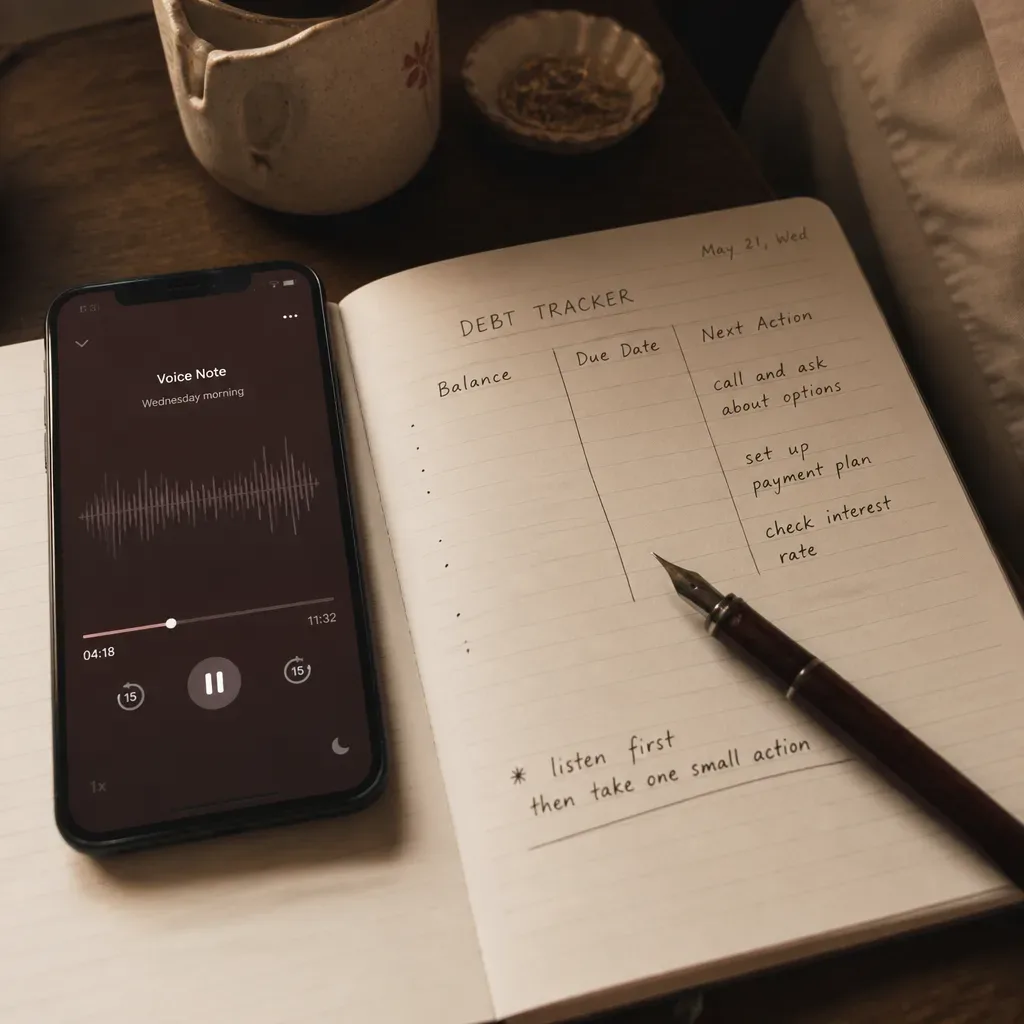
The audio interrupts the loop before the old action begins. You listen first. You breathe. You hear a version of you who does not run from the number. Then you take one tiny money action. Over time, the cue changes meaning.
The AYA Method is a daily audio manifestation practice. Each day you listen to a short personalized recording — your Dream-Self Moment — narrated from the version of you who has already manifested the life you intend. Listening is the practice. Repetition is the work. The audio is the method. Read more about the AYA Method if you want the full frame.
For debt freedom manifestation, your Dream-Self Moment might sound like this: I check my balances every Friday morning. I know what is due. I make the payment I can make. I call when I need new terms. I do not leave myself alone with fear.
That last sentence matters. Shame isolates. A 2022 FINRA Investor Education Foundation report found that people with high financial anxiety were more likely to delay health care, overdraw accounts, and carry costly debt. The practice is not only about belief. It is about lowering the shame enough to act.
How do you write a debt freedom audio script that feels true?
Write the script from the future self who is already steady with debt, but keep every detail believable enough for your body to accept.
Start with facts, not fantasy. If you owe 12,000, do not begin with I woke up and all 12,000 was gone. Your mind may reject it before the first minute ends. Begin with a new relationship to the debt: I know my numbers. I open the app without bracing. I pay what I planned. I ask for support before the late fee appears.
The language should be present tense. Neville Goddard wrote often about assuming the feeling of the wish fulfilled. In a grounded debt practice, that does not mean ignoring creditors. It means speaking from the identity that no longer abandons the plan. Joe Dispenza also emphasizes mental rehearsal, though his claims are broader than most lab evidence can confirm. The safer, research-consistent piece is this: repeated self-relevant cues can influence attention, memory, and action selection.
A good 5-minute script has 5 parts:
- Arrival: One sentence that slows the body. Example: I am here, and I can look gently.
- Identity: One clear money identity. Example: I am someone who keeps promises to my future self.
- Evidence: Three small behaviors you already do or can do this week.
- Future scene: A simple moment from debt freedom, such as closing a final payment screen.
- Next step: One action after listening, no more than 10 minutes long.
Here is a short section you can adapt:
I know the number now. It is information, not a verdict. Every Friday, I check the balance. I pay what I planned. When I need help, I ask early. I am becoming someone who stays with herself around money.
Dr. Andrew Huberman has spoken often about neuroplasticity needing attention, repetition, and sometimes emotional salience. You do not need to force intensity. You need the line to matter. A calm sentence repeated daily for 30 days can become more available than a dramatic sentence you abandon by Thursday.
Do not overload the script with too many outcomes. Debt freedom is the heading. The daily behavior is the doorway.
What is the exact 5-minute practice?
The exact practice is to listen to your future-self audio, regulate your body, and complete one small debt-related action immediately after.
Set a timer for 5 minutes if you need edges. The audio can be 3 to 5 minutes long, with silence before and after. The shorter it is, the more likely you are to keep it on difficult days. A 2021 review in the Journal of Medical Internet Research noted that engagement with digital health tools often drops when tasks feel too demanding. Tiny is not weak. Tiny survives.
Use this structure:
- Minute 0:00 to 0:30: See the room. Notice one object near you. Put both feet down. Let your jaw loosen.
- Minute 0:30 to 3:30: Listen to the Dream-Self Moment. Do not multitask if you can help it. Let the words land.
- Minute 3:30 to 4:30: Name the one action. Say it plainly: I will open the banking app. I will schedule 25. I will read the letter.
- Minute 4:30 to 5:00: Begin. Open the app, notebook, email, or repayment page before the timer ends.
The point is not to feel certain. Certainty is not required for action. You only need enough steadiness to do the next true thing.
If you use Aya, the app also includes a daily affirmation and a Manifestation Board. Let them support the audio, not replace it. If you are curious about wording, the Affirmations pillar can help you keep language specific and gentle.
You can also pair the practice with your calendar. For example, listen every weekday at 8:10 a.m., then check one account. The cue should be stable. Research on implementation intentions by Peter Gollwitzer has shown that if-then plans can improve goal follow-through across many domains. If it is Friday after coffee, then I check my debt tracker.
Keep a paper note nearby with 3 lines:
- Balance checked today: yes or no
- Action taken: one sentence
- Shame level after action, 0 to 10
Over 2 weeks, you are not just tracking debt. You are tracking your capacity to stay.
How do you make it work with a real repayment plan?
You make it work by giving the audio one job: help you return to the plan you can actually follow.
A manifestation practice without a money plan can become a place to hide. A money plan without emotional support can become a place to quit. You need both. The audio prepares your state. The plan tells your money where to go.
Start with the simplest version. List each debt, balance, interest rate, minimum payment, and due date. The Consumer Financial Protection Bureau has long recommended knowing the full cost of debt, including fees and annual percentage rates, before choosing a repayment path. You do not need a perfect spreadsheet. You need a true one.
Then choose one repayment method. The debt snowball pays the smallest balance first. The debt avalanche pays the highest interest rate first. Mathematically, avalanche can save more interest. Emotionally, snowball can create earlier wins. A 2016 study in the Journal of Consumer Research found that focusing on smaller balances first can increase motivation because progress feels more visible.
Here is a quiet comparison:
| Method | Best when | Watch for |
|---|---|---|
| Snowball | You need early proof that change is happening | You may pay more interest over time |
| Avalanche | You want to reduce total interest cost | Motivation may feel slower at first |
| Consolidation | You qualify for a lower rate and can avoid new debt | Fees, terms, and temptation to reuse cards |
| Hardship plan | Income has dropped or payments are not possible | You may need documents and patience |
Your audio should mention the method you chose. Not as a lecture. As identity. I make the smallest balance smaller each month. Or: I send extra to the highest interest card because I protect my future cash.

If you want to bring timing symbolism into the practice, keep it secondary. Some people like lunar dates, birthdays, or personal cycles. The Astrology and manifestation piece can help you use timing as a gentle cue, not as permission to delay payment.
A plan is a kindness when it is built for the person who has to live it on a tired Tuesday.
What should you do when debt shame interrupts the practice?
When shame interrupts, lower the intensity, name one fact, and take an action small enough that your body does not need to flee.
Shame says you are the debt. Practice says the debt is a situation you are learning to handle. Those are not the same sentence. In clinical psychology, self-compassion research by Kristin Neff and others has linked kinder self-response with lower anxiety and better coping. It does not make people passive. In many studies, it helps them try again.
So when you miss a day, do not restart the whole practice. Listen the next day. When you avoid a bill for a week, do not write a dramatic script about never avoiding again. Open one message. Copy one number. Make one call. The nervous system trusts evidence more than speeches.
Use these repair lines inside your audio:
- I can return without punishment.
- One missed payment does not erase my ability to act today.
- I can ask for terms, dates, and help.
- I am allowed to learn money skills later than I wish I had learned them.
- I do not need to feel brave to make a 10-minute call.
There is a practical reason to reduce shame. Avoidance can cost money. Late fees, penalty APRs, overdraft charges, and collections notices often grow when you cannot look. The CFPB reported that credit card late fees cost consumers billions of dollars in recent years before rule changes were contested and revised. Even one earlier phone call can matter.
You may also need outside support. If your debt includes legal notices, tax debt, payday loans, or threats, do not use manifestation as the only response. Look for nonprofit credit counseling, legal aid, or a trusted financial adviser. The audio can help you make the call. It should not replace the call.
The Manifestation pillar is useful here because it keeps desire connected to action. Your future self is not a fantasy figure. She is the one who stayed long enough to read the fine print.
How do you know the practice is changing something?
You know the practice is changing something when your recovery time gets shorter and your money actions become more consistent.
Do not measure only by the debt balance at first. Interest, income changes, emergencies, and fees can blur the signal. Measure behaviors that sit closer to your control. Did you listen 20 out of 30 days? Did you check balances weekly? Did you make a payment before the due date? Did you ask for help earlier than last time?
Behavioral science often separates outcome goals from process goals. Outcomes matter, but process goals tell you what to do today. In small behavior-change studies, self-monitoring is one of the more reliable tools, especially when paired with specific goals. You can keep it plain.
Track these 5 numbers for 30 days:
- Days listened
- Balances checked
- Payments made on time
- Avoided messages opened
- Shame rating before and after action, 0 to 10
After 30 days, look for a pattern. If your shame rating drops from 8 to 5 after listening, that is data. If you open bills within 24 hours instead of 10 days, that is data. If you made 3 calls you had avoided since spring, that is data too.
You can also update your script every 2 weeks. Keep the core identity stable, but add new evidence. I called the lender. I changed the due date. I paid 40 extra. I did not disappear when the number scared me.
For more support with self-talk, return to the Affirmations pillar. For the full audio practice, come back to the AYA Method. The method is simple on purpose: listen daily, let repetition do its quiet work, then act from the self you are rehearsing.
The new identity is not proven by a perfect month. It is proven by the return.
The bill is still on the table, and you are still here.