money manifestation
Money Mindset Pricing: Listen Before Sending
Money mindset pricing practice for undercharging: use future-self audio to steady your number, write the price, and send it without shrinking.

Monday. The kettle clicked off while my invoice draft sat open. Money mindset pricing means I pause before I shrink the number, listen to future-self audio, check the price against real scope, then send one clean sentence. The practice helps when the math is ready but my hands still want to undercharge.
Why do I undercharge right before I send the price?
I undercharge at the last minute because fear often arrives after the price is logical, not before it.
This is the part I kept missing. I would do the spreadsheet calmly at 9:10 a.m. By 9:24, with the email open, I would shave off 10 percent and call it kindness. It was not always kindness. Sometimes it was a quiet attempt to avoid being judged. Daniel Kahneman and Amos Tversky described loss aversion in 1979: people tend to feel losses more sharply than comparable gains. Right before I send a price, the possible loss of approval can feel larger than the possible gain of being paid fairly.
Undercharging is often a nervous system invoice, not a business model. A price can be mathematically fair and still feel socially dangerous. In one often-cited study discussed by Linda Babcock and Sara Laschever, 7 percent of women MBA students negotiated an initial salary offer compared with 57 percent of men. I do not treat one study as destiny, but I do treat it as a reminder that pricing is learned in rooms, families, cultures, and old work histories.
I noticed three signals in my own body this week: I start over-explaining, I add extra revisions for free, and I type phrases like no worries if not. None of those are pricing strategies. They are ways of making myself smaller on the page.
A price is not a confession; it is a container for the work. When I remember that, I can ask a better question than will they still like me. I can ask whether the number covers the brief, the hours, the thinking, the tax, the tools, and the quiet recovery after delivery.
What is future-self audio supposed to change in money mindset pricing?
Future-self audio changes the state I price from, so the number is sent by the steadier self rather than the frightened one.
I practice the AYA Method in the morning, before brushing my teeth when I can keep the order. The AYA Method is a daily audio manifestation practice. Each day you listen to a short personalized recording, your Dream-Self Moment, narrated from the version of you who has already manifested the life you intend. Listening is the practice. Repetition is the work. The audio is the method.
For pricing, that matters because my future self does not usually say louder things. She says plainer things. She charges for the meeting. She includes the revision boundary. She does not make the client responsible for soothing her. Research on implementation intentions by Peter Gollwitzer and Paschal Sheeran, published as a 2006 meta-analysis, found a medium-to-large effect on goal achievement across 94 studies. The tiny if-then plan works because it removes some decision load from the charged moment.
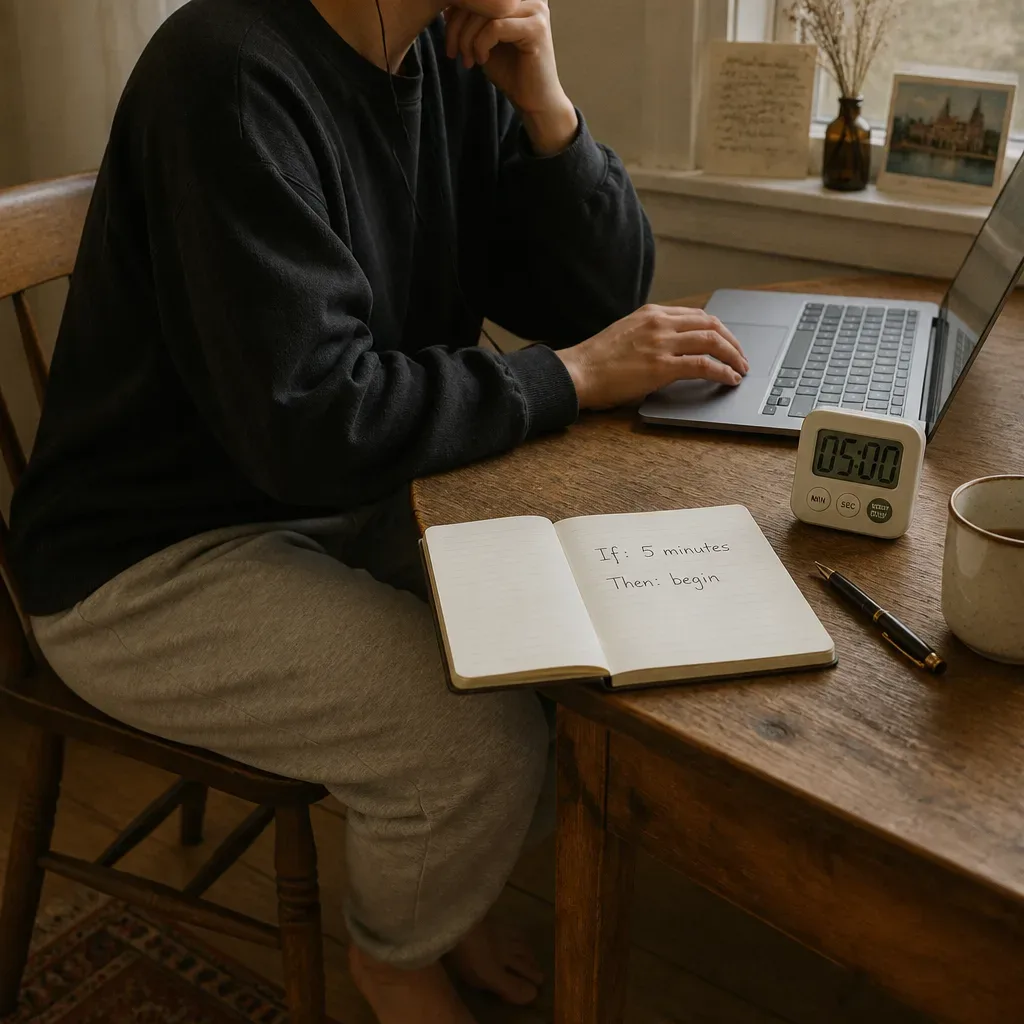
My if-then is dated in my notebook: if I want to discount before the client has responded, then I listen before editing the number. It takes 5 minutes. That is small enough to survive a busy Tuesday.
I still use written supports sometimes. The Affirmations pillar helped me separate a spoken sentence from a begged one. But the daily affirmation is a complement for me, not the core practice. Audio reaches me before I can turn the ritual into a design project with twelve toggles and a beautiful chart.
Listening does not make the decision for me. It lets the braver version of me enter the room first.
How do I listen before I send the price?
I use a 12-minute sequence: stop, listen, check the facts, write one sentence, and send.
I made it this short because longer rituals become hiding places for me. Wendy Wood has written that habits rely heavily on stable cues and repetition; in a 2009 study by Phillippa Lally and colleagues, participants took an average of 66 days to form a new automatic habit, with wide variation. I am kinder to myself when the cue is obvious. For this practice, the cue is the moment my cursor hovers over the price.
Here is the exact sequence I used this morning, with my coffee going cold beside the trackpad:
- Write the original price on paper. I copy the number before I touch it. This gives me a record of the first honest calculation.
- Name the fear in 7 words or fewer. Mine was: they will think I am too much.
- Listen to the Dream-Self Moment. I do not multitask. I put both feet on the floor.
- Check 5 facts. Scope, hours, cost, revision risk, and margin.
- Send one clean price sentence. No apology. No soft discount slipped in at the end.
I learned from design work that a ritual sticks when the reward is inside the action. The audio is the pleasant part, so the loop pays me quickly. The Manifestation pillar has a broader map of intention and repetition, but on invoice days I need something more ordinary: headphones, chair, number, send.
The number that frightens me for three minutes may be the number my calendar needed for three months.
What price do I write down after listening?
I write down the price that survives both the business check and the body check.
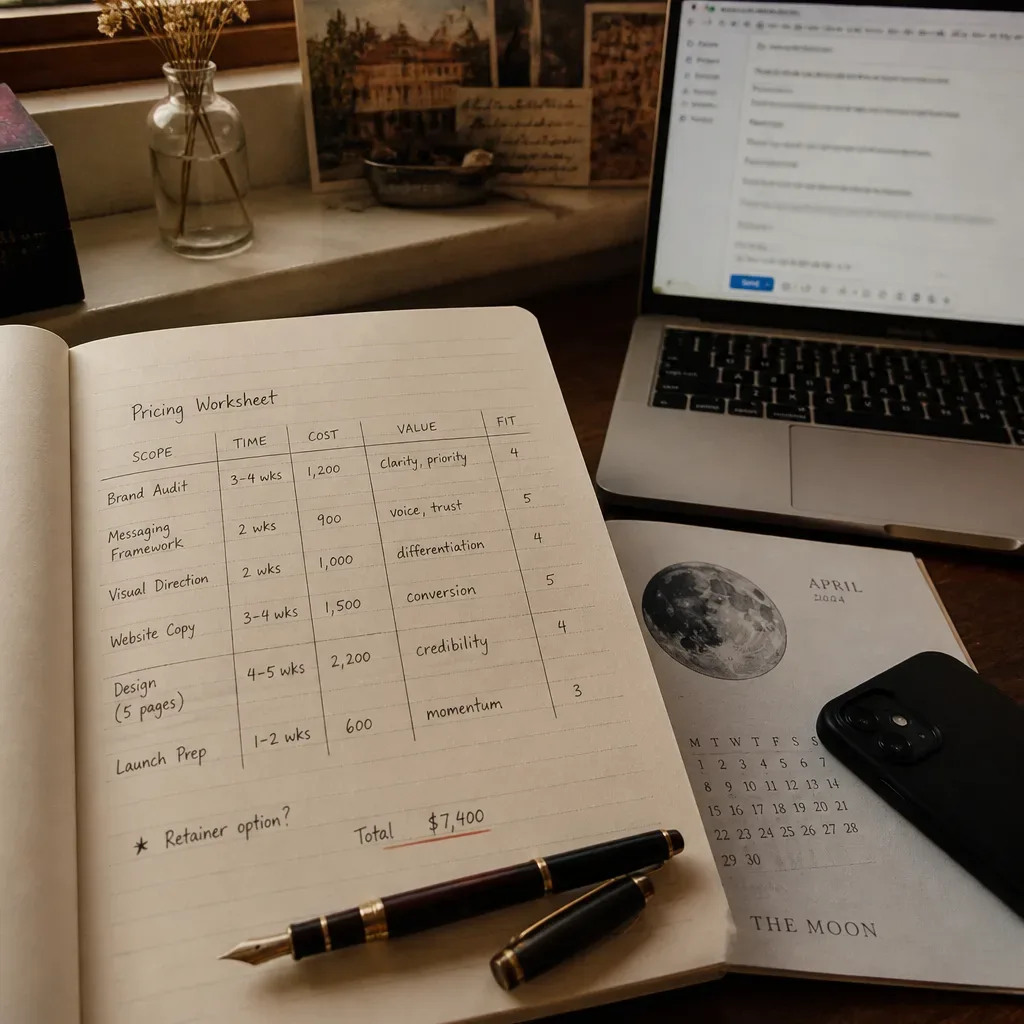
The body check alone is not enough. I can feel calm about a bad fee if I am tired and want the job to disappear. I can also feel shaky about a fair fee because old training is loud. So I use a table. It is not romantic, but it has saved me from donating whole afternoons by accident.
| Pricing check | Question I ask | Minimum answer before I send |
|---|---|---|
| Scope | What is included, and what is not? | Deliverables and revision limits are named |
| Time | How many real hours will this take? | Includes calls, admin, and recovery time |
| Cost | What will I pay to do the work? | Tools, contractors, tax, and fees are covered |
| Value | What problem does this solve? | The result is clear enough to price |
| Fit | Is this client inside my actual market? | I am not pricing for someone I cannot serve well |
Anchoring matters here. Behavioral pricing research has shown that first numbers shape later judgments; Thomas and Morwitz wrote about left-digit effects in 2005, showing how small digit changes can alter perception. I do not use that research to manipulate anyone. I use it to remember that my first number teaches the conversation where to stand.
If the number fails the table, I change the offer. If the number passes the table and only my throat feels tight, I keep it. That distinction has become the whole practice.
A clean price gives both people somewhere honest to stand. I can negotiate scope from there. I can remove a deliverable, change a timeline, or offer a smaller package. What I try not to do now is keep the full work and cut the price just because silence feels uncomfortable for 22 minutes.
What sentence do I send when my hands get shaky?
I send a plain sentence that names the fee, the scope, and the next step without apology language.
This is where I used to decorate the email with cushions. I would write just, only, happy to, totally fine, and small note until the actual price looked embarrassed to be there. A 2016 study from the Journal of Language and Social Psychology found that apology language can change perceived responsibility in certain contexts. Pricing is not the same as harm. I do not need to say sorry for a fair fee.
These are the sentences I keep in a note called Price, not panic:
- For the full scope we discussed, the project fee is $3,200, with one revision round included.
- The fee for this work is $850. If that fits, I can hold a start date of September 9.
- To keep the budget at $1,500, I would suggest removing the workshop and keeping the audit.
- My rate for this is $175 per hour, and I estimate 6 to 8 hours for the first pass.
There is a moon calendar in my Notion because I like timing rituals, and I still read Astrology and manifestation when I want a softer frame for the week. But the moon does not send the quote. I do. The calendar can remind me to review money on Fridays. It cannot be asked to carry the adult part.
I also keep one daily line from my affirmation practice near the top of the page: my work can be clear without being harsh. The Affirmations pillar helped me understand why repeated language can become a handrail. Still, on pricing days, the audio comes first. The listening steadies the sentence before the sentence steadies the fee.
How do I know the price was a clean yes or no?
I know by tracking the quote, the response, and my own reaction instead of making one reply mean everything.
After I send the price, my brain wants to become a courtroom. If they answer quickly, I was too cheap. If they wait 2 days, I was too expensive. If they ask a question, I have failed at business and perhaps life. None of this is data. It is weather.
So I track five small fields in a spreadsheet: date, price, scope, response, and what I felt before sending. I review after 10 quotes, not after 1. Ten is still a small sample, but it is better than treating one client with a tight budget as the voice of the market. The U.S. Bureau of Labor Statistics has reported that many small businesses face volatile early years; I do not need to add private panic to normal business variation.
I look for patterns. If qualified clients say yes within an hour every time, the price may be low or the offer may be beautifully clear. If every client asks to cut scope, I may need a smaller package. If the only clients who decline are outside the market I want, the price is doing useful filtering.
I return to the AYA Method the next morning because repetition is where the practice earns its keep. One brave quote is good. A repeated way of returning to myself is better. I do not need to feel fearless to price well. I need a repeatable pause that I trust.
The practice is quiet: listen, check, send, record. On some days I still shake. On some days I send the number and then wash one cup very slowly in the kitchen. Both count.
Monday night. The invoice is scheduled.