money manifestation
Manifest 10K Month With a 5-Minute Audio
A practical way to manifest 10k month income using a daily 5-minute future-self audio, clear numbers, and one repeatable money routine.

Sunday morning. The kettle clicked off while I wrote the number again: $10,000. To manifest 10k month income with a 5-minute future-self audio, I need three things: a precise money target, a daily listening habit, and one visible income action after listening.
I am writing this before the apartment is fully awake because money planning changes shape when I wait too long. By noon, $10K becomes a mood. At 7:12 a.m., it is arithmetic. I can count offers, prices, invoices, and follow-ups. I can hear myself get less dramatic about it.
What does it mean to manifest 10K month without pretending numbers are magic?
It means I treat the 10K month as both an identity rehearsal and a measurable business target.
The first thing I wrote today was not a sentence. It was a split: $10,000 gross revenue, not take-home pay. That distinction matters because a freelancer with 30% set aside for taxes and expenses is not living on the same number as someone clearing $10,000 after costs. The U.S. Small Business Administration has often noted that cash flow is one of the main reasons small businesses struggle, and cash flow begins with definitions, not hope.
When I use manifestation language here, I mean the practice of naming an intended reality so often, and with enough specificity, that my decisions start to match it. I keep the wider frame in my notes under Manifestation pillar, mostly because it reminds me that attention is not the same as action. Attention is the room I act from.
A 10K month can come from many structures. Mine, this week, looked like this:
| Route | Simple math | Hidden question |
|---|---|---|
| 2 clients | 2 × $5,000 | Can I sell depth, not hours? |
| 4 projects | 4 × $2,500 | Can delivery stay clean? |
| 10 retainers | 10 × $1,000 | Can I maintain relationships? |
| 100 sales | 100 × $100 | Can traffic support it? |
The table calmed me down. A money goal becomes less mystical when it has a unit count. One study in the Journal of Consumer Research found that specific goals tend to guide behavior better than vague positive intent, especially when the next action is clear. I have seen that in my own graveyard of abandoned routines. The vague ones felt good for 3 days. The specific ones survived the dishwasher, the bus, and bad sleep.
A number I refuse to define becomes a number I can keep avoiding.
Why use a 5-minute future-self audio for a money goal?
I use audio because listening has lower friction than writing, visualizing, or making myself feel inspired on command.
This is where the AYA Method fits my actual life. The AYA Method is a daily audio manifestation practice. Each day I listen to a short personalized recording, my Dream-Self Moment, narrated from the version of me who has already manifested the life I intend. Listening is the practice. Repetition is the work. The audio is the method.
Five minutes is not a decorative choice. BJ Fogg’s behavior model at Stanford puts behavior at the meeting point of motivation, ability, and prompt. If the practice is short enough to do on a low-motivation day, it has a better chance of becoming real. I have reviewed wellness apps that asked for 27 minutes every morning. They worked beautifully for imaginary people with quiet kitchens.
The future-self audio gives the brain a repeated scene. Joe Dispenza writes often about rehearsing a future state until the body begins to recognize it, and while I keep some distance from big claims, the rehearsal part is practical. Athletes have used mental rehearsal for decades; a 2016 review in sport psychology found imagery can improve performance when paired with physical practice. The phrase that matters is paired with practice.
My 10K audio does not say, money finds me while I do nothing. It says, I sent the proposal before lunch. It says, I checked the numbers without flinching. It says, I did not discount because silence made me nervous.
The daily affirmation on my desk is only one line, and the Manifestation Board has one small income column. They help me remember. They are not the work. The work is listening, then behaving like I heard myself.
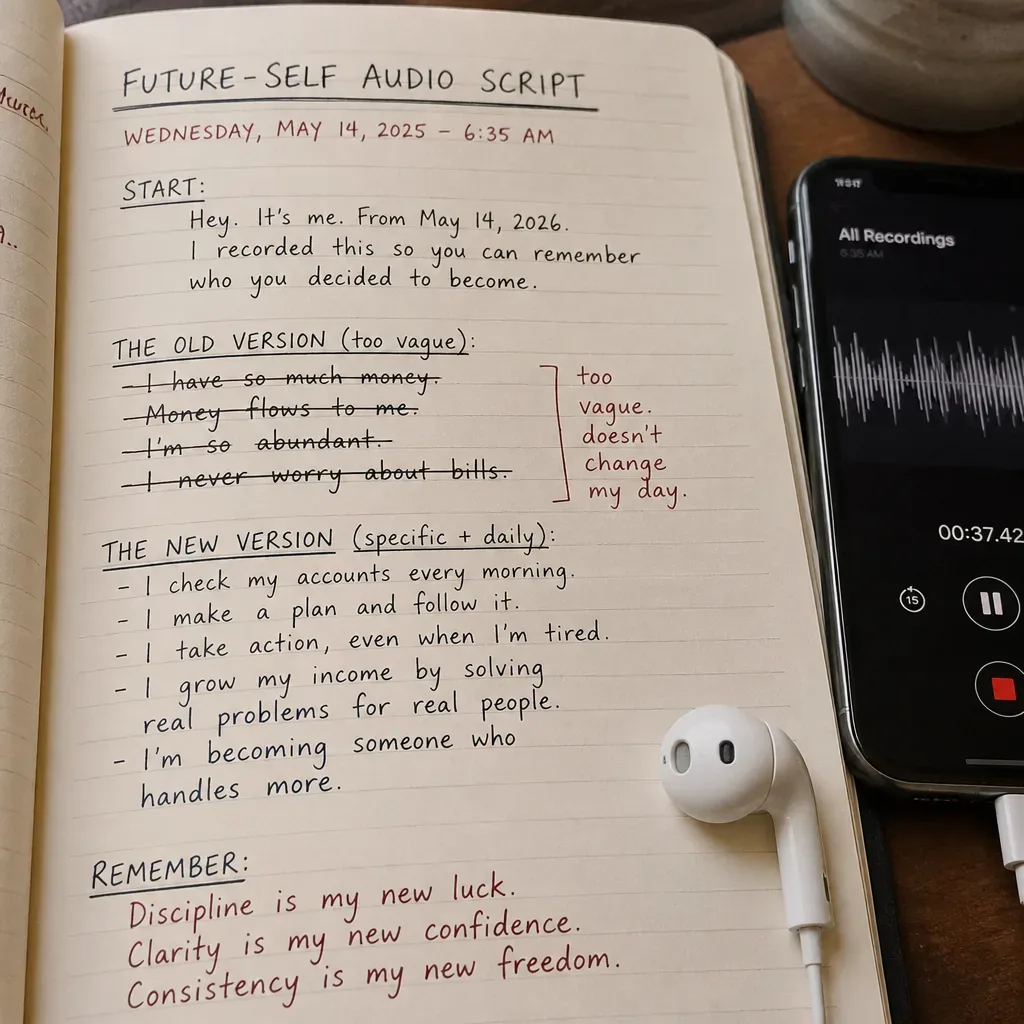
How do I write the future-self script so it does not become vague wealth talk?
I write the script like a dated diary entry from the month after the money landed.
The page I used this morning had 6 lines at the top: date, amount, source, action, feeling, proof. I filled them in before writing anything pretty. The amount was $10,000. The source was client work and one digital product sale. The action was follow-up. The feeling was steady. The proof was paid invoices, not applause.
Here is the 5-part script structure I use:
- Begin in a real place. Name the kitchen, the chair, the train, the invoice tab.
- State the completed number. Say whether it is gross, net, booked, or collected.
- Name the normal behaviors. Include outreach, pricing, delivery, and follow-up.
- Describe the body state. Calm hands matter more than glittery language.
- Close with one next action. The audio should leave me pointed at the day.
A useful script line sounds like this: It is October 31st, and I collected $10,000 this month through 4 clear offers I was willing to name out loud. A weak line sounds like this: I am rich and everything is easy. The weak line has no calendar, no behavior, and no receipt.
Neville Goddard called it living in the end. I translate that into design terms: reduce the gap between the person rehearsed and the person scheduled. If my future self follows up on invoices every Friday, then my calendar needs a Friday invoice block. A 2022 Gallup workplace report found that clear expectations are one of the strongest drivers of engagement at work. I think the same is true inside a person. I need to know what I am asking myself to do.
For wording support, I sometimes revisit the Affirmations pillar, especially when I notice my script has become either too soft or too grand. A sentence can be kind without being slippery.
The best money script is not louder than your life. It is clearer than your fear.
Where should the 5-minute listening practice go in a real day?
It should attach to a habit that already happens, not to a fantasy version of the morning.
I listen after coffee and before messages. That is the order. Coffee first, because I am not heroic. Audio second, because if I open messages first, other people start renting space in my attention. The whole practice takes 5 minutes and 38 seconds, including finding my headphones under yesterday’s sweater.
Habit researchers often call this anchoring. James Clear popularized the idea through habit stacking, but the research base is older: implementation intention studies by Peter Gollwitzer found that if-then plans can significantly increase follow-through. The useful sentence is plain: If I pour coffee, then I listen to the audio. Not if I feel ready. Not if the morning is peaceful.
My rule is to make the practice pass the worst-Tuesday test. If I cannot do it when the sink has plates in it and my calendar is already rude, the system is too fragile. In my app review years, week 3 was where most beautiful routines died. Novelty fades around then. Friction remains.
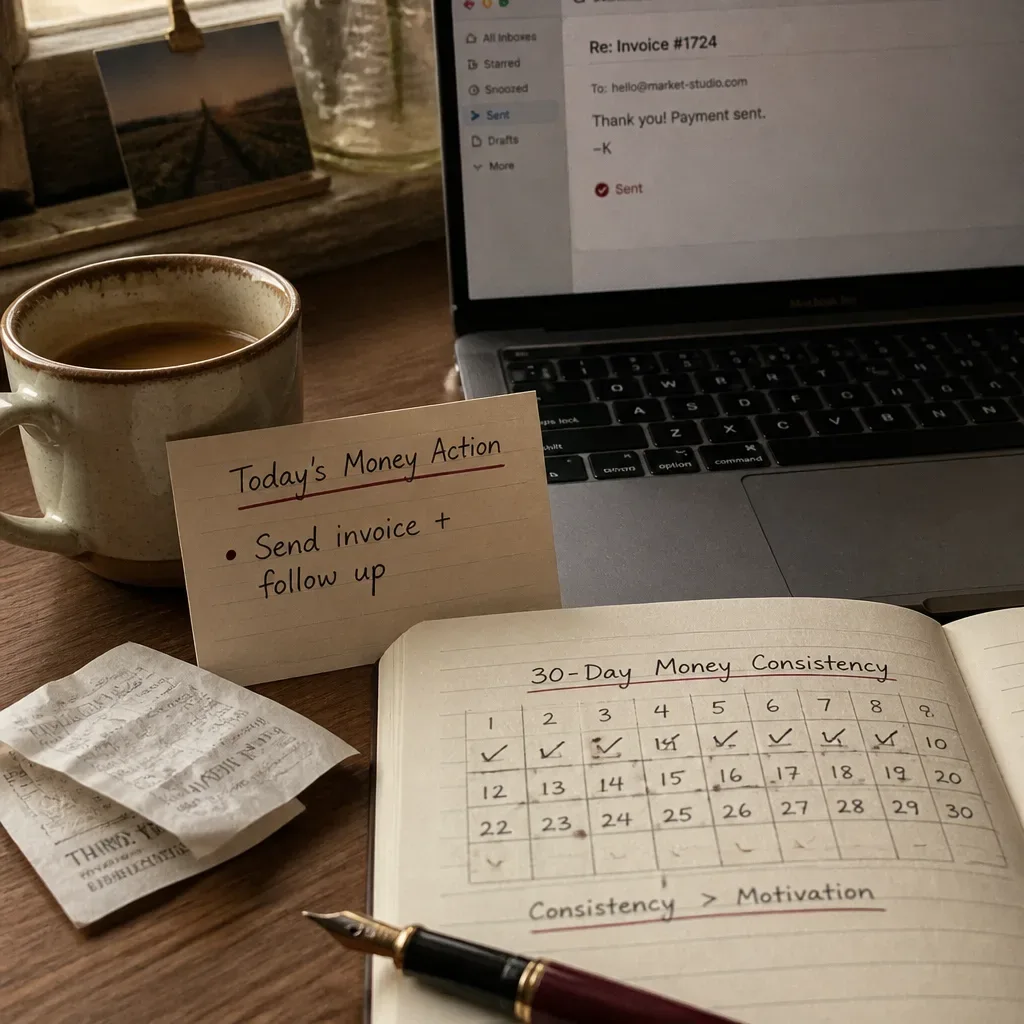
I keep a small tracking note with only 3 marks:
- Listened today: yes or no.
- Money action chosen: one sentence.
- Money action done: yes or no.
This is intentionally boring. A 2020 study in PLOS ONE on habit formation reinforced something simple: consistency of context matters more than intensity. I would rather listen daily for 5 minutes than perform a 45-minute ritual every other Sunday and call it devotion.
Astrology sometimes gives me language for timing, especially around money anxiety and risk, but I keep it secondary. If I read about Astrology and manifestation, I still have to send the proposal. The moon does not click send for me.
What money action should follow the audio each day?
One income action should follow the audio, and it should be small enough to finish before the day becomes dramatic.
Today’s action was to send a follow-up email I had avoided for 4 days. It took 11 minutes. The audio did not send it for me, but it changed the state I sent it from. I was less apologetic. I used the actual price. I did not add a nervous discount in the last paragraph.
For a 10K month, I sort actions into 4 categories:
| Category | Example action | Why it matters |
|---|---|---|
| Create | Write offer page, package service | Makes the sale legible |
| Invite | Send pitch, ask for referral | Creates possible money |
| Close | Follow up, answer objection | Moves money from maybe to yes |
| Collect | Send invoice, check payment | Turns sales into cash |
The action after listening should come from the weakest category. If I am always creating and never inviting, I am decorating the shop with the door locked. If I am always inviting and never collecting, I am confusing interest with income. According to Intuit’s small business data, late payments and uneven cash flow remain common stress points for small firms; that is not a mindset flaw. It is a system problem that needs a calendar.
Here is the daily sequence I wrote on an index card:
- Listen to the 5-minute audio.
- Write one money action.
- Do it before checking analytics.
- Mark it done or not done.
- Adjust tomorrow’s action without drama.
I need the last line because shame makes terrible plans. If I miss the action, I do not write 9 actions for tomorrow. I return to one. The practice is not punishment. The practice is return.
How do I measure whether this is working after 30 days?
I measure the practice by behavior first, income second, because income can lag behind the person becoming consistent.
The 30-day review is where I become less romantic. I open the note file and count. How many days did I listen? How many money actions did I complete? How many offers went out? How many invoices were sent? How much cash was collected? A 10K month has feelings attached to it, yes, but the review needs numbers with edges.
I use this scorecard:
| Metric | Target for 30 days | My note |
|---|---|---|
| Audio listens | 25–30 | Did the habit hold? |
| Money actions | 20–30 | Did listening change behavior? |
| Offers or pitches | 8–20 | Did I create chances? |
| Follow-ups | 5–15 | Did I stay with the ask? |
| Cash collected | Defined by goal | Did money arrive? |
The range matters. A person with a full client load may need fewer pitches and more collection. A person building from zero may need 20 invitations before the first yes. HubSpot’s sales data has often shown that follow-up is where deals are won or lost, with many sales requiring multiple touches. I do not turn that into pressure. I turn it into a checkbox.
If the income did not reach $10K, I do not immediately declare the practice failed. I ask whether the behavior changed. If I listened 28 days and sent 14 offers after months of hiding, something moved. If I listened 6 days and mostly edited the script, the system did not hold.
A manifestation practice that cannot be measured will eventually ask to be believed instead of improved.
I also look for softer evidence: less panic when naming prices, fewer apology words in emails, faster recovery after a no. These are not the full goal, but they are leading indicators. The month before money changes, the body often changes first.
What if I feel ridiculous listening to my richer future self?
Feeling ridiculous is normal; I treat it as friction, not as evidence against the practice.
The first time I heard my future-self audio mention a 10K month, I took one earbud out. I did not feel inspired. I felt embarrassed in my own kitchen, which is a very specific kind of privacy. Then I remembered that cognitive dissonance is often what happens when an old self-concept meets a new behavior. Leon Festinger named the theory in 1957. The body may object before the calendar does.
So I lower the volume of the claim, not the standard of the goal. Instead of saying, I always make $10K with ease, I say, I am becoming the kind of person who can receive, track, and repeat a $10K month. That sentence gives my nervous system a bridge. It still points to the number, but it does not demand instant belief.
There is also a practical reason to keep going through embarrassment. Repeated exposure reduces strangeness. In small studies on self-affirmation, including work associated with Claude Steele’s theory, people sometimes show better openness to difficult information after affirming valued identity. I am careful with the claim, but the direction fits what I notice: when I rehearse steadiness, feedback becomes less threatening.
I keep the audio private. I do not make it a performance. No one needs to know I listened while folding towels or sitting in the parked car. The quietness is part of why it works for me.
The sentence I trust most is this: the future self should feel unfamiliar, not fake. Unfamiliar asks for repetition. Fake asks for revision. If the audio sounds like a stranger selling me a life I do not want, I rewrite it. If it sounds like me with cleaner habits and a steadier hand, I keep listening.
The kettle is cold now, and the follow-up has been sent.