money manifestation
Manifest Clients: Listen Before Refreshing Your Inbox
Manifest clients without inbox panic: a quiet 12-minute audio-first routine for sellers, coaches, and freelancers who want steadier outreach.

Monday, 8:06, coffee cooling beside the laptop. To manifest clients without turning the inbox into a slot machine, I listen before I refresh. The practice is simple: close email, hear the identity first, take one client-facing action, then check replies. The order is the whole method.
Why listen before refreshing the inbox?
Listening first interrupts the panic loop before the inbox gets to name the day for me.
I learned this the unglamorous way, from building a habit tracker used by about 14,000 people and watching where routines actually broke. The break point was rarely belief. It was sequence. People planned to do the healthy thing after checking messages, after clearing notifications, after seeing whether anyone needed them. By then, the day had already voted. Email is a very loud room for something so small on the screen.
Gloria Mark, the University of California, Irvine researcher who studies attention, has reported that average screen attention before switching has dropped to around 47 seconds in her recent work. I think about that number when I hover over refresh. Forty-seven seconds is not enough time to become a steadier seller, coach, designer, or consultant. It is enough time to ask the inbox if I am safe.
For me, the phrase manifest clients means I rehearse being the kind of person clients can reach, trust, and pay, then I behave that way in public and private. I do not mean sitting still and waiting for invoices to appear. The Manifestation pillar says the quiet part plainly: attention changes behavior, and behavior changes what life can answer.
The inbox is feedback. It is not an altar. If I open it first, I tend to react to yesterday’s evidence. If I listen first, I begin from today’s chosen identity. That sentence is small enough to keep: the first voice of the day should not be the market’s mood.
What exactly am I listening to?
I listen to a short personalized audio that speaks from the version of me for whom paid client work is already normal.
In the AYA Method, the audio is not decoration around the practice. The AYA Method is a daily audio manifestation practice. Each day you listen to a short personalized recording, your Dream-Self Moment, narrated from the version of you who has already manifested the life you intend. Listening is the practice. Repetition is the work. The audio is the method.
I listened this morning before brushing my teeth. That is the order I do them in when I am being honest. Headphones, kettle, chair. The recording did not tell me I was special. It described ordinary evidence: calm proposals, clear follow-ups, one clean offer, clients who did not need to be chased like birds in a station.
There is a reason audio works well for this. In a 2009 study in the European Journal of Social Psychology, Phillippa Lally and colleagues found that habit automaticity took a median of 66 days to form, with wide variation from 18 to 254 days. Repetition mattered more than drama. Audio is repeatable when ambition is tired. Audio can meet me at the kettle.
I keep a written daily affirmation sometimes, one sentence on the page after listening. I also have a Manifestation Board with three screenshots of past client notes. But those are complements. They help me notice. The listening is the practice that sets the state before I act.
Here is the distinction I keep taped inside my head:
| Tool | What it does for me | When I use it |
|---|---|---|
| Dream-Self Moment audio | Rehearses identity through listening | Before inbox, before outreach |
| Daily affirmation | Compresses the identity into one line | After listening, if I need words |
| Manifestation Board | Holds visible evidence | Weekly review, not every refresh |
| Inbox | Delivers feedback | After one client action |
A sentence I trust more each month: repetition is not proof that nothing is happening; repetition is how the new normal learns my address.

How do I set up the 12-minute routine?
I set it up by making the first action smaller than my resistance.
The routine is not a morning overhaul. I do not wake at 5. I do not light anything. I do not need a perfect desk. I need twelve minutes and one rule: no inbox until one client-facing action has happened. BJ Fogg’s Tiny Habits work at Stanford has popularized the idea that behavior grows when it is anchored, tiny, and immediately reinforced. My anchor is the first coffee. The tiny behavior is pressing play.
Here is the routine I use on client mornings:
- Minute 0 to 1: close the inbox. I shut the email tab and put the phone face down. If the phone stays visible, the routine becomes a negotiation.
- Minute 1 to 7: listen to the Dream-Self Moment. I sit in the chair by the kitchen window. I do not multitask unless the kettle counts.
- Minute 7 to 9: write one client sentence. I write, “Today I help ___ with ___ by ___.” One blank per truth.
- Minute 9 to 12: take one visible action. I send one follow-up, one referral ask, one useful note, or one paragraph that a real person can read.
- After minute 12: refresh once. Once means once. If there is no reply, the routine still counts because I acted.
I like twelve minutes because it is hard to mythologize. The American Time Use Survey has repeatedly shown that people spend hours per day on work communication and digital media, depending on category and year. Twelve protected minutes is not a luxury in that context. It is a boundary with shoes on.
When I used to check first, I called it being responsible. It was often fear wearing a collared shirt. The body knows the difference. Shoulders up, breath shallow, thumb moving before thought. Dr. Andrew Huberman often describes the link between respiration and autonomic state in public education on stress regulation; slower exhales tend to support downshifting. I do not turn that into a performance. I simply breathe while the audio plays.
The whole routine works because it gives the day a cue, a script, and a receipt. Cue: coffee. Script: the audio. Receipt: one client action. A practice that leaves no receipt is too easy for fear to edit later.
What should I say after the audio?
I say one plain sentence that turns the listened identity into a client action.
The sentence matters because client work lives in specificity. “More clients” is too foggy for the nervous system and too vague for the calendar. “I help first-time founders clean up their onboarding emails by Friday” gives my hands somewhere to go. In sales research, response rates vary wildly by industry and relationship, but most practical outreach studies agree on one thing: relevance beats volume. A clear sentence makes relevance possible.
I keep four sentence frames in the back of my notebook:
- Today I help one specific person with one specific problem.
- The client who needs me is probably already near one existing room, list, or relationship.
- The smallest useful proof I can send is one example, one audit, or one clear question.
- Before I ask for trust, I can show one piece of competence.
This is where the Affirmations pillar has been useful to me, but only when the sentence stays honest. An affirmation like “Clients trust my work” can steady me. A sentence like “I will receive ten inquiries by noon” usually makes me check the inbox nine times by 11:30. The body hears the difference between a vow and a dare.
A good post-audio sentence has three traits:
- It names a real buyer or client group.
- It names a problem they would recognize in their own words.
- It points to one action I can complete in under five minutes.
I have used this with coaching offers, design retainers, writing work, and tiny consulting projects. The category changes. The mechanism does not. If I cannot name who I help in one sentence, refreshing the inbox will not help me. It will only give confusion a blue notification badge.
Neville Goddard wrote often about assuming the feeling of the wish fulfilled. I translate that into behavior design because that is the language I trust. If I had steady clients, what would I send this morning? If I were not begging the inbox for a verdict, what would my next clean action be?
How do I take one client action without sounding needy?
I make the action useful before I make it persuasive.
Neediness usually appears when I ask the other person to regulate me. Usefulness appears when I reduce their load. Those are different emails. One says, “Just checking in.” The other says, “I noticed the signup page repeats the same objection twice; here is a cleaner version if useful.” The second note may still get ignored. But it lets me keep my posture.
Cialdini’s work on influence, first published widely in 1984 and revised across later editions, names reciprocity as one of the durable principles of persuasion. I hold that carefully. I am not trying to trap anyone with a favor. I am trying to enter the conversation by being useful enough to deserve a reply.
My menu of one-action choices looks like this:
| If I have 3 minutes | If I have 10 minutes | If I have 25 minutes |
|---|---|---|
| Send one warm follow-up | Write a short useful audit | Draft a proposal section |
| Ask one past client for a referral | Record a 2-minute Loom-style note | Publish a specific case note |
| Clarify one offer sentence | Send one thoughtful introduction | Improve one sales page block |
I do not let myself choose research unless research will be sent to someone. I do not let myself choose planning unless planning changes a page, note, proposal, or message. In my old tracker data, users who made a habit visible had better retention than users who kept it private, especially after the first missed day. I cannot give you a peer-reviewed number from my own app without pretending it was a study. I can say 14,000 users taught me this: hidden effort is easier to abandon.
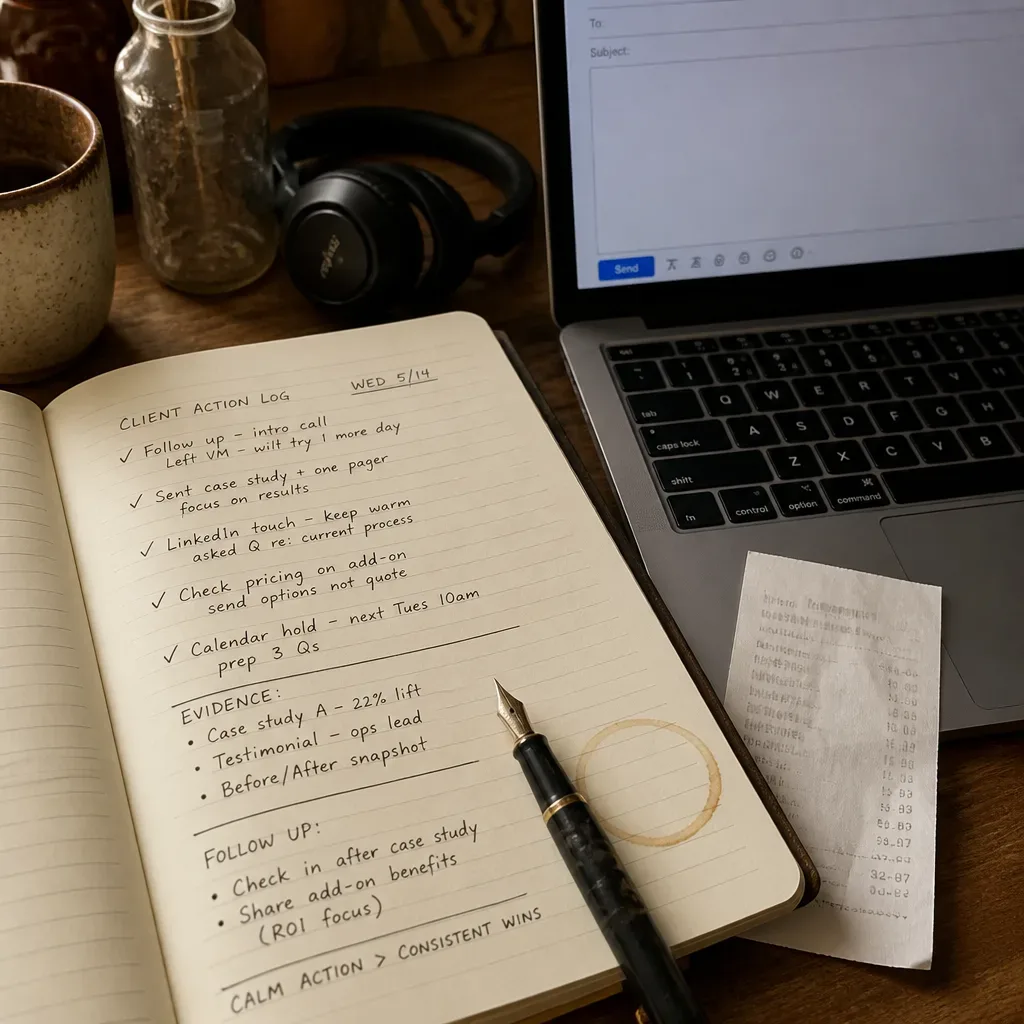
There is a money reason for this, too. Client pipelines are often slow. A HubSpot sales report from recent years has described follow-up and prospecting as persistent challenges for sales teams, even with software. Freelancers and founders are not exempt because they have nicer notebooks. The quiet work is still the work: follow up, clarify, ask, show proof, repeat.
I keep one line for the mornings when I feel exposed: I am not asking a stranger to save me; I am offering a useful next step to someone with a real problem.
What if no one replies after I do it?
No reply means I record the action as evidence, not as a verdict.
This is the part I had to learn slowly. A quiet inbox after brave action can feel personal. It usually is not. People travel. Budgets pause. A message lands under twelve other messages. Pew Research Center has reported for years that large shares of adults feel digitally interrupted or overloaded in different ways, and workplace studies routinely show email volume as a stressor. My one clean note is entering a crowded room.
So I separate two columns in my notebook:
| Evidence I control | Evidence I do not control |
|---|---|
| I listened before checking | They replied today |
| I sent one useful follow-up | They had budget this week |
| I named the client clearly | They were ready to buy |
| I improved the offer page | Their timing matched mine |
This is not a trick to avoid reality. It is how I keep reality readable. If ten useful actions produce no conversations, I need to revise the offer, the audience, or the proof. But if one action produces silence, I do not need to revise my identity before lunch.
Small studies on self-affirmation, including work by David Creswell and colleagues, suggest that reflecting on values can buffer stress responses in certain conditions. I think the audio works in a neighboring way for me. It reminds me who I said I was before the inbox gives me weather. Weather matters. It does not get to rename the house.
This is also where astrology and manifestation sometimes enters my week, softly. I may notice a timing pattern, a moon note, or a season where outreach feels heavier. I do not use timing as permission to disappear. I use it as context, then I still send the one useful thing.
After no reply, I do three quiet moves:
- Mark the action complete.
- Write one sentence of evidence from my side.
- Choose the next follow-up date, usually 3 to 7 days later depending on the relationship.
The inbox can report silence. It cannot report whether I am becoming trustworthy. That evidence has to be kept by hand.
How do I keep this from becoming another thing I quit?
I keep the routine boring enough that it can survive a bad Tuesday.
Most routines fail because they are designed by the version of us who has already slept well. The real test is the version with a train delay, a weird stomach, a mother calling, and a calendar with no mercy. Lally’s 66-day median is useful here because it lowers the drama. Missing once did not ruin habit formation in that study. Returning mattered.
I use three rules:
- Never add a second client action until the first is automatic. Ambition is where routines go to get theatrical.
- Keep the audio before the inbox, even if the action shrinks. On hard days, I send one sentence instead of one page.
- Track returns, not streaks. A streak can shame me after travel. A return teaches me I am still the kind of person who comes back.
James Clear popularized identity-based habits in Atomic Habits, and the research tradition behind identity and behavior is older than that. The practical point is plain: people repeat what fits who they believe they are. The Dream-Self Moment gives me a daily rehearsal of that fit. Then the small action gives it a body.
I keep a tiny log under the date:
Listened. Sent referral ask to M. No refresh before action.
Some days I add a line from the Manifestation pillar or a sentence from my own page. Some days I do not. The log is not literature. It is proof for tomorrow morning, when fear will pretend we have never done this before.
If you want the shortest version, this is the one I would write on a card:
- Coffee.
- Listen.
- One client sentence.
- One useful action.
- Refresh once.
- Record evidence.
That is how I practice manifest clients without making the inbox my oracle. It is not glamorous. It is twelve minutes, repeated. The boring daily unit, protected from panic, is where client trust begins to compound.
Tuesday now. The kettle is already clean.