audio manifestation
Future Self Meditation Script to Dream-Self Audio
Use a future self meditation script to record Dream-Self audio that feels personal, repeatable, and small enough to practice every morning without adding time.
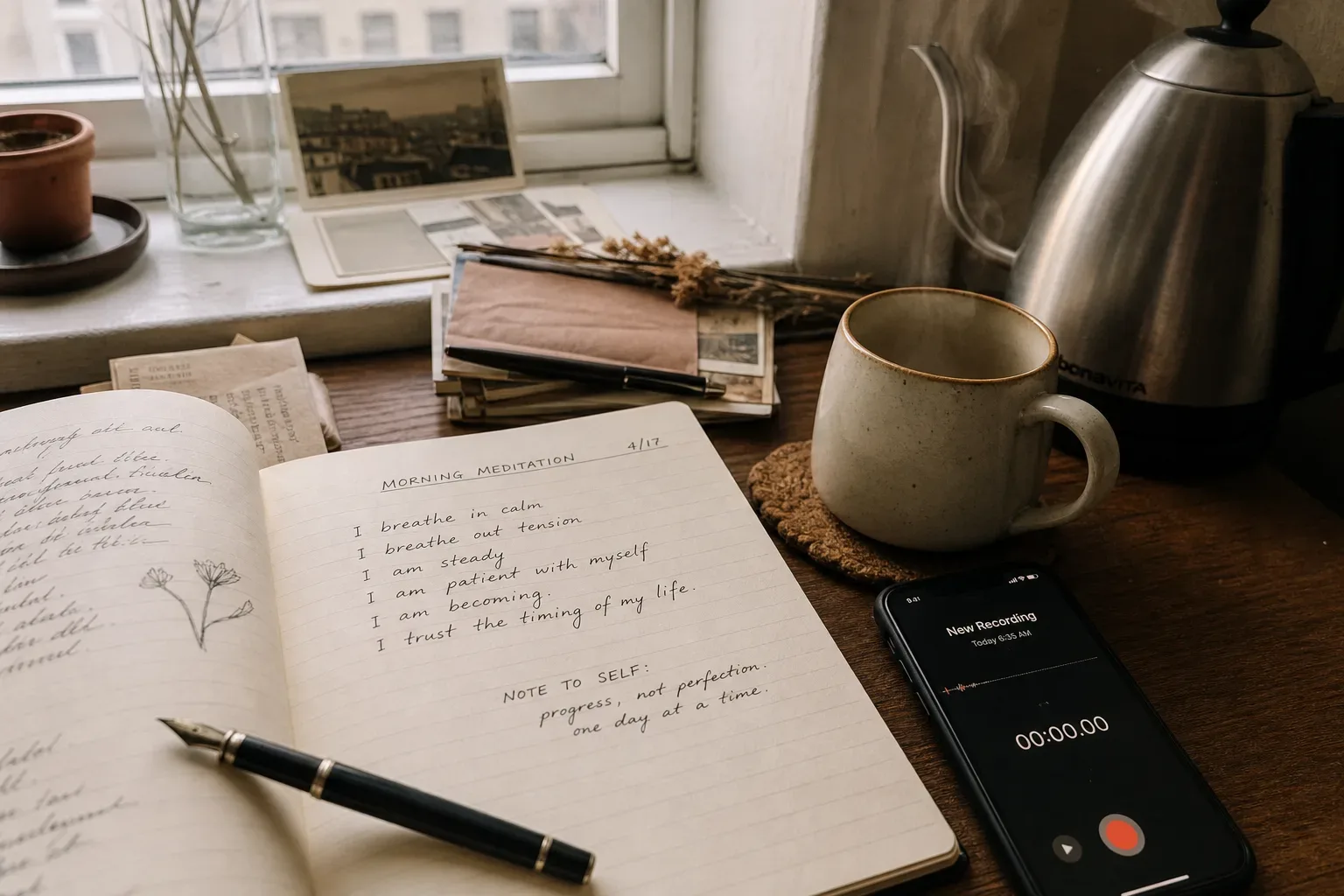
September 1st. The kettle clicked off before I found my pen. A future self meditation script becomes useful when I turn it into short Dream-Self audio: one concrete scene, spoken in present tense, listened to daily at the same cue. The script is the draft. The audio is the practice.
What should a future self meditation script actually do?
A future self meditation script should give my mind a specific identity to rehearse, not a pretty paragraph to admire.
I have written too many scripts that sounded good at night and collapsed by breakfast. The problem was not sincerity. It was size. A useful script tells me three things in under 350 words: who I am practicing being, what that person repeatedly does, and what evidence now exists in ordinary life. In habit research, context matters. Wendy Wood and David Neal wrote in 2007 that habits are cue-response patterns learned through repetition in stable contexts. That sentence stayed with me because it made the kitchen more important than mood.
So I write the scene like I am leaving myself a note on the table. Not cosmic. Not inflated. Tuesday morning. Blue mug. Phone face down. The version of me in the script has already done the small thing 40 times, so he does not announce it like a victory. He simply does it.
A future self that cannot be pictured in a room will usually fail in a calendar.
For me, the script has to answer these questions:
- What does my future self do before checking messages?
- What does my body feel like when the behavior is normal?
- Who notices the change, if anyone?
- What small friction has been removed?
- What promise is small enough to keep on a tired day?
This is where I connect it to the AYA Method, because the method is not the page. The AYA Method is a daily audio manifestation practice. Each day you listen to a short personalized recording, your Dream-Self Moment, narrated from the version of you who has already manifested the life you intend. Listening is the practice. Repetition is the work. The audio is the method.
I keep that definition close because it saves me from decorating the practice until it no longer executes.
How do I choose the right future self before I write?
I choose the future self by choosing one behavior I can observe within seven days.
This morning, I nearly wrote, I am calm with money. It sounded clean. It also gave me nowhere to stand. So I made it smaller: I open my banking app every Friday after coffee and write one number on the page. That sentence has a cue, an action, a day, and a visible trace. BJ Fogg, in his 2020 behavior model, keeps returning to the same practical rule: behavior happens when motivation, ability, and prompt meet. I trust that more than a mood.
The future self does not need to be grand. Mine usually holds a receipt, a notebook, or a glass of water. In the Manifestation pillar, manifestation is treated as a practice of attention and repeated inner rehearsal. I read that through a habit lens: attention becomes useful when it changes what I do at 8:10 a.m., not just what I say at midnight.
Here is the little filter I use before writing:
| Question | Weak answer | Usable answer |
|---|---|---|
| What changed? | I feel better | I walk for 12 minutes after lunch |
| When does it happen? | Every day | After I put my plate in the sink |
| What proves it? | I just know | Seven marks on the calendar |
| Who am I becoming? | My best self | Someone who returns without drama |
A 2009 study by Phillippa Lally and colleagues in the European Journal of Social Psychology found that habit automaticity took 18 to 254 days, with an average of 66 days. I write scripts with that range in mind. Seven days is enough to begin. Sixty-six days is a better frame for believing that repetition needs room.
The future self is not a fantasy character. It is tomorrow’s behavior, given a voice.
I do not ask the script to fix everything. I ask it to point at the next repeatable action.
What exact script structure turns the idea into Dream-Self audio?
The best structure I have found is a five-part script: arrival, evidence, behavior, felt sense, and return.
I write it by hand first because my typing voice tries to impress people. My pen is slower. The first draft is usually 220 words, which becomes about 2 minutes when read slowly. Most people speak between 125 and 160 words per minute in ordinary speech. For audio that is meant to be heard before the day hardens, I aim closer to 110 words per minute, with small pauses.
Here is the structure I used today:
- Arrival: I name the date or room. I am already living the ordinary morning.
- Evidence: I mention one thing I have kept doing long enough to trust myself.
- Behavior: I describe the next action with a cue and a first movement.
- Felt sense: I name the calm, steadiness, or relief in my body without exaggerating.
- Return: I end with a line about coming back tomorrow.
A rough example, before I clean it up:
It is Tuesday morning. I am sitting in the kitchen before messages. The kettle is cooling beside my cup. I have kept my first 20 minutes for writing often enough that my hands know where to go. I open the notebook before I open the inbox. I write one plain paragraph. I do not bargain with the day yet. This is how I keep faith with the person I said I was becoming. Quietly, I return.
That is not poetry. It is a behavioral instruction wearing a human coat. The line I listen for is the one my body does not fight. If I hear myself thinking, no you do not, I edit. Dr. Andrew Huberman has often discussed mental rehearsal in relation to motor planning and neuroplasticity, and while popular summaries can overstate the certainty, the basic point is defensible: repeated mental practice can prime attention and action.
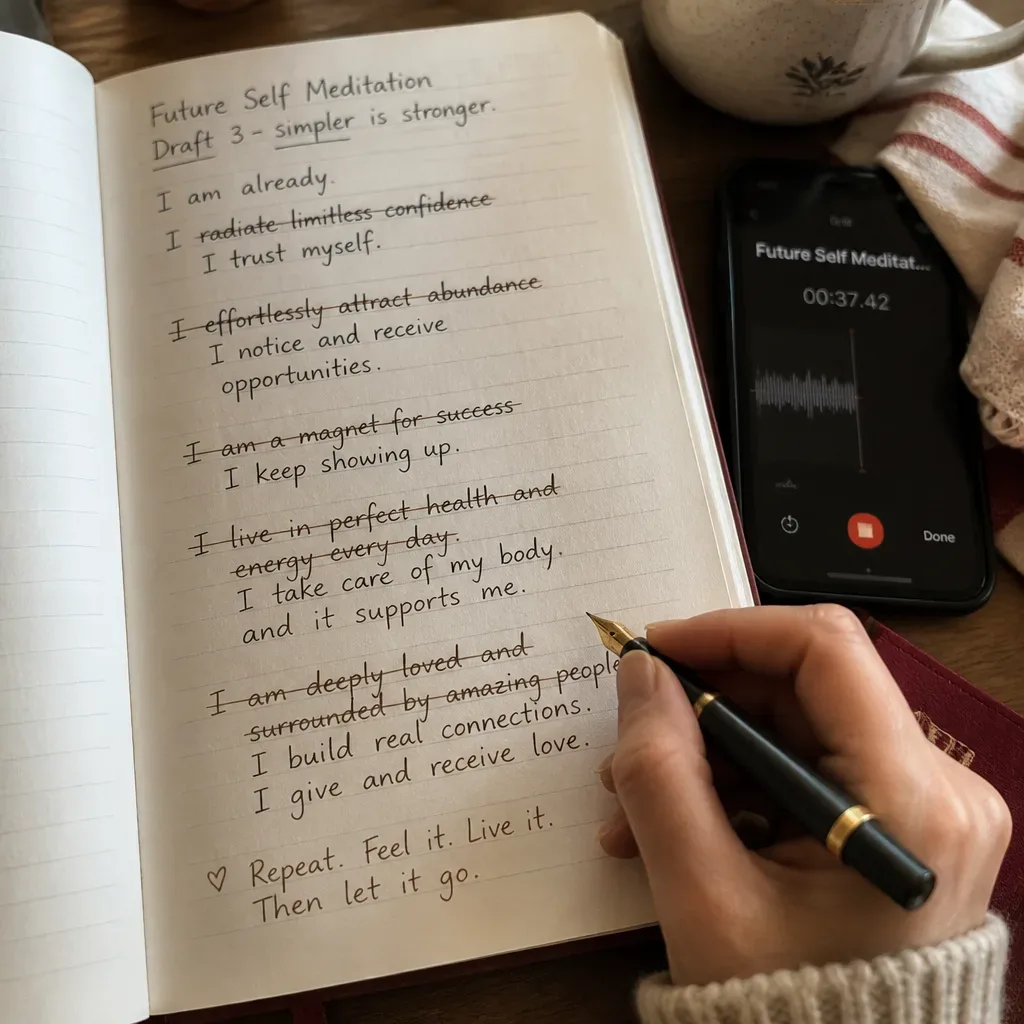
I also borrow one small practice from the Affirmations pillar: present-tense language. But I keep affirmations in their place. A daily affirmation might be one sentence on the page. The Dream-Self audio is the thing I actually listen to while brushing my teeth.
A script becomes stronger when it stops trying to sound powerful.
If the words sound like something I would never say in the kitchen, I do not record them.
How do I record the script so I will actually listen?
I record the script badly enough to finish it and clearly enough to repeat it.
This is the part where my old app-founder brain becomes useful. In the habit tracker I built, used by about 14,000 people, the pattern was embarrassingly consistent: the feature people requested loudest was rarely the one that kept them. Friction killed more routines than doubt did. Travel broke streaks. Late nights broke streaks. A first action that took more than 2 minutes broke more streaks than users wanted to admit.
So I make the recording simple. I sit in the chair near the window. I put the phone 20 centimeters from my mouth. I read slower than feels natural. I leave one breath between the five parts. I do not add music on the first version because production becomes a hiding place. If the room hums, I let it hum. If I stumble, I restart once, not seven times.
My small recording rules:
- Keep it between 90 seconds and 3 minutes.
- Use my own name once, near the beginning.
- Speak in the present tense.
- Remove any sentence that sounds like a command.
- End with a return line, not a climax.
Research on implementation intentions by Peter Gollwitzer, first formalized in the 1990s, found that if-then plans increase follow-through across many goals. I treat the recording cue the same way: if the kettle goes on, then the audio starts. If I am on the bus, then headphones go in before the first stop. A script without a cue is a loose page.
I save the file with a boring name: dream-self-september-writing.m4a. Boring names are underrated. They help tomorrow-me find the thing before he invents a reason not to.
Where should I place the audio in my day?
I place the audio beside an existing habit, because new practices survive better when they borrow an old doorway.
The doorway matters more than the hour. I used to believe morning was morally superior. Then I watched enough user data to stop romanticizing it. Some people keep promises at 6:40 a.m. Some keep them on the train. Some keep them in the bath after their children sleep. Pew Research Center reported in 2024 that 90% of U.S. adults own a smartphone, which means the delivery device is usually already present. The problem is not access. The problem is remembering without negotiating.
This week, my cue is brushing my teeth. I listen to my Dream-Self Moment before I rinse. That is the order. Toothbrush, audio, rinse, coffee. The whole thing takes less than 3 minutes. If I miss it, I do not punish myself. I play it while the kettle boils and keep the chain alive.
I keep a tiny mark on the page after listening. Not because the mark is magic. Because evidence calms the part of me that says nothing is happening. Some days I also write one daily affirmation underneath it, usually five or six words. The Manifestation Board sits in the app as a visual reminder, but I do not treat it as the center. The audio is the center.
For readers who like timing by lunar cycles or symbolic dates, I would point them to Astrology and manifestation with one caution from my notebook: timing can support a practice, but it cannot replace repetition. A new moon can help me begin. It cannot listen for me on day 17.
The cue is the hinge. Without it, the most beautiful script stays closed.
The quiet win is not feeling inspired. The quiet win is hearing the same future-self voice when the day is ordinary.
How do I revise the script after the first week?
I revise after seven listens by changing what feels false and keeping what helped me return.
Seven listens give me enough evidence to edit without guessing. Not enough to declare a new identity permanent. Enough to know which lines make my jaw tighten. In a 2010 study on the Best Possible Self exercise, Peters and colleagues found increases in positive affect and optimism after guided future-oriented writing, though effects vary by person and context. I take that as encouragement, not a blank check. The practice still has to survive dishes, email, and weather.
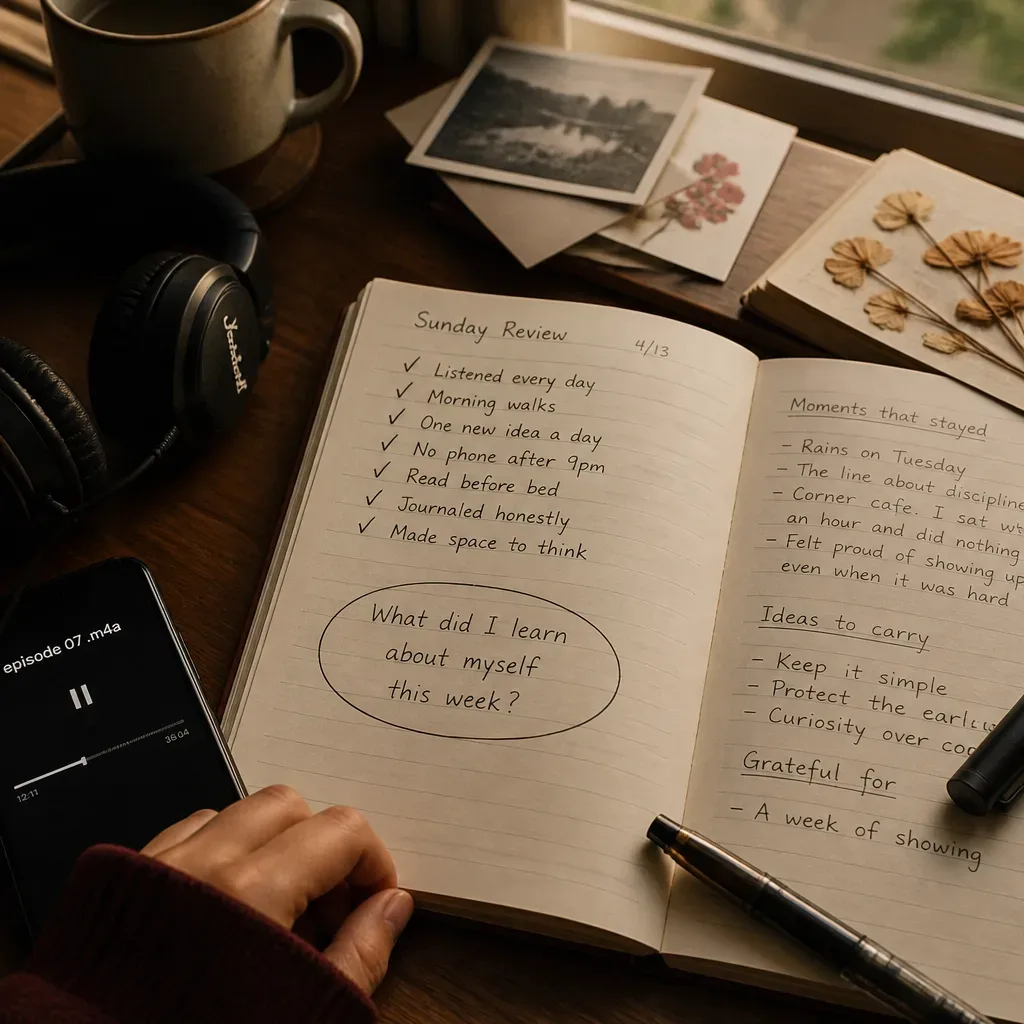
My review takes 10 minutes on Sunday. I listen once without multitasking. I put a dot beside any line I believed in my body. I put a small slash beside any line that sounded borrowed from someone else. Then I rewrite only those lines. This matters because novelty can become avoidance. If I rerecord every morning, I am not practicing repetition. I am practicing editing.
Here is my seven-day review list:
- Which line made me soften?
- Which line made me argue?
- Did the cue happen on at least 5 of 7 days?
- Did the script point to a behavior I could see?
- Is the audio short enough that I did not avoid it?
- What evidence can I add from this week?
If I kept the behavior 3 days out of 7, I do not write, I always do this now. I write, I am becoming someone who returns faster. That is more honest, and honesty is stickier than theater. For the broader map, I keep returning to Manifestation pillar, then narrowing it down again to the line I can live with before coffee.
A future self meditation script should mature like a note passed between versions of the same person. Less performance. More proof.
What mistakes make future-self audio stop working?
Future-self audio stops working when I make it too long, too vague, too polished, or too far from my actual life.
The first mistake is ambition. I have done this. I write a 12-minute recording that includes health, money, love, work, family, sleep, and forgiveness. Then I listen twice and quietly avoid it. A 2012 meta-analysis on mental imagery interventions found that imagery can influence emotion and behavior, but the effect depends on clarity, repetition, and fit. I write that as a warning in the margin: fit first.
The second mistake is using language I would be embarrassed to say out loud. If I cannot hear the sentence while standing in socks in the kitchen, I cut it. The third mistake is confusing intensity with consistency. A dramatic recording may move me once. A plain recording can meet me 30 mornings in a row.
The fourth mistake is skipping the body. My future self is not only an idea. He has shoulders. He breathes differently before opening email. He puts the phone down with the screen facing the table. This is why the script needs objects and gestures. In the Affirmations pillar, language is a tool for attention. In audio, language becomes even more physical because I hear it while moving through the room.
I also avoid outsourcing the whole thing. Templates help. This guide helps. But the line that works is usually embarrassingly personal: my mother noticing I sound less hurried, the chair by the heater, the receipt folded into the notebook. Princeton Engineering Anomalies Research, often called PEAR, studied mind-matter questions for nearly 28 years, and its conclusions remain debated. I mention it only to say this: even where the research is contested, daily attention still has to become daily behavior.
So I keep the script close to the floor. I record it. I listen tomorrow. I let the evidence collect in small marks.
Tuesday night. The file is saved, and the kettle is clean.