audio manifestation
Habit Stacking Manifestation With Dream-Self Audio
Habit stacking manifestation with Dream-Self audio: a quiet 5-minute guide to attach listening to an existing cue and make daily practice easier.

Your toothbrush is already waiting by the sink. Habit stacking manifestation means attaching Dream-Self audio to something you already do, so the practice happens without a new morning routine. Pick one steady cue, listen for 2 to 5 minutes, and repeat it daily until the cue feels incomplete without the audio.
What is habit stacking manifestation?
Habit stacking manifestation is the practice of placing a short manifestation cue directly after an existing habit.
The phrase habit stacking became popular through behavior design, especially BJ Fogg’s Tiny Habits model and James Clear’s writing on atomic habits. The science is older than the phrase. In a 2009 study in the European Journal of Social Psychology, Phillippa Lally and her colleagues found that new behaviors took a median of 66 days to feel automatic, with a wide range from 18 to 254 days. The lesson is gentle but firm: repetition has its own timing.
For manifestation, the problem is rarely belief alone. The problem is placement. You may want to listen, write, visualize, or repeat a sentence, but if the practice floats somewhere in the day, it has to be found again each time. That is expensive for the mind. A cue lowers the cost.
This is where the AYA Method fits without ceremony: The AYA Method is a daily audio manifestation practice. Each day you listen to a short personalized recording — your Dream-Self Moment — narrated from the version of you who has already manifested the life you intend. Listening is the practice. Repetition is the work. The audio is the method.
The cue is the door; the audio is the room.
A habit stack is not a performance. It is a small piece of design. You take something already stable, then let it hold something tender. If you are new to manifestation, this matters because it keeps the practice out of drama and inside daily life.
Why does Dream-Self audio work well in a stack?
Dream-Self audio works well in a stack because listening requires less setup than writing, planning, or forcing yourself into a mood.
Audio is useful because it can meet you while your hands are busy and your willpower is ordinary. You can listen while water boils, while you sit on the edge of the bed, or after you shut your laptop at 6:12 p.m. That is not a small detail. Wendy Wood’s habit research has repeatedly shown that stable contexts help behavior repeat because the setting starts to prompt action before decision-making begins.
There is also a nervous system reason to keep the stack short. Dr. Andrew Huberman often points to the role of repeated cues and reward prediction in behavior learning; the brain gets better at preparing for what usually comes next. If your cue is brushing teeth and what comes next is 3 minutes of listening, the body starts to know the sequence.
Dream-Self audio also protects the practice from overthinking. A blank page can invite editing. A long visualization can invite strain. A recorded Dream-Self Moment simply begins. You listen to a future-tense identity as if it is already familiar. This is close to what Neville Goddard called assuming the feeling of the wish fulfilled, though here the practice is grounded in a repeatable audio cue instead of a long inner scene.
A practice does not become real because it is dramatic. It becomes real because you can find it again tomorrow.
If you use the app’s daily affirmation, keep it after the audio. If you use a Manifestation Board, let it be something you see later. They can support the method, but they do not replace it. Listening is the center.
Which daily cue should you attach it to?
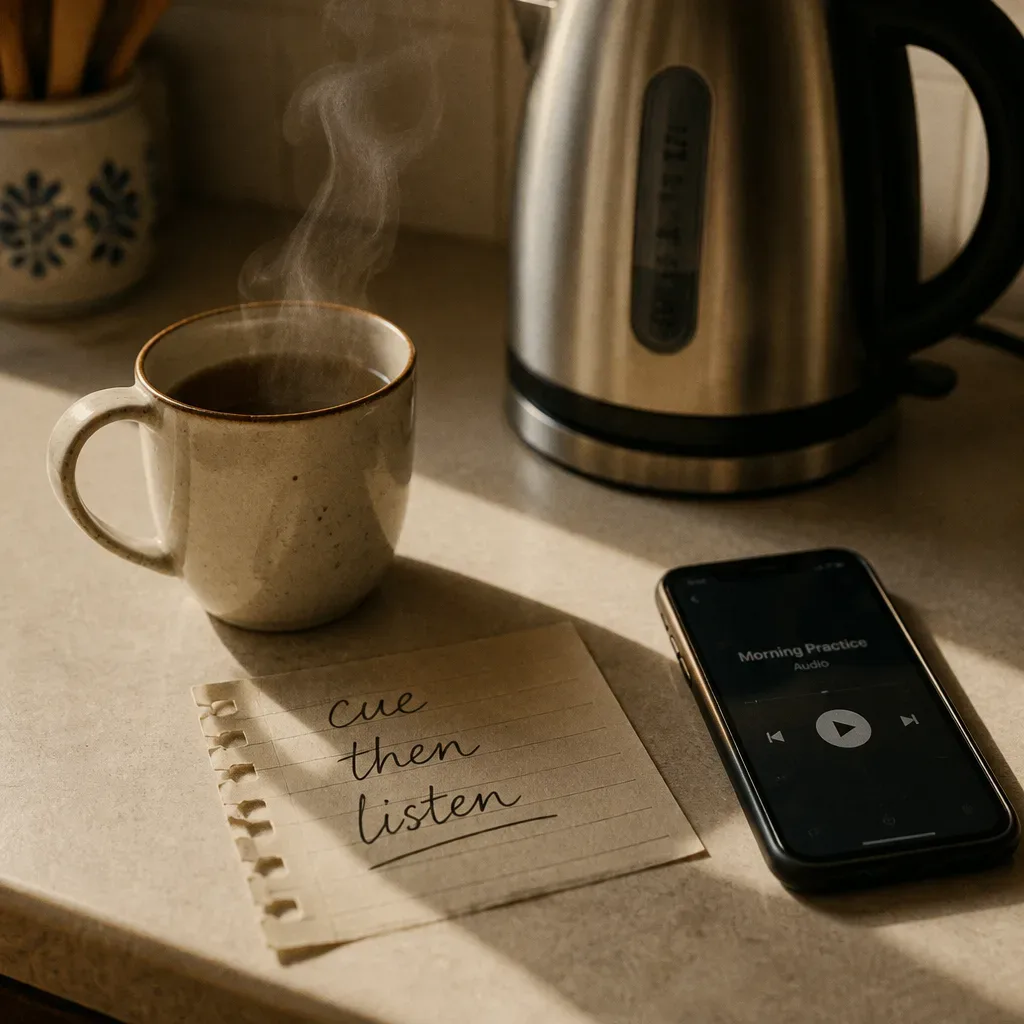
Attach Dream-Self audio to a cue that already happens almost every day and has a clear ending.
Good cues are physical and specific. Bad cues are vague. After I get ready is too loose. After I put my toothbrush back in the cup is clear. BJ Fogg teaches that the prompt is the most important part of a tiny behavior, and in practice that means the cue should be visible, repeatable, and close to the new action. If it takes more than 10 seconds to start the audio, the stack has too much friction.
Use this table before you decide:
| Existing cue | Why it works | Risk | Best audio length |
|---|---|---|---|
| Brushing teeth | Happens daily, clear finish | Bathroom may feel rushed | 2 to 3 minutes |
| Making coffee or tea | Natural waiting time | Weekends may shift | 3 to 5 minutes |
| Closing laptop | Strong workday boundary | Not daily for everyone | 2 to 4 minutes |
| Putting on shoes | Body is already moving | Easy to forget headphones | 2 minutes |
| Getting into bed | Quiet, repeated setting | Sleepiness may blur attention | 2 to 3 minutes |
Pick the cue with the least romance. I know that sounds plain. It is meant to. The cue is not there to impress you. It is there to find you. In Lally’s 2009 study, missing one day did not erase progress, but inconsistency made automaticity slower. A boring cue often protects you from that.
A few filters help:
- The cue happens at least 5 days a week.
- The cue has a clear before and after.
- Your phone or headphones can be ready within 10 seconds.
- You are not likely to be interrupted for 2 minutes.
- The cue belongs to you, not someone else’s schedule.
If astrology is part of how you time your reflection, keep it light and practical. You might read about astrology and manifestation, then still choose the cue that actually happens. The moon can mark a date. Your toothbrush has to carry Tuesday.
How do you build the stack in five minutes?
You build the stack by choosing one cue, placing the audio beside it, and rehearsing the first 10 seconds before the next real day begins.
Do not redesign your morning. That is how small practices get buried under beautiful plans. The whole setup should take less than 5 minutes. If you are tempted to add candles, journaling, stretching, and a new wake time, pause. Those may be lovely later. They are not the stack.
Here is the simplest setup:
- Name the cue. Say it in this form: After I finish brushing my teeth, I listen to my Dream-Self audio.
- Reduce the start time. Put the audio where you can press play in under 10 seconds.
- Choose the minimum. Set the first version at 2 minutes, even if you want more.
- Rehearse once. Touch the toothbrush, put it down, press play. The body learns sequence through contact.
- Leave a mark. Put one check box where you will see it later.
This is not childish. It is behavior design. In a 2012 review in the British Journal of General Practice, researchers described habits as actions triggered automatically in response to contextual cues. Context is not decoration. It is part of the mechanism.
The first 3 days are not proof of anything. They are wiring. Day 7 tells you more. Day 30 tells you what the cue can hold when your week is not ideal. If the stack fails 3 times in the first week, do not question your future. Question the cue.
Repeat the smallest true thing until your day starts making room for it.
What should the Dream-Self audio actually say?
The Dream-Self audio should speak from the identity you are practicing, in concrete scenes your body can believe enough to revisit.
A useful Dream-Self Moment does not need grand language. It needs specificity. The future self is not floating above your life. They are inside it. They answer email differently. They eat breakfast without checking for approval. They ask for the fee without apologizing. They leave the room when the room costs too much.
Joe Dispenza often speaks about mental rehearsal and the body’s learned familiarity with a future state. You do not have to accept every claim around that work to use the practical idea: repeated inner rehearsal can change what feels available. Sports psychology has studied imagery for decades; a 2017 meta-analysis in Psychology of Sport and Exercise found mental practice can support performance, especially when paired with physical practice.
For manifestation audio, make the language sensory and ordinary:
- I wake and know what matters today.
- My work has a clean shape now.
- I speak slowly when money comes up.
- I finish one true task before I offer myself to everyone else.
- I return to my body before I answer.
This is also where affirmations can help, if they stay simple. One sentence after listening is enough. More is not always more. A 2015 paper in Social Cognitive and Affective Neuroscience linked self-affirmation to activity in brain regions associated with self-processing and future orientation, but the sentence still has to feel personally meaningful.
Keep the recording short enough to finish. A 12-minute audio that you skip is less useful than a 3-minute audio you keep. The future self becomes familiar through contact, not length.
How do you keep the stack honest for 30 days?
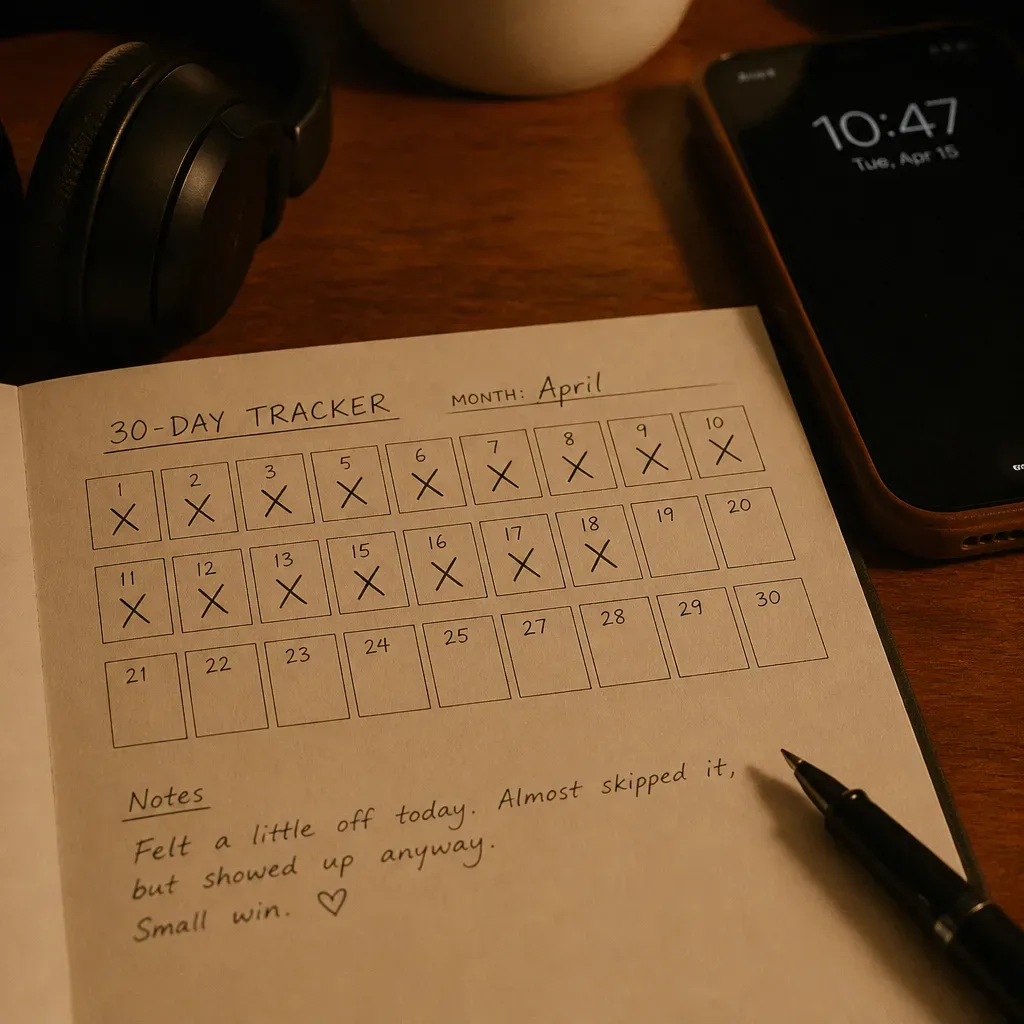
Keep it honest by tracking only the listening, not your mood, belief, or visible results.
Mood tracking can become a second job. Belief tracking can become a trial. For the first 30 days, the cleanest question is yes or no: did you listen after the cue? That is enough data. In a small habit-tracking app I once built, used by about 14,000 people, the streaks that survived were usually attached to plain cues, not big intentions. People did better when the mark took less than 5 seconds.
Use a tiny tracker:
| Day | Cue happened? | Audio listened? | Note under 5 words |
|---|---|---|---|
| 1 | Yes | Yes | Sink, quiet |
| 2 | Yes | No | Phone upstairs |
| 3 | Yes | Yes | Easier start |
The note matters only when something breaks. If you miss a day because the phone was in another room, you do not need a new identity. You need the phone by the sink. If you miss because the cue moved, choose a cue that moves less.
Tracking is not a scorecard. It is a way of seeing what you’re already becoming willing to repeat.
At day 10, make one adjustment. At day 20, make one more if needed. At day 30, decide whether to keep the same cue for another month. The AYA app may also give you a daily affirmation or a Manifestation Board to revisit, but for this 30-day test, protect the center. The audio is the method.
What changes when the stack starts to feel automatic?
When the stack starts to feel automatic, the practice becomes less dependent on motivation and more tied to the shape of your day.
You may notice it first as a small absence. You put the toothbrush down and something in you expects the voice. You close the laptop and reach for headphones before you argue with yourself. That is the sign. Not fireworks. Not certainty. Recognition.
The habit research is useful here because it keeps you patient. Lally’s range of 18 to 254 days means your 30-day mark is not a final exam. It is a reading. Some cues become sticky in 3 weeks. Others need a season. If your life has irregular shifts, caregiving, travel, or chronic stress, the cue may need to be even smaller.
This is the quiet promise of manifestation when it is paired with behavior design: you stop asking the practice to live in a perfect day. You give it a home in the day you actually have. That is kinder. It is also more serious.
After 30 days, you can lengthen the audio, add one written line, or look at your Manifestation Board after listening. Add only one thing at a time. In habit science, stacked complexity can hide the part that is working. Keep the signal clean.
The cue stays small, and you return.