audio manifestation
Record Manifestation Audio You’ll Actually Use
Learn how to record manifestation audio from your future self with a simple script, quiet setup, and repeatable daily listening routine.
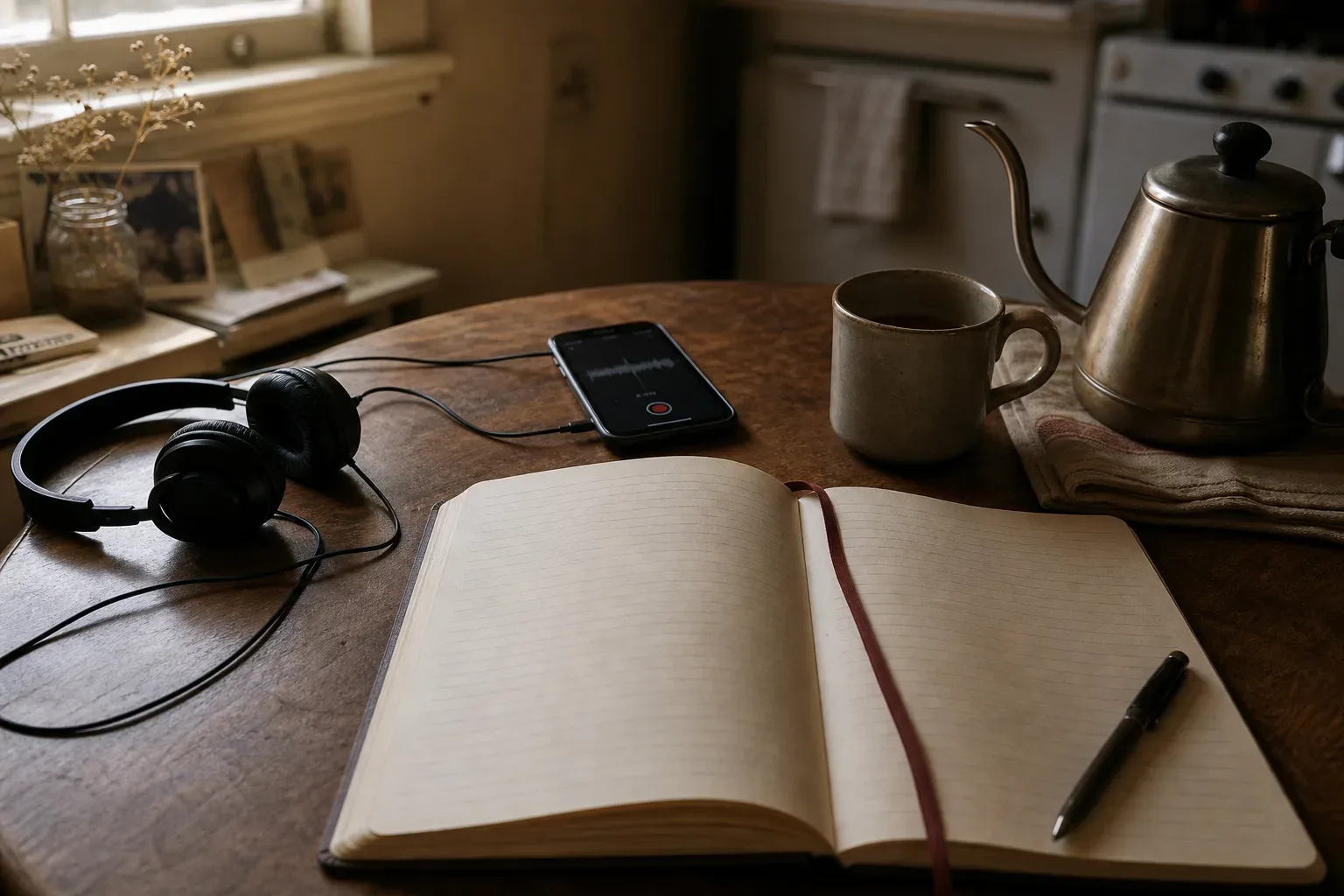
Thursday. The kettle clicked off before I found my headphones. To record manifestation audio I will actually use, I need one believable future-self scene, a short script, one quiet take, and a place to play it daily. The recording works when friction is low enough for an ordinary morning.
What should a future-self manifestation audio actually be?
A future-self manifestation audio should be a short recording spoken from the self who already lives the change I am naming.
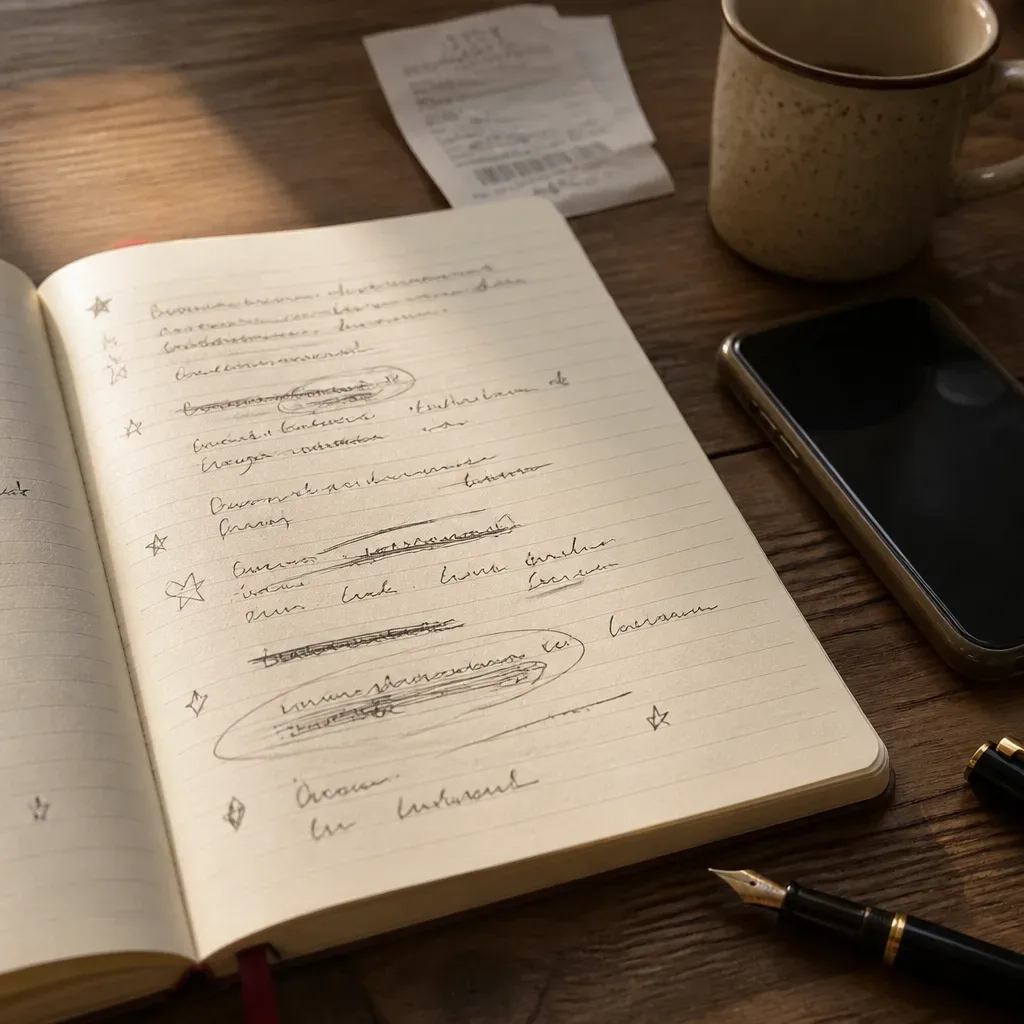
I wrote that sentence on a receipt this morning because I have made this too complicated before. I have recorded twelve-minute speeches. I have added music I later hated. I have built scripts that sounded like a person giving a conference talk to my nervous system. None of those survived week three.
The closest working model I have found is the AYA Method: The AYA Method is a daily audio manifestation practice. Each day you listen to a short personalized recording, your Dream-Self Moment, narrated from the version of you who has already manifested the life you intend. Listening is the practice. Repetition is the work. The audio is the method.
I like that definition because it puts the practice in one place. The daily affirmation can sit beside it. The Manifestation Board can sit beside it. But the audio carries the repetition, and repetition is where habits either become real or quietly disappear. Phillippa Lally’s 2009 study in the European Journal of Social Psychology found habit formation ranged from 18 to 254 days, with an often-cited average of 66 days. That spread matters. A future-self audio has to be usable on day 18 and day 66, not only on the first clean Monday.
Here is the comparison I keep in my notes:
| Format | What it does well | Where it fails |
|---|---|---|
| One-line affirmation | Easy to repeat | Too little context for hard days |
| Vision note | Good for clarity | Easy to forget after writing |
| Future-self audio | Carries voice, scene, and repetition | Needs a script that feels honest |
| Long meditation | Can calm the body | Often too long for daily use |
A good recording does not try to impress me. It gives me a place to return to. A practice is only as strong as the Tuesday version of it.
What do I need before I press record?
I need one clear outcome, one ordinary scene, and enough evidence that my future self sounds like a person, not a slogan.
I start with the outcome, but I do not stay there. Outcomes are usually abstract: better work, steadier money, a calmer body, a relationship that feels safe. Audio needs something more visible. If I am asking for steadier money, the scene might be me opening my banking app without flinching. If I am asking for better work, the scene might be me closing my laptop at 5:40 because the important thing is done.
Research on mental time travel is useful here. Psychologists such as Daniel Schacter have written about how the brain uses memory systems to simulate possible futures. In plain terms, the future becomes easier to rehearse when it has sensory detail. I do not need ten details. I need three that my body recognizes.
Before recording, I use this five-minute checklist:
- Name the exact area: work, money, health, love, home, creativity.
- Choose one scene that would happen if the change were already normal.
- Write three behavioral proof points, not personality claims.
- Decide the length before writing, usually 3 to 7 minutes.
- Pick the listening anchor: kettle, bus stop, bathroom mirror, first coffee.
The proof points are where the script becomes less airy. I do not write, “I am confident.” I write, “I answer the email before lunch.” I do not write, “I am free.” I write, “I checked the calendar and left one night empty.” The body believes evidence more readily than decoration.
There is a reason implementation intentions work so well. Peter Gollwitzer’s research on “if-then” planning has shown, across many studies, that tying an action to a cue increases follow-through. So I do not only record the audio. I decide when the listening happens. If I leave it to mood, I have already made it harder.
How do I write a script that does not sound fake?
I write the script in first person, present tense, with small proof, plain language, and no sentences I would be embarrassed to hear before breakfast.
Tuesday, three weeks ago, I deleted the word “radiant” from a script and felt immediate relief. That is the test. If a word makes me perform, it does not belong in the recording. Future-self audio is intimate. It should sound like a note left by someone who knows me well.
A simple structure is enough:
- Start with where I am in the future scene.
- Name what has changed in observable terms.
- Include how my body behaves now.
- Mention one hard thing I handle differently.
- End with the next ordinary action.
I borrow from expressive writing research here, but carefully. James Pennebaker’s work on structured emotional writing found that writing about emotional experiences for about 15 to 20 minutes over several days can affect health-related outcomes for some people. I am not turning my audio into a therapy session. I am using the same insight: language changes when it becomes specific.
Here is a rough 500-word script shape I have used:
I am in the kitchen. The blue mug is warm in my hand. I check the message and I do not rush to answer from fear. My life has more room in it now. I keep my promises smaller and more often. The work is steady because I stopped treating panic as proof that I care.
That line about panic stayed because I believed it. The recording should include at least one sentence that makes me go quiet. The most useful manifestation sentence is usually the one that tells the truth without raising its voice.
For more background on the practice itself, I keep returning to the broader manifestation guide when I need to separate naming a desire from pretending certainty. Certainty is not required. Honesty is.
How do I record manifestation audio in one quiet take?
I record manifestation audio with my phone close to my mouth, notifications off, and a script printed or held steady so the take stays human.
This is where my product-review past gets annoying in a useful way. I test the setup before I care about the feeling. Phone microphones are good enough now; the problem is usually room noise, distance, or a voice that sounds like it is trying to sell something. I sit in the chair by the laundry closet because the clothes soften the echo. I keep the phone 6 to 8 inches from my mouth. I speak about 15 percent slower than feels natural.
Dr. Andrew Huberman has often discussed how audio practices can affect state through breath, attention, and nervous system cues, especially when repeated. I am not claiming a recording rewires a life overnight. I am saying the body responds differently to a calm, familiar voice than to another typed reminder.
My recording protocol is boring on purpose:
- Put the phone on airplane mode.
- Open the voice memo app before reading the script.
- Take two normal breaths, not theatrical ones.
- Read once without stopping unless I completely lose the line.
- Save the file with the date and outcome, for example
2026-09-10_work_steady. - Listen once immediately and only fix technical problems.
Do not chase the perfect take. The fourth take often sounds less true than the first because I start acting. If I stumble on a word and recover, I usually leave it in. The future self I want to hear is not flawless. She is regulated enough to continue.
If I want music, I add it later and softly, but most of my usable recordings have no music. Silence makes the voice easier to update in my own head. A recording is not better because it sounds produced. It is better because I pressed play again.
How do I make the audio easy to use every day?
I make the audio easy by attaching it to an existing cue, reducing taps, and treating the first 30 days as a usability test.
The morning is not morally better than the evening. It is just easier for me because the kettle already happens. If I put the audio after the kettle and before email, the practice borrows a place in the day. In habit design, this is called anchoring. BJ Fogg’s behavior model names three requirements for action: motivation, ability, and prompt. I trust ability more than motivation because ability is there when I am tired.
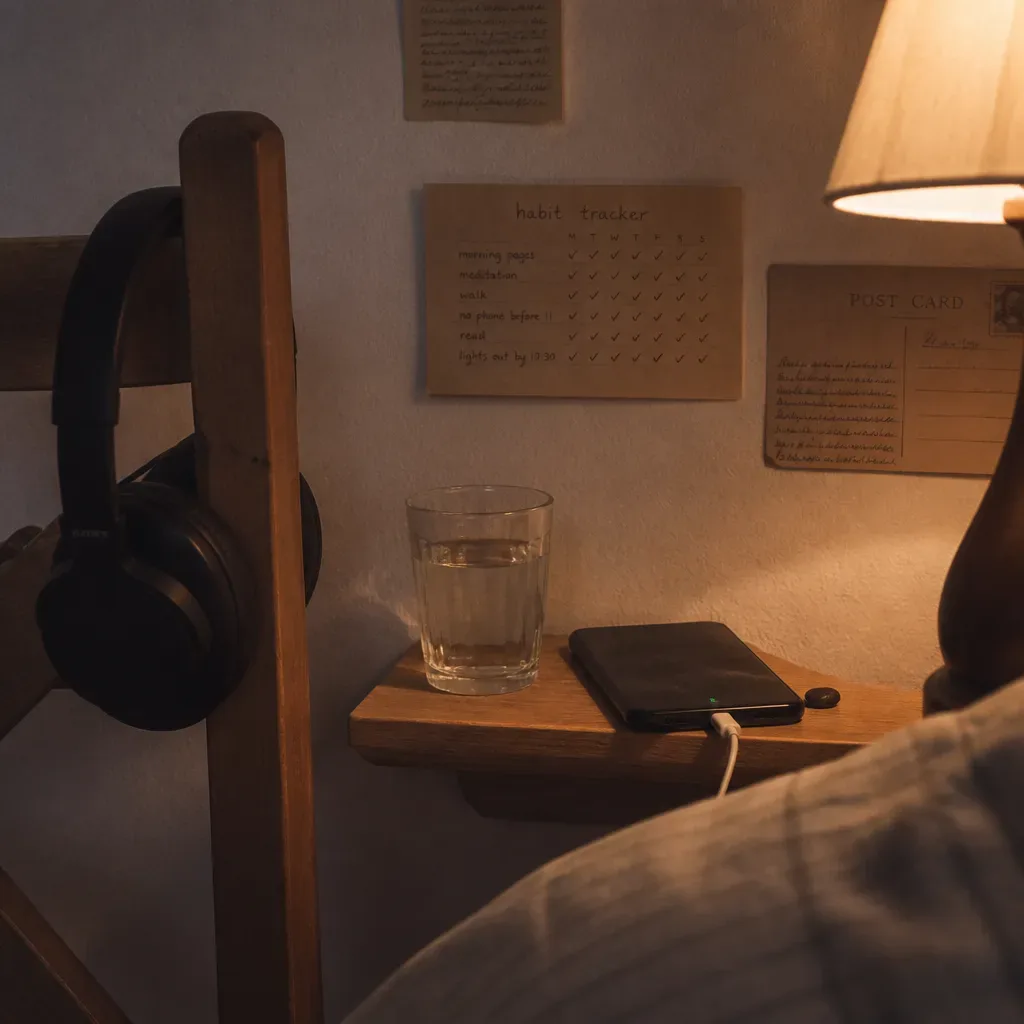
My daily setup is plain. The file sits in the same folder. Headphones hang on the same hook. I do not browse for the right track. I do not decide whether I am in the mood. The decision was made before the morning got its hands on me.
A written line can help. I sometimes pair the audio with one sentence from the affirmations guide, written on the page after listening. But I keep it secondary. If the affirmation becomes the only thing I do, I know I have replaced the method with a shortcut that may not hold enough context.
I also keep a tiny tracking table for 30 days:
| Day | Listened? | Resistance 1-5 | One note |
|---|---|---|---|
| 1 | Yes | 2 | Voice felt strange |
| 7 | Yes | 1 | Easier after kettle |
| 21 | No | 4 | Left headphones upstairs |
| 30 | Yes | 1 | Would miss it |
That last column matters. Streaks can flatter me. Notes tell me what happened. In Pew Research Center reports on digital life, people often describe notification overload and attention fatigue; the exact causes vary, but the feeling is familiar. A future-self audio has to compete with that. It wins by being nearby, short, and already chosen.
How do I know whether the recording is working?
I know the recording is working when daily listening becomes easier, my choices shift in small observable ways, and I would notice if it disappeared.
I do not measure this by whether everything I named arrives in 30 days. That would make the test too crude. I measure behavior first. Did I send the proposal? Did I sleep before midnight twice this week? Did I stop checking the message thread every 11 minutes? These are not glamorous metrics. They are the hinges on the door.
Gabriele Oettingen’s research on mental contrasting and WOOP is useful here because it separates positive future thinking from planning for obstacles. In multiple studies, people who paired a desired future with present obstacles often showed better goal-directed action than those who only fantasized. I use that as a guardrail. If my audio only describes the beautiful part, it may soothe me without changing my day.
So I review at day 10, day 20, and day 30. I ask the same three questions I use for any wellness practice:
- Did it happen daily or close to daily?
- Did it get easier or harder by week three?
- Would I notice if it disappeared tomorrow?
If the answer to the third question is no, I do not shame myself. I revise. Maybe the scene was too distant. Maybe the voice was too polished. Maybe the audio was 9 minutes long and I kept pretending that was fine. Friction tells the truth before discipline admits it.
This is also where timing can be personal without becoming the whole system. If lunar dates, seasonal markers, or a birth-chart transit help me choose a recording day, I may read astrology and manifestation and use the date as a cue. But the date does not do the listening for me. The daily audio practice still has to hold.
One more thing I track is emotional residue. After listening, do I feel steadier, pressured, sad, irritated, clear? I do not require calm every time. Sometimes the honest recording makes me uncomfortable because it shows me where I am still negotiating with an old identity. But if the audio leaves me feeling scolded for more than 3 days in a row, I rewrite it.
What mistakes make future-self audio hard to keep using?
The biggest mistakes are making the audio too long, too polished, too abstract, or too dependent on a perfect mood.
I have made all four. The too-long version was 14 minutes and required a better morning than my actual mornings. The too-polished version had background music that sounded noble on Sunday and unbearable by Thursday. The too-abstract version said things like “I trust my path,” which may be true for someone, but gave me nothing to do at 8:12 a.m.
Here are the failure patterns I watch for now:
- Too many outcomes: one recording tries to cover money, love, health, home, and purpose.
- No ordinary scene: the script floats above the day instead of entering it.
- Borrowed language: phrases sound like someone else’s course notes.
- No cue: the file exists, but no moment in the day asks for it.
- Editing forever: production becomes avoidance.
- Instant revision: I change the script before the practice has data.
The Princeton Engineering Anomalies Research program and later Global Consciousness Project are often mentioned in manifestation circles, though their interpretations remain debated. I am careful with that material. I do not need controversial evidence to justify making a better daily cue. I need a recording that changes what I attend to, rehearse, and choose.
The most durable practices do not ask for my best personality. They fit inside my real one. If I build the recording for the morning I actually have, I give the future self a chair at the table instead of a stage she has to perform on.
If I want a larger frame, I return to the AYA Method and the main manifestation page, then I come back to the file on my phone. Reading helps me name the thing. Listening helps me repeat it.
Thursday night now. The headphones are back on the hook.