reality shifting
Julia Method Shifting With Dream-Self Audio, Safely
A safe, grounded guide to julia method shifting with Dream-Self audio, nervous-system checks, clear steps, and ways to stop if it feels wrong.
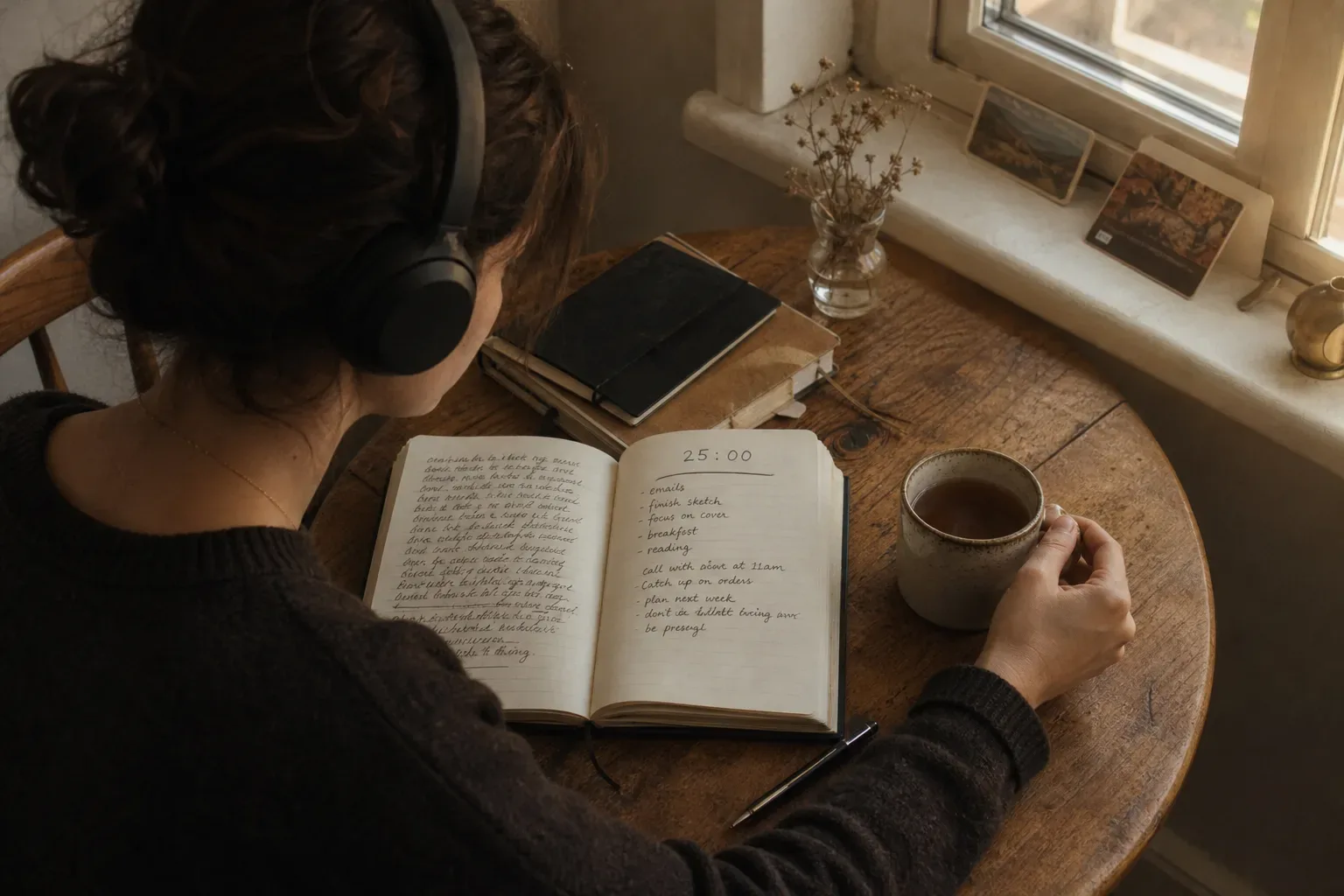
Wednesday. The kettle clicked off while I wrote the timer length on a receipt: 20 minutes. Julia method shifting is safest when I treat it as structured imagination with body checks, not escape. Dream-Self audio can guide the self-talk, but the practice still needs limits, grounding, and a clear way back.
What is Julia Method shifting, really?
Julia Method shifting is a reality-shifting routine built around repeated “I am” statements, counting, and entering a desired self-state while the body rests.
I am careful with the word “shifting.” In the research room, I would call much of this guided imagery plus self-referential language. In my diary, I call it the thing I do in the chair when I want to rehearse being braver than I felt at breakfast. Both names matter. The first keeps me honest. The second keeps me human.
The typical Julia Method asks a person to lie down, relax the body, count upward, repeat identity statements, and notice sensory signs. People online often describe tingling, floating, heaviness, or a sense of being somewhere else. Those sensations are not rare. In sleep research, hypnagogic imagery appears during the transition into sleep, and in laboratory studies of meditation, altered body sensations are reported by experienced and new practitioners alike. The sensation is real as a sensation. It is not automatic evidence of a literal relocation.
The safety question begins there. I do not need to insult the experience to keep it grounded. A felt thing can be meaningful without being treated as medical, cosmic, or compulsory. The DSM-5-TR describes dissociation as disruption in identity, memory, or perception, and that distinction matters because pleasant absorption and distressing detachment are not the same thing.
I keep one sentence on the page before I begin: The practice is allowed to feel deep, but it is not allowed to make this life disappear. That line has saved me more than any counting script.
For the wider map, I return often to the Manifestation pillar, because it separates intention, attention, and action in a way my nervous system can understand. Julia Method shifting sits inside that larger family, but it needs more care because it plays close to sleep, identity, and dissociation.
Why use Dream-Self audio with the Julia Method?
Dream-Self audio gives the Julia Method a steadier identity cue than improvised repetition, especially when the recording is calm and specific.
This morning I used a short recording before brushing my teeth. That is the order I do them in when I am not pretending to be more disciplined than I am. I practice the AYA Method as a daily audio manifestation practice: each day I listen to a short personalized recording, my Dream-Self Moment, narrated from the version of me who has already manifested the life I intend. Listening is the practice. Repetition is the work. The audio is the method.
With Julia Method shifting, I do not use the audio as a portal. I use it as a cue. That distinction is small on the page and large in the body. Cognitive neuroscience has a long record of showing that self-relevant language recruits midline brain regions linked with self-processing, including the medial prefrontal cortex. A 2014 paper by Ethan Kross and colleagues also found that distanced self-talk can change emotional regulation during stressful tasks. The phrasing matters.
My Dream-Self audio says ordinary things in the past tense. It does not command me. It does not say I must leave the room, abandon my body, or prove belief. It says I handled the call. I took the walk. I answered with care. These are boring sentences, which is partly why I trust them.
The audio is not a portal; it is a cue. A cue can be repeated. A cue can become familiar. In Lally and colleagues’ 2009 habit study, automaticity took a median of 66 days, with wide variation from 18 to 254 days. That number humbles me. I am less interested in a single dramatic session than in what repeated self-language makes easier by week six.
If I also write one daily affirmation afterward, I treat it as a small complement, not the structure itself. The Affirmations pillar is useful for language hygiene, but the audio carries the practice when I am using AYA.
How do I prepare before trying it safely?
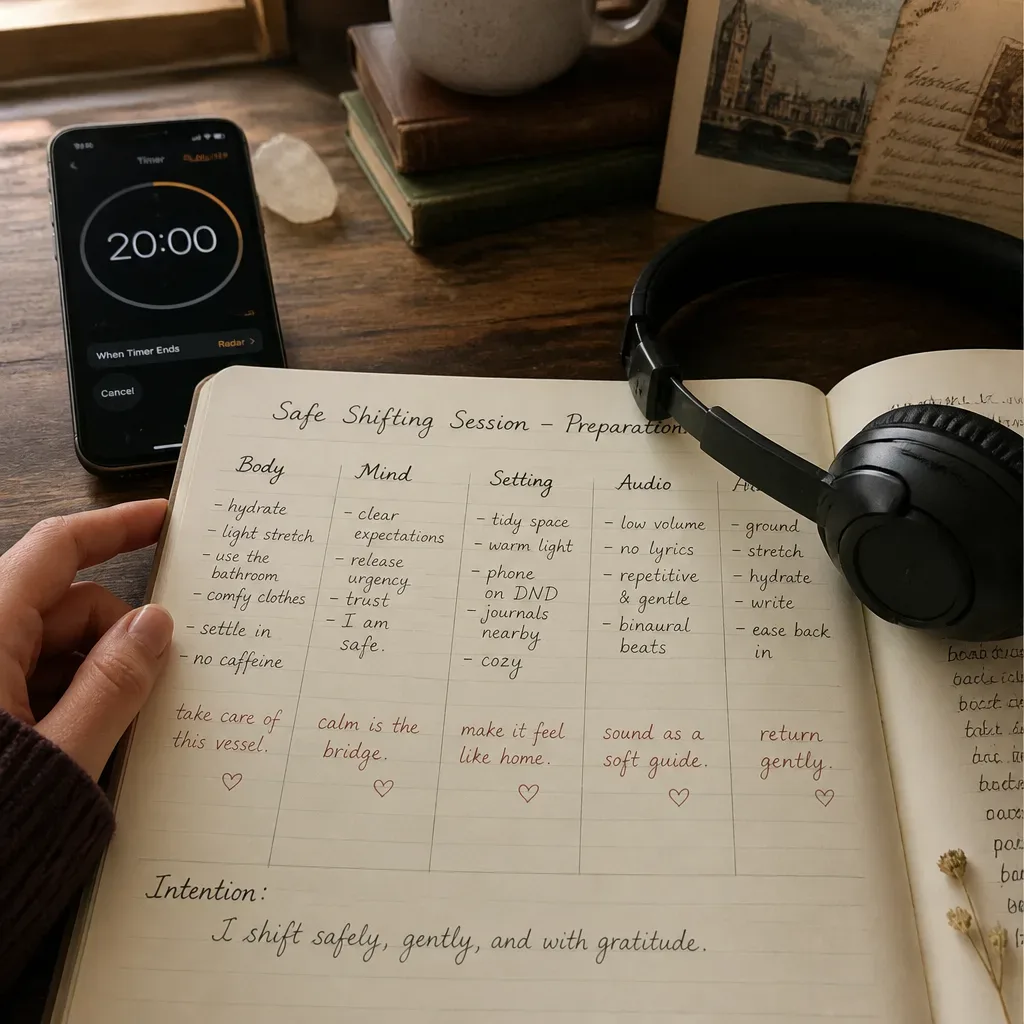
I prepare by setting a time limit, checking my state, choosing grounded audio, and deciding exactly how I will stop.
Before I start, I ask three plain questions: Did I sleep enough? Have I eaten? Am I trying to avoid something urgent? The answers are not moral. They are data. In sleep medicine, sleep deprivation is known to increase emotional reactivity and perceptual oddities; even one poor night can change attention and mood. I do not do shifting practices when I am overtired enough to feel unreal already.
I also avoid sessions if I am panicky, dissociated, intoxicated, or in the middle of grief that feels too sharp to hold. That is not because imagination is dangerous by itself. It is because absorption can amplify the state I bring into it. A 2018 review in Frontiers in Psychology described guided imagery as potentially useful for stress and pain, but context and screening still matter.
Here is the note I keep folded into the back of my notebook:
| Check | Safe enough for me | I pause instead |
|---|---|---|
| Body | Fed, hydrated, rested | Dizzy, numb, sleep-deprived |
| Mind | Curious, steady, willing to stop | Panicked, compulsive, desperate |
| Setting | Timer set, door safe, phone away | Hidden, rushed, afraid of interruption |
| Audio | Calm, personal, present-life friendly | Threatening, grandiose, body-denying |
| Afterward | One ordinary task planned | No plan to reorient |
I choose a chair more often than a bed. The bed makes my brain expect sleep. The chair keeps my feet available. I name the date, the room, and one thing I will do after the timer ends. Today it was: Wednesday, kitchen chair, wash the blue mug.
Safety is not the opposite of belief; it is the container that lets belief stay human.
What are the exact Julia Method steps with Dream-Self audio?
The safest steps are to ground first, listen gently, count slowly, let imagery arise, and close with present-time orientation.
I keep the whole session to about 20 minutes. Some people use longer scripts, but attention gets slippery for me after that. In meditation research, even brief interventions of 10 to 20 minutes can shift state measures of calm or attention in small studies, so I do not treat duration as proof of seriousness. More minutes are not always more care.
My version looks like this:
- Set the timer for 10 to 25 minutes. I use 20 minutes unless I am tired.
- Sit or lie with support. I notice my feet, the back of the chair, and my hands.
- Name three present facts. Date, place, after-task.
- Start the Dream-Self audio quietly. The volume is low enough that I can still hear the room.
- Repeat “I am” with counting. I count from 1 to 100 if it feels steady, and stop earlier if it does not.
- Let the desired scene be simple. One room. One action. One feeling in the body.
- Do not chase symptoms. Tingling, heaviness, warmth, or images may come. They are not grades.
- Close when the timer ends. I open my eyes, name five objects, drink water, and write three lines.
The scene I use is deliberately small. I am at my desk. The email is sent. My shoulders are not up by my ears. My future self is not glittering or unreachable. She is just me, after doing the thing I was avoiding.
This matters because implementation intention research, especially Gollwitzer’s work from 1999 and the 2006 Gollwitzer and Sheeran meta-analysis, suggests that specific if-then plans support goal follow-through. I do not only picture a vague new life. I attach the self-state to a next action. If I hear “I answer cleanly,” then after the session I send the draft.
I keep the AYA Method separate in my mind from the Julia structure. AYA is the daily audio practice. The Julia Method is the counting and shifting container I sometimes place around the audio. That clarity helps me not turn every tool into the same tool.
What should I do if I feel anxious, floaty, or unreal?
If I feel anxious, floaty, or unreal, I stop immediately and orient to the room through senses, movement, and ordinary facts.
I write this without drama because stopping is part of the method. It is not failure. It is a skill. The 5-4-3-2-1 grounding exercise, often used in anxiety care, asks a person to name five things they see, four they feel, three they hear, two they smell, and one they taste. It is simple enough to remember when the mind is noisy.
My stop rule is short: if fear rises above a 6 out of 10, if the room feels unreal, if I feel pulled to keep going against my judgment, or if I cannot name the date, I stop. I turn off the audio. I put both feet on the floor. I press my palms together. I say my full name, the city, the year, and the after-task.
There are also red flags I take seriously:
- Losing time in a way that frightens me
- Feeling detached from my body after the session ends
- Hearing commands or threats in audio or thought
- Needing to shift to tolerate ordinary responsibilities
- Skipping food, sleep, school, work, or medication for practice
- Feeling that present relationships are fake or disposable
If any of those persist, this becomes a mental-health question, not a manifestation question. The American Psychiatric Association’s diagnostic language around dissociation is clinical for a reason: distress and impairment matter. I would rather be cautious too early than brave too late.
A practice that requires me to abandon my body is not a practice I trust.
I also keep one ordinary repair action ready. Wash a cup. Step outside for 3 minutes. Text a friend a normal sentence. In my lab notes, I might call this behavioral reorientation. In the kitchen, I call it coming back.
How do I know whether this is helping or becoming avoidance?
The practice is helping if it leaves me more able to live my present day, and it is avoidance if it makes present life smaller.
I track outcomes for seven days at a time. Not mystical signs. Behavior. Did I send the message? Did I sleep? Did I speak more kindly to myself? Did I attend to the thing the Dream-Self audio named? A 2015 review in the Journal of Behavioral Medicine on mindfulness-based interventions noted benefits for stress outcomes across many studies, but the useful question for one person is still concrete: what changed after practice?
This is where my Manifestation Board can help, but only as a complement. I pin one image or phrase there after the audio has already done its work. If I start rearranging images for an hour instead of making the call, I know I am decorating avoidance. The Astrology and manifestation notes on timing are similar for me: interesting as reflection, unhelpful if I use them to postpone the ordinary next step.
I use this small scorecard:
| After 7 days | Green signal | Yellow signal | Red signal |
|---|---|---|---|
| Mood | Calmer or clearer | Mixed, but stable | More fearful or unreal |
| Action | One next step taken | Thinking only | Avoiding more |
| Body | Sleeping and eating normally | Slightly disrupted | Sleep or food neglected |
| Relationships | More present | Neutral | Withdrawing or dismissive |
| Practice | Easy to stop | Urge to extend | Feels compulsive |
The scorecard is not romantic, which is why I like it. If the method makes daily life smaller, the method is too loud.
I also compare my notes with broader manifestation practice ideas when I feel myself drifting into certainty. Princeton’s PEAR lab is often cited in manifestation spaces, but its anomalous cognition claims remain controversial, and the lab closed in 2007. I do not build my safety plan on disputed evidence. I build it on sleep, attention, repetition, and behavior.

How should I close the session and keep the effect grounded?
I close by returning to sensory facts, writing a short note, and taking one small action that belongs to the present day.
The closing is not decorative. It is the hinge. Without it, a session can stay foggy and unfinished. I open my eyes before I interpret anything. I name five objects, move my neck, drink water, and stand up slowly. Then I write three lines with the time. Not a long entry. Just enough to date the experience.
My note from this week looked like this:
- 7:42 a.m., kitchen chair.
- Audio felt calm; counting got heavy around 63.
- Sent the email afterward, no drama.
That last line matters most. In behavior change research, identity statements become more useful when they are tied to repeated action. James Clear popularized that idea in habit writing, but the older psychology sits in self-perception theory and implementation intentions. We infer who we are partly from what we repeatedly do. The Dream-Self audio gives me language. The after-action gives the language a place to land.
I sometimes add one sentence from the Affirmations pillar style, but I keep it plain: “I can return to the page without making it holy.” Then I wash the cup, answer the message, or step onto the balcony. The body likes proof it can complete a loop.
If the session was intense, I do not repeat it later that day. I wait at least 24 hours. A small practice kept well is better than a large practice that leaves me scattered. That is not a slogan. It is how I protect the part of me that still has to buy bread, call my mother, and sleep.
Thursday now. The blue mug is clean.