reality shifting
Raven Method Shifting With Dream-Self Audio, Safely
Raven method shifting can be practiced safely with gentle pacing, clear grounding, and Dream-Self audio that supports identity rehearsal.

September 30. The kettle clicked off before my headphones connected. Raven method shifting is safest when I treat it as a short, grounded imagination practice: lie down, relax the body, count gently, use Dream-Self audio as a cue, and stop if fear, numbness, or sleep loss shows up.
What is raven method shifting, really?
Raven method shifting is a structured visualization practice where I lie still, count slowly, and rehearse an intended reality or self-state while staying aware of my body.
The version I first heard about used a starfish position, counting to 100, and affirming between numbers. I do not love the word “should” in practices like this. In the lab, protocols matter. In a bedroom at 11:18 p.m., comfort matters too. Sleep research from the CDC estimates that about 1 in 3 U.S. adults does not get enough sleep, so I am careful with any nighttime practice that can become another way to stay awake.
I write this as Vera, with my neuroscience notebook open and my coffee gone cold. Shifting language often makes large claims. Some of them are not testable. Some are metaphors. Some are private experiences people are trying to describe with the words they have. My safer definition is modest: the Raven Method uses stillness, repetition, counting, and self-relevant imagery to change attention and felt identity for a short period.
That does not make it trivial. Self-relevant processing is one of the brain’s favorite subjects. A 2012 meta-analysis by Qin and Northoff linked medial prefrontal regions to self-related thought across many imaging studies. Repeatedly rehearsing “this is who I am becoming” may not move a person into another physical universe, but it can make a self-description feel less foreign.
A practice does not need to be cosmic to matter. A sentence repeated gently can become a room the mind learns to enter.
If you are new to this language, I would pair this guide with the broader Manifestation pillar, because it separates intention, attention, repetition, and behavior without asking you to believe every claim at once.
How do I prepare safely before I try it?
I prepare safely by making the session short, bodily comfortable, and easy to stop.
Before I lie down, I choose a time limit. My own container is 20 minutes. The American Academy of Sleep Medicine recommends at least 7 hours of sleep for most adults, and that number sits beside me like a kind supervisor. If the practice steals sleep, it is not serving the life I am asking for.
I also check my state. If I am already panicky, dissociated, feverish, or very sad in a way that makes the room feel far away, I do not practice the Raven Method that night. I make tea. I text my sister. I put both feet on the kitchen floor. The Journal of Trauma & Dissociation has published clinical work showing that dissociation can be worsened by practices that intensify absorption for vulnerable people, so I do not romanticize losing contact with the present.
Here is the small checklist I keep in my notes app:
- I have eaten something in the last 4 hours.
- I am not using alcohol or cannabis for this session.
- My alarm is set for 20 minutes or less.
- I know the date, the room, and where my body is.
- I can stop without calling the session a failure.
The last line is the important one. Pressure makes the nervous system loud. In psychophysiology studies, slow breathing around 6 breaths per minute can increase heart-rate variability for many people, a marker often used for parasympathetic regulation. I use three slow breaths at the start, not to perform calm, but to ask the body whether it is willing.
A safe practice begins before the method begins. It begins with permission to remain here.
How do I use Dream-Self audio with the Raven Method?
I use Dream-Self audio as a gentle identity cue before or during the count, not as a forceful attempt to override my mind.
In the AYA Method, the audio is the practice: each day I listen to a short personalized Dream-Self Moment, narrated from the version of me who has already manifested the life I intend. Listening is the practice. Repetition is the work. The audio is the method. I keep that definition close because it prevents me from turning every complement into a pillar.
For Raven Method shifting, I play the Dream-Self Moment at low volume while lying down. Mine is under 4 minutes. That length matters. In habit research, repetition works partly because the cue is easy to repeat; Lally and colleagues, in a 2010 European Journal of Social Psychology study, found habit automaticity took a median of 66 days to form, with wide variation from 18 to 254 days. Small repeatable cues beat dramatic rare ones.
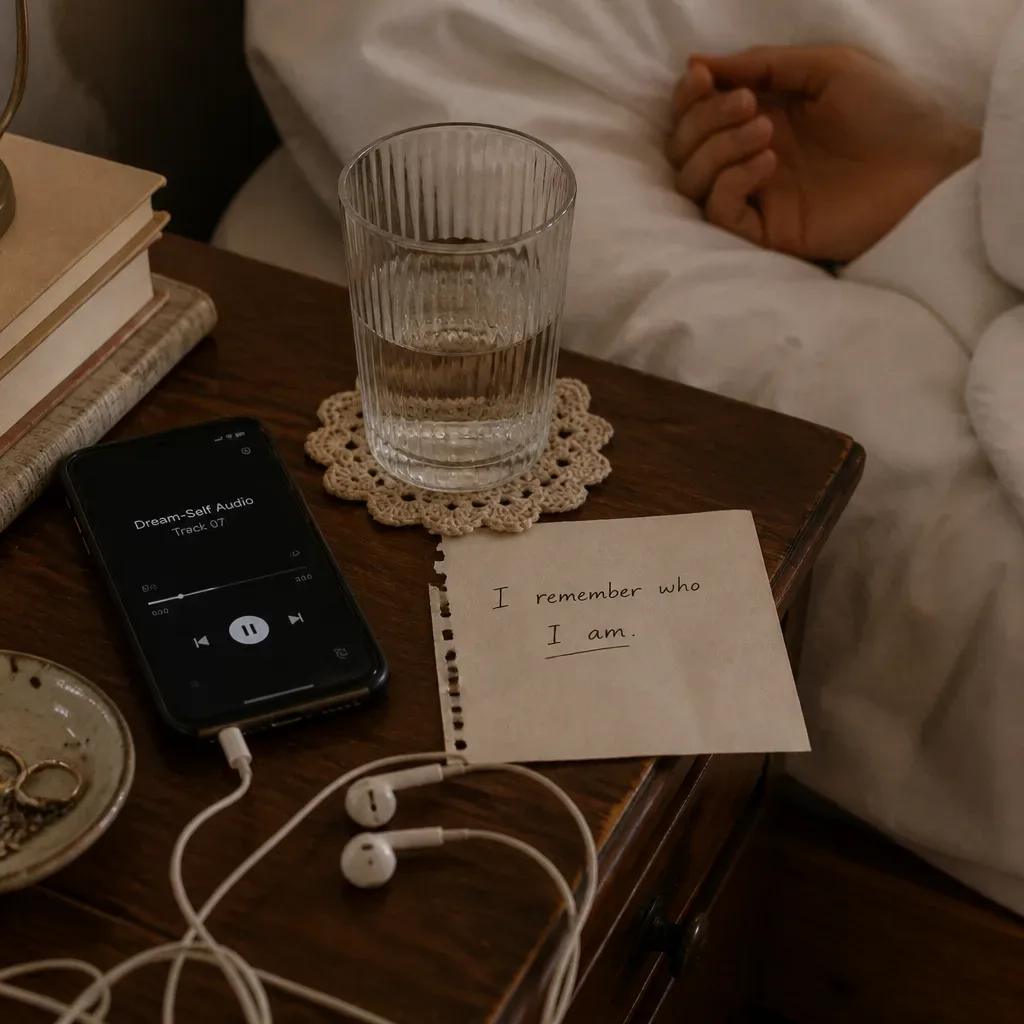
I do not stack a dozen affirmations on top of the audio. If I write one daily affirmation afterward, I treat it as a note in the margin, not the method itself. The Affirmations pillar is useful here because it explains why phrasing matters. A phrase that feels like a lie can create argument. A phrase that feels like rehearsal can create access.
My order is simple:
- Lie down and feel the weight of the body.
- Start the Dream-Self audio softly.
- Let one sentence from it become the session’s anchor.
- Count from 1 to 100, returning to the sentence every 10 numbers.
- Stop when the timer ends, even if nothing unusual happened.
Nothing unusual is not nothing. In the brain, familiarity is often built by unglamorous returns.
What should I say while counting?
I say fewer words than the internet taught me to say, because the mind settles better when it is not being crowded.
The classic Raven Method often places affirmations between numbers: “1, I am shifting. 2, I am in my desired reality.” I understand why. Repetition gives attention a track. But I prefer one sentence from my Dream-Self audio, spoken in first person and present tense, then enough quiet to feel it. Working memory is limited; Miller’s old “7 plus or minus 2” paper from 1956 has been revised by newer work, but the core point remains that the mind cannot hold endless material clearly.
Here is the table I use when people ask me what to say:
| If your mind does this | Try this sentence style | Why it helps |
|---|---|---|
| Argues with big claims | “I am practicing the self I intend.” | Reduces internal debate |
| Drifts into fantasy only | “I can feel my body and picture the scene.” | Keeps grounding present |
| Gets urgent | “There is no deadline in this count.” | Lowers pressure |
| Feels numb | “I notice one small detail.” | Uses sensory attention |
I also borrow caution from mental imagery research. Kosslyn and later cognitive neuroscience work showed that imagery and perception share some neural resources, but they are not identical. The popular line “the brain cannot tell imagination from reality” is false as stated. The better sentence is quieter: imagination can recruit perception-like systems enough to affect emotion, expectation, and behavior.
That distinction protects the practice. I can let the image matter without pretending the chair is not under me.
For readers who also use timing, moon phases, or symbolic dates, I would keep that as atmosphere, not authority. I have written about Astrology and manifestation with the same rule: symbols can focus attention, but they do not get to bully the nervous system.
How do I know when to stop or pause?
I stop when the body sends distress signals, when sleep is being harmed, or when the practice becomes compulsive.
This is the section I wish someone had taped to my wardrobe when I was younger. Absorption can feel meaningful. So can fear. The fact that something feels intense does not prove it is wise. In clinical screening, depersonalization and derealization are often described as feeling detached from the body, the world, or one’s own thoughts; transient moments are common, but repeated distress deserves care. Population studies have estimated depersonalization-derealization disorder around 1 to 2 percent, though brief symptoms are much more common.
I pause the Raven Method for at least 7 days if any of these happen:
- I feel unreal for more than a few minutes after stopping.
- I lose sleep two nights in a row because I keep trying.
- I feel afraid to return to ordinary tasks.
- I start checking forums for reassurance for more than 30 minutes a day.
- I believe I must complete the method perfectly or something bad will happen.
I am not being dramatic. I am being loyal to the body that has to live the next morning.
If I stop mid-session, I use a 5-4-3-2-1 grounding pattern: five things I see, four I feel, three I hear, two I smell, one I taste. Sensory grounding is common in trauma-informed care because it brings attention back to present-moment input. It is not magic. It is practical neurology.
Then I write one dated sentence. “Wednesday, 10:42 p.m., I stopped because my chest tightened.” The date matters. It turns a frightening blur into a recorded event with edges.
What does a full 25-minute safe session look like?
A full safe session is brief, timed, bodily grounded, and closed with ordinary orientation.
I did this last Thursday in the bedroom, after washing my face. The chair had laundry on it. The radiator made the old clicking sound. I mention this because reality shifting practices can become too smooth in description, while real practice happens beside socks and unpaid bills.
Here is the 25-minute version I give to friends who ask me for structure:
- Minute 0 to 2: Orient. Say the date, place, and time. Notice the surface under your body.
- Minute 2 to 5: Breathe slowly. Use three to six slow breaths. Do not chase perfect calm.
- Minute 5 to 9: Listen. Play one short Dream-Self Moment from the AYA Method, at low volume.
- Minute 9 to 19: Count. Count to 100. Every 10 numbers, repeat one chosen sentence.
- Minute 19 to 22: Picture one scene. Keep it simple: the kitchen, a desk, a morning walk, your hands doing the thing.
- Minute 22 to 25: Return. Open your eyes, name the room, drink water, write one sentence.
The scene should be specific, not cinematic. Research on implementation intentions by Peter Gollwitzer, developed across the 1990s and 2000s, suggests that concrete “if-then” planning can improve follow-through. I borrow that spirit. Instead of picturing a whole new life, I picture one behavior that belongs to the self I am rehearsing.
If my intended self is a calm researcher, I picture opening the document before checking messages. If my intended self is loved well, I picture answering honestly when someone asks how I am. The shift I trust most is the one that leaves evidence in Tuesday.
You can also place this beside the wider Manifestation pillar if you need a less charged frame. Name the life. Rehearse the self. Take the small action. Repeat.
What should I write afterward?
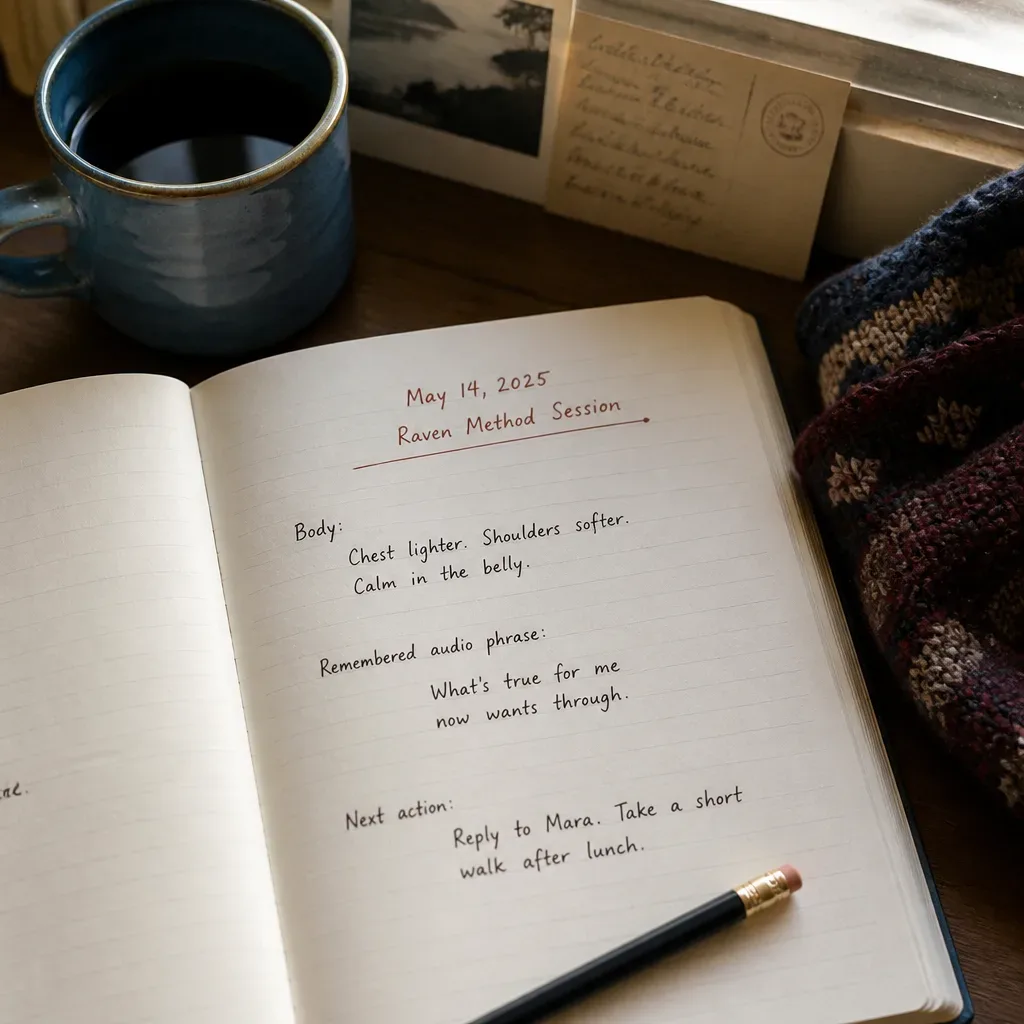
I write one dated observation, one body note, and one small next action.
The after-note is not decorative. It is how I keep the practice honest. Memory changes when we retrieve it; cognitive psychology has shown for decades that recall is reconstructive, not a perfect recording. If I do not write the ordinary details down, my mind may later inflate the session into either miracle or failure. Neither helps me practice tomorrow.
My page usually looks like this:
- Date and time: September 30, 9:14 p.m.
- Body: jaw tight at first, hands warm by 40.
- Audio line remembered: “I answer my life from steadiness.”
- Image: blue mug, morning desk, no phone.
- Next action: put phone outside bedroom tonight.
That is enough. I do not score the session. I do not ask whether I shifted “for real” every time, because that question can become a trapdoor. I ask a more useful question: did this repetition make the next right action easier by even 1 percent?
Behavior change often looks embarrassingly small while it is working. In Lally’s habit study, missing one opportunity did not erase progress, which is a relief I have written in the margin twice. The nervous system learns through return, not through perfect attendance.
I keep a Manifestation Board sometimes, mostly images of rooms and worktables, but I do not make it carry the practice. The audio carries the practice. The board is a quiet thing on the side, like a postcard tucked into a book.
Tonight, I would rather have one true sentence than ten dramatic ones.
The kettle is empty now, and I am still here.