reality shifting
Shifting Script Template to Future-Self Audio
Use this shifting script template to write a grounded future-self script, record it as daily audio, and keep the practice small enough to repeat.
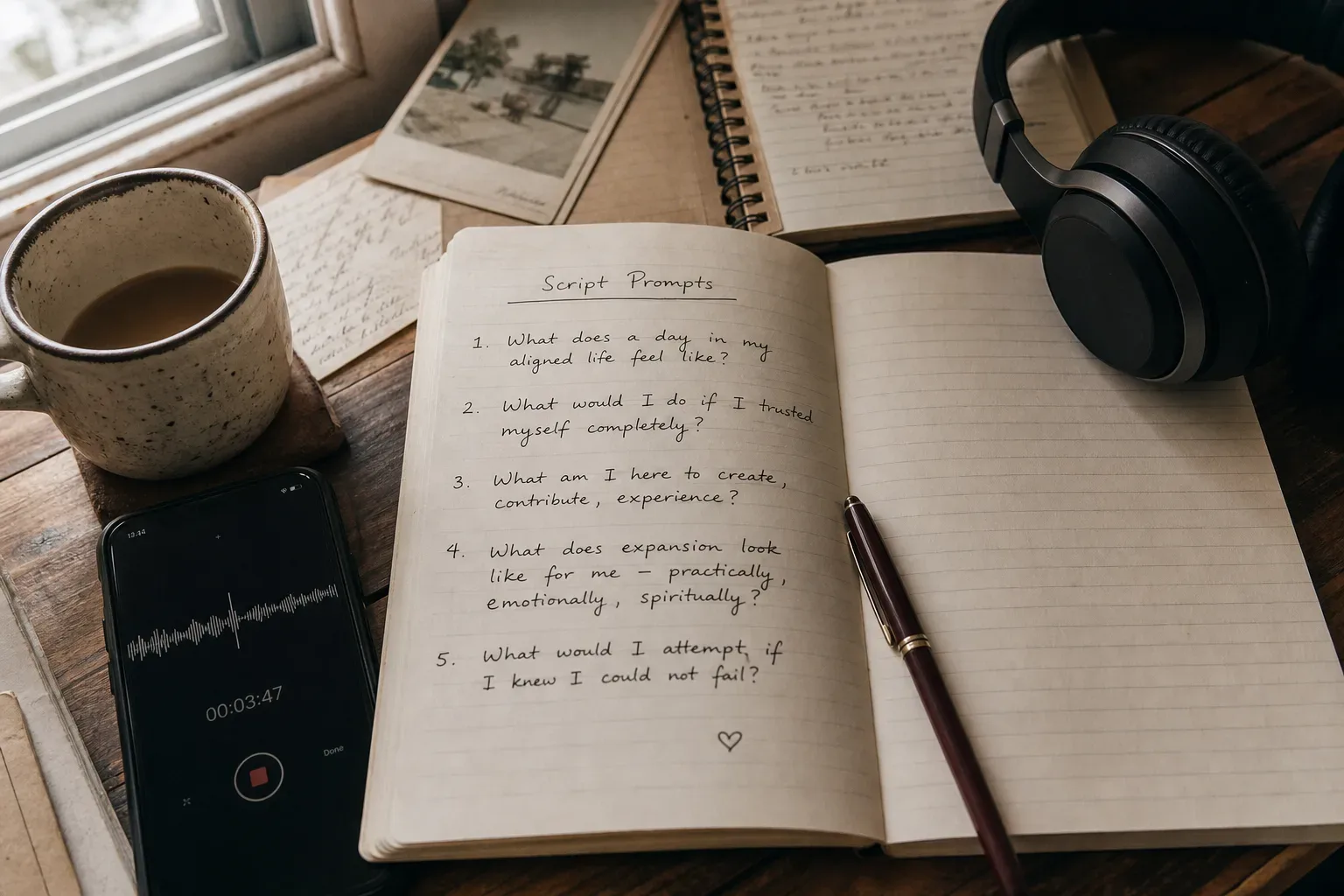
Saturday. The kettle clicked off before my notebook was open. A shifting script template becomes useful when I stop treating it as a perfect document and turn it into short future-self audio: one reality frame, clear identity lines, sensory proof, and a daily listening cue I can repeat without negotiation.
What should a shifting script template actually do?
A shifting script template should help me describe a desired reality clearly enough that I can rehearse it daily, not bury myself in decorative detail.
I write that down because I have seen templates grow like weeds. Hair color, bedroom shape, city name, weather, friends, meals, entire histories. Some of that can be tender and useful. Some of it is avoidance in a nice pen. When I worked on a habit-tracking app used by about 14,000 people, the pattern was plain: people did not fail because their plan lacked beauty. They failed because the first action was too large to repeat on an ordinary Tuesday.
I use a shifting script template as a compression tool. It takes a wide desire and turns it into a small daily signal. That makes it closer to identity-based habit change than fantasy writing. In Lally and colleagues’ 2009 habit formation study in the European Journal of Social Psychology, automaticity developed over a median of 66 days, with wide variation. That number matters to me because it lowers the temperature. I do not need a perfect script tonight. I need a script I can hear for 66 ordinary mornings if needed.
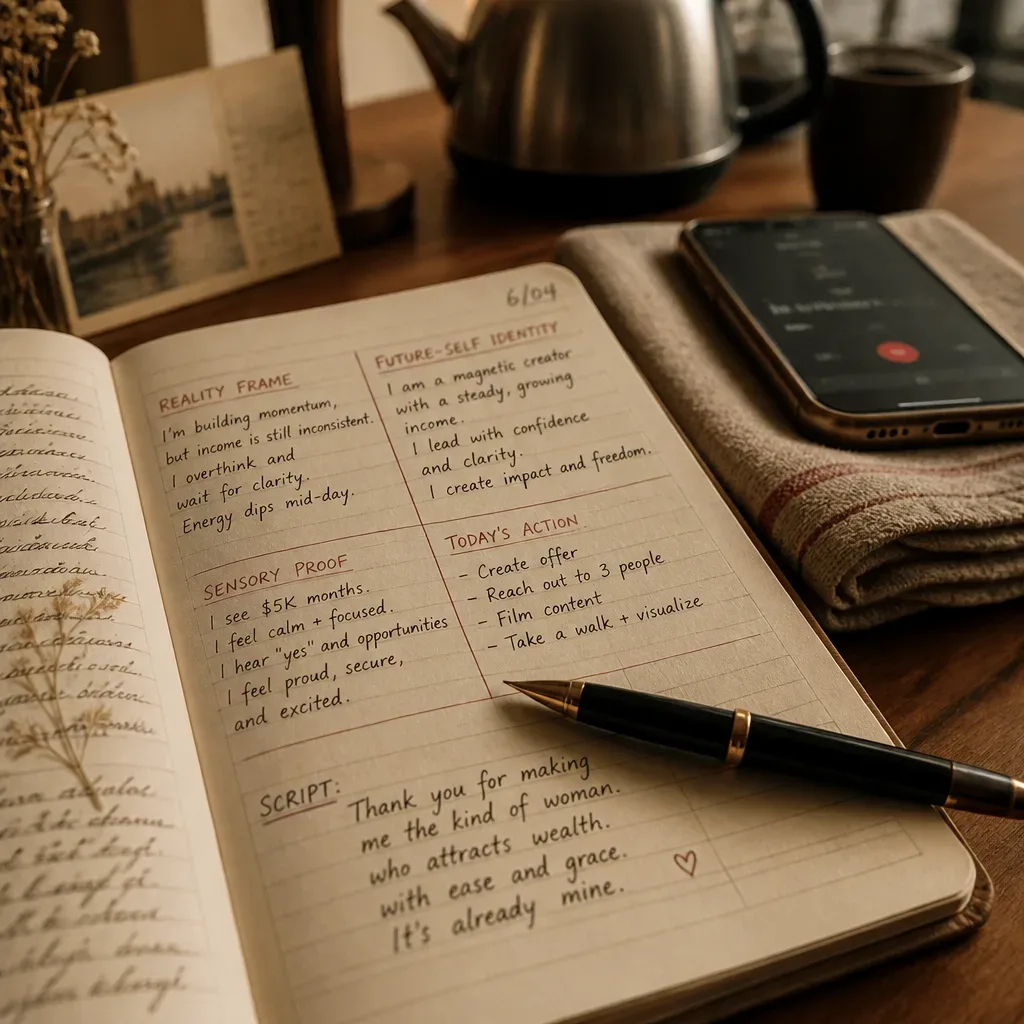
Here is the table I keep taped inside my notebook:
| Template part | What I write | What I remove |
|---|---|---|
| Reality frame | One sentence naming the life I am rehearsing | Multiple competing timelines |
| Future-self identity | How I act, choose, and speak now | Vague labels like perfect or chosen |
| Sensory proof | Rooms, sounds, textures, time of day | Cinematic scenes I cannot feel |
| Daily evidence | One behavior that would prove it today | Outcomes I cannot control by noon |
| Audio line | A sentence I can listen to calmly | Anything I would cringe at hearing daily |
A script is not stronger because it is longer. A script is stronger when it survives the morning.
How do I choose the right reality frame?
I choose the right reality frame by writing one plain sentence that names the life I want to rehearse and excludes the lives I am not practicing today.
This morning mine was small: I am the kind of person who finishes the work before checking the room for approval. Not dramatic. Not pretty. Useful. Reality shifting communities sometimes call this the DR, the desired reality. I keep the term if it helps, but I make the sentence behaviorally specific. If the sentence cannot shape my next 24 hours, I rewrite it.
Peter Gollwitzer’s work on implementation intentions is useful here. A 2006 meta-analysis by Gollwitzer and Sheeran reviewed 94 independent studies and found that if-then planning had a medium-to-large effect on goal achievement. I read that as a warning against fog. If my reality frame cannot produce an if-then line, it is probably still a mood, not a practice.
I ask three questions before I keep the frame:
- What would I do differently before 10 a.m.?
- What would I stop rehearsing in my head?
- What would someone close to me notice after seven days?
The third question has saved me from grand scripts. My mother would not notice that I had become magnetic, to use a word I try not to use. She would notice that I returned the call when I said I would. She would notice that my voice was less defensive. She would notice the kitchen counter cleared before bed.
I also keep one soft boundary with Astrology and manifestation. Timing symbols can give me a date to begin, but they do not get to replace the practice. A moon note in the margin is fine. The audio still has to be played.
What goes into the future-self section?
The future-self section should describe the version of me who already lives the desired pattern, using specific present-tense actions and ordinary evidence.
I do not write, I am confident. I write, I answer the message without drafting it nine times. I do not write, I am loved. I write, I let my friend see the unfinished draft. Future-self writing works better for me when it has sleeves rolled up. The body believes small proof faster than slogans.
There is research behind that feeling. Self-affirmation theory, first formalized by Claude Steele in 1988, suggests people can handle threat better when they remember a valued identity. Later studies have found mixed effects depending on context, but the mechanism still matters: identity cues can change what feels available under pressure. The Affirmations pillar explains the difference between a sentence that steadies me and a sentence that tries to argue with my nervous system.
I write the future-self section in five parts:
- How I wake up
- How I choose when nobody is watching
- How I speak to people I love
- How I handle delay
- What small proof I leave behind today
The delay line is important. A shifting script template that only describes the easy scene will abandon me at the first inconvenience. I want the audio to know me on the bus, late, irritated, holding coffee in one hand and my phone in the other. In my own practice with the AYA Method, this is why the Dream-Self Moment is audio, not a poster. The AYA Method is a daily audio manifestation practice. Each day you listen to a short personalized recording, your Dream-Self Moment, narrated from the version of you who has already manifested the life you intend. Listening is the practice. Repetition is the work. The audio is the method.
The line I kept today was this: I do not wait to feel different before I act different in one small place.
How do I make the script sound natural out loud?
I make the script sound natural by rewriting every sentence for the ear, cutting abstractions, and leaving enough silence for my body to answer.
Reading voice and listening voice are not the same. On the page I tolerate long sentences because my eyes can go back. In audio, the sentence either lands or passes. Dr. Andrew Huberman has often discussed how repetition and attention shape nervous system learning, and while that is a broad summary rather than a single prescription, it matches what I notice: the line I can hear clearly is the line I remember at 3 p.m.
I use this simple conversion:
| Page sentence | Audio sentence |
|---|---|
| I exist in my desired reality where I am disciplined, loved, protected, and successful. | I wake up and keep the first promise. |
| Everyone sees me as my best self and responds with respect. | I speak slowly. I do not chase approval. |
| I always know what to do and everything works out for me. | When I do not know, I take the next honest step. |
The spoken version is plainer. That is the point. A sentence does not need to sparkle to change my morning. It needs to be available when my brain is still half asleep.
I read the script out loud once before recording and mark every place where I run out of breath. That is usually where I have tried to fit three desires into one line. Then I cut. For a two-to-five-minute recording, I aim for 280 to 650 spoken words. Most conversational speech sits near 130 to 160 words per minute, though voice and pauses change the number. My own audio is slower because morning Joon does not like being rushed.
I also remove commands that sound like a coach shouting from another room. I prefer witness language: I notice, I choose, I return, I keep. Pressure creates resistance. Recognition creates room.
How do I record future-self audio without making it theatrical?
I record future-self audio by using a quiet room, a normal voice, short paragraphs, and one take that sounds like someone I would trust before breakfast.
My first recording was too polished. I lowered my voice as if I were narrating a documentary about discipline. I deleted it after 40 seconds. The better version was recorded in the kitchen, standing near the sink, with the refrigerator making its small electric sound. I could hear myself swallow once. It stayed.
The technical setup does not need much. A phone microphone is enough for most people. Apple and Android voice memo apps record at quality far beyond what a two-minute practice requires. In audio production, distance matters more than gear at this level. I hold the phone about 15 to 20 centimeters from my mouth, turn slightly away from hard plosive sounds, and leave two seconds of silence at the start so the file does not feel abrupt.
Here is my recording order:
- Put the phone on a folded towel.
- Read the reality frame once.
- Pause for one breath.
- Read the future-self lines slowly.
- Add three sensory proof lines.
- End with one action for today.
- Save the file with the date.
I do not add music unless silence makes the practice harder. In small studies on music and mood regulation, people often use music to shift emotional state, but lyrics and strong dynamics can compete with spoken words. For this practice, clarity wins.
If I use a daily affirmation afterward, I treat it as a small complement, not the structure. Same with a Manifestation Board. The board may remind me. The audio does the daily work.
When should I listen so the habit sticks?
I listen at the same point in an existing routine because a stable cue makes the practice easier to repeat than motivation does.
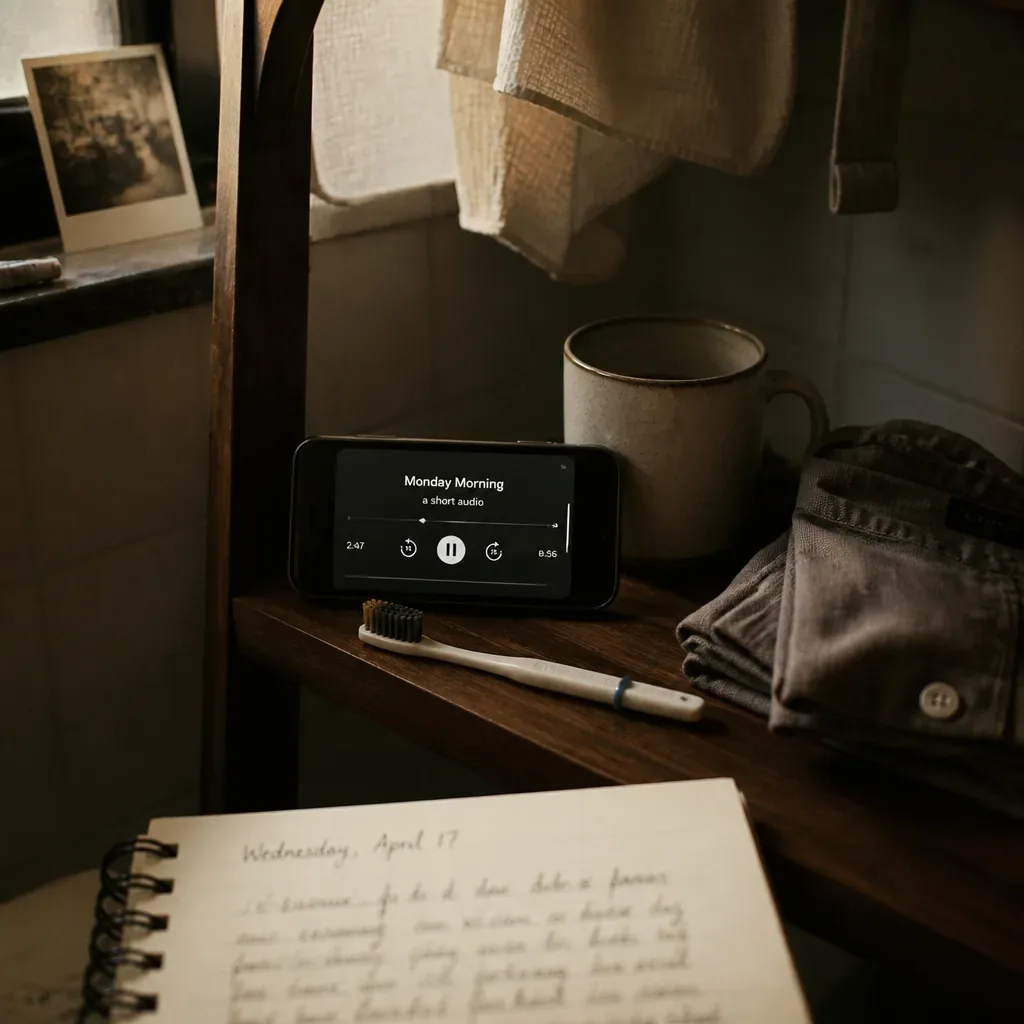
For me it is after brushing my teeth and before coffee. That order is not sacred. It is just reliable. In Wendy Wood’s habit research, repeated behavior in stable contexts is central; one often-cited estimate from Wood, Quinn, and Kashy in 2002 found that about 43 percent of daily actions were performed habitually in familiar contexts. I think about that when I place the audio. I want the habit to borrow a track that already exists.
A good cue has three qualities:
- It already happens at least five days a week.
- It happens in roughly the same place.
- It leaves two to five minutes open without negotiation.
Bad cues are romantic. Good cues are boring. I have tried lighting candles at night. I lasted four days. I have tried listening in the bath. Lovely, but inconsistent. Toothbrush, kettle, train platform, chair by the window: those survive travel better.
This is where Manifestation pillar helps me stay honest. Manifestation, when I practice it, is not a mood I enter once. It is a pattern I rehearse until it becomes easier to choose. The shifting script template gives the content. The cue gives the container.
I keep the audio file on the first screen of my phone. Not in a folder. Not under a clever name. If tomorrow-me has to search, today-me has overdesigned. Habit design is often an act of mercy toward the tired version of yourself.
How do I revise the shifting script template after a week?
I revise after seven listens by changing only the lines that feel false, vague, or too heavy to repeat.
Seven is not magic. It is just enough data. In my old habit app, people would often redesign a habit after one failed day, then redesign again after the redesign failed. That made the system noisy. A week gives me a small sample: weekdays, one tired day, maybe one good day, perhaps one morning when the kettle takes too long and I am less noble than I hoped.
I use a three-column review on day seven:
| Keep | Cut | Rewrite |
|---|---|---|
| Lines I remembered without trying | Lines that made me tense | Lines that were true but too broad |
| Sensory details that felt real | Decorative details | Any sentence with always or never |
| One action that changed my day | Outcomes I cannot control | Proof I can create by tonight |
The always and never rule matters. In cognitive behavioral work, absolute language is often treated as a thinking pattern worth questioning because it can make one exception feel like total failure. I am not doing therapy in my notebook, but I borrow the caution. If my audio says I always trust myself, one anxious morning becomes evidence against the whole script. If it says I return to myself after doubt, the anxious morning is included.
Reality shifting writing can become a place to leave the body. I try to make it a place to return to the body. Chair. Breath. Mug. Message sent. Draft opened. The ordinary proof is not less spiritual because it is ordinary. The ordinary proof is where the practice can find me.
If I want a broader frame, I reread the Manifestation pillar and then come back to the file. The audio is still only two to five minutes. That limit protects me.
What is the full shifting script template I can copy?
The full template is a short set of prompts that moves from desired reality to future-self audio without letting the page become the whole practice.
I copied this into my notebook today. It is plain on purpose.
Shifting script template for future-self audio
- Reality frame: The reality I am rehearsing is: ____.
- Why this matters now: I am choosing this because: ____.
- Future-self identity: In this reality, I am someone who: ____.
- Morning proof: Before noon, I show this by: ____.
- Relationship proof: With other people, I practice: ____.
- Delay proof: When I have to wait, I: ____.
- Sensory anchor: I can see, hear, or feel: ____.
- One sentence for today: Today I keep: ____.
- Closing line: I return to this version of me by: ____.
Then I turn it into audio like this:
I am rehearsing the life where I keep the first promise. I know why this matters. It changes the way I speak to myself before the day gets loud. This morning I open the draft before I check for approval. I answer slowly. I let delay be delay, not a verdict. I feel the cup in my hand. I hear the kettle. Today I keep one small promise and let it count.
That sample is 73 words. At a slow pace, it takes less than 40 seconds. Add your specific details and you have a two-minute file quickly. If you want the practice to sit inside a fuller audio structure, the AYA Method is the place I would start because the Dream-Self Moment already treats listening as the method, not decoration.
The final test is simple. Would I listen to this on a gray morning when I do not feel special? If yes, I keep it. If no, I make it kinder and shorter.
Saturday night. The audio is queued for the morning.