manifestation for life areas
Manifest Job Offer After Rejection With Audio
Manifest job offer after rejection with a future-self audio practice that steadies your nervous system, refines action, and keeps you applying.

Tuesday. The rejection email was still open when the kettle clicked off. To manifest job offer results after a no, I use future-self audio to steady my self-talk, then I take one concrete career action. The audio does not replace applications, interviews, or follow-up. It helps me return to them without shrinking.
What do I do first after the rejection lands?
I name the rejection as an event, not a prophecy.
This is the first thing because the brain is quick with verdicts. One email becomes, “I am not chosen.” One silence becomes, “It is over.” In cognitive neuroscience, we would call this meaning-making, not evidence. The message says they are not moving forward with this application. It does not say what will happen across the next 10 applications, 3 referrals, or 2 interviews.
I learned to write the plain sentence first. “They did not offer me the role.” Not, “I ruined my chance.” Not, “Nobody wants me.” The plain sentence leaves the door open. The inflated sentence closes it before the next person has even read my CV.
Rejection also has a body. The American Psychological Association has written for years about social pain using overlapping neural systems with physical pain, especially in work building from Naomi Eisenberger’s social rejection research. I do not need to make that dramatic. I just need to respect it. My chest tightens. My face gets hot. My fingers want to send three messages too quickly.
So I wait 20 minutes before doing anything important. I drink water. I stand by the sink. I let the first wave move through. A rejected application is information, but the first five minutes after reading it are usually not wisdom.
I keep a small note on the page:
- What happened: the company declined.
- What I still want: a fitting job offer.
- What I can do today: one clean next step.
- What I will not do: turn one decision into my identity.
A no can be real without being final. That sentence has saved me more than one afternoon.
How can future-self audio help me recover my direction?
Future-self audio helps by giving my attention a repeated, believable place to land.
When I use the AYA Method, I treat it as a daily audio manifestation practice. Each day, I listen to a short personalized recording, my Dream-Self Moment, narrated from the version of me who has already manifested the life I intend. Listening is the practice. Repetition is the work. The audio is the method.
After rejection, the mind rehearses the wrong scene without being asked. It replays the interview answer I disliked. It rereads the email. It invents the hiring panel in a room, all of them disappointed. A future-self audio is not magic against that. It is a counter-rehearsal. It gives the brain another script, and in my field, scripts matter.
Self-referential processing research often points to the medial prefrontal cortex, a region involved when people think about themselves. A 2016 review in Trends in Cognitive Sciences discussed how self-related information tends to be remembered and prioritized. That is why generic motivation can feel thin, while a sentence that sounds like your own future life can catch.
I keep the audio short, usually 3 to 7 minutes. Long enough to enter the scene. Short enough to repeat every morning. Dr. Andrew Huberman often talks about state and repetition when discussing learning and behavior, and while not every podcast sentence is a clinical protocol, the basic principle is well supported: repeated cues paired with action can shape what becomes easier to do.
Here is the distinction I keep taped to the inside of my head: the audio does not make the employer choose me. The audio helps me remain someone who keeps choosing clean action.
I also keep the broader manifestation practice close, but I make it less misty than people sometimes do. I name the desired outcome. I rehearse the identity. I behave in ways that make the outcome more likely. That is enough work for one morning.
What should my job offer audio actually say?
The audio should sound like a dated memory from the future, not a demand shouted at the present.
I write it in first person because my brain believes my own voice more readily than a slogan. I include sensory details because vague wanting is hard to repeat. I include action because a job offer usually comes through a chain of visible behaviors: applying, asking, practicing, following up, resting, trying again.
A simple structure helps:
- Start with the future moment. “It is Friday morning, and I am reading the offer email at the kitchen table.”
- Name the role clearly. “The work uses my research skills and pays enough for me to breathe.”
- Mention the rejection honestly. “I remember the no that came before this, and I did not let it name me.”
- Describe the steady actions. “I revised my examples, asked for one referral, and applied again.”
- Close with the body. “My shoulders are lower. My hands are calm. I can receive this.”
Specificity matters. A Glassdoor report from 2015 often cited that an average corporate job opening attracted about 250 resumes, though applicant pools vary widely by field and year. Even if the number is imperfect now, the point holds: hiring is noisy. A rejection can reflect competition, timing, salary range, internal movement, or a person on the panel preferring one narrow example.
I do not put revenge in the audio. I do not say, “They regret rejecting me.” That keeps me tied to the old room. I want the next door, not a courtroom in my head.
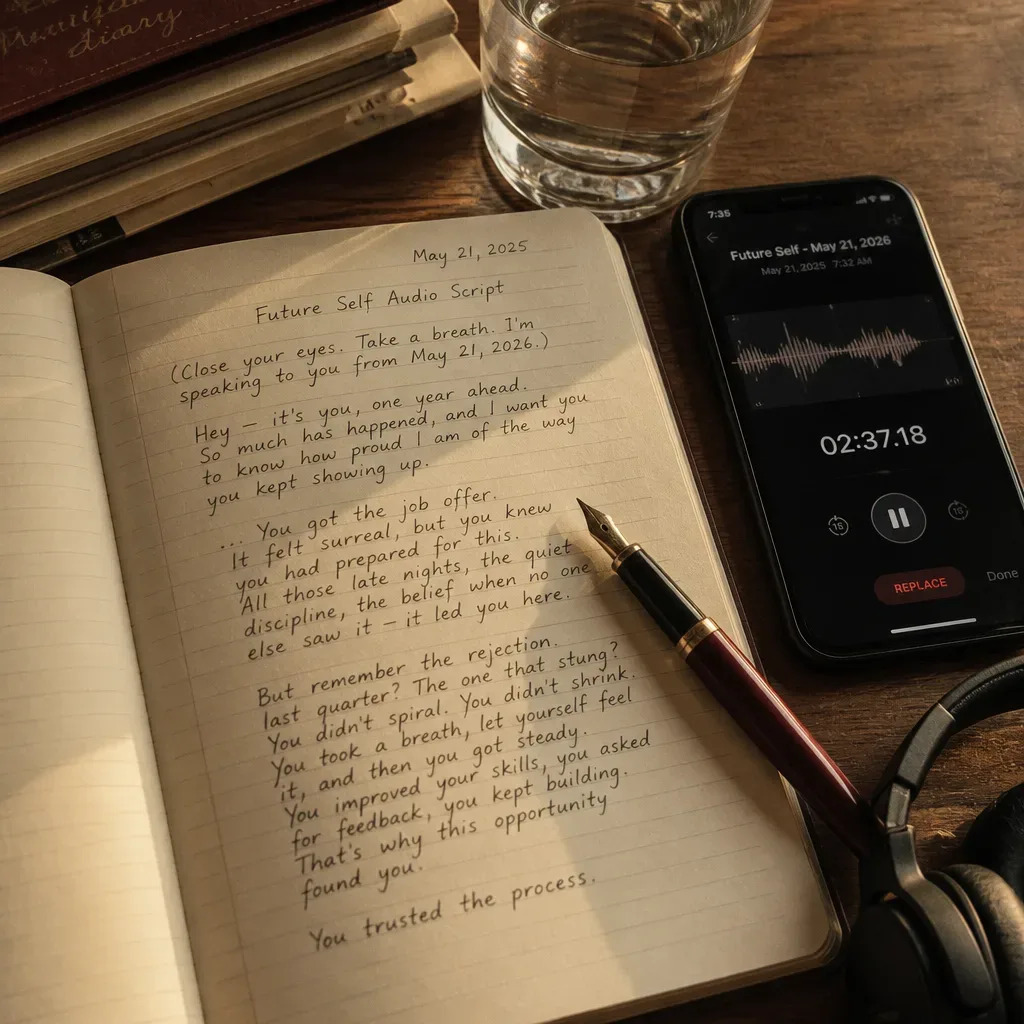
Sometimes I add one daily affirmation, especially if I am fragile: “I can be disappointed and still be available for good work.” For more on how I keep those lines from becoming brittle, I return to the affirmations guide. But I do not let the affirmation become the whole practice. The daily listening holds the shape.
A useful future-self audio is not louder than fear. It is more repeatable than fear.
How do I pair the audio with real job-search action?
I pair the audio with one small action immediately afterward so the practice has a behavioral landing place.
This is where I am strict with myself. If I listen and then scroll for 40 minutes, the audio becomes comfort only. Comfort is allowed, but the job offer needs contact with the world. Peter Gollwitzer’s work on implementation intentions, often summarized as “if-then” planning, has shown across dozens of studies that specific cues improve follow-through. In one widely cited 2006 meta-analysis with Paschal Sheeran, implementation intentions had a medium-to-large effect on goal achievement.
My rule is simple: after the audio, I do one thing that takes 5 to 25 minutes. Not a whole career overhaul. One thing.
| After listening, if I feel… | I do this next | Time |
|---|---|---|
| embarrassed | revise one interview answer | 10 minutes |
| angry | walk before sending any email | 15 minutes |
| tired | save one suitable role | 5 minutes |
| hopeful | send one tailored application | 25 minutes |
| unsure | ask one person for feedback | 10 minutes |
The table keeps me honest. It stops the feeling from becoming the manager of the day.
Mental contrasting research from Gabriele Oettingen also matters here. Her WOOP method asks people to name a wish, outcome, obstacle, and plan. Studies across school, health, and work contexts suggest that pairing a desired future with the real obstacle can improve action more than positive fantasy alone. I use the same spirit. I hear the future. Then I look at the obstacle in my calendar.
Some days the action is a follow-up note. Mine is short:
“Thank you for letting me know. I appreciated learning more about the role and the team. If another position opens that fits my background in X, I would be glad to be considered. If you are able to share one piece of feedback, I would be grateful.”
That is all. No pleading. No performance. No hidden accusation.
I have also noticed that astrology and manifestation can be a tender language for timing, especially when someone is trying not to force a decision. I use it lightly. I do not let a transit decide whether I send the application. The calendar can be symbolic. The email still needs to be written.
How long should I keep listening before I change the script?
I keep the same audio for 14 days before changing it, unless it starts making me avoid reality.
Two weeks is long enough to notice patterns and short enough that I do not get precious about the script. Habit formation research by Phillippa Lally and colleagues, published in 2010 in the European Journal of Social Psychology, found that automaticity took a median of 66 days, with wide variation from 18 to 254 days. I am not trying to become automatic in 14 days. I am trying to become less chaotic.
I listen at the same time each morning, usually before brushing my teeth. That order helps because it attaches the audio to an existing routine. In behavior science, cueing a new behavior to a stable one is a plain, useful trick. No candle required, though I have used one in November because the mornings were dark by 7:30.
I track four numbers on paper:
- Days listened.
- Applications sent.
- Conversations started.
- Interviews or replies received.
The numbers keep the practice from floating away. If I listened for 14 days and took no action, the issue is not the audio’s wording. The issue is avoidance. If I listened for 14 days, applied to 9 roles, asked for 2 referrals, and got 1 reply, that is a different picture.
I also track softer evidence, but I date it. “Wednesday: I answered the salary question without apologizing.” “Friday: I did not reread the rejection email.” These things count, especially after a no. A person who stops apologizing in interviews is not the same applicant they were 10 days ago.
I change the script when the next level of truth arrives. At first, it may need to say, “I survived the rejection.” Later it can say, “I am prepared for the interview.” Later still, “I am reading the offer and asking clear questions before I sign.”
The future self should grow as the present self gathers evidence.
What if I still feel rejected while I am listening?
Feeling rejected during the audio does not mean the practice is failing.
I used to think the goal was to feel certain. It isn’t. Certainty is too expensive after a fresh no. The more honest goal is to stay in contact with the desired future while the body is still tender. That is a skill, and like most skills, it arrives unevenly.
There is decent evidence that self-affirmation can reduce defensive responses under threat. Claude Steele’s self-affirmation theory dates back to the 1980s, and later reviews, including work by Geoffrey Cohen and David Sherman, describe how reflecting on valued aspects of the self can help people stay open to information. I read that as permission to be kind and accurate at the same time.
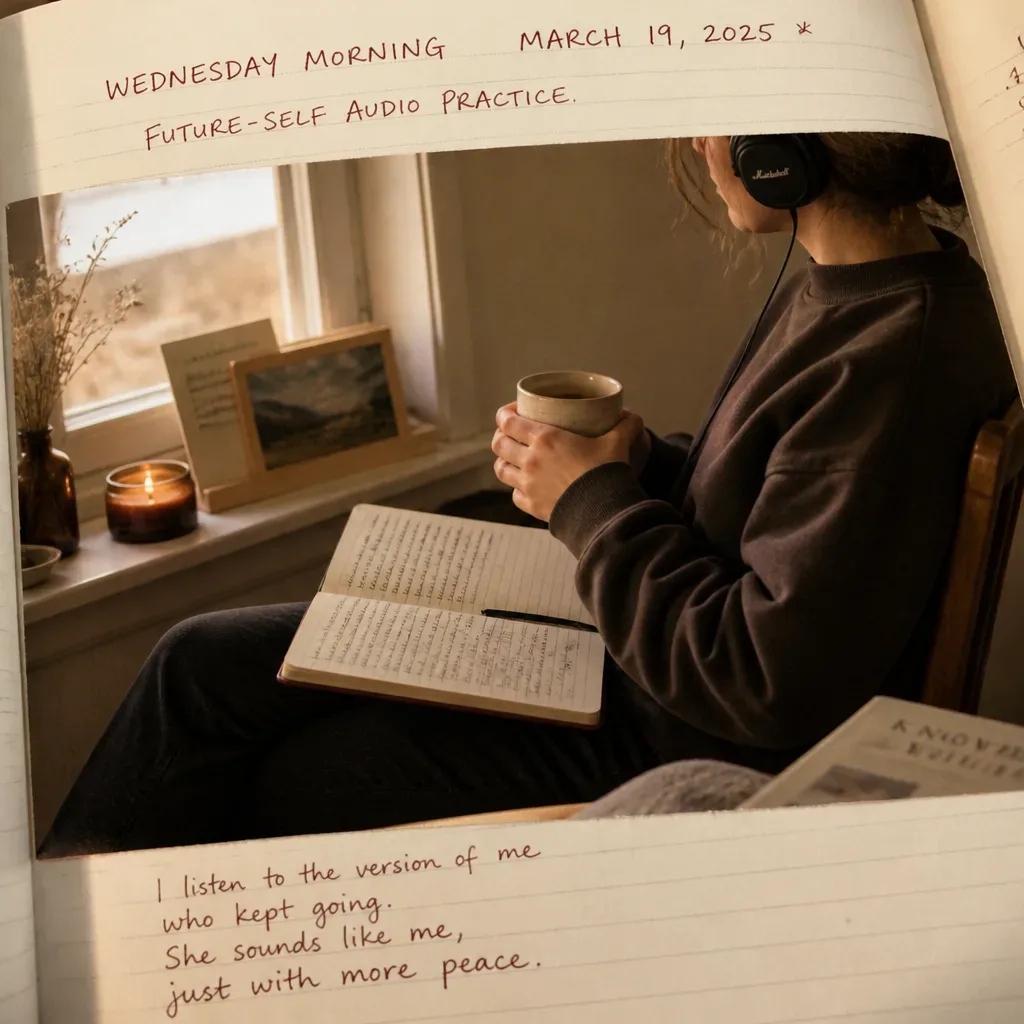
If I cry while listening, I let that be part of the morning. If I feel cynical, I lower the script’s intensity. I might change “I know the offer is mine” to “I am becoming someone who can receive the right offer and keep applying until it arrives.” That sentence is less glamorous. It is also easier to believe at 8:10 a.m. with swollen eyes.
I do not use the audio to deny the job market. In 2024 and 2025, many sectors had slower hiring cycles, longer interview loops, and more automated screening. LinkedIn and other labor-market reports have noted that applicants often submit far more roles than they did a decade ago, partly because online applications are easier to send and easier to ignore. That context matters. Your nervous system may be reacting to a genuinely draining process.
When the feeling is sharp, I add a grounding sequence before pressing play:
- Name 5 things I can see.
- Put both feet on the floor.
- Exhale longer than I inhale for 6 breaths.
- Touch the chair, the cup, the page.
- Then listen.
A practice does not have to erase pain to be useful. Sometimes it is useful because it gives pain a chair and does not let it drive.
How will I know the practice is working?
I know it is working when my behavior changes before my circumstances do.
This is the part I wish someone had told me younger. The first sign is rarely the offer email. The first sign is that I send the next application without making it a referendum on my life. The first sign is that I prepare 3 examples for the interview instead of hoping charm will carry me. The first sign is that I ask about compensation without whispering.
I use a simple review after 14 days:
| Question | Good sign | Needs care |
|---|---|---|
| Did I listen most days? | 10 or more days | 5 or fewer days |
| Did I act after listening? | one step most days | mostly scrolling |
| Did my self-talk shift? | more specific, less cruel | same verdict language |
| Did I learn from rejection? | clearer examples | avoiding feedback |
| Did I stay open? | applying again | waiting only |
Specific numbers help me not lie to myself. If I sent 12 better applications, had 2 calls, and felt 20 percent less panicked, something is moving even if the offer has not arrived. If I sent nothing and only listened, I need a smaller next step, not a bigger fantasy.
I also compare the practice with the wider frame of manifestation. The word can get heavy with claims. I use it lightly and practically: attention, identity, repetition, action, response. The world answers through people, systems, budgets, timing, and chance. I do not control all of that. I do control whether rejection makes me disappear.
The final offer may come from a place I did not expect. A recruiter may return after another candidate declines. A friend may forward a role. A second-choice company may fit better than the first. Princeton Engineering Anomalies Research, often called PEAR, studied mind-matter questions for decades, but even sympathetic readers debate what those findings mean. I do not build my job search on contested effects. I build it on repeated attention and repeated action.
That is enough mystery for me. A future-self audio keeps the door in view while my hands do today’s work.
Tuesday night. I washed the blue mug and left tomorrow’s page open.