aya method deep dive
Manifest Multiple Things With One Dream-Self Audio
Learn how to manifest multiple things with one Dream-Self audio by grouping desires under one future identity, then listening daily.

Wednesday. I made coffee before the kettle finished its complaint. To manifest multiple things with one Dream-Self audio, I group the desires under one future identity, not separate wishes. The recording should narrate a lived pattern. Listening daily helps attention, emotion, and behavior rehearse the same direction.
Can one Dream-Self audio hold more than one desire?
Yes, one audio can hold several desires when they belong to the same future self.
This morning I listened in the kitchen, standing because the chair had laundry on it. My audio names work, health, and love in the same breath, but not like a spreadsheet. It sounds like a day. I hear myself leaving the laptop at 6:10, walking without checking my phone, answering a message from someone kind, and noticing that my bank app no longer feels like a small threat. Four things, one person.
That distinction matters. Miller’s often-cited 1956 paper on working memory suggested people hold about 7 items, plus or minus 2, though later research puts practical working memory closer to 4 chunks. I take that seriously. If the audio contains 12 unrelated desires, my attention starts doing venture-style diligence on the script. It begins asking what belongs, what is fantasy, what is filler.
The core of the AYA Method is simple enough to survive a bad Tuesday: it is a daily audio manifestation practice. Each day I listen to a short personalized recording, my Dream-Self Moment, narrated from the version of me who has already manifested the life I intend. Listening is the practice. Repetition is the work. The audio is the method.
A single audio is not a container for wanting more. It is a container for becoming more specific. Neville Goddard wrote often about assuming the state of the wish fulfilled, and even if someone reads him symbolically rather than literally, the practical instruction is clean: enter the state, not the inventory. A state can include more than one visible result because a life always does.
A scattered list asks life to deliver objects. A clear identity teaches the day what to repeat.
How do I choose what belongs in one audio?
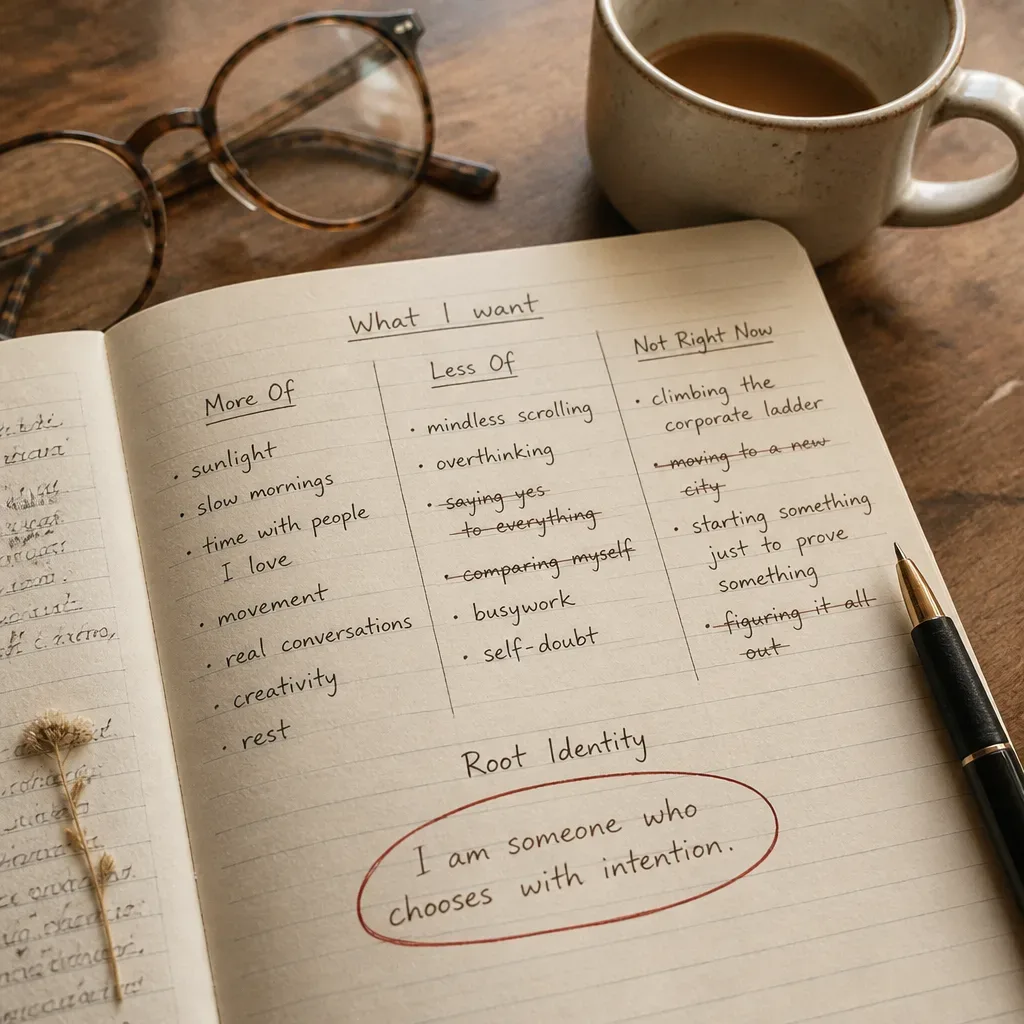
I choose desires that share a root identity, then I leave the rest for another season.
I learned this by making one ugly draft. It had a better apartment, a stronger body, calmer parents, a paid speaking offer, lower taxes, and better sleep. By the end I sounded like a founder adding every requested feature before a seed round. Nothing was wrong with any single desire. Together, they had no center.
I use a three-part filter now. It takes ten minutes on paper, which is less time than I used to spend comparing meditation apps. Research on implementation intentions by Peter Gollwitzer, including a 2006 meta-analysis with 94 studies, found that specific if-then plans reliably help people act on goals. I am borrowing the spirit of that: make the desire specific enough that the day can recognize it.
- Same identity: Do these desires point to one kind of person I am practicing being?
- Same emotional tone: Do they create a similar feeling in my body, such as steadiness, ease, devotion, courage, or creative focus?
- Same daily evidence: Would I see proof of them in the same ordinary day?
Here is the table I keep in my notebook, dated because dates stop me from pretending I always knew what I meant.
| Desire | Root identity | Keep in one audio? |
|---|---|---|
| Paid writing work | Creatively paid and respected | Yes |
| Stronger body | Person who keeps promises to his body | Yes, if the audio is about steadiness |
| New relationship | Available and calmly chosen | Yes, if love belongs to the same future self |
| Viral attention | Approval-hungry and noisy | No |
| Revenge success | Still negotiating with the past | No |
The Manifestation pillar makes a useful distinction between wishing and practicing attention. I need that distinction most when I want to add one more thing. More is not always honest. Sometimes more is fear wearing a nice coat.
How do I write the audio so it does not become a shopping list?
I write the audio as an ordinary scene where the desires are already integrated.
The sentence I avoid is: I have this, this, this, and this. It sounds efficient, but it does not give my body much to inhabit. Joe Dispenza often talks about rehearsing an emotional future before it is visible. I am cautious around big claims, but that part tracks with basic psychology: mental rehearsal works best when it includes sensory and emotional detail, not only outcome labels.
I start with the room. Yesterday it was the kitchen again, because apparently my future self also owns plates. Then I add time, posture, and one small choice. Specificity is not decoration. In a 2018 review in Psychological Bulletin, goal progress was more likely when people received clear feedback and had concrete targets. The audio needs targets my day can notice.
I use this structure when I write:
- One opening identity line: I am the person who lives steadily inside the life I asked for.
- Three to five integrated proofs: The body, the work, the relationship, the money, the home, or the creative life show up as ordinary facts.
- One emotional texture: Calm, chosen, clean, brave, rested, devoted.
- One behavior I can do today: Send the email, take the walk, cook the meal, close the laptop, answer honestly.
- One closing line that sounds like me: No grand speech. No borrowed vocabulary.
A good Dream-Self audio does not flatter me. It gives me a place to stand. I want the script to sound like someone who has paid rent, slept enough, and stopped auditioning for his own life.
The Affirmations pillar is helpful here because a daily affirmation can sharpen one line from the audio. But I do not treat the affirmation as the main practice. For me, it is a note in the margin. The listening is where the repetition lands.
What should I listen for each day after the audio is made?
I listen for the smallest behavior that matches the future self in the recording.
This is where I think many manifestation practices lose people. They build a beautiful recording, listen twice, then wait for lightning. My test is less romantic. Did the audio change one choice before lunch? Did I answer the message without spiraling? Did I go to bed at 10:40 instead of proving a point to the internet?
Behavioral scientists at Duke University published a 2006 paper suggesting that more than 40 percent of daily actions may be habits rather than fresh decisions. The exact percentage gets repeated too casually online, but the principle holds: a life is built from repeated cues and responses. If the audio is going to matter, it has to meet habit, not mood.
I attach listening to one cue. For me it is coffee. Not the ideal coffee, not a ceremonial coffee, just the blue mug and whatever beans I remembered to buy. Dr. Andrew Huberman has spoken often about dopamine and motivation being tied to pursuit, not only reward. I notice that when the audio gives me one next behavior. The pursuit becomes less theatrical. It becomes answer the invoice. Walk after dinner. Tell the truth sooner.
Some mornings I also look at my Manifestation Board for 30 seconds, mostly to notice whether the pictures still feel alive. Then I stop. If I turn the board into a second job, it starts billing me in attention. The audio remains the practice.
The future self is not proven by a mood. It is proven by the next small thing I do while nobody is grading it.
What if two desires feel like they pull in different directions?
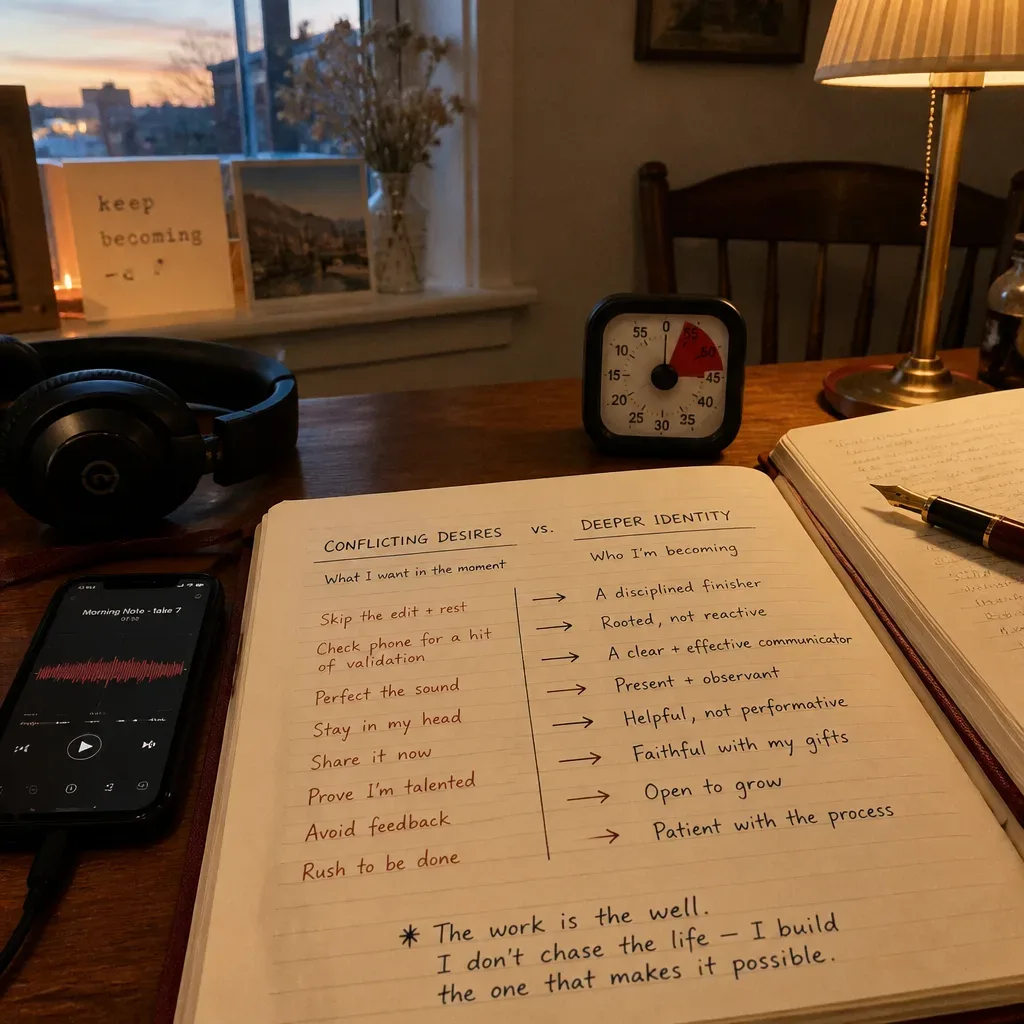
If two desires conflict, I do not force them into the same audio until I know the deeper request.
This happened with money and rest. I wanted higher income and slower mornings. At first they seemed opposed, mostly because my old model of earning came from venture: more access, more calls, more urgency, more people saying quick question when the question was not quick. When I put both desires in one audio, the recording sounded fake.
So I asked a dull but useful question: what identity holds both? The answer was not rich or relaxed. It was sovereign with time. That phrase passed my test because it changed actual choices. I stopped taking calls before 10. I raised one rate. I declined one project that would have made my calendar smell like 2018. In a 2021 Pew Research Center survey, 53 percent of Americans who quit a job cited low pay, and 45 percent cited lack of flexibility. Money and time are often tangled, not separate.
When desires clash, I sort them this way:
| Apparent conflict | Deeper shared identity | Audio language |
|---|---|---|
| More money and more rest | Sovereign with time | My work pays cleanly and my mornings are protected |
| Love and independence | Securely available | I am close without abandoning myself |
| Fitness and pleasure | Respectful of the body | I enjoy taking care of the body I live in |
| Visibility and privacy | Selectively seen | My work reaches the right people without consuming my life |
I sometimes read astrology and manifestation pieces at night, not because I outsource decisions to a chart, but because timing language can make me more honest about seasons. Some desires belong to winter. Some need spring. The audio should not pretend all seasons are one room.
How long should I keep listening before I change the audio?
I keep one audio for at least two to four weeks unless it feels clearly untrue.
I know the temptation to edit. It feels productive. It is also a way to avoid being witnessed by the same promise every morning. Apps know this loophole well. They sell novelty because novelty feels like progress. A practice that repeats has to be better than novelty, or it will not survive Tuesday.
Habit research by Phillippa Lally and colleagues at University College London found in 2009 that habit formation took anywhere from 18 to 254 days, with an average of 66 days in their sample. I do not turn that into a law. I do use it as a reminder that eight days is information, not a verdict. My own recommendation threshold for wellness tools is usually 30 days. The AYA Method got my private yes on day eight because I had used it twice when I forgot I was testing it.
I update the audio when one of three things is true:
- The identity has matured. The old recording names a version of me I have already stepped into.
- The desires no longer belong together. One branch has become its own tree.
- The language feels borrowed. I can hear performance in the script, and it makes me not want to listen.
I do not update because I had a flat morning. A flat morning is exactly where repetition earns its keep. Princeton Engineering Anomalies Research, often called PEAR, studied mind and randomness for decades and remains debated; I mention it only to say this: I do not need controversial proof to know attention affects behavior. I need to watch my Tuesday.
The manifestation guide covers broader theory. My working rule is smaller. If the audio helps me return to the same clean identity and take one matching action, it is still alive.
What is the exact 12-minute process I use?
I use a 12-minute process: name the identity, select the desires, write the scene, record the audio, and attach it to a daily cue.
I did this at the kitchen table with a timer because without a timer I start optimizing fonts. The point is not to make the perfect recording. The point is to make one I will actually hear tomorrow. Time is the only honest currency in this category. Every practice is billing me in minutes, and the good ones leave change.
Here is the process I would repeat today:
- Minute 1: write the root identity. One line only. Mine was: I am sovereign with time, paid cleanly, and available for love.
- Minutes 2 to 4: choose three to five desires. I circle only what belongs to that identity. I cross out panic desires, even if they are persuasive.
- Minutes 5 to 8: write one ordinary scene. I include the room, the hour, one body sensation, one work proof, one relationship proof, and one money proof.
- Minutes 9 to 10: remove inflated language. If I would not say it to a friend at the table, I do not put it in my ear every morning.
- Minutes 11 to 12: record and choose the cue. I use coffee. Someone else might use the bus, the bath, or brushing teeth.
There is good evidence that self-talk can affect performance. A 2011 meta-analysis in Perspectives on Psychological Science found that instructional and motivational self-talk had small to moderate benefits across sports and tasks. A Dream-Self audio is not identical to self-talk, but it lives near the same mechanism: repeated language, embodied attention, and a cue that makes action easier to find.
If you also keep a daily affirmation, let it be one sentence from the audio, not a second operating system. The same goes for a board, a journal, or a note on the mirror. Complements are useful when they keep the audio close. They become noise when they compete with it.
One clear recording beats five perfect intentions I never return to.
Wednesday night. The blue mug is already in the sink.