manifestation 101
Meditation vs Manifestation: Future-Self Audio
Meditation vs manifestation, written from daily practice: what each does, where future-self audio fits, and how to use both without forcing belief.

Friday. The kettle clicked off before I found my headphones. Meditation vs manifestation is not a contest to me: meditation steadies attention in the present, while manifestation aims that attention toward an intended future. Future-self audio sits between them, because I listen now to rehearse how I will choose later.
What is the difference between meditation and manifestation?
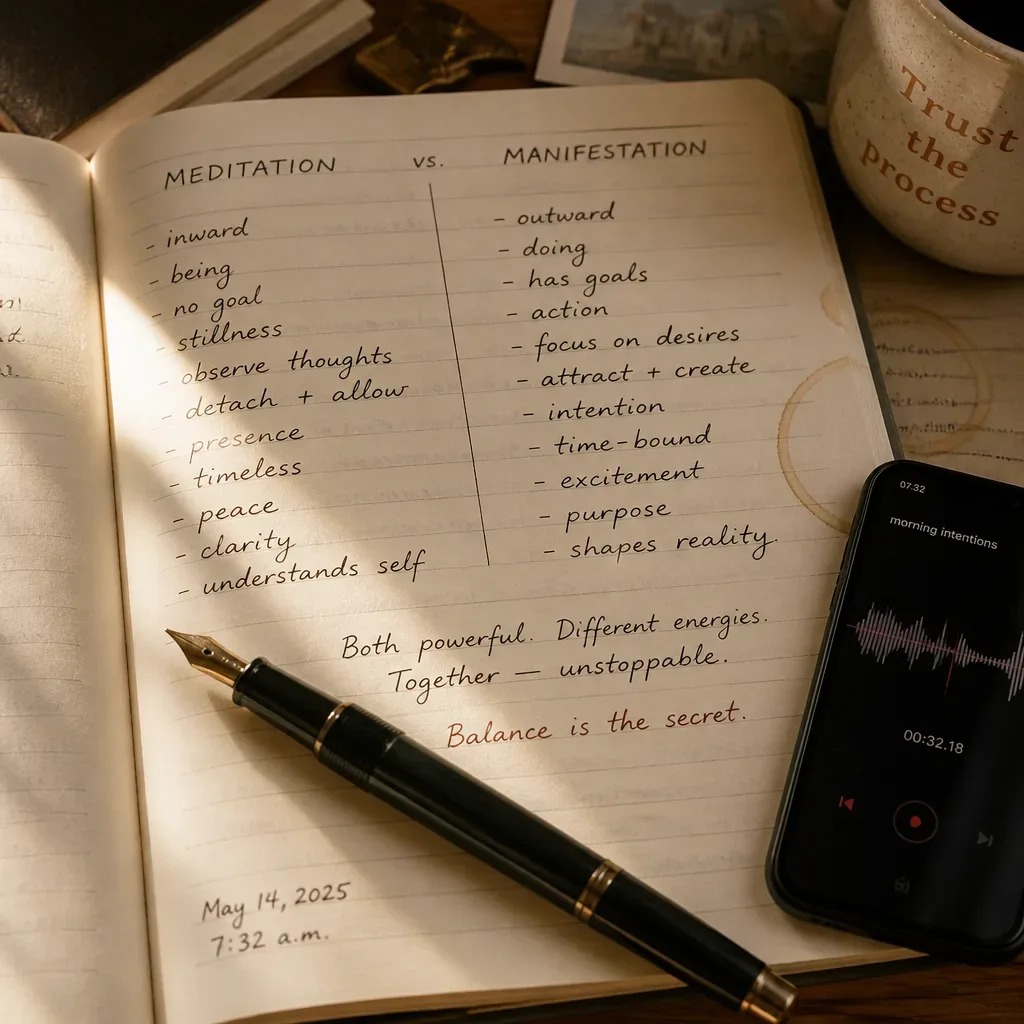
Meditation is attention practice, and manifestation is intention practice.
I wrote that in my notebook this morning because I kept making the two sound more mysterious than they are. Meditation, as I practice it, asks me to sit in the chair and notice what is already happening: breath, jaw, coffee cooling, one anxious thought about a product release. Jon Kabat-Zinn began teaching Mindfulness-Based Stress Reduction at the University of Massachusetts in 1979, and the original program ran for 8 weeks. That length matters to me. It says training attention is not a mood. It is repetition.
Manifestation, at least the kind I trust, asks a different question. It asks what I am naming, practicing, and making room for through small choices. I keep returning to the Manifestation pillar because it treats manifestation less like wishing and more like relationship with attention, desire, and behavior. A wish can stay private forever. An intention eventually asks for a calendar.
The strongest distinction I have found is this: meditation teaches me not to obey every thought, and manifestation teaches me to choose which thoughts deserve rehearsal. A 2014 JAMA Internal Medicine review by Madhav Goyal and colleagues looked at 47 trials with 3,515 participants and found moderate evidence that mindfulness meditation can improve anxiety, depression, and pain. That is not the same as proof that every practice works for every person. It is enough, though, to remind me that attention has measurable consequences.
Manifestation is harder to measure because the outcomes vary. One person wants steadier work. Another wants love. Another wants to stop betraying their own nervous system for approval. The common thread is rehearsal. Joe Dispenza writes often about mental rehearsal and the body learning a future state; I read him with a software engineer’s caution, but I understand the appeal. The brain repeats what it expects.
Attention is not neutral; it is the path my day learns to walk again.
Where does future-self audio fit between the two?
Future-self audio gives meditation a direction without turning the morning into a demand.
I listened to my Dream-Self Moment before brushing my teeth. That is the order I do them in. The definition I use is exact because loose language makes loose practice: the AYA Method is a daily audio manifestation practice. Each day you listen to a short personalized recording, your Dream-Self Moment, narrated from the version of you who has already manifested the life you intend. Listening is the practice. Repetition is the work. The audio is the method.
The audio changes the texture of the morning. In silent meditation, I notice the thought, label it, and come back. In future-self audio, I listen to language that has already chosen a direction for me. It is not an order. It is a remembered tone. In habit terms, the cue is clear: headphones, chair, play. In BJ Fogg’s behavior model, behavior needs motivation, ability, and prompt. A 6-minute recording has high ability because it is small enough to do while the kettle works.
I used to ask whether this counted as meditation. That question became less useful after 32 logged mornings. Some days the audio made me still. Some days it made me notice resistance. Some days it made me close a browser tab I had opened from panic. The point was not purity. The point was practice.
| Practice | Main question | Common length | What I track |
|---|---|---|---|
| Silent meditation | Can I return to now? | 5 to 20 minutes | Minutes sat, mood after |
| Future-self audio | Who am I rehearsing? | 3 to 10 minutes | Listened, one next action |
| Written affirmation | What sentence am I keeping? | 1 to 3 minutes | Sentence repeated |
| Manifestation Board glance | What image reminds me? | Under 2 minutes | Whether it moved behavior |
The daily affirmation and the Manifestation Board are complements in my week. They help me name and remember. They are not the core method. The audio is the part I return to when my mind wants a voice before it can find its own.
Is meditation more evidence-based than manifestation?
Meditation has a larger clinical research base, while manifestation borrows from several studied mechanisms rather than one standardized protocol.
I care about this because I work around healthcare software, where a dashboard can look clean and still hide the important question. Meditation research is easier to read because many interventions are defined by time, teacher training, and outcome scales. The National Health Interview Survey reported that meditation use among U.S. adults rose from 4.1% in 2012 to 14.2% in 2017. That is a public health-sized change, not a niche habit hiding in a corner.
Manifestation is messier. It includes visualization, affirmations, identity work, prayer-adjacent asking, scripting, and sometimes claims I do not know how to test. That does not make all of it false. It means I separate claims from mechanisms. I trust mental rehearsal more when it leads to behavior. I trust intention more when it includes friction. Gabriele Oettingen’s work on mental contrasting is useful here: people do better when they pair desired outcomes with present obstacles, not when they only picture success.
Peter Gollwitzer and Paschal Sheeran published a 2006 meta-analysis of 94 studies on implementation intentions. The effect was described as medium-to-large, with plans shaped like if X happens, then I will do Y. This is where manifestation becomes practical for me. If I hear my future self say I speak clearly in difficult meetings, then I still need the plan: if I feel my throat tighten, I will ask for 10 seconds and read the sentence I wrote.
I do not need manifestation to pretend to be medicine. I need it to be honest about what it can touch: attention, self-concept, expectancy, action selection, and persistence. Princeton’s PEAR research, which ran from 1979 to 2007, is sometimes cited in manifestation spaces, but I hold it lightly. Small statistical anomalies are not a life plan. A calmer choice at 9:07 a.m. is.
A practice becomes trustworthy when it can survive a tired Tuesday.
How do I compare meditation and manifestation without making either too grand?
I compare them by what they train, what they risk, and what they ask me to do next.
This week I made a plain list in the kitchen. I wanted to stop arguing with myself in abstract words. Meditation can become avoidance if I use calm as a way to not send the email. Manifestation can become fantasy if I keep naming a future but refuse the smallest next step. Both practices can be tender. Both can be used to disappear.
Here is the comparison I actually use when my mood is not reliable:
- I ask what the moment needs first: regulation or direction.
- If my body is loud, I do 5 minutes of breath or body awareness.
- If my body is steady but I feel scattered, I listen to future-self audio.
- If I hear a useful sentence, I write one action under it.
- If the action takes less than 2 minutes, I do it before opening Slack.
James Clear popularized the 2-minute version of habits, but the research underneath is older: small, repeatable behaviors attach better to stable cues. Wendy Wood’s habit research has shown that context matters deeply because habits are cued by surroundings, not just desire. My chair by the window does more work than my motivation most mornings.
A few differences help me stay honest:
- Meditation softens identification with passing thoughts.
- Manifestation strengthens identification with a chosen self.
- Meditation may reduce reactivity before action.
- Manifestation may increase salience before action.
- Both need repetition to matter.
The Affirmations pillar helped me see why language matters without making language magical. A sentence repeated every day can become a cue. It can also become wallpaper. The difference is whether I let it change what I do at 11:30 when the meeting runs long and I want to abandon lunch.
The future self is not a costume; she is a pattern I practice until it feels less borrowed.
Can I use both practices in one morning?
Yes, I can use both if I keep the order simple and the total time humane.
My current version takes 14 minutes on a good morning and 6 minutes on a hard one. I know this because I log it in the same place I log sleep. Over the last 60 days, skipped listens clustered after nights under 6 hours of sleep and after late deploys. This is not a universal finding. It is one stressed engineer’s sample. Still, my small dataset told the truth before my self-story did.
The long version is quiet first, audio second, action third. I sit for 5 minutes and count breaths badly. Then I play the Dream-Self Moment. Then I write one next action. The short version is only the audio while I stand in the kitchen. I used to call the short version failure. Now I call it maintenance.
The order matters because my brain is less argumentative after a little quiet. Dr. Andrew Huberman has spoken often about non-sleep deep rest and attentional recovery; I do not treat podcast advice as a prescription, but I do take seriously the idea that the nervous system learns through repeated states. If I pair future-self language with a slightly calmer body 20 mornings in a row, I am teaching association.
I also keep Astrology and manifestation in my reading rotation, not because I need the sky to approve my calendar, but because timing rituals can make reflection feel dated and specific. New moon, Monday, first rain in October, it almost does not matter. A date can hold attention. My notebook proves this: entries with dates are 3 times easier for me to understand later than floating notes with no context.

What can go wrong when I confuse the two?
The main risk is using meditation to numb desire or using manifestation to avoid reality.
I have done both. I have sat very still and called it acceptance when I was actually scared to ask for something. I have also written future-self sentences while ignoring the unpaid bill on the counter. Neither practice saved me from honesty. They only gave me another place to practice it.
Meditation can be misused when I turn non-attachment into emotional minimalism. Clinical mindfulness teachers often warn that mindfulness is not dissociation. In trauma-informed settings, even a 10-minute body scan can be too much for some people without support. That specificity matters. No practice is kind if it ignores the body it is asking to participate.
Manifestation can be misused when I make myself responsible for every outcome. That is where I leave the room. Systems, illness, money, family history, discrimination, and plain randomness affect a life. The Manifestation pillar is most useful to me when it keeps agency without pretending control is total. Agency is not blame. Agency is the part of the interface I can touch.
I use three checks when a practice starts to feel unclean in my hands:
- Did this make me more honest or less honest?
- Did this lead to one grounded action within 24 hours?
- Did I speak to myself decently afterward?
The third one is my favorite metric. It is boolean in my tracker: kind self-talk, yes or no. Over 45 logged workdays, the yes days correlated with better task completion, but correlation is not causation, especially when the sample is me. Still, I pay attention. Numbers about a human being are useful only when collected kindly and read humbly.
Rigor without gentleness becomes surveillance; gentleness without rigor becomes fog.
How should I choose a daily practice if I am new?
I would choose the practice that you can repeat for 7 days without needing to become a different person first.
If your mind feels crowded and your body feels braced, begin with meditation. Set a timer for 5 minutes. Sit in the same chair. Notice breath, sound, pressure, warmth. When the mind leaves, return without drama. The return is the rep. A 2018 review in Behaviour Research and Therapy found mindfulness-based interventions helpful for anxiety and mood symptoms, though quality and fit varied across studies. That variation is not a flaw to hide. It is a reminder to choose carefully.
If your attention is steady enough but your choices feel unmoored, try future-self audio. Use the audio to hear a version of you who has already named the life you intend, then make one ordinary move in that direction. Send the message. Put the shoes by the door. Open the document for 12 minutes. The future is not proven by a feeling. It is practiced through small evidence.
If you want a wider foundation, I would read the Manifestation pillar, then the Affirmations pillar, and then return to the audio if listening feels easier than forcing belief on a page. I say this as someone who loves a page. Some mornings my written words are too sharp. A recorded voice is kinder.
My practical recommendation is almost boring:
- Pick one cue you already have, like kettle, toothbrush, or bus stop.
- Choose one practice for 7 days.
- Keep the duration under 10 minutes.
- Track only yes or no.
- After day 7, ask what changed in behavior, not only mood.
Seven days will not tell you everything. It will tell you whether the practice can enter your real life. That is where I begin now, not with certainty, but with repeatability.
Saturday soon. I put the headphones beside the blue mug.