manifestation 101
Bay Leaf Manifestation: Listen to Audio First
Bay leaf manifestation works best as a small ritual after Dream-Self audio. Here is my quiet, practical order for writing, burning, and tracking it.

Thursday, 7:12 a.m. Bay leaf manifestation is a small intention ritual: write one clear request on a dried bay leaf, then burn or release it safely. I listen to my Dream-Self audio first because the audio gives the ritual direction, and the leaf becomes a marker, not the whole method.
What is bay leaf manifestation actually doing?
Bay leaf manifestation is giving one intention a physical shape so my attention can return to it.
I kept a bay leaf in the blue bowl by the stove this morning while the kettle came on. It looked too ordinary to carry meaning, which is partly why I like it. A bay leaf is not rare. A packet costs a few dollars and may sit in a kitchen cabinet for 18 months before anyone notices it. The plainness helps me. The ritual does not have to perform for me.
When people talk about bay leaf manifestation, they usually mean three acts: choosing an intention, writing it on the leaf, and burning the leaf. I add a step before all of that. I listen to my Dream-Self Moment through the AYA Method, then write. The AYA Method is a daily audio manifestation practice. Each day you listen to a short personalized recording — your Dream-Self Moment — narrated from the version of you who has already manifested the life you intend. Listening is the practice. Repetition is the work. The audio is the method.
The bay leaf is not magic in the way a vending machine is magic. I do not insert smoke and receive rent money. I treat it closer to a handwritten timestamp. In a 2015 review in the Journal of Behavioral Medicine, expressive writing studies were described as mixed but often meaningful for emotional processing, especially when people wrote with specificity over repeated sessions. That matters to me. A vague wish can float around for years. One sentence on a leaf has to fit inside the ribs of one morning.
A ritual is a container for attention. It does not replace attention.
I also keep the practice near the broader basics of manifestation, because the word can get swollen. For me, manifestation means naming an inner direction and behaving as if I am willing to meet it. Some days that behavior is an email. Some days it is not checking my phone before I have heard my own future self speak for 3 minutes.
Why do I listen to Dream-Self audio before lighting the leaf?
I listen first because sound changes the state I write from, and the state changes the sentence.
This is the part I learned the slow way. If I write on the bay leaf before listening, my phrase often comes from pressure. It sounds like a dashboard alert. Need more money. Fix this. Make them reply. After 4 minutes of audio, the phrase is less frantic. It becomes: I speak clearly about the contract. Or: I receive the right reply and answer steadily. The difference is not decorative. It changes what I notice after the ritual.
Dr. Andrew Huberman has often discussed the nervous system role of breath, attention, and sensory input in shifting state; the broad point is not controversial, even when specific protocols vary. Audio gives the mind a track to follow. Research on mental imagery is also relevant. In a well-known 1998 study by Shelley Taylor and colleagues, students who visualized the process of studying tended to do better than those who only imagined the desired outcome. I read that as a warning against fantasy without rehearsal.
The Dream-Self audio rehearses identity before the bay leaf records intention. That order has kept me honest.
I think of the bay leaf as a receipt. The listening is the purchase. If I skip the audio and only burn the leaf, I can still feel comforted, but it is thinner. It lasts about as long as the smoke. When I listen first, I have a voice in my ear that names how I move, answer, choose, and wait. Then the leaf gets one sentence from that version of me.
This is why I do not put the daily affirmation or Manifestation Board at the center here. I use both sometimes. They help around the edges, the way a calendar or a sticky note helps. But the audio is the practice. The ritual is an added quiet thing.

How do I do bay leaf manifestation without turning it into a performance?
I keep the ritual short, safe, and trackable, because drama makes it harder to repeat.
Here is the order I used this morning. It took 12 minutes, including the time I spent finding matches in the drawer with the rubber bands. If you have asthma, pets, smoke alarms that frighten you, or a lease that forbids flames, skip the burning. A no-flame release counts. According to the National Fire Protection Association, U.S. fire departments responded to an estimated 343,100 home structure fires per year in the 2017 to 2021 period, so I do not romanticize open flame in a kitchen.
- Sit in a chair and listen to the Dream-Self audio once.
- Choose one dried bay leaf, not five.
- Write one present-tense phrase in small letters.
- Read it once out loud, softly.
- Burn it in a fireproof dish, or tear it and place it in compost.
- Write the date, phrase, and one body note in a journal.
- Return to the audio tomorrow, even if nothing visible happens.
I write the body note because numbers and sensations keep me from inventing a better story later. Today I wrote: hands warm, jaw tight, breath slower after the audio. It is not poetry. It is data from one person before coffee.
| Part of the ritual | What I use it for | What I do not ask it to do |
|---|---|---|
| Dream-Self audio | Practice the identity daily | Force an instant result |
| Bay leaf | Hold one written intention | Carry every fear I have |
| Flame or release | Mark that I have let the sentence go | Prove the request will arrive |
| Journal note | Track patterns over time | Turn my life into a lab report |
I need that last line because I am a software engineer and can over-measure anything. Lally and colleagues published a 2009 habit study with 96 participants and found the average time to automaticity was 66 days, with wide variation. That number softened me. One day is not a verdict. One leaf is not a system. Repetition is where the evidence begins to have a pulse.
What should I write on the bay leaf?
I write one believable present-tense phrase that points my behavior toward the life I am practicing.
The phrase has to be short because bay leaves are small and because I am prone to hiding behind complex sentences. I do not write an essay on a herb. I choose a phrase with a noun and a felt quality. Calm client call. Steady rent money. Honest conversation with my mother. Clear sleep by 10:30. If the intention is relational, I keep it ethical. I do not write that another person obeys me. I write how I show up and what kind of answer I am ready to receive.
Gail Matthews at Dominican University reported in a goal-setting study often cited from 2015 that participants who wrote goals and sent accountability updates had higher completion rates than those who only thought about goals. The exact effect depends on the group and method, but the direction makes sense to me. A written intention has edges. It can be checked against a Tuesday.
I use these filters before I write:
- Is it one request, not a pile of requests wearing one coat?
- Can I picture one ordinary action that matches it within 24 hours?
- Does my body soften at least 5 percent when I read it?
- Would I still respect myself if the answer came slowly?
- Is the sentence about my choices rather than control over someone else?
A good intention makes the next decent action easier to see.
If I need language help, I sometimes read about affirmations, not because an affirmation is the main practice, but because wording matters. I want a sentence my nervous system can stay in the room with. I avoid huge claims on hard mornings. My body does not believe them, and then the ritual becomes a debate. Better to write: I take the next honest step, than to write a sentence so grand I flinch before the ink dries.
How do I read signs without lying to myself?
I read signs as prompts for attention, not as final proof.
This is where I have to be careful. After bay leaf manifestation, the mind starts collecting evidence. A song lyric, a license plate, a message at 11:11. I am not immune. Last winter I saw the same client name twice in one day and wanted to call it a sign. It may have been. It may also have been my attention doing what attention does after I give it a target.
Psychologists call this frequency illusion or the Baader-Meinhof phenomenon: once something is salient, we notice it more. The term was popularized in the 1990s, and the cognitive pattern is related to selective attention. I do not use that fact to flatten mystery. I use it to stay kind and accurate. If I ask for a new role and suddenly notice 6 job posts, the useful question is not whether the posts were placed there for me. The useful question is whether I will apply.
Princeton Engineering Anomalies Research, often called PEAR, studied mind-machine interactions for nearly 28 years before closing in 2007. Its findings remain debated, and I do not use them as proof for a bay leaf. I mention them because people have long tried to measure the border between intention and outcome. My own practice is humbler. I track sleep, mood, listening, and action. I let the strange things be strange without handing them the steering wheel.
Here is my rule: a sign is only helpful if it returns me to a decent action.
That rule keeps astrology and manifestation in the same place for me. Astrology can help me reflect on timing and pattern. It cannot excuse me from sending the email, resting when I am depleted, or telling the truth. The bay leaf smoke rises and disappears. My calendar remains.
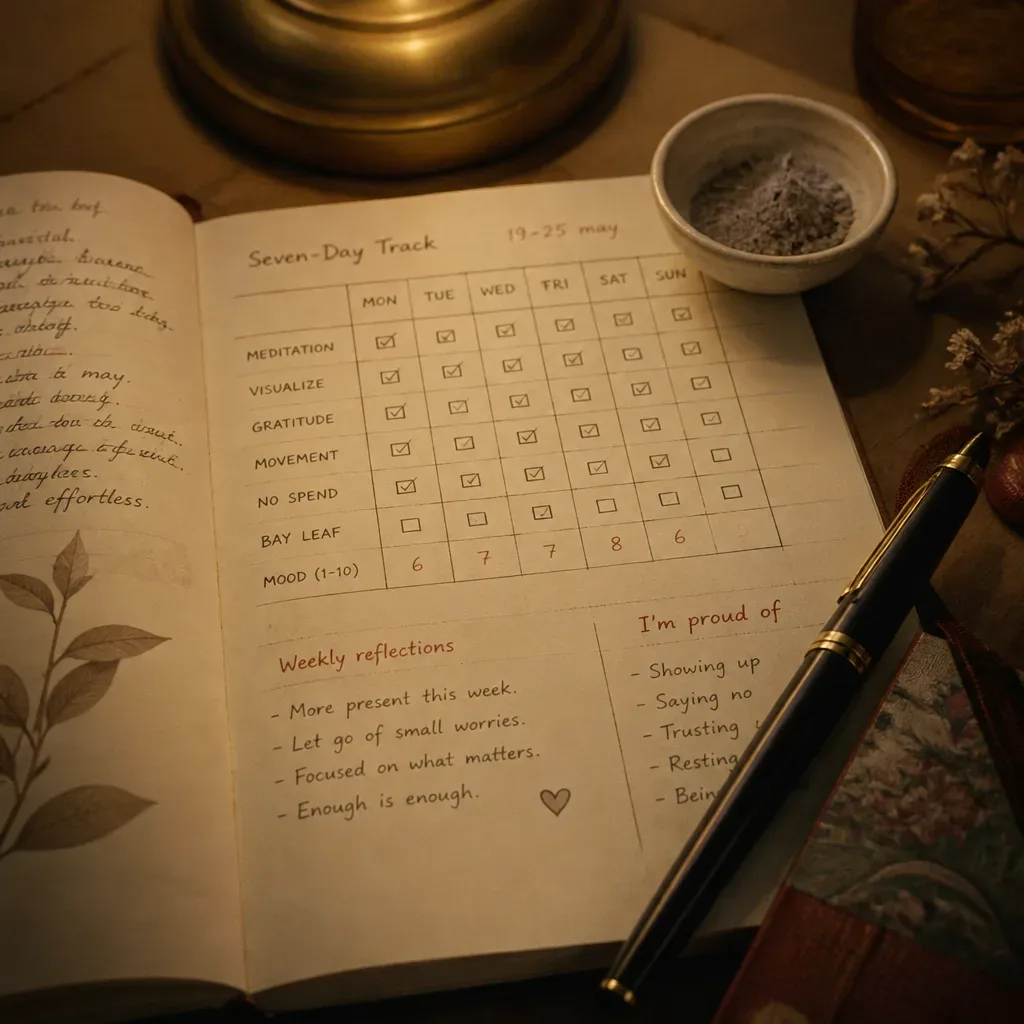
What changes if I repeat the ritual for 7 days?
Seven days gives me enough repetition to notice patterns, but not enough time to pretend I have solved my whole life.
I like 7 days because a week has a shape. Monday carries one kind of fear. Friday carries another. If I do bay leaf manifestation once, I mostly learn what I wanted in that moment. If I listen to the Dream-Self audio daily and use a bay leaf ritual on day 1 and day 7, I learn what stayed, what softened, and what became unnecessary. That is better data.
The American Time Use Survey reported that adults in the U.S. spent about 8.95 hours per day on personal care activities including sleep in 2023, but only a small fraction of a day is needed for a ritual like this. My full practice is usually under 12 minutes. I have lost more time than that looking for my headphones while holding them in my hand.
For 7 days, I track only 4 fields:
- Did I listen to the audio today, yes or no?
- What was my mood from 1 to 5 before listening?
- What one action matched the intention?
- Did I speak to myself decently today, yes or no?
That last one is my favorite metric because it is hard to fake. It also keeps me near the AYA Method as practice, not spectacle. The listening repeats. The self I hear becomes less theoretical. The bay leaf is just one small ceremony beside that repetition.
If you are new to the wider frame, start with the Manifestation pillar and then come back to the leaf. If your phrase keeps sounding harsh, spend time with the Affirmations pillar for gentler language. If timing is what you are trying to understand, Astrology and manifestation may give you another lens, but keep your feet on the floor.
The quietest practice is often the one I can repeat when no one is watching.
Thursday night. The sink is clean and the leaf is ash.