vision boards
Pinterest Vision Board: Turn Pins Into Dream-Self Audio
Turn a pinterest vision board into a daily Dream-Self audio script, using saved pins as cues for identity, mood, place, and action.
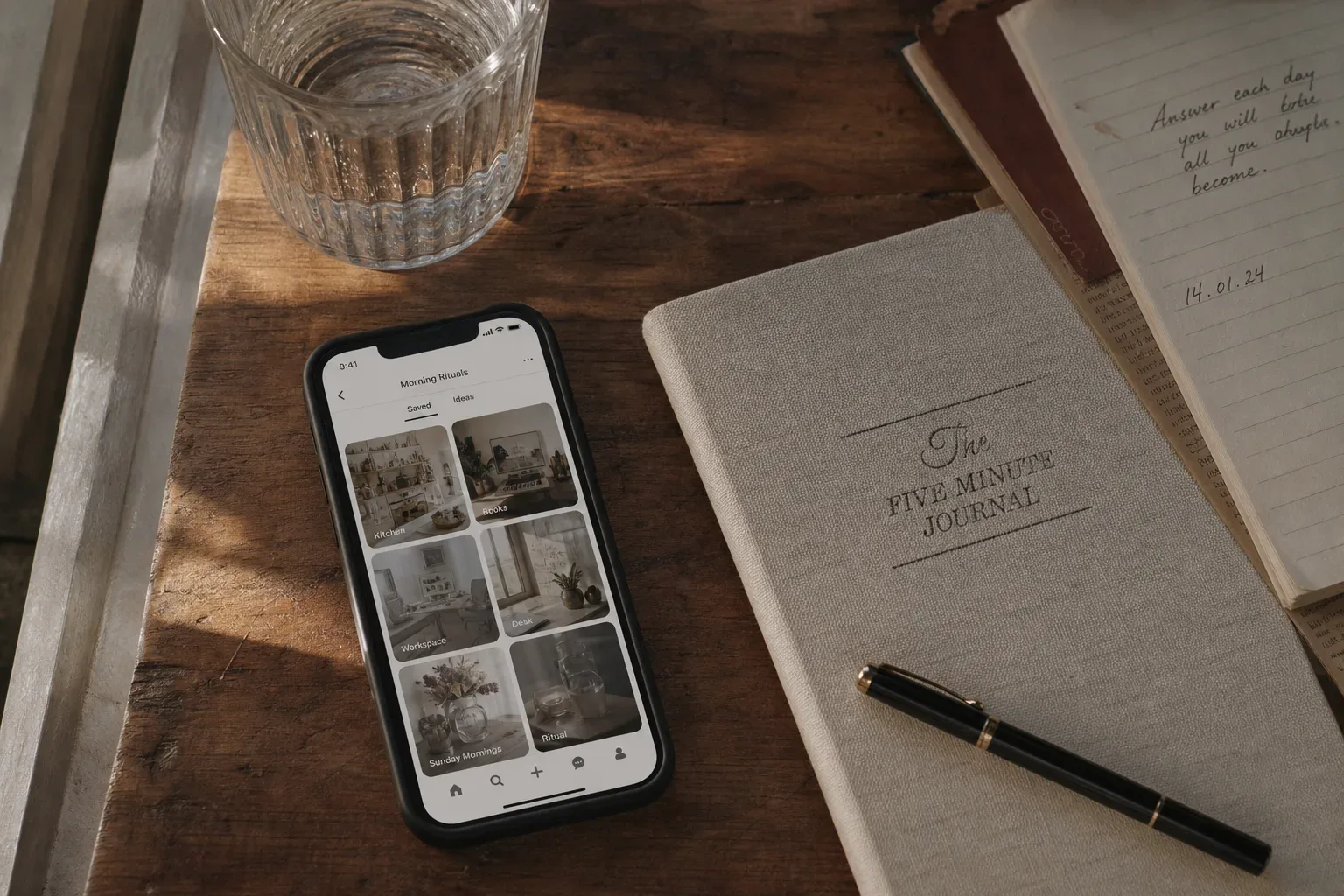
A pinterest vision board becomes useful when you stop treating it as a gallery and start treating it as raw material for one short recording. Choose the pins that feel specific, name the life they point toward, then write a Dream-Self Moment you can hear every morning.
What is your pinterest vision board really showing you?
Your pinterest vision board is showing you repeated cues about identity, place, rhythm, and desire.
Open the board without editing it. Do not make it prettier yet. Scroll slowly. Pinterest reported 570 million monthly active users in Q1 2025, which means the app is built for endless saving. Your work is not to save more. Your work is to see what keeps returning.
A pin is evidence, not instruction. One kitchen may mean beauty. Three kitchens may mean home. Five quiet desks may mean you want a different relationship with work. In cognitive science, repetition matters because repeated cues become easier to retrieve. A 2016 review in Psychological Bulletin found that mental imagery can influence emotion and behavior partly because it simulates perception, not because it stays abstract.
So ask smaller questions. What time of day appears again and again? What kind of body posture do you keep saving? What colors of room, not as trend, but as feeling? What are people doing with their hands? The pattern is usually more honest than the caption.
If you want a broader base for the practice, keep the Manifestation pillar close. Manifestation works best when it becomes specific enough to meet the day. A board full of distant symbols is easy to admire. A board that tells you how you wake, speak, choose, and rest is easier to live.
Use this first pass as a quiet audit:
- 3 pins that show where you are
- 3 pins that show how your day moves
- 2 pins that show how you relate to your body
- 2 pins that show how you speak, work, or love
- 1 pin that feels like the whole thing, even if you cannot explain it
The image gives the nervous system a door; the audio teaches it to walk through.
Which saved pins should become Dream-Self audio?
The saved pins that should become audio are the ones with concrete details you can hear, feel, and repeat.
Do not choose the most impressive pins. Choose the ones that feel strangely familiar. In a classic meta-analysis by Driskell, Copper, and Moran in 1994, mental practice improved performance across many tasks, especially when the rehearsal was specific and repeated. Your pins should give your mind something precise to rehearse.
Look for details that can become sentences. A linen bed is not just a bed. It may become: I wake in a room that is already calm. A woman walking with coffee may become: I leave the house without rushing. A studio desk may become: I begin my work before I check for approval.
Here is a simple sorting table:
| Pin type | Keep it if it shows | Audio line it may become |
|---|---|---|
| Room | A real setting | I live in a space that makes quiet easy. |
| Clothing | A body state | I dress like I am already taking myself seriously. |
| Work | A daily action | I start with the page, not the noise. |
| Relationship | A tone | I answer with care and do not disappear from myself. |
| Money | A behavior | I check the numbers calmly and make one clean choice. |
A pinterest vision board often gets crowded because saving feels like doing. Pinterest itself has said that users come to the platform to plan, and its 2024 trend reporting leaned heavily on future intent. Planning is useful. But a practice begins when a cue asks for repetition.
If a pin only makes you compare, leave it out. If a pin makes your chest soften, keep it. Your future self is easier to believe when she sounds like someone you already know.
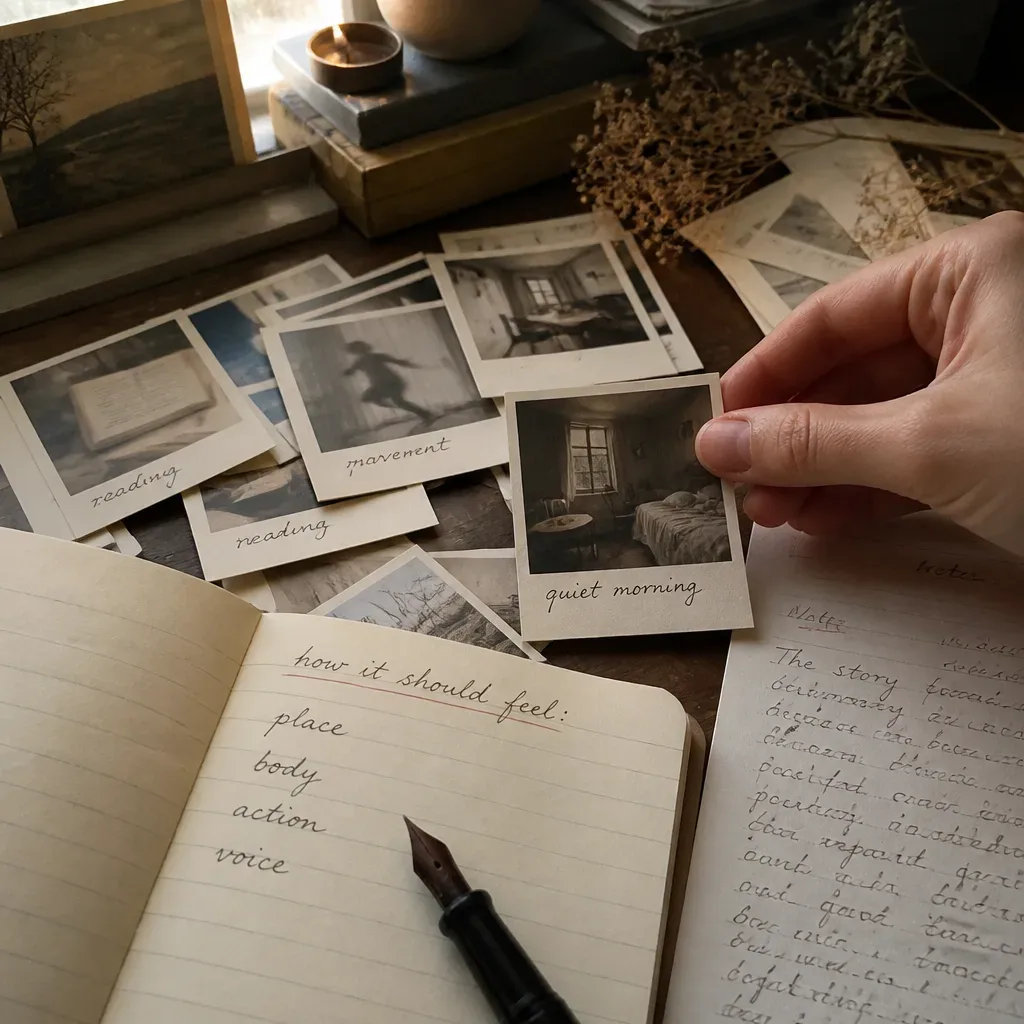
How do you turn pins into a Dream-Self script?
You turn pins into a Dream-Self script by translating visual details into first-person present-tense scenes.
Start with 7 to 12 pins. More than that usually makes the recording too wide. Research on working memory often points to a limited capacity, with Nelson Cowan’s 2001 review suggesting about 4 chunks are held clearly at once. That is why your audio needs a few strong scenes, not every dream you have ever saved.
Use this 5-step script method:
- Name the setting. Where are you when the scene begins?
- Name the body. How are you breathing, standing, moving, or resting?
- Name the action. What are you doing now that you used to postpone?
- Name the self-talk. What do you know about yourself here?
- Name the proof. What small evidence tells you this is real?
A simple script may begin like this: I wake before the room asks anything of me. The light is soft. My phone is not the first voice I hear. I know what matters today. I choose the first true task and begin before I explain myself to anyone.
Notice how little drama it needs. The sentence does not beg. It remembers. In self-affirmation research, Cohen and Sherman’s 2014 review in Annual Review of Psychology found that affirming valued identity can reduce defensiveness under threat. The point is not to pretend. The point is to speak from a stable place often enough that it becomes easier to return there.
This is where the AYA Method enters quietly. The AYA Method is a daily audio manifestation practice. Each day you listen to a short personalized recording — your Dream-Self Moment — narrated from the version of you who has already manifested the life you intend. Listening is the practice. Repetition is the work. The audio is the method.
If you are new to this, read your script aloud once. If one line makes you tense, soften it. I am completely different becomes I choose differently here. The body often trusts what is near enough to touch.
How should the audio sound when you record it?
The audio should sound slow, intimate, and believable enough to hear every day without resisting it.
A Dream-Self Moment is not a performance. Record it as if you are leaving a note for yourself before dawn. Keep it between 90 seconds and 4 minutes. Many meditation and audio habit studies use brief daily sessions because consistency matters more than length; for example, brief mindfulness interventions of 10 minutes have shown measurable effects on attention in small controlled studies.
Speak in first person. Use present tense. Let the sentences breathe. If you record in your own voice, leave two seconds between important lines. If you use a personalized tool, edit the script until it sounds like language you would actually say.
Good audio lines are plain:
- I wake and know where my attention goes first.
- I move through my home like I belong to myself.
- I answer the message after I answer my own need.
- I let the work be simple enough to begin.
- I can have beauty without making my life harder.
Avoid lines that feel like a costume. The nervous system is not persuaded by volume. It is persuaded by repetition, safety, and detail. Neville Goddard called imagination the creative act, but the useful part here is practical: he asked people to enter the wish fulfilled as a lived scene. Joe Dispenza also centers repeated mental rehearsal, though some of his claims go beyond what mainstream neuroscience can verify.
As a neuroscience researcher, I would say it more carefully. Repeated audio can shape attention and self-talk because it gives the brain a stable cue. It does not override reality. It helps you notice and practice a different response inside reality.
For more language support, pair the recording with the Affirmations pillar. Keep the affirmation as a small echo of the audio. One sentence. Not a second practice trying to compete with the first.
Where do the Manifestation Board and daily affirmation fit?
The Manifestation Board and daily affirmation fit as complements that help you see and name what the audio is teaching you to hear.
This matters. The audio is the method. The daily affirmation and Manifestation Board are not pillars. They are helpful supports when they make the Dream-Self Moment easier to return to. In habit research, context cues matter: a 2009 study by Lally and colleagues in the European Journal of Social Psychology found habit formation took a median of 66 days, with wide variation from 18 to 254 days.
Your Pinterest board can become the source. Your Manifestation Board can become the distilled version. Your daily affirmation can become the one line you carry after listening. The order matters because it protects the practice from becoming another task pile.
Here is the quiet order:
- Pinterest shows you the raw pattern.
- The Dream-Self audio gives the pattern a voice.
- The Manifestation Board holds a few chosen images.
- The daily affirmation names one sentence from the recording.
- Daily listening keeps the whole thing alive.
If you use astrology as a reflective tool, not a rulebook, you can also bring in timing. A new moon might be a clean day to choose pins. A full moon might be a day to remove what no longer feels true. For a grounded take, read Astrology and manifestation and keep agency with yourself.
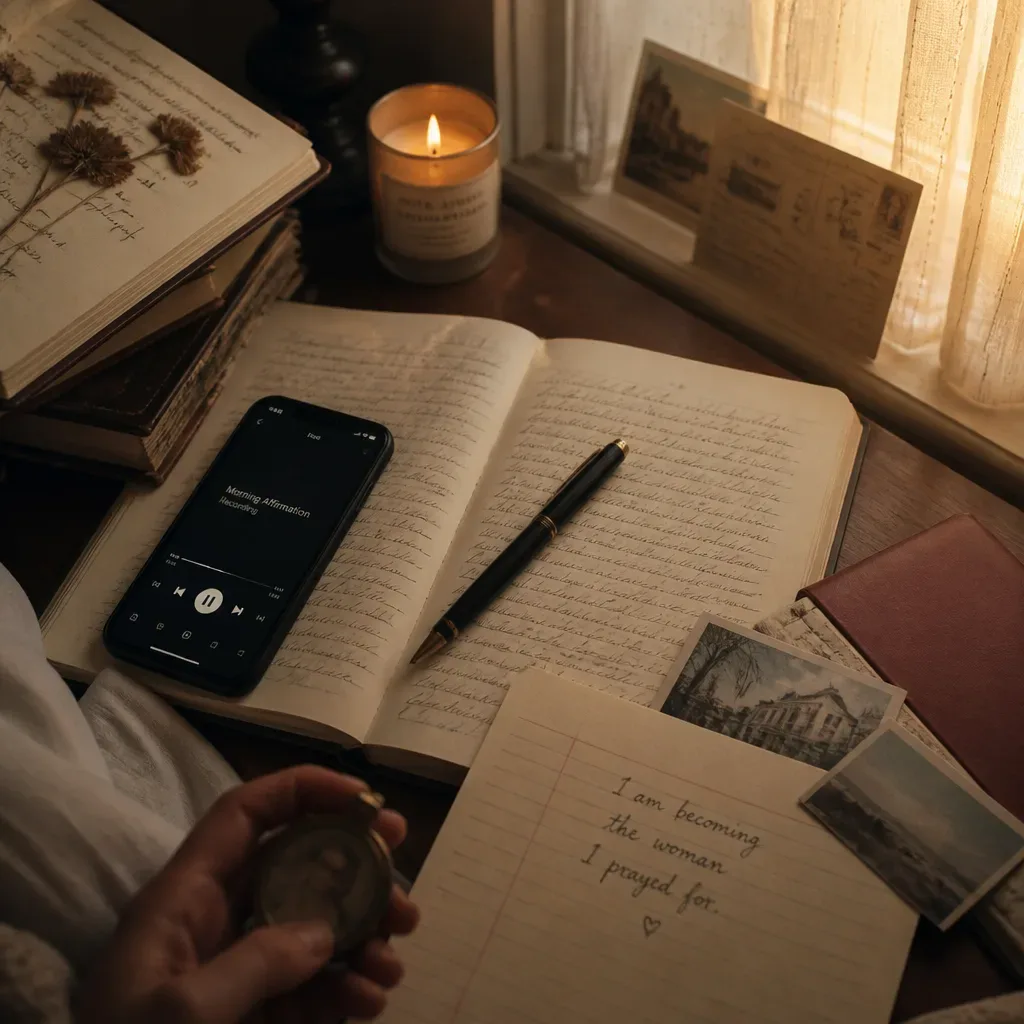
A board can become noisy when it tries to hold every possible self. Keep it seasonal. Review it every 4 weeks, not every 4 hours. Pew Research Center has reported that a large share of adults are online almost constantly; that is exactly why your practice needs an edge.
Repetition is not decoration. It is how a new sentence becomes familiar.
How do you make this a daily practice without overworking it?
You make it daily by attaching the audio to one existing moment and refusing to keep improving it.
Choose one listening place. Bed. Walk. Bathroom mirror. The first cup of tea. Dr. Andrew Huberman often speaks about using morning light as a stabilizing cue for circadian rhythm; the same behavioral idea applies here. A stable cue lowers the number of choices you have to make.
Do this for 7 days before editing anything. Seven days is not magic, but it is long enough to notice friction. If you keep skipping the audio, do not blame your will. Change the cue. If the script feels too far away, make it more ordinary. If the Pinterest board keeps pulling you back into comparison, close it after you choose the pins.
A simple daily rhythm:
| Moment | What you do | Time |
|---|---|---|
| Day 1 | Choose pins and write the script | 20 minutes |
| Day 2 | Record and listen once | 10 minutes |
| Days 3 to 7 | Listen without editing | 2 to 4 minutes daily |
| Day 8 | Change one line only if needed | 5 minutes |
You can keep learning through the wider vision board practice, but do not make learning a way to avoid listening. You may also return to the Manifestation pillar when you want the larger frame for desire, action, and belief.
The cleanest sign that it is working is not fireworks. It is a small change in what you do next. You answer the email. You wash the cup. You open the document. You speak to yourself with less punishment. In behavior science, that is meaningful. Identity changes are often visible first as repeated micro-actions.
Your board gave you the picture. Your audio gives you the return.
Save one image. Then listen.