money manifestation
Scarcity Mindset Reset: Listen Before You Discount
A scarcity mindset can make fair prices feel unsafe. This listening reset helps you pause, regulate, and quote your work before discounting it.
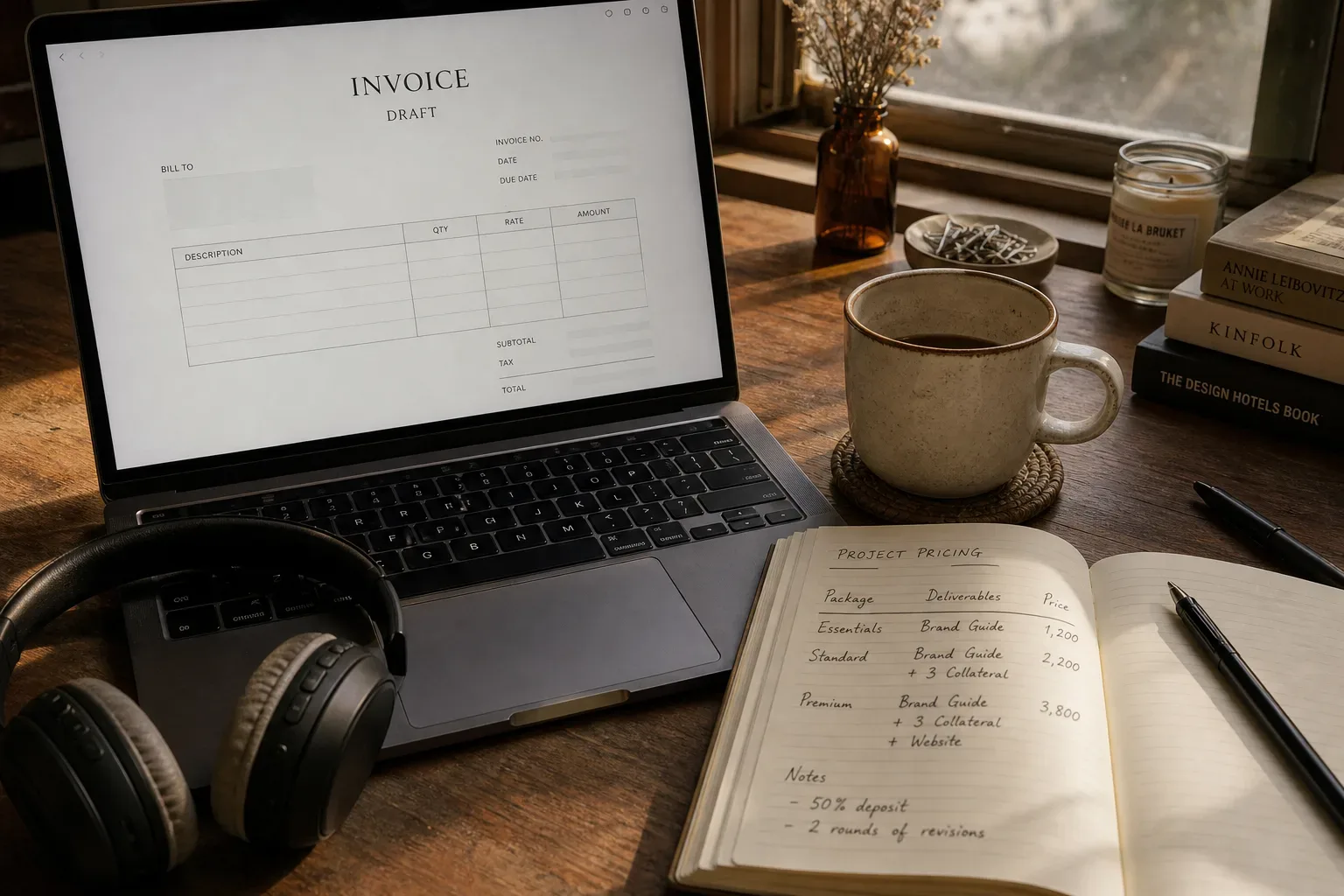
Wednesday, 7:10 a.m. The kettle clicked off while my invoice sat open. A scarcity mindset reset means pausing before you lower your price, listening to a steadier version of yourself, checking the facts, and only then deciding. The work is not to feel rich. The work is to stop negotiating against yourself.
What is actually happening when I want to discount my work?
A scarcity mindset is attention narrowed by fear, and it often reaches the keyboard before good judgment does.
I know the feeling by its speed. My shoulders lift. My hand moves to the number. I tell myself I am being reasonable, but the invoice has not even left the room. Sendhil Mullainathan and Eldar Shafir wrote in Scarcity in 2013 that scarcity captures the mind. Their phrase helped me because it made the problem less moral. I was not weak. My attention had been taken hostage by a possible no.
There is research behind that small hijacking. In a 2013 Science paper, Anandi Mani, Mullainathan, Shafir, and Jiaying Zhao found that financial worry could reduce cognitive performance in a way they compared to losing about 13 IQ points. I think about that whenever I try to price work while anxious. The number I choose in that state may feel practical, but it is often just fear wearing office clothes.
Scarcity also makes the present feel louder than the future. A discount promises relief now: the client may say yes, the email may stop sitting there, the calendar may look safer for one more week. But the future version of me has to live with the reduced fee, the tighter margin, and the quiet resentment that arrives around revision two. A cheap yes can become expensive when it teaches your nervous system that panic is the pricing manager.
So I do not start by arguing with myself. I start by noticing the body signal. The faster I want to reduce the fee, the more slowly I need to move.
Why do I listen before I touch the price?
I listen first because audio gives my attention somewhere to rest before fear turns into a business decision.
This is where the AYA Method has become strangely practical in my working day. The AYA Method is a daily audio manifestation practice. Each day you listen to a short personalized recording, your Dream-Self Moment, narrated from the version of you who has already manifested the life you intend. Listening is the practice. Repetition is the work. The audio is the method.
I listened this morning before brushing my teeth. That is the order I do them in. I do not use it to avoid the spreadsheet. I use it before the spreadsheet, so I am not entering the numbers as the most frightened version of myself. Habit researchers often describe behavior as cue, routine, reward. Charles Duhigg popularized that loop in 2012, and B. J. Fogg later emphasized that tiny behaviors survive because they ask for less motivation. A three-minute audio works for me because it is small enough not to become another task.
The voice in the recording does one important thing. It makes the future ordinary. Not grand. Not sparkling. Ordinary. I hear a version of me who has sent clear quotes many times. She does not overexplain the fee. She does not apologize for the rate. She changes scope when the budget is smaller. That is not fantasy. That is rehearsal.
A fair price often feels unsafe before it feels natural.
I keep a daily affirmation on a small card near the monitor, but it is not the pillar. It is a complement, like my coffee or the timer on my desk. I also keep a simple Manifestation Board in Notion, mostly screenshots of paid invoices and notes from clients. Still, when the pressure rises, the listening is what reaches me first.

How do I do the nine-minute scarcity mindset reset?
The reset takes nine minutes, and the rule is simple: no price changes until the reset is complete.
I use a timer because an open-ended pause can become avoidance. Nine minutes is short enough to respect a workday and long enough to interrupt the automatic discount. In a 2022 American Psychological Association report, money remained one of the most common stressors for adults in the United States, with inflation and finances named by large majorities. I mention that because pricing stress is not rare. It is not a private defect. It is a common pressure point.
Here is the reset I used today, with my blue mug cooling beside the laptop:
- Minute 1: stop typing. I take both hands off the keyboard. I name the sentence in my head: I am about to lower this because I am scared.
- Minutes 2 to 4: listen. I play my Dream-Self Moment. I do not multitask. If my mind argues, I let it argue quietly.
- Minutes 5 to 6: write the fear. I finish this line: I am afraid that if I charge this, they will…
- Minutes 7 to 8: check the facts. I look at scope, hours, taxes, revision rounds, payment terms, and the last three similar projects.
- Minute 9: choose the next sentence. I either keep the price, adjust the scope, or sleep on it. I do not silently cut.
A discount is not wrong. A panic discount is different.
I keep the distinction on paper because I forget it under pressure. Strategic discounts are chosen in daylight. Panic discounts are chosen under a table inside the mind.
What facts should I check before I decide?
I check the business facts because a scarcity mindset loves vague danger and hates exact numbers.
My design brain likes tables, so I made one after a bad Tuesday in August. I had cut a proposal by 18 percent before sending it, then spent the whole project irritated at a client who had never asked for the reduction. The table is not glamorous. It is load-bearing.
| What I check | Why it matters | My note before changing price |
|---|---|---|
| Estimated hours | Time is the first real cost | Have I included admin and calls? |
| Revision rounds | Extra rounds quietly eat margin | Can I cap revisions instead? |
| Rights and usage | Wider use should cost more | Is this internal, public, or paid media? |
| Payment timing | Late payment creates risk | Do I need a deposit? |
| Recent comparable work | Memory distorts under stress | What did I charge last time? |
| Client budget | Scope can move with budget | What can be removed cleanly? |
The exact numbers calm me because they make the decision visible. Research on implementation intentions by psychologist Peter Gollwitzer, first developed in the 1990s, shows that if-then planning can improve follow-through across many goals. My version is plain: if I feel the urge to discount before a client asks, then I check the table first.
This is also where I return to the wider practice of Manifestation pillar, not as wishing, but as attention training. Naming a desired financial pattern means very little if I refuse to notice the pattern I am already repeating. I cannot ask for steadier income while practicing rushed undercharging every Thursday.
The money story has to meet the calendar, the invoice, and the tax line.
I also keep a small note from Affirmations pillar beside the table: My price can be clear before my confidence catches up. That sentence has earned its place because it does not ask me to be fearless. It only asks me to be accurate.
What should I say instead of offering a discount?
I keep boundary sentences ready because scarcity makes me wordy, and wordiness usually leaks the boundary.
A client may have a real budget limit. That does not mean the only respectful response is to reduce the same work for less money. The Freelancers Union has reported for years that late payment and nonpayment remain common freelancer issues; in their 2019 survey work, many freelancers named payment reliability as a serious concern. I keep that in mind because a price is not only a number. It is part of the working conditions.
These are the sentences I keep in a note called before you fold:
- I can keep the fee at this scope, or I can reduce the scope to meet your budget.
- For that budget, I would recommend removing the second concept round.
- I do not discount this service, but I can split the payment into two dates.
- If the timing is flexible, I can offer a lower-priority schedule at a different rate.
- That fee includes research, production, revisions, and usage for the agreed channels.
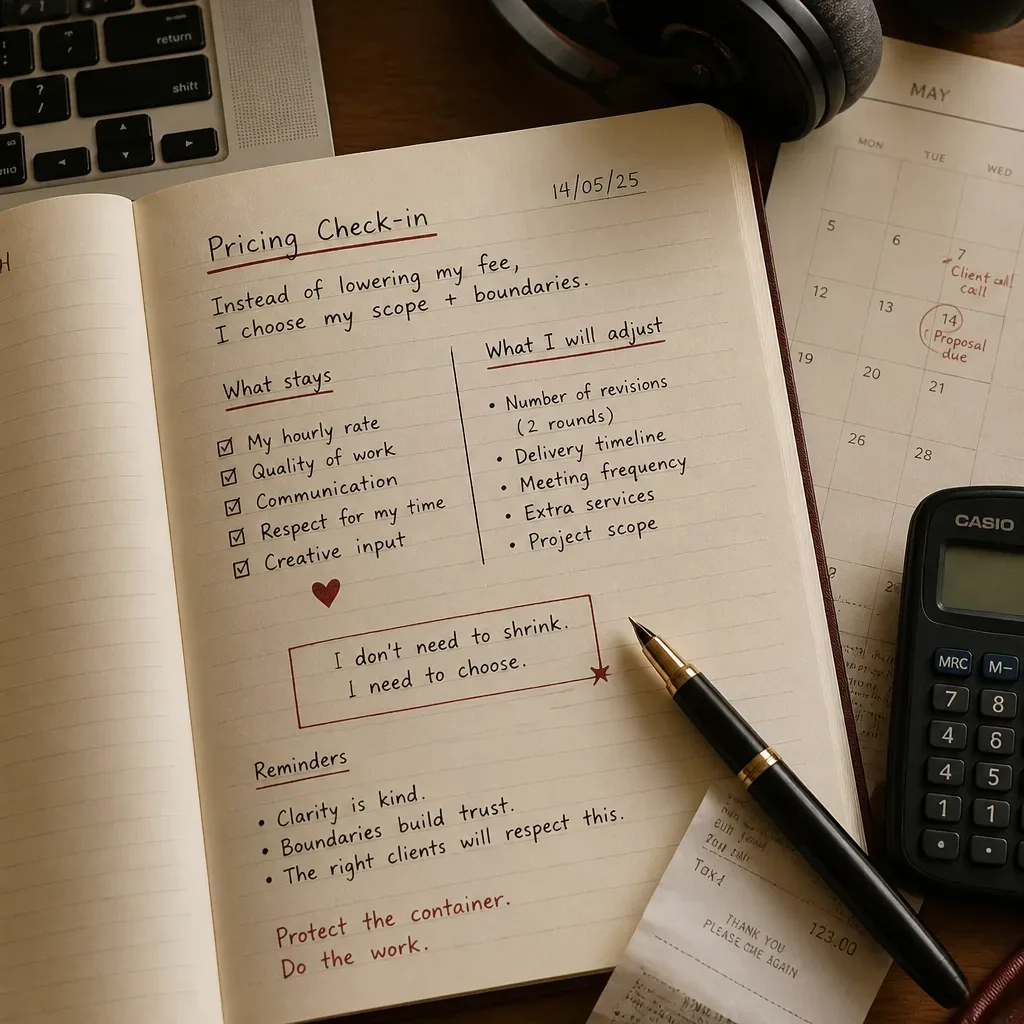
The sentence that saves me most often is the first one. It gives the client a choice without making my labor the soft part. Scope can move. Timing can move. Payment structure can move. The worth of the work does not have to be the first thing sacrificed.
I learned this after reading more about anchoring in behavioral economics. Daniel Kahneman and Amos Tversky described anchoring effects in the 1970s, and the basic finding still matters in pricing: the first number shapes the conversation. If my first number is already a frightened compromise, I have anchored the negotiation below the work.
How do I keep the reset from becoming another ritual I abandon?
I keep the reset small, attached to a real cue, and forgiving enough to survive a busy week.
This is the part my product-design work keeps teaching me. A habit does not fail only because the person lacks discipline. It often fails because the design asks for too much at the wrong moment. Pew Research Center reported in 2021 that roughly three in ten U.S. adults said they were almost constantly online. I am one of those people on deadline days. If a practice needs a candle, a clean desk, and a perfect mood, it will lose to email by 9:15.
So my cue is brutally specific: when I open a proposal or invoice and feel the urge to lower the number, I listen before editing. Not sometime that day. Not after I have spiraled. Right there. Headphones on, chair turned slightly away from the screen.
I also track it lightly. I put a small dot in my notes app for each time I complete the reset. No streak drama. No punishment. In small behavior-change studies, self-monitoring is often associated with better adherence, especially when the tracking is simple. The dot is enough. If tracking becomes a second job, I know I have overbuilt the system.
There is a moon note in my Notion too, because I am still myself. On new moons I review the last month of quotes, not to make the moon responsible for my income, but because a monthly rhythm helps me return. I wrote about timing practices in Astrology and manifestation, and my rule is the same here: the calendar is useful if it brings me back to the page.
The kindest system is the one that still works when I am tired.
When is discounting actually the right choice?
Discounting can be wise when it is chosen deliberately, documented clearly, and exchanged for something real.
I do not want to turn pricing into a purity test. Sometimes I reduce a fee for a repeat client who pays on time and gives clean feedback. Sometimes I offer a smaller version of the work because the project matters and the scope can be honest. Sometimes I make a strategic choice because the relationship, usage, or timing gives me something concrete in return. The difference is that I decide it after listening and checking, not before breathing.
Here is my small rule set:
- If I discount, I write the original price and the reduced price on the proposal.
- If I discount, I name what changes: scope, timeline, usage, or revision count.
- If I discount for access or exposure, I ask what measurable access means.
- If I discount once, I do not let it become the new default rate.
- If I feel ashamed while writing the fee, I wait one sleep cycle before sending.
Sleep matters more than I used to admit. Dr. Andrew Huberman often discusses how sleep loss affects emotional regulation and prefrontal control, and large sleep studies consistently connect poor sleep with worse decision-making. I am not my clearest negotiator at 11:42 p.m. My late-night self thinks every opportunity is the last train.
I also return to the broader money practice inside Manifestation pillar when I review the month. Did I price from evidence or fear? Did I ask the work to prove my safety? Did I let one quiet week rewrite the value of a skill built over years? These questions are not soft. They are operational.
This morning, after the nine minutes, I left the number alone. Then I changed one sentence in the proposal so the scope was clearer. That was the real edit.
Wednesday now. The price stays on the page.