money manifestation
Manifest Financial Stability in 5 Minutes a Day
A quiet 5-minute practice to manifest financial stability with Dream-Self audio, habit cues, money evidence, and calmer daily decisions.
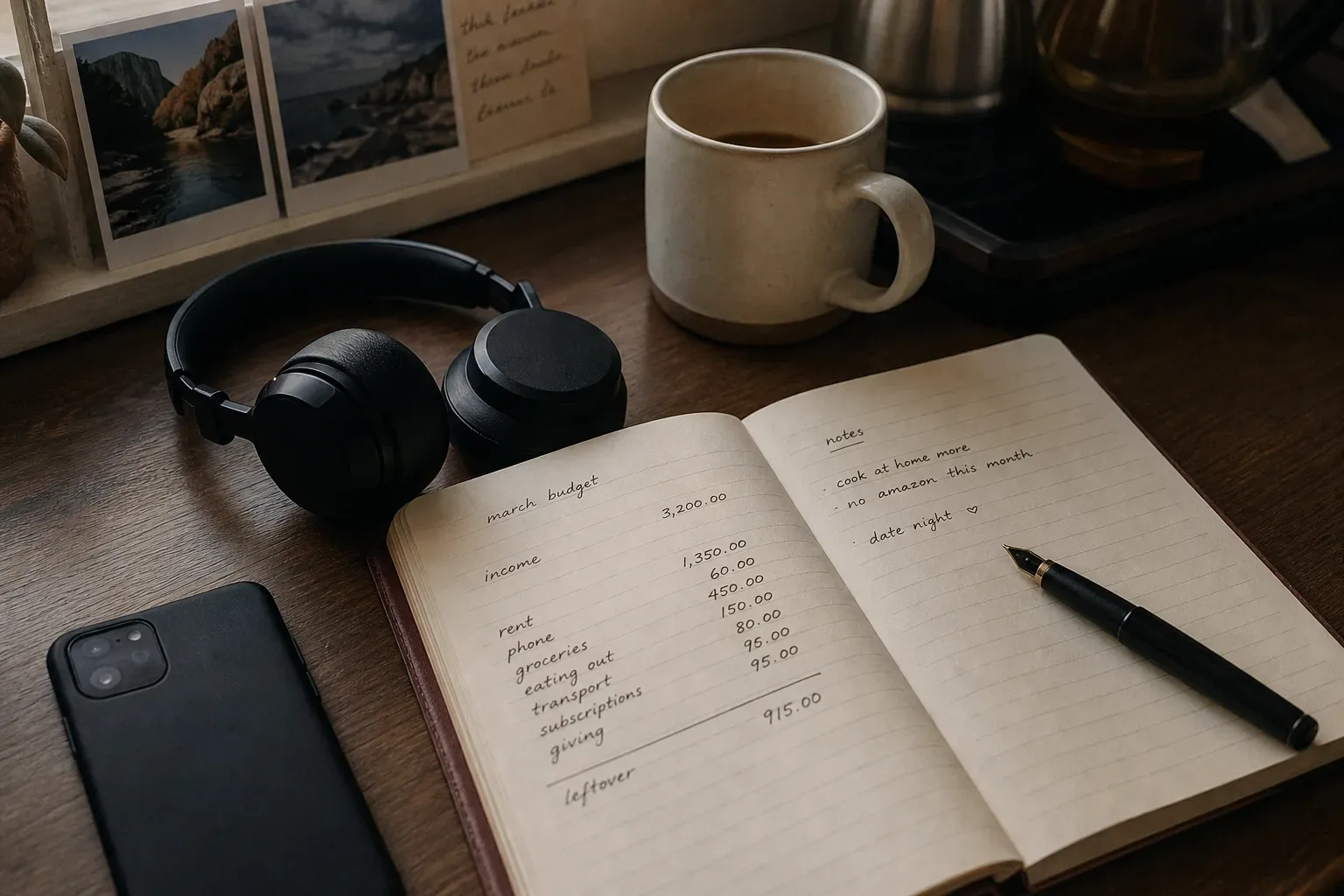
Sunday. The kettle clicked off before I found my glasses. To manifest financial stability with a 5-minute Dream-Self audio, I listen daily, rehearse the identity of a steady money person, then take one small money action. The audio is not magic. It is a cue, repeated until my behavior has somewhere calmer to stand.
What does it mean to manifest financial stability with audio?
It means I use a short recording to rehearse the thoughts and behaviors of the financially stable version of myself before the day starts spending itself for me.
I use the word manifest carefully here. I do not mean sitting in the kitchen hoping the rent changes its mind. I mean naming a stable financial identity, hearing it daily, and letting that identity choose one next action. The Federal Reserve reported in its 2023 Survey of Household Economics and Decisionmaking that 37% of adults would not cover a 400 dollar emergency fully with cash or its equivalent. That number is not abstract when I read it at my table. It sounds like drawers opening, cards being checked, someone holding their breath.
The audio gives the nervous system a script before old money fear writes one. In the AYA Method, the practice is simple: a daily audio manifestation practice where each day I listen to a short personalized recording, my Dream-Self Moment, narrated from the version of me who has already manifested the life I intend. Listening is the practice. Repetition is the work. The audio is the method.
Financial stability, for me, is not a number large enough to impress a stranger. It is bills paid before panic, groceries bought without checking the account six times, and savings that survive a bad Tuesday. Pew Research Center reported in 2024 that inflation and household costs remained top concerns for many adults in the United States. My body already knew that before the report did.
A money practice has to be small enough to survive a tired person. Five minutes survives me.
Here is the distinction I keep on the page:
| Practice | What I ask it to do | What I do not ask it to do |
|---|---|---|
| Dream-Self audio | Rehearse stable identity daily | Replace earning, saving, or planning |
| Budget check | Show current numbers | Tell me who I am worth being |
| Daily affirmation | Give one sentence of direction | Carry the whole method |
| Manifestation Board | Keep visible evidence nearby | Become proof by itself |
I keep this table because I have built habit products used by about 14,000 people, and confused jobs break habits. When one tool is asked to do five jobs, the person quits by Thursday.
Why does five minutes work better than a long money ritual?
Five minutes works because it removes the part where ambition makes the habit too expensive to repeat.
I learned this the unglamorous way, through retention charts. In the small habit app I built, the first-week drop-off was always sharpest when users made their first goal too large. BJ Fogg, the Stanford behavior researcher, has written for years that tiny behaviors work because they are easier to do when motivation is low. Money fear lowers motivation quickly. A short audio respects that.
The 5-minute frame also keeps the practice from becoming another financial chore. I already have chores: taxes, receipts, subscriptions, the quiet shame of a free trial I forgot for 3 months. When the audio stays short, I can listen before brushing my teeth. That is the order I do it in. Audio, teeth, coffee. I do not negotiate with myself before 7:15.
There is a behavior design reason for this. A 2002 Duke University study often associated with Wendy Wood and colleagues found that about 43% of daily actions were performed habitually in familiar contexts. The number is not perfect for every life, but the principle has held in my own data: context carries behavior after enthusiasm leaves.
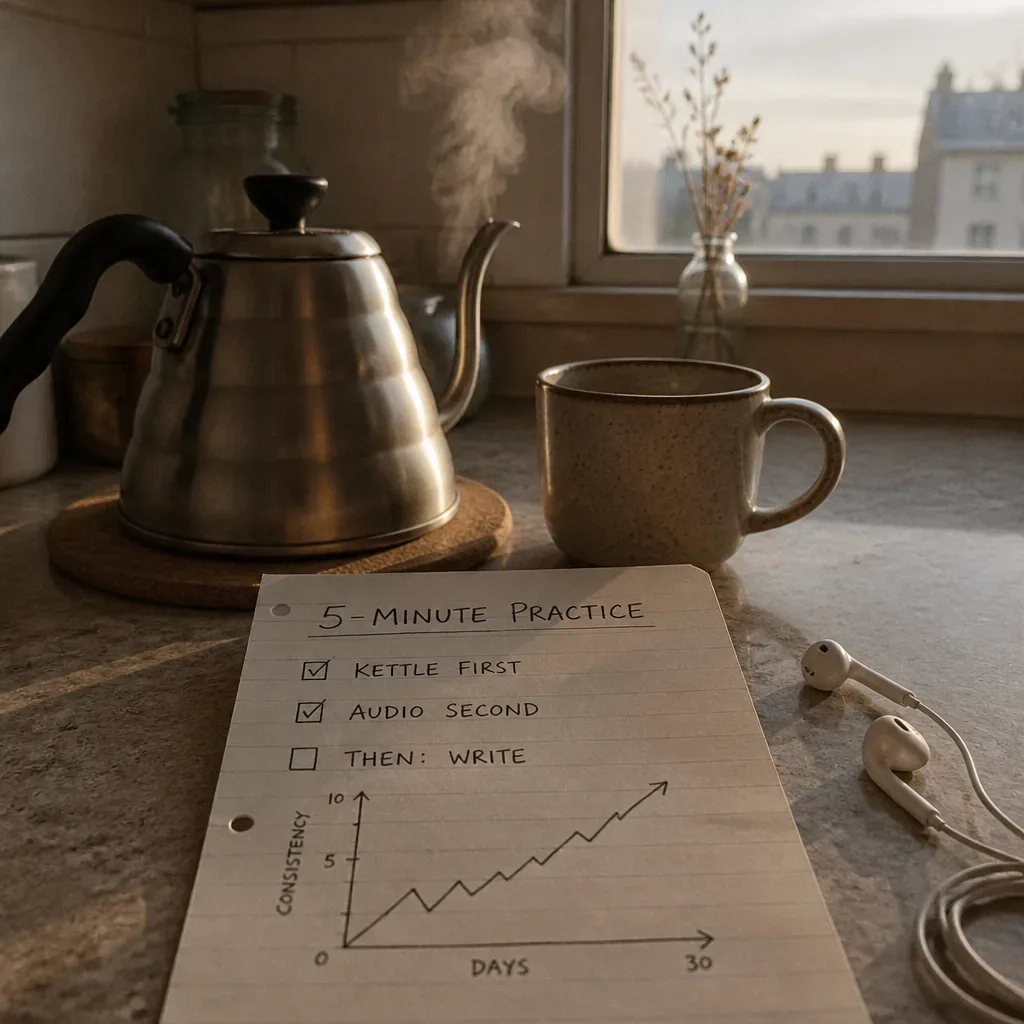
The audio becomes a context cue. The kettle says morning. The headphones say stable-me speaks now. The notebook says leave evidence.
I use a 5-minute Dream-Self audio this way:
- I press play before checking messages.
- I hear stable-me describe one ordinary money scene.
- I let the scene be boring and specific.
- I write one money action I can finish today.
- I stop before I make the practice dramatic.
A practice that needs a perfect mood is not a practice. It is a weather report.
If you want the wider map, I would read this alongside the Manifestation pillar, especially if you are trying to separate wishing from repeated attention. I needed that separation. I still do.
What should my Dream-Self audio actually say about money?
It should say specific, believable evidence of financial stability in the present tense, from the voice of the version of you who already behaves that way.
I wrote mine on a Tuesday night with a dull pencil because pens make me perform. The first draft was too grand. It had big numbers in it. It sounded like a person trying to win an argument with fear. So I crossed most of it out. Neville Goddard often wrote about feeling the wish fulfilled, but the part I find usable is not theatrics. It is the felt assumption of being the person who would act differently now.
My better version said this: I check my account without flinching. I pay what is due before it becomes noise. I move a small amount to savings because small amounts are still votes. I pause before buying the thing that is really a feeling. I know what comes in. I know what goes out. My money has dates on it.
The American Psychological Association has repeatedly found money to be a major source of stress in its Stress in America reports; in 2023, inflation and the economy were named by many adults as significant stressors. This matters because a stressed brain does not need poetry first. It needs orientation.
I keep these ingredients in the script:
- One line about safety in the body.
- One line about knowing the numbers.
- One line about bills handled on time.
- One line about saving, even if the amount is 5 dollars.
- One line about saying no without making a speech.
- One line about the next visible action.
If you already use a daily sentence from the Affirmations pillar, let it be a complement, not the whole engine. The audio does the daily carrying. A sentence can point. The recording can immerse.
Here is a tiny script skeleton I have used:
I am the version of me who checks the numbers calmly. I know what is due this week. I choose one clean action before I spend. I let small savings count. I do not confuse pressure with truth. I am building stability in dated, visible ways.
Money becomes less mythical when it has a date, an amount, and a next action.
How do I make the practice fit into a real morning?
I attach the audio to an existing morning cue so I do not need a new personality before breakfast.
My cue is the kettle. Yours can be the bathroom light, the bus stop, the first elevator ride, or the moment your laptop opens. The cue matters more than the romance of the cue. James Clear popularized habit stacking, and the research base behind it is older than the phrase: implementation intentions, studied by Peter Gollwitzer, show that if-then plans can increase follow-through across many behaviors. If kettle, then audio. If train doors close, then audio. If coffee brews, then audio.
I keep the phone face down. This is not moral purity. It is engineering. If I see messages first, my attention goes to other people’s emergencies. A 2023 Reviews of Human Factors and Ergonomics paper would use cleaner language for attention switching, but my kitchen has its own term: I leak.
The first 30 seconds decide the morning. I do not ask whether I feel like listening. I press play while still half-asleep enough to be obedient.
My setup is plain:
| Cue | Audio placement | Evidence after listening |
|---|---|---|
| Kettle boils | Headphones already beside mug | Write today’s money action |
| Train begins moving | Audio downloaded offline | Check one account after arrival |
| Lunch break starts | Calendar reminder at 12:05 | Cancel or delay one expense |
| Bedside lamp turns on | Phone in focus mode | Move a small amount to savings |
I have watched thousands of users try to build habits, and the ones who keep going usually make the start line embarrassingly close. Not noble. Close.
Some mornings I add one sentence from my affirmation page after the audio. Some mornings I look at my Manifestation Board because I have a photo there of an account balance from a month when I did not go backward. But I do not confuse those with the main practice. The audio is the method. The rest are small objects around it.
If you track timing, 5 minutes is enough: 4 minutes for listening, 1 minute for evidence. A 2019 study in the Journal of Behavioral Medicine found that self-affirmation interventions can support adaptive responses under threat, though effects vary by context. I take that as permission to be modest.
What money action should I take after listening?
I take one action small enough to finish immediately and concrete enough to leave proof.
The action is not always saving. Sometimes it is looking. Looking is underrated. Avoidance charges interest too, not always in money, but often in late fees and body tension. The Consumer Financial Protection Bureau’s financial well-being work defines well-being partly as having control over day-to-day finances and capacity to absorb shocks. Control begins with seeing what is there.
My rule is one action under 60 seconds. Not because larger actions are bad, but because 60 seconds prevents bargaining. I can always continue after. I often do. But the promise stays small, because small promises keep trust with tomorrow-me.
Here are actions that count:
- Check the balance of one account.
- Pay one bill that is already due.
- Move 5, 10, or 20 dollars to savings.
- Cancel one unused subscription.
- Put a 24-hour pause on one purchase.
- Write the next payday and next bill date on paper.
- Send one invoice or payment reminder.
A stable person is not someone who never wants things. A stable person can wait long enough to choose.
If astrology is part of how you mark time, I would keep it practical and read Astrology and manifestation as a timing aid, not as permission to avoid numbers. I have used moon dates as review dates. The account still needed opening.
Joe Dispenza often speaks about rehearsing a future state until the body begins to recognize it. I file that beside habit science, with one caution written in pencil: the body also needs receipts. After the audio, I leave one. A transfer confirmation. A crossed-out bill. A note that says checked account, no hiding.
One piece of evidence per day becomes 30 pieces in a month. Thirty pieces are harder to dismiss than a mood.
How do I track whether financial stability is actually changing?
I track evidence, not feelings, because feelings move too quickly to be the only measure.
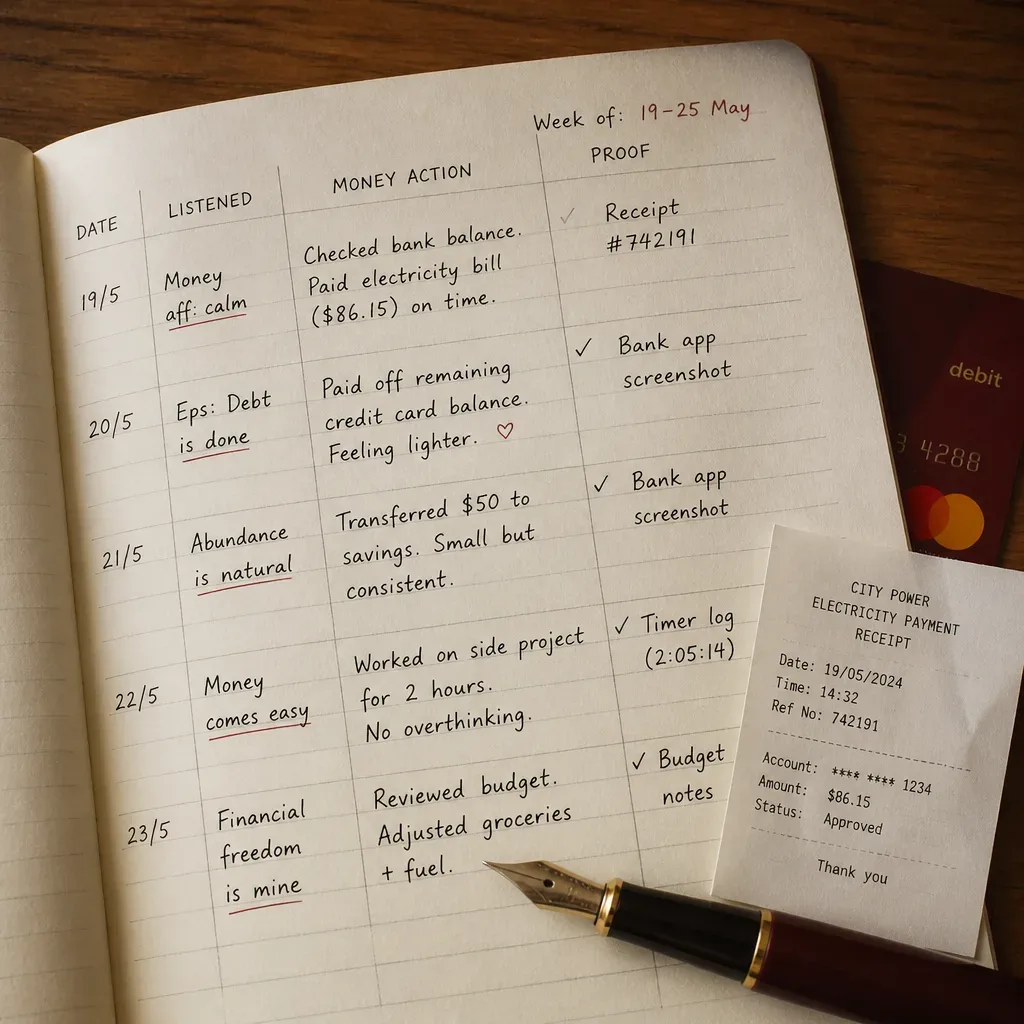
I use a small page with 4 columns: date, listened, money action, proof. It is not pretty. Pretty trackers sometimes become another thing to maintain. In my old app data, users who created simple binary logs often stayed longer than users who customized complex dashboards. I cannot publish every internal number because user privacy matters, but the pattern was clear across thousands of accounts: friction hides inside beauty.
Here is the version in my notebook:
| Date | Listened? | Money action | Proof |
|---|---|---|---|
| Oct 1 | Yes | Checked rent account | Balance written |
| Oct 2 | Yes | Delayed jacket | 24-hour note |
| Oct 3 | Yes | Moved 10 dollars | Transfer saved |
| Oct 4 | No | Paid phone bill | Receipt saved |
The missed day matters less than the return. Habit research often notes that automaticity grows through repetition in context, not perfection. A well-known 2009 study by Phillippa Lally and colleagues found habit formation averaged 66 days, with wide variation from 18 to 254 days. I like that range because it sounds like real people.
I check 3 signs every Sunday:
- Did I listen at least 5 days this week?
- Did I leave at least 3 pieces of money evidence?
- Did one decision feel calmer than it used to?
That third question is soft, but I keep it. Stability is partly numerical and partly physiological. If I can open the banking app without my shoulders rising, that counts. If I can say not this week without explaining my entire childhood, that counts too.
I also keep a monthly measure: emergency buffer. It may be 25 dollars. It may be 250. The number matters less than whether it is growing or protected. The Federal Reserve’s 400 dollar emergency question stays in my head because it is a simple benchmark. I do not worship it. I use it as a mile marker.
The page is not there to judge me. The page is there so my fear cannot edit the evidence.
What should I do when I miss a day or feel scared again?
I restart at the next cue and lower the action until it is too small to refuse.
I missed last Thursday. I remember because it rained hard in Tokyo and the train was late by 22 minutes. I checked messages first, then news, then the day had teeth. By night I had not listened. Old me would have made that mean something large. Current me wrote missed and went to bed.
The next morning I did not try to compensate with a 40-minute money review. Compensation is often punishment wearing a useful coat. I pressed play at the kettle and moved 5 dollars. That was all. The practice returned because I made the doorway small again.
This is also where I reread basic manifestation notes, not to get inspired, but to remember the mechanism: attention, identity, repetition, action. I do not need a bigger speech when I am scared. I need a smaller next step.
If fear is high, I use this reset:
- Listen to the 5-minute audio once.
- Put one hand on the table and name today’s date.
- Open one account only.
- Write one number without commentary.
- Choose one action under 60 seconds.
- Stop while the practice still feels returnable.
Small is not the opposite of serious. Small is how serious things remain possible.
Some money situations need outside help: debt counseling, legal advice, benefits support, a conversation with a lender, or a second set of eyes. Audio does not replace those. It helps me become the person who can make the call. The National Foundation for Credit Counseling says many certified counseling sessions run around 30 to 60 minutes. If you need that hour, take it. Then return to the 5 minutes tomorrow.
Tonight the headphones are already beside the blue mug. I am leaving them there on purpose.