money manifestation
Money Manifestation Audio for Earning Identity
Use this money manifestation audio practice to rehearse a steadier earning identity in 5 minutes a day, with quiet steps and grounded cues.

Your phone is face down beside a glass of water. Five minutes is enough to begin a money manifestation practice when the audio rehearses who you’re becoming with earning, asking, pricing, saving, and receiving. The point isn’t to wish harder. It’s to listen daily, then make one small money move.
What does money manifestation actually change?
Money manifestation changes the identity you bring to financial action, not the laws of arithmetic.
A useful practice doesn’t pretend rent is paid by mood. It asks something more exact: who are you when you open the account, quote the fee, follow up, save the first 5%, or admit you need better numbers? The answer matters because money behavior is rarely only math. In the Federal Reserve’s 2023 report on U.S. household well-being, 37% of adults said they couldn’t cover a $400 emergency expense with cash or its equivalent. That’s not a mindset statistic. It’s a pressure statistic. Still, pressure changes how you decide.
When money feels unsafe, the body tries to move fast. You avoid the invoice. You underprice the work. You buy comfort with money you meant to keep. A quiet audio gives you one daily place to rehearse a different self before the old reflex takes the wheel. You don’t become steady by scolding the part of you that panics. You become steady by giving it a new room to stand in.
This is why a short practice can matter. In habit research published in the European Journal of Social Psychology, Phillippa Lally and colleagues found that automaticity took 66 days on average, with wide variation from 18 to 254 days. Five minutes is not small because it’s weak. It’s small because you can repeat it.
For a broader map of the practice, keep Manifestation pillar nearby. It separates wishful thinking from identity rehearsal and repeated action. Money manifestation belongs there. It works best when it becomes ordinary.
Why use audio instead of writing another affirmation?
Audio works because hearing a future self can feel less like a demand and more like a memory being practiced.
Writing has its place. I like a clean sentence in a notebook as much as anyone who has tested too many apps from a small desk in São Paulo. But when the nervous system is already tight around money, another sentence can turn into homework. Audio asks less from you at the start. You press play. You listen. The voice carries the frame while your attention returns.
The AYA Method is a daily audio manifestation practice. Each day you listen to a short personalized recording — your Dream-Self Moment — narrated from the version of you who has already manifested the life you intend. Listening is the practice. Repetition is the work. The audio is the method.
That distinction matters. The daily affirmation and the Manifestation Board can support the practice, but the audio is the method. A sentence on a screen may remind you. A board may help you see. The Dream-Self Moment lets you hear the version of you who no longer treats earning as a test of worth.
Self-affirmation research offers a useful clue here. In a 2013 PLOS ONE study, David Creswell and colleagues found that self-affirmation improved problem-solving under stress among chronically stressed participants. The point wasn’t magic language. It was access. People performed better when their sense of self was less narrowed by threat.
A money audio can do something similar in daily life. It can say, in your own frame: I send the invoice without apology. I know the price before I enter the call. I check the number because knowing is kinder than guessing.
| Practice | What it does well | What to watch |
|---|---|---|
| Audio | Rehearses identity through voice and repetition | Needs daily listening |
| Written affirmation | Clarifies one belief in a line | Can stay abstract |
| Budget sheet | Shows the real numbers | Can trigger avoidance |
| Vision board | Makes desire visible | Can become aesthetic only |
For language that stays clean and specific, Affirmations pillar is useful. One affirmation is not the whole practice. It can be the handrail.
How do you build a 5-minute money manifestation audio?
Build it around one earning identity, one sensory scene, and one next action.
Don’t try to repair your whole financial life in five minutes. That’s how a practice becomes fog. Choose one identity. Maybe you’re the person who charges clearly. Maybe you’re the person who receives without shrinking. Maybe you’re the person who checks the account every Friday at 9:00, the way someone waters a plant.
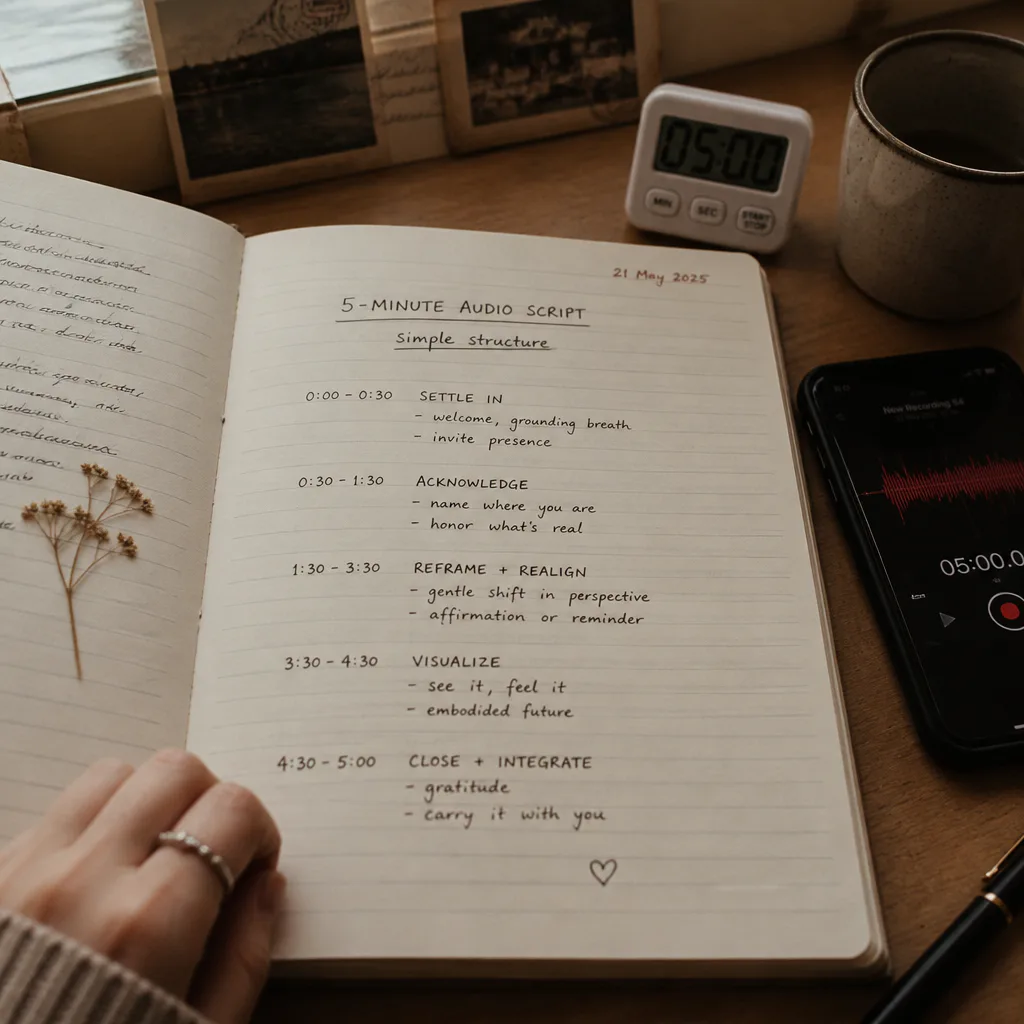
Use this 5-minute structure:
- Minute 1: Arrive. Name the present body. Feet on the floor. Jaw unclenched. Breath slower than the scrolling mind.
- Minute 2: Name the future self. Speak from the version of you who already relates to money with steadiness.
- Minute 3: Enter one ordinary scene. A proposal sent. A fee stated. A savings transfer made. Keep it boring enough to believe.
- Minute 4: Rehearse the feeling of receiving. Not fireworks. Just room in the chest. No apology.
- Minute 5: Choose one action. Send, ask, check, save, learn, or price.
Specificity protects the practice. Neuroscientist Andrew Huberman often describes neuroplasticity as tied to attention, repetition, and salience; the popular phrasing varies, but the principle is common across learning research. The brain doesn’t change from a vague wish. It changes through repeated attention to a pattern that matters.
A good script sounds like this: “I open the account and stay. I see the number. I don’t make it mean I’m behind as a person. I choose the next true action.” Money becomes less haunted when you can look at it without leaving yourself.
You can also add one sentence about timing. For example: “At 10:00, I send the follow-up.” Peter Gollwitzer’s research on implementation intentions has shown that if-then plans improve follow-through across many behaviors. Identity needs a door into the day.
What should you say in the recording?
Say only what your body can almost believe, then repeat it until it becomes familiar.
The best money manifestation lines aren’t grand. They are usable. If the sentence makes your chest harden, soften it. “I am rich beyond measure” may sound theatrical when your card was declined last month. “I can learn to hold more money without fear” may be truer. Truth is more useful than decoration.
Try these lines as raw material:
- I know what I charge before I enter the room.
- I receive payment without over-explaining.
- I can look at my numbers and remain kind.
- I let money become information, not a verdict.
- I save a small amount because small is still real.
- I ask one clear question before I assume the answer is no.
- I learn the skill that lets my earning grow honestly.
In a 2022 Bankrate survey, 56% of U.S. workers said their pay wasn’t keeping up with inflation. Numbers like that are a reminder to stay honest. Money stress can be structural. Your audio should never blame you for a hard economy. It should help you meet the next choice with more steadiness.
Neville Goddard wrote often about assuming the feeling of the wish fulfilled. Read gently, that idea can be practical: rehearse the inner posture of the person who already acts from the new identity. Not fantasy. Posture. The way you sit before the call. The way you breathe before naming the fee.
For money work, I prefer three kinds of sentences:
Identity sentences
These name who you’re practicing being. “I’m a person who asks clearly.” One line. No performance.
Scene sentences
These place the identity somewhere real. “I send the invoice on Thursday before lunch.” The calendar helps.
Receiving sentences
These teach the body that being paid doesn’t require collapse or apology. “I let the payment arrive, and I keep breathing.”
An earning identity is not a costume. It’s a pattern you stop betraying in small moments.
How do you listen so it changes your day?
Listen at the same cue each day, then take one matching action before the old pattern returns.
A 5-minute audio can become a ritual, but don’t let ritual become theater. The test is what happens after. If your audio says you’re someone who charges clearly, the action might be editing the proposal fee. If it says you’re someone who knows your numbers, the action might be opening the banking app for 60 seconds without spiraling.
Use a simple loop:
- Cue: after brushing teeth, before email, or before your first work block.
- Audio: listen once, with no multitasking if possible.
- Action: one money behavior within 10 minutes.
- Mark: place a small check beside the date.
- Return: if you miss a day, restart without drama.
The 10-minute window is practical, not sacred. It keeps the state connected to behavior. BJ Fogg’s behavior model from Stanford emphasizes that behavior depends on motivation, ability, and a prompt. A short audio can act as the prompt. The tiny money action keeps ability high.
This is where the AYA Method stays useful for skeptics like me. It doesn’t ask you to become a different person through force. It asks you to listen to the Dream-Self Moment daily, then let repetition make the identity less strange.
If you like timing practices, you may also be curious about Astrology and manifestation. Use timing as a mirror, not as a reason to wait. The invoice still needs sending on a Tuesday.

Keep the room ordinary. Headphones help. A chair helps. A walk helps. Candles are optional. The nervous system tends to trust what returns at the same time more than what arrives with ceremony once a month.
How long before money manifestation feels real?
Expect the first shift in days, the first evidence in weeks, and the deeper identity work over 2 to 3 months.
The first shift may be modest. You open your account without flinching. You notice the urge to discount your work and pause. You send one follow-up. These are not small if the old pattern was avoidance. The National Financial Educators Council has reported for years that financial illiteracy costs adults hundreds or thousands of dollars annually by self-report; exact figures vary by survey method, but the theme is steady. Avoidance is expensive.
You can track four signs without turning your life into a spreadsheet:
- You recover faster after money stress.
- You name your price with fewer extra words.
- You check numbers on a set day.
- You take one earning action before seeking reassurance.
A 21-day mark can show consistency. A 66-day mark is better for habit. The Lally study’s average matters here because it lowers the shame. If you don’t feel remade after a week, nothing has gone wrong. You are building recognition. The future self starts as a voice, then becomes a choice you recognize sooner.
Pair the audio with grounded learning. If earning identity is tied to skill, take a course, pitch more clearly, or ask someone experienced to review your offer. If it’s tied to debt, get the numbers and call the provider. Manifestation that refuses reality becomes another way to avoid reality.
For a wider frame, return to Manifestation pillar. For exact language, return to Affirmations pillar. Let them support the audio. Don’t let them replace it.
What are the mistakes that make this practice feel fake?
The practice feels fake when the words are too inflated, the action is missing, or the goal is used to hide fear.
The first mistake is choosing language your body rejects. If you say, “I earn millions with ease,” while your next task is asking for a 5% raise, your mind may treat the sentence as noise. Try: “I can ask for the next honest increase.” Smaller isn’t weaker. Smaller is often more believable.
The second mistake is using the audio as a mood bath. Feeling calm is good. But money manifestation needs a behavior. In 2023, Pew Research Center reported that 60% of Americans said inflation was a very big problem for the country. Under strain, a pleasant five minutes can help you breathe. It still needs to lead somewhere.
The third mistake is making receiving feel morally suspicious. Some people under-earn because asking feels like taking. A clean audio can separate fair pay from greed. “I can be useful and be paid.” Say that enough times and notice what it lets you do.
The fourth mistake is outsourcing timing to signs. I have tenderness for signs. I also like invoices paid on time. If you use moon dates, lucky days, or a birth chart, let them make you attentive. Don’t let them make you passive. Astrology and manifestation is best when it brings rhythm to action.
The last mistake is quitting when the first discomfort appears. Discomfort may mean the sentence is touching the old identity. Adjust it. Don’t abandon the whole thing.
Listen once. Then let the next small money action find you here.