evening rituals
Stop Doomscrolling at Night With Dream-Self Audio
A quiet 5-minute way to stop doomscrolling at night by replacing the phone loop with a Dream-Self audio cue before sleep.
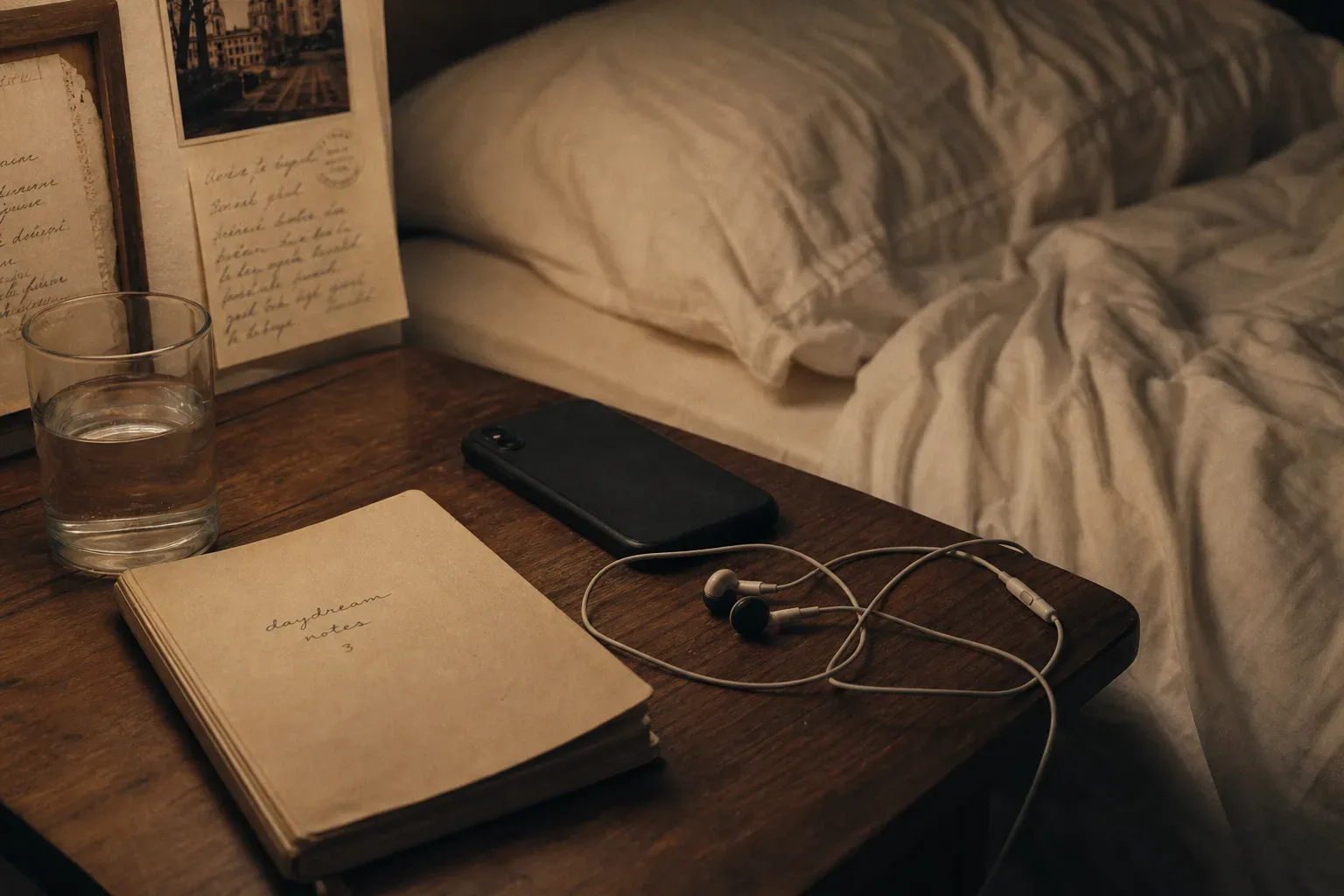
November 7th. The kettle clicked off late tonight, and my phone was already warm in my hand. To stop doomscrolling at night, I need a replacement action, not a lecture: set the alarm, play a 5-minute Dream-Self audio, put the phone away, and let the same order repeat until it becomes boring.
Why does night scrolling feel so hard to stop?
Night scrolling is hard to stop because it combines fatigue, uncertainty, and a reward schedule that keeps offering one more piece of information.
I used to think my night scrolling was a failure of character. It was not that noble. It was a small machine doing what small machines do well. At 11:42 p.m., after email and dishes and the last glass of water, my thumb would look for novelty. The news would give me numbers. Messages would give me little social sparks. A feed would give me a new card every two seconds if I let it.
Sleep researchers have been pointing at this for years. The National Sleep Foundation has often recommended a screen-free wind-down of about 30 minutes before bed, partly because light and stimulation both matter. A 2019 review in Chronobiology International found that evening light exposure can delay melatonin timing, and phone use adds content that asks the nervous system to stay on duty. The body may be in the bedroom, but attention is still commuting.
The trouble is not only blue light. It is also unfinishedness. Pew Research Center reported in 2022 that 31% of U.S. adults said they were online almost constantly. I do not need that statistic to scold myself. I need it to remember that my private habit is also a public design pattern. Apps are not waiting politely for me to feel sleepy.
A tired brain does not need a better argument. It needs a smaller next move.
That is why I stopped trying to win a debate at midnight. I began making the next move physical and short. Five minutes is not heroic. That is exactly why it survives the day.
What does a 5-minute Dream-Self audio do differently?
A 5-minute Dream-Self audio gives the hand, the ear, and the mind one directed ritual to do instead of continuing the feed.
In the AYA Method, the practice is very plain: The AYA Method is a daily audio manifestation practice. Each day you listen to a short personalized recording, your Dream-Self Moment, narrated from the version of you who has already manifested the life you intend. Listening is the practice. Repetition is the work. The audio is the method.
I listened tonight with my back against the kitchen chair. I did not light a candle. I did not optimize the room. I put the phone face up for the first ten seconds, pressed play, then turned it over. The difference was almost embarrassingly practical. Instead of asking, What did I miss, the audio asked me to inhabit a future I had already named in daylight.
There is a reason short audio can work as a bridge. In behavioral psychology, an implementation intention is an if-then plan: if X happens, then I do Y. Peter Gollwitzer’s research on implementation intentions has been cited for decades because specific cues change follow-through. My cue became: if I catch myself scrolling in bed, then I listen to the Dream-Self audio once.
This is not the same as forcing optimism. The Manifestation pillar makes a larger case for desire, attention, and repeated inner rehearsal, but at night I keep it more modest. I am not trying to solve my whole life at 11:15. I am trying to stop feeding my worry with fresh material.
The phone wants continuation. The audio gives me completion.
How do I set up the 5-minute ritual before bed?
I set it up by removing decisions before I am tired, then letting the audio become the only thing left to do.
Here is the order I keep written on the small page beside my bed. It looks too simple, which is one reason it works.
- Set tomorrow’s alarm before opening anything else.
- Turn on Do Not Disturb for the night.
- Place the charger somewhere I cannot reach from the pillow.
- Sit in the chair or on the edge of the bed, not under the blanket yet.
- Play the 5-minute Dream-Self audio once.
- Put the phone on the charger without checking the screen.
- Get into bed with both hands empty.
The chair matters. Habit researchers often talk about context. Wendy Wood’s work on habit formation, including her book Good Habits, Bad Habits, emphasizes that repeated behavior is strongly tied to cues in the environment. If my bed is where I scroll, then I do not begin the replacement fully inside that old cue. I borrow a different seat.
I also lower the standard. Seven clean nights would be lovely. One clean night is useful. In small sleep studies, people often improve not by removing every screen forever, but by creating a predictable buffer before sleep. My buffer is five minutes of listening plus the fifteen seconds it takes to move the phone.
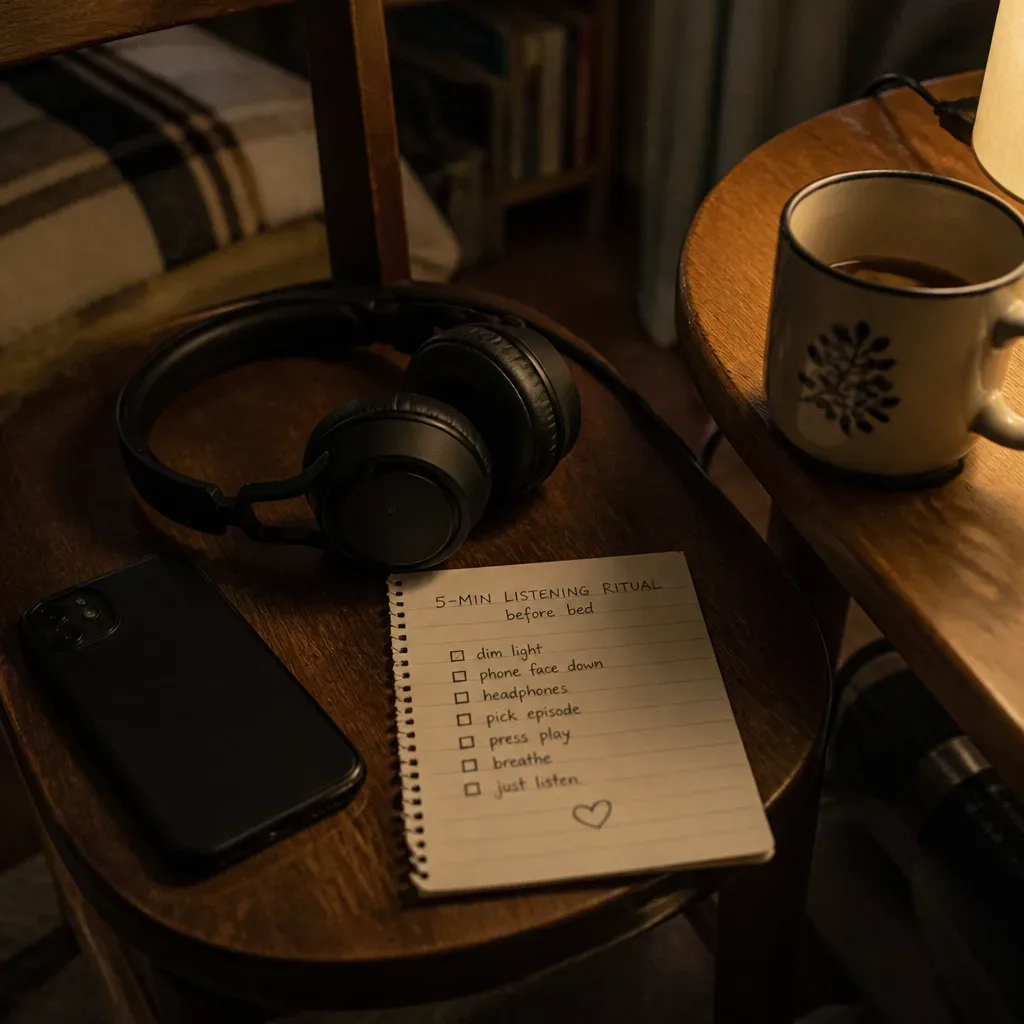
I do not treat the daily affirmation as the main event here, though I sometimes write one line after listening. If I do, I keep it plain and use the guidance in the Affirmations pillar: one sentence, present tense, believable enough to repeat. The audio remains the practice. The written line is just a small receipt.
What should I listen for when the urge to scroll comes back?
I listen for the first sentence that makes my body stop bargaining with the phone.
The urge usually comes back around minute two. My brain remembers a message, a headline, a thing I forgot to buy. I used to obey that remembering as if it were a fire alarm. Now I label it more carefully. Sometimes it is a task. Sometimes it is anxiety wearing a task costume. The difference matters because one belongs on tomorrow’s list, and the other belongs to the nervous system.
Dr. Andrew Huberman has discussed non-sleep deep rest and the way guided audio can help downshift arousal, though the AYA practice is not a clinical sleep protocol. I borrow the principle, not the lab coat. A voice can narrow attention. Narrowed attention can reduce the number of doors the mind is trying to hold open.
Here is the small table I keep in my notes app, which feels funny because the notes app is on the same phone I am trying to put down. Still, it has helped.
| If I notice this | I do this instead | Why it helps |
|---|---|---|
| I want one more headline | Start the audio from the beginning | It replaces novelty with a known sequence |
| I remember a task | Write three words on paper | Paper does not open a feed |
| I feel lonely | Put one hand on my chest while listening | The body gets a cue of contact |
| I want to check the time | Turn the phone face down | The screen stays out of the ritual |
The best line in the audio is not always the grandest one. Some nights it is a practical sentence about waking clear. Some nights it is a sentence about being less available to panic. Neville Goddard wrote about assuming the feeling of the wish fulfilled, and I understand that better at night than in the morning. At night, I do not need a theory. I need one felt rehearsal that is stronger than the feed.
I do not break a habit by hating it. I break it by giving my body a kinder loop.
How do I keep from turning the audio into another phone habit?
I keep the audio from becoming another phone habit by making the screen less interesting than the listening.
This is the part I nearly missed. A phone can hide a calm practice inside a noisy object. The same device holds the audio, the inbox, the bank, the weather, the photograph from my mother, and three things I did not ask to see. If I do not create a boundary, the ritual becomes a hallway back to the feed.
So I make the phone boring before I press play. I set the volume. I open the recording. I turn the brightness down. I use Do Not Disturb. Some people use grayscale at night, and studies on color and attention are mixed, but the behavioral value is obvious enough: a dull screen asks for less touching. Apple introduced Screen Time in 2018, and Android has Digital Wellbeing, but timers alone did not change me. A timer can tell me I have stayed too long. It cannot give me somewhere better to go.
I also avoid measuring too much. Calm productivity taught me this the hard way. If I track seven variables, I create seven ways to feel behind. For this ritual, I track only two marks: listened, phone away. That is all. The whole record fits on one line of the page.
I have written elsewhere in my own notebooks about astrology and manifestation, especially how timing can make a ritual feel more human. Still, I do not wait for a perfect moon to put the phone down. Tuesday works. Rain works. A bad mood works. The point is repetition, not decoration.
A ritual that needs perfect conditions is not ready for a real evening.
What if the news, group chats, or work feel genuinely urgent?
I decide in advance what counts as urgent, because midnight is a poor judge.
This was the sentence I resisted. I live in São Paulo. News is not abstract here, and neither are family messages. Some nights there are storms, delays, illnesses, and people I love crossing the city late. I do not want a ritual that makes me careless. I want one that stops false urgency from borrowing the face of care.
The American Psychological Association has reported for years that news and political stress affect sleep for many adults, and a 2022 APA Stress in America report found that inflation, global uncertainty, and national issues were major sources of stress. I believe it. I have felt my jaw tighten over a headline that changed nothing I could do before morning.
So I make a small urgent list in daylight:
- Calls from immediate family can ring through.
- A second call within three minutes can ring through.
- Work messages wait unless I am officially on call.
- News waits unless it changes my physical safety before morning.
- Everything else goes onto paper for tomorrow.
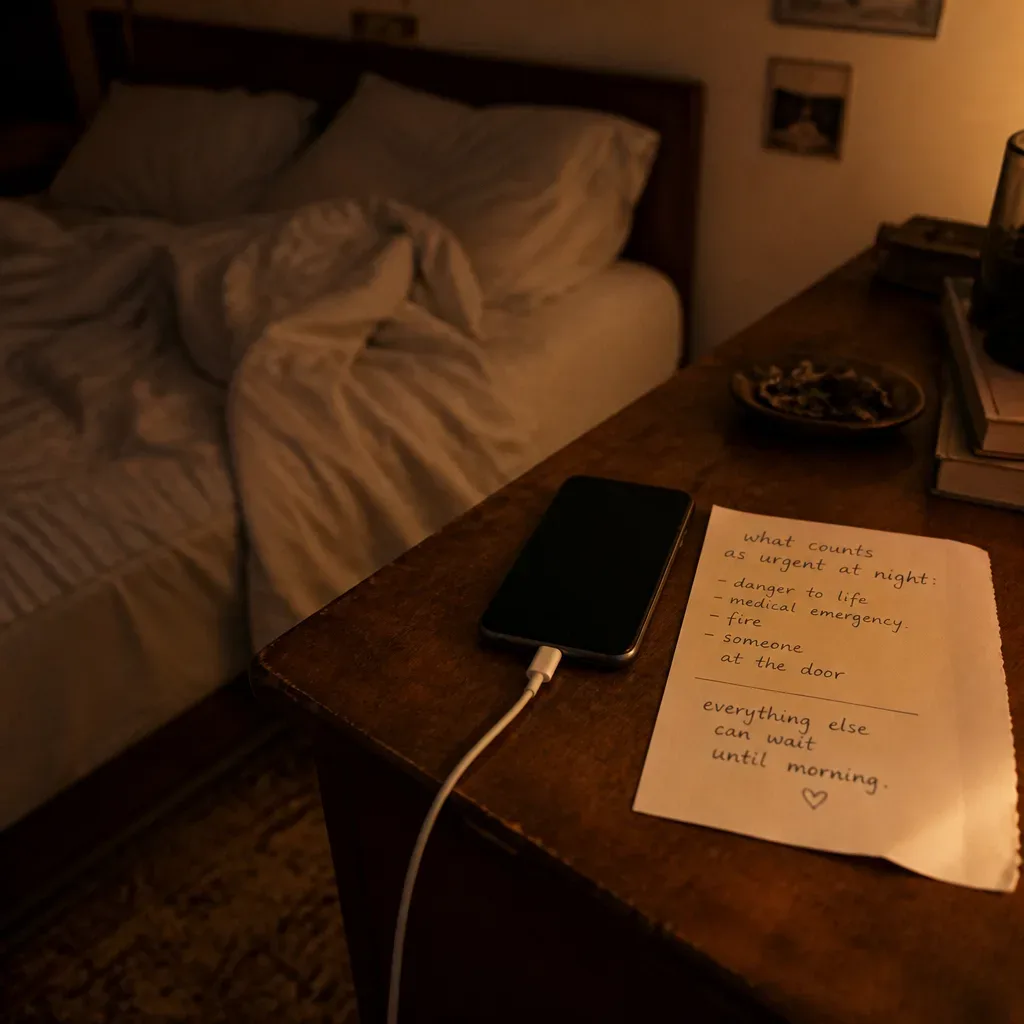
This list is not cold. It is merciful. Without it, every notification gets to audition as an emergency. With it, I can answer what needs answering and still keep the night intact. The AYA audio then becomes a return, not an escape. I handle the real thing, if there is a real thing, and then I return to the same five minutes.
The Manifestation pillar uses attention as a serious word, not a decorative one. What I give attention to before sleep becomes part of the room I carry into dreams. That does not mean bad news caused a bad morning. It means the last rehearsal matters more than I used to admit.
How will I know the ritual is working?
I know it is working when the gap between the urge and the scroll gets wider, even if the habit is not gone.
I did not wake up as a different person. On night three, I still picked up the phone after the audio and checked a football score. I wrote that down because honesty keeps a practice usable. By night seven, the score-checking had moved earlier. By night twelve, I was leaving the phone on the dresser without making a speech about it.
Habit formation is not usually a 21-day miracle. A 2009 study by Phillippa Lally and colleagues at University College London found an average of 66 days for a new behavior to become automatic, with wide variation across people and habits. That number comforts me. It means a clumsy first week is not evidence against the ritual. It is just the part where the old loop still knows the house.
I use three signs instead of perfection:
- I start the audio before opening another app.
- I put the phone down sooner than I did last week.
- I wake with fewer fragments of other people’s panic in my head.
If I miss a night, I do not make it dramatic. I return the next night. That is the quiet genius of the AYA Method for me: it is small enough to return to without ceremony. The daily affirmation, if I use one, follows the listening. The Manifestation Board can wait for morning. The night practice is the audio and the putting down.
There are stronger interventions for severe insomnia, anxiety, or compulsive phone use, and cognitive behavioral therapy for insomnia has good evidence behind it. If doomscrolling is tied to panic, depression, or work demands you cannot control, I would not ask a five-minute ritual to carry the whole weight. I would ask it to do one honest job: interrupt the loop long enough for help, rest, or a better boundary to become possible.
Friday now. The phone is across the room, and the chair is empty.