audio manifestation
Audio Manifestation for People Who Can't Visualize
Audio manifestation helps when mental pictures stay blank. Learn a quiet listening practice for intention, repetition, and a clearer future self.
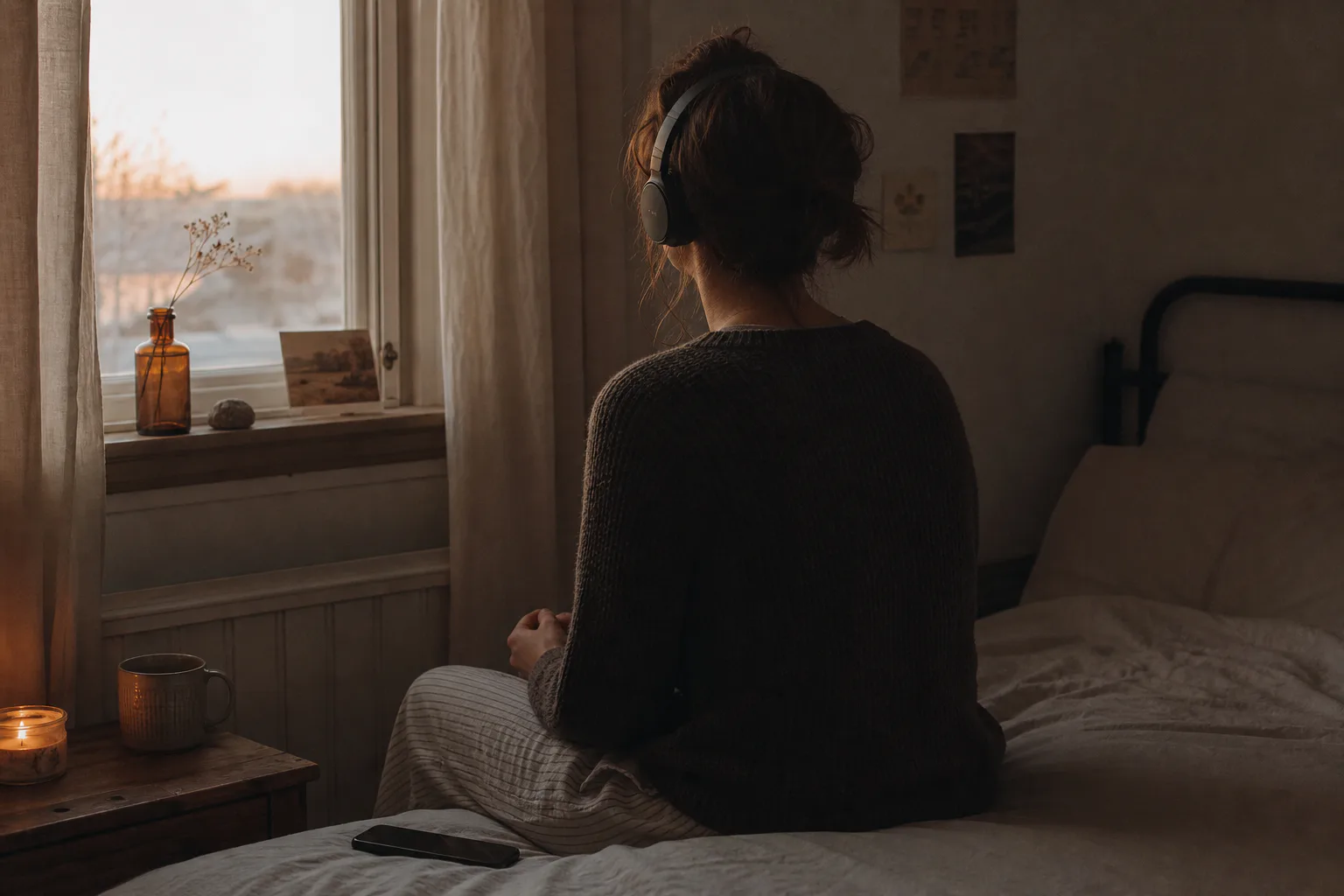
Your room is dim. The phone is face down. Audio manifestation works for people who can’t visualize because it asks you to listen, not picture. You use voice, repetition, and a future-self scene carried by sound. If your inner screen stays blank, the practice can still be precise, steady, and yours.
What if my mind stays blank when I try to visualize?
A blank inner screen is not a failure; it may be a real difference in mental imagery.
Some people do not form voluntary mental pictures. The term aphantasia was named by neurologist Adam Zeman and colleagues in 2015, after people reported little or no visual imagery despite normal vision. Later estimates vary, but many papers place aphantasia around 3% to 4% of people. That is not rare. It is quiet. Many people only notice it when a meditation teacher says, see a beach, and nothing appears.
The common mistake is treating manifestation as a visual test. It isn’t. Manifestation is the practice of rehearsing a chosen state until your attention, choices, and self-concept begin to move around it. Seeing can help some people. For others, language is clearer. Sound is clearer. The body knows before the picture arrives.
Aphantasia studies often use the Vividness of Visual Imagery Questionnaire, a 16-item measure first developed by David Marks in 1973. People score very differently. Some see rich mental images. Some get fragments. Some get nothing. A blank screen can still belong to a mind that remembers, plans, loves, chooses, and changes.
Here is the first correction: you do not need to make a picture to make a pattern. Audio manifestation gives the mind a repeatable pattern it can hear. The voice becomes the place you return to. The sentence becomes the shape.
If visualization feels like forcing light into a room, listening may be the door that was already open.
How does audio manifestation work without images?
Audio manifestation works by turning intention into a repeated listening cue your nervous system can recognize.
When you hear the same meaningful words often, your brain gets fewer decisions to make. It can settle into the pattern. Cognitive research has shown that repetition supports memory, and habit research by Phillippa Lally and colleagues in the European Journal of Social Psychology found that a new behavior took a median of 66 days to become automatic. The range was wide, from 18 to 254 days. That matters. You are not trying to win one morning. You are building a return.
Sound also carries timing. A spoken recording has pace, breath, and emphasis. Those cues can be easier to follow than a silent visual scene. Dr. Andrew Huberman often describes attention and repetition as central to neuroplasticity, especially when the brain receives a clear signal again and again. Audio gives you that signal in a form you do not have to invent each time.
This is where the AYA Method enters quietly. The AYA Method is a daily audio manifestation practice. Each day you listen to a short personalized recording — your Dream-Self Moment — narrated from the version of you who has already manifested the life you intend. Listening is the practice. Repetition is the work. The audio is the method.
Joe Dispenza and Neville Goddard both wrote about rehearsing a changed self before the outside world fully reflects it. You do not have to share their full view to use one practical point: the mind learns from repeated identity cues. If the cue is sound, that is enough.
| Visual route | Audio route |
|---|---|
| Try to see a finished scene | Hear a future-self voice describe it |
| Depends on image vividness | Depends on attention and repetition |
| Can feel effortful with aphantasia | Can feel more natural when sound is clear |
| Often done silently | Often guided by pace, tone, and words |
A picture can fade. A voice can come back on schedule.
What should I put in the recording?
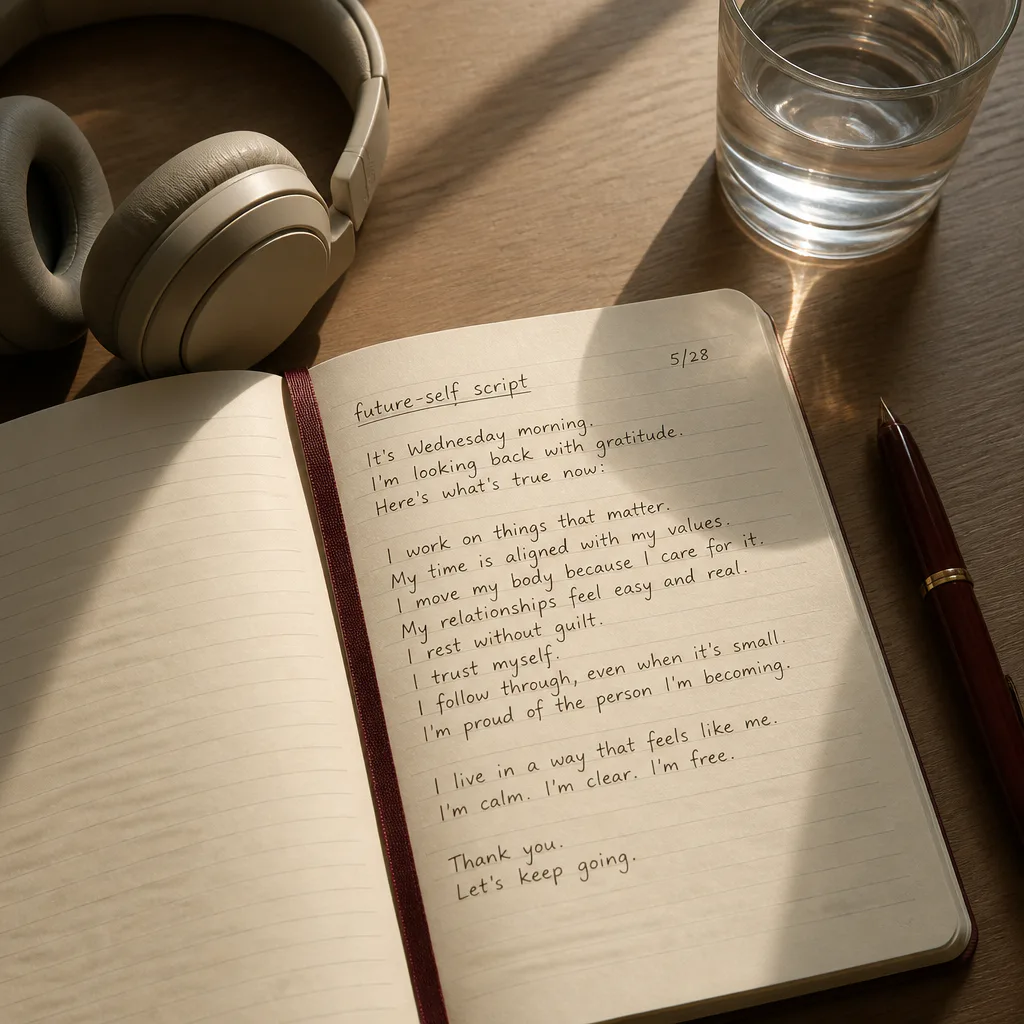
Put one ordinary future-self moment in the recording, told in present tense and heard in a calm voice.
Do not begin with a huge life montage. Begin with one scene you can recognize without seeing it. Maybe it is the first ten minutes after waking. Maybe it is the walk after a hard meeting. Maybe it is the sound of your own voice answering a question without shrinking. Specificity matters. In implementation-intention research, Peter Gollwitzer found that if-then planning improves follow-through because the cue is clear. Your audio can do the same.
For people who cannot visualize, the script should favor sound, touch, and knowing. You can write, I hear the kettle click off. I feel my shoulders lower. I know I do not need to check for proof before I begin. These details do not require an inner movie. They give the mind handles.
Use this simple order:
- Name the moment. Choose one scene that would happen in a real day.
- Speak as the future self. Use I am, I choose, I notice, I already know.
- Include 2 or 3 sensory anchors. Let at least one be sound.
- Name one changed behavior. Make it observable.
- End with a small return line. Something you can hear again tomorrow.
If you use affirmations, keep them short and let them support the recording. An affirmation might be one sentence inside the audio, not the whole practice. A Manifestation Board can help you choose symbols, but the audio carries the daily method.
The best script does not impress you. It recognizes you.
A 2022 review in Nature Reviews Psychology noted that mental imagery can involve multiple senses, not only vision. That gives you permission to stop chasing pictures. Your future self can arrive as cadence. As pressure leaving the jaw. As one sentence that feels more true each week.
How do I practice audio manifestation each day?
Practice audio manifestation by attaching one short listen to a daily cue you already trust.
The cue matters more than the mood. If you wait until you feel inspired, the practice becomes optional in the wrong way. B.J. Fogg’s behavior model at Stanford describes behavior as a mix of motivation, ability, and prompt. When ability is high and the prompt is clear, the action becomes easier. A 4-minute audio after brushing your teeth is better than a 25-minute ritual you avoid.
Try this daily structure for 12 minutes or less:
- Minute 0 to 1: Put the phone down, lower the light, and choose not to multitask.
- Minute 1 to 6: Listen to the recording once. Do not grade your focus.
- Minute 6 to 8: Sit in quiet. Let one phrase remain.
- Minute 8 to 10: Write one action the future self would take today.
- Minute 10 to 12: Begin that action or place it where you will see it.
A small study in the Journal of Behavioral Medicine and related mindfulness research has often found that brief daily practices can reduce perceived stress when repeated consistently, though results depend on the group and method. The point is not that audio manifestation is a medical treatment. It is that brief daily repetition can change what your day keeps returning to.
If you miss a day, do not repair it with guilt. Return the next day. Lally’s habit study also found that missing one opportunity did not necessarily ruin habit formation. That is useful. The practice is not fragile.
For a wider frame, the Manifestation pillar explains why repetition matters more than intensity. The loud version of a practice often burns out. The repeatable version stays.
What if I get distracted while listening?
Distraction is normal; the practice is the act of returning to the voice.
Attention moves. That is not a personal defect. A 2010 paper by Matthew Killingsworth and Daniel Gilbert in Science used phone sampling and found that people’s minds wandered often, and wandering was linked with lower reported happiness in that dataset. You do not need to fight the mind. You need a return point. In audio manifestation, the return point is the next sentence.
When you notice you have drifted, do three quiet things. First, feel the contact point: feet, chair, hand, blanket. Second, listen for the next word instead of replaying what you missed. Third, let the missed part stay missed. This keeps the practice from becoming a performance.
There are also design choices that reduce distraction:
| Problem | Adjustment |
|---|---|
| You keep checking the screen | Turn the phone face down before pressing play |
| The voice feels too intense | Lower the volume by 20% |
| You fall asleep every time | Listen sitting up, earlier in the evening |
| The script feels fake | Rewrite one line to be more ordinary |
| You overthink the result | Track one action, not a feeling |
This is where app design matters. A practice that asks for too many taps creates friction. Pew Research Center has reported for years that smartphone use is woven into daily life for most adults in the United States, with 90% owning a smartphone in 2024. That means the question is not whether the phone is present. It is whether the phone helps you listen or pulls you away.
Your attention does not have to be perfect to be sincere.
How can I tell if the practice is working?
You can tell audio manifestation is working when your choices begin to match the recording in small, observable ways.
Do not use instant certainty as the measure. Certainty rises and falls. Behavior is cleaner data. If your recording says you answer messages with calm, look for one message answered without panic. If it says you protect your first hour, look for one morning when you do not give it away. If it says you speak clearly, notice the sentence you did not swallow.
Track proof for 30 days. Not dramatic proof. Plain proof. In behavior-change research, self-monitoring is one of the most reliable techniques across many goals; a 2011 review by Michie and colleagues identified self-monitoring as a common active ingredient in effective interventions. You are not tracking to judge yourself. You are tracking so the mind sees evidence.
Use this three-line note after listening:
- Phrase I heard: Write the line that stayed.
- Choice I made: Name one matching action.
- What I know now: Write one sentence from the future self without forcing belief.
You can also use visual supports if they help. Astrology and manifestation can give some people timing language and reflection points. A board can hold images, dates, or symbols. But if you cannot visualize, do not make the board carry the whole practice. Let it be a complement. Let the audio lead.
After two weeks, look for softer signs too: less argument with the script, faster return after doubt, one repeated phrase becoming familiar. Familiar is not small. Familiar is how the future self stops sounding like a stranger.
What are the common mistakes with audio manifestation?
The common mistakes are making the recording too big, too vague, too rare, or too far from your actual day.
The first mistake is writing a script that sounds like a speech to a crowd. Your nervous system does not need a stage. It needs a believable signal. Research on goal setting, including the work of Edwin Locke and Gary Latham, has long found that specific goals tend to guide action better than vague ones. Specific does not mean grand. It means you know what the sentence would look like in Tuesday’s life.
The second mistake is changing the recording every time you feel doubt. Doubt is not always a sign the script is wrong. Sometimes it is simply contact with a new pattern. Give a recording at least 7 days before editing unless it feels untrue in your body. In product design, changing the interface too often makes learning harder. The same is true here.
The third mistake is treating audio manifestation as passive wishing. Listening is the practice, but the day still asks for one matching move. If your Dream-Self Moment says you care for your work, open the document for 10 minutes. If it says you rest without bargaining, put the device away at the hour you named.
Keep these guardrails:
- One recording at a time.
- One daily cue.
- One proof note.
- One small action.
- One weekly edit, at most.
You can read more about the method itself at the AYA Method, and you can place it beside the broader Affirmations pillar if short statements help you keep the language close. Just remember the order. The audio is the method. The other tools are there to support your return.
The next listen can be small.